Claude Code Source Code Leaked, Over 500,000 Lines of Code Obtained by Developers

marsbitPublicado a 2026-04-01Actualizado a 2026-04-01

Resumen

Anthropic faces a major security incident as the complete source code for its AI tool Claude Code, exceeding 500,000 lines of TypeScript, was leaked. The breach originated when a developer shared a compressed file on Twitter, which quickly gained over 5.3 million views. The exposure was due to Anthropic accidentally including .map files when publishing to npm, revealing core code. The leaked code unveils several advanced features, including a project codenamed BUDDY, which offers a personalized cyber pet system with traits like debugging power and even a "sarcasm value." Another feature, KAIROS, aims to create an "always-on" AI assistant capable of maintaining memory across sessions and initiating tasks. The code also includes a "Nightly Dreaming" mechanism, allowing Claude to organize information and consolidate core content while the user sleeps. Despite the breach, the incident has inadvertently showcased Anthropic's innovative capabilities, turning a PR crisis into an unexpected demonstration of their cutting-edge AI developments.

Recently, artificial intelligence company Anthropic encountered an unprecedented crisis when the complete source code of its latest tool, Claude Code, was accidentally leaked within the developer community. The incident began when a developer, Chaofan Shou, posted a compressed package containing over 500,000 lines of TypeScript code on Twitter, sparking widespread attention and discussion among developers globally. This leak quickly exploded online, with page views surpassing 5.3 million within hours, becoming a hot topic in the tech circle.
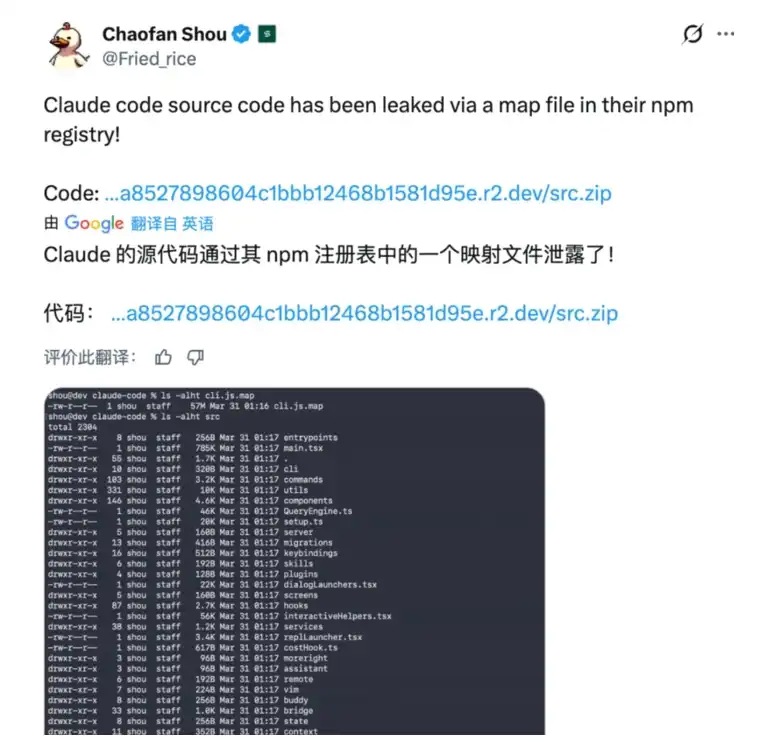
So, what was the cause of this leak? According to reports, when Anthropic published the code to npm, it actually forgot to remove the .map files, leading to the exposure of the core code. This mistake not only embarrassed the company but also raised external doubts about its security management. However, this accidental leak has given the outside world an early glimpse into some of Anthropic's cutting-edge functionalities in the AI field.

From the source code, it can be seen that Claude Code includes several astonishing features, with the project codenamed BUDDY being particularly notable. It can not only accompany developers in writing code but also has a unique personalized pet system, allowing users to incubate their own cyber pets based on personal information. This pet not only has a cute appearance but also has dynamic stats like debugging power and patience, and even a "sarcasm value," undoubtedly adding a lot of fun to the work atmosphere.

Even more forward-looking is the feature codenamed KAIROS, which aims to achieve an "always-on" AI assistant. Unlike traditional conversation methods, KAIROS can maintain memory across multiple sessions and proactively initiate tasks. Additionally, the source code includes a Nightly Dreaming mechanism, where Claude organizes information and consolidates core content while the user sleeps. This innovative concept not only makes the AI smarter but also brings new possibilities for future work methods.

Although Anthropic is currently busy dealing with this leak, the unexpected exposure might also provide a platform to showcase their cutting-edge technology. This accidental PR crisis has instead highlighted the company's innovative capabilities. The future of the AI field will become even more exciting because of such attempts.

Preguntas relacionadas

QWhat was the cause of the Claude Code source code leak at Anthropic?

AAnthropic forgot to remove .map files when publishing the code to npm, which exposed the core source code.

QHow many lines of TypeScript code were leaked in the Claude Code incident?

AOver five hundred thousand lines of TypeScript code were leaked.

QWhat is the name of the project that features a personalized cyber pet system for developers?

AThe project is called BUDDY, which includes a personalized cyber pet system with traits like debugging power and patience.

QWhat is the KAIROS feature designed to do according to the leaked source code?

AKAIROS is designed to be an 'always-on' AI assistant that maintains memory across multiple sessions and can proactively initiate tasks.

QWhat mechanism does Claude have for processing information during user inactivity?

AClaude has a 'Nightly Dreaming' mechanism where it organizes information and consolidates core content while the user is sleeping.

Lecturas Relacionadas

SpaceX Ties Up with Cursor: A High-Stakes AI Gambit of 'Lock First, Acquire Later'

SpaceX has secured an option to acquire AI programming company Cursor for $60 billion, with an alternative clause requiring a $10 billion collaboration fee if the acquisition does not proceed. This structure is not merely a potential acquisition but a strategic move to control core access points in the AI era. The deal is designed as a flexible, dual-path arrangement, allowing SpaceX to either fully acquire Cursor or maintain a binding partnership through high-cost collaboration. This "option-style" approach minimizes immediate regulatory and integration risks while ensuring long-term alignment between the two companies. At its core, the transaction exchanges critical AI-era resources: SpaceX provides its Colossus supercomputing cluster—one of the world’s most powerful AI training infrastructures—while Cursor contributes its AI-native developer environment and strong product adoption. This synergy connects compute power, models, and application layers, forming a closed-loop AI capability stack. Cursor, founded in 2022, has achieved rapid growth with over $1 billion in annual revenue and widespread enterprise adoption. Its value lies in transforming software development through AI agents capable of coding, debugging, and system design—positioning it as a gateway to future software production. For SpaceX, this move is part of a broader strategy to evolve from a aerospace company into an AI infrastructure empire, integrating xAI, supercomputing, and chip manufacturing. Controlling Cursor fills a gap in its developer tooling layer, strengthening its AI narrative ahead of a potential IPO. The deal reflects a shift in AI competition from model superiority to ecosystem and entry-point control. With programming tools as a key battleground, securing developer loyalty becomes crucial for dominating the software production landscape. Risks include questions around Cursor’s valuation, technical integration challenges, and potential regulatory scrutiny. Nevertheless, the deal underscores a strategic bet: controlling both compute and software development access may redefine power dynamics in the AI-driven future.

marsbitHace 18 min(s)

SpaceX Ties Up with Cursor: A High-Stakes AI Gambit of 'Lock First, Acquire Later'

marsbitHace 18 min(s)

Trading

Spot
Futuros
活动图片