‘Clarity once and for all’ – White House reviews SEC’s new crypto framework

ambcryptoPublicado a 2026-03-24Actualizado a 2026-03-24

Resumen

The U.S. SEC is shifting its approach to crypto regulation by moving away from enforcement actions toward creating clear rules. On March 20, it submitted two proposals to the White House, one aimed at classifying digital assets to determine which should be considered securities. If approved, many cryptocurrencies may no longer be classified as securities, reducing regulatory confusion. An "innovation exemption" may ease compliance for crypto firms, encouraging innovation in the U.S. The CFTC chair emphasized the need for clarity. The SEC-CFTC collaboration suggests most digital assets should not be automatically treated as securities. Despite recent market gains, investor sentiment remains fearful. The new framework seeks to balance oversight and growth while awaiting potential congressional legislation.

The U.S. Securities and Exchange Commission (SEC) is starting to change how it handles crypto regulation. Instead of relying mainly on lawsuits and enforcement actions, it is now working toward creating clear and structured rules.

On the 20th of March, the SEC quietly sent two important proposals to the White House. One focuses on making hedge funds and private equity firms more transparent.

Meanwhile, the second proposal was a more significant one for crypto. The latter aims to create a clear system to classify digital assets.

White House reviews crypto interpretation

If approved, many cryptocurrencies may no longer be classified as securities, reducing confusion and giving the industry clearer rules to follow. Instead of relying on lawsuits, the SEC is shifting toward setting clear guidelines, as reported by Bloomberg.

The proposed “innovation exemption” highlights this change. Rather than strict enforcement, the SEC is offering a more supportive environment where crypto firms can operate with fewer restrictions. This means new companies may not need to immediately meet complex registration requirements, making it easier for them to build and grow in the U.S.

Remarking on the same, Michael S. Selig, Chair of the Commodity Futures Trading Commission (CFTC), said,

Chairman Atkins and I now have developed a new interpretation that will provide clarity once and for all as to what’s a security and what’s not

Citing the reason behind this shift, Selig explains that earlier, the SEC, under Chair Gary Gensler, companies were often left guessing what was allowed and what wasn’t. This confusion pushed many crypto businesses to move outside the U.S.

In fact, because of this unclear environment, many developers became hesitant and stopped taking risks. Now, the new SEC proposals are trying to fix that by bringing more clarity and encouraging innovation to return to the U.S.

Private fund space also gets a breather

A similar shift is happening in the private fund space. The SEC has delayed some reporting rules (Form PF) until the 1st of October and is rethinking the strict data requirements introduced under Gary Gensler.

This revives an important debate. Following the Archegos collapse, regulators pushed for greater transparency to mitigate risk. Now, however, the SEC is shifting focus toward easing compliance burdens for firms, aiming to strike a balance between market safety and regulatory simplicity.

Notably, this change comes at a time when there is a significant disconnect between price movements and investor sentiment.

Market scenes are full of question marks

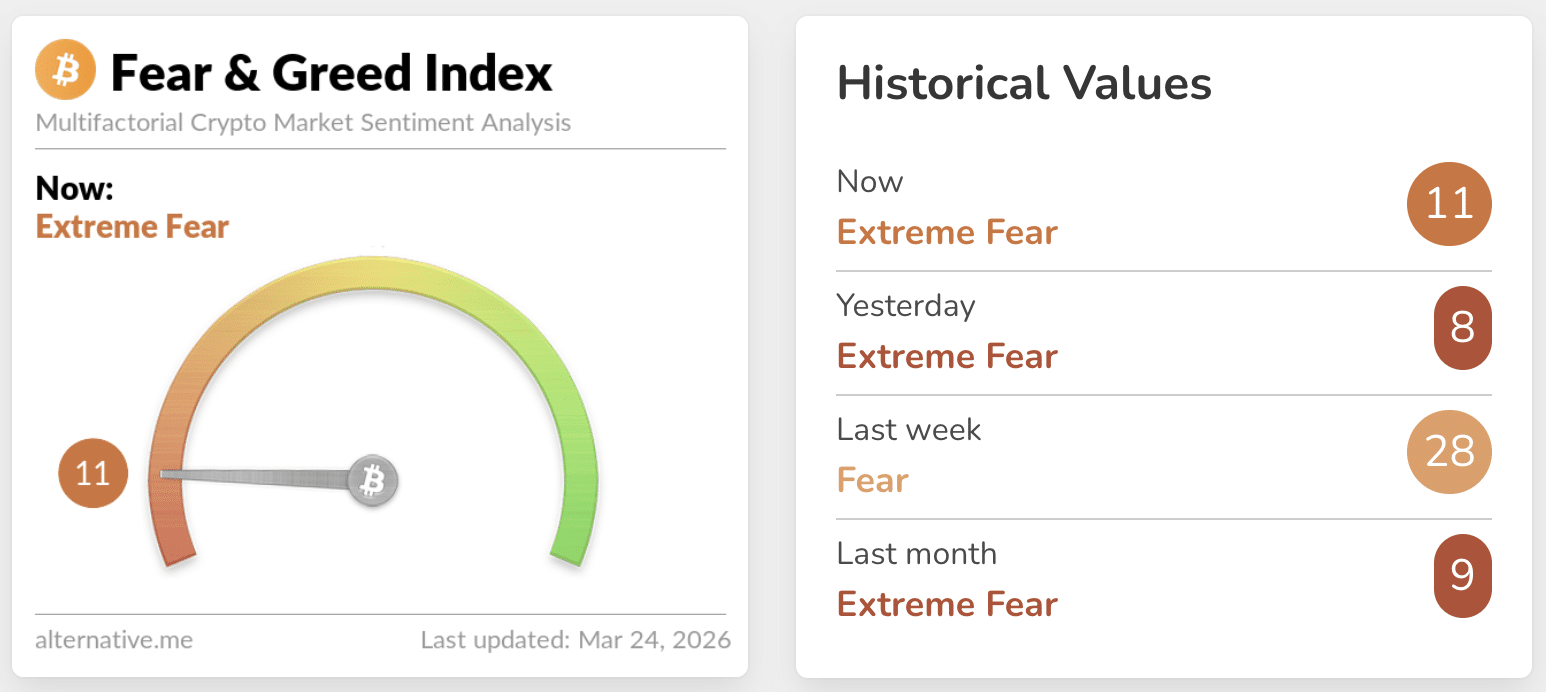
In the last 24 hours, the total crypto market value has gone up by about 3.26% at press time. But even with this rise, investor confidence is still very low.

The Crypto Fear & Greed Index is stuck in the “Extreme Fear” zone, showing that people are still uncertain and cautious.
Source: Alternative

However, with all these developments, the SEC is trying to build a bridge between its old approach and future laws like the CLARITY Act, which aim to provide clearer legal clarity.

Needless to say, the SEC is also working closely with the CFTC. In a recent interpretation on the 17th of March, they suggested that most digital assets should not be treated as securities automatically. This helps reduce risk and uncertainty for crypto companies in the U.S.

It’s still unclear whether these new rules will be temporary until Congress passes full legislation or if they will become a long-term framework. But one thing is clear: under Chairman Paul Atkins, the SEC is trying to end the confusion.


Final Summary

  • Collaboration between the SEC and CFTC is a key step toward unified oversight, reducing regulatory overlap and uncertainty.
  • Clear classification of digital assets could finally remove the grey zone that has stalled crypto innovation.


Preguntas relacionadas

QWhat is the main shift in the SEC's approach to crypto regulation as described in the article?

AThe SEC is shifting from relying mainly on lawsuits and enforcement actions to creating clear and structured rules for the crypto industry.

QWhat is the purpose of the proposed 'innovation exemption' mentioned in the article?

AThe 'innovation exemption' aims to create a more supportive environment where crypto firms can operate with fewer restrictions, allowing new companies to build and grow without immediately meeting complex registration requirements.

QAccording to the article, what problem did the previous regulatory environment cause for crypto businesses?

AThe previous unclear regulatory environment, under Chair Gary Gensler, caused confusion that pushed many crypto businesses to move outside the U.S. and made developers hesitant to take risks.

QWhat does the current 'Crypto Fear & Greed Index' indicate about investor sentiment, despite recent market gains?

ADespite a recent rise in the total crypto market value, the Crypto Fear & Greed Index is stuck in the 'Extreme Fear' zone, indicating that investor confidence is still very low and people remain uncertain and cautious.

QHow are the SEC and CFTC collaborating to provide clarity, according to the recent interpretation on March 17th?

AIn their recent interpretation, the SEC and CFTC suggested that most digital assets should not be automatically treated as securities, which helps reduce risk and uncertainty for crypto companies in the U.S.

Lecturas Relacionadas

Gensyn AI: Don't Let AI Repeat the Mistakes of the Internet

In recent months, the rapid growth of the AI industry has attracted significant talent from the crypto sector. A persistent question among researchers intersecting both fields is whether blockchain can become a foundational part of AI infrastructure. While many previous AI and Crypto projects focused on application layers (like AI Agents, on-chain reasoning, data markets, and compute rentals), few achieved viable commercial models. Gensyn differentiates itself by targeting the most critical and expensive layer of AI: model training. Gensyn aims to organize globally distributed GPU resources into an open AI training network. Developers can submit training tasks, nodes provide computational power, and the network verifies results while distributing incentives. The core issue addressed is not decentralization for its own sake, but the increasing centralization of compute power among tech giants. In the era of large models, access to GPUs (like the H100) has become a decisive bottleneck, dictating the pace of AI development. Major AI companies are heavily dependent on large cloud providers for compute resources. Gensyn's approach is significant for several reasons: 1) It operates at the core infrastructure layer (model training), the most resource-intensive and technically demanding part of the AI value chain. 2) It proposes a more open, collaborative model for compute, potentially increasing resource utilization by dynamically pooling idle GPUs, similar to early cloud computing logic. 3) Its technical moat lies in solving complex challenges like verifying training results, ensuring node honesty, and maintaining reliability in a distributed environment—making it more of a deep-tech infrastructure company. 4) It targets a validated, high-growth market with genuine demand, rather than pursuing blockchain integration without purpose. Ultimately, the boundaries between Crypto and AI are blurring. AI requires global resource coordination, incentive mechanisms, and collaborative systems—areas where crypto-native solutions excel. Gensyn represents a step toward making advanced training capabilities more accessible and collaborative, moving beyond a niche controlled by a few giants. If successful, it could evolve into a fundamental piece of AI infrastructure, where the most enduring value in the AI era is often created.

marsbitHace 8 hora(s)

Gensyn AI: Don't Let AI Repeat the Mistakes of the Internet

marsbitHace 8 hora(s)

Why is China's AI Developing So Fast? The Answer Lies Inside the Labs

A US researcher's visit to China's top AI labs reveals distinct cultural and organizational factors driving China's rapid AI development. While talent, data, and compute are similar to the West, Chinese labs excel through a pragmatic, execution-focused culture: less emphasis on individual stardom and conceptual debate, and more on teamwork, engineering optimization, and mastering the full tech stack. A key advantage is the integration of young students and researchers who approach model-building with fresh perspectives and low ego, prioritizing collective progress over personal credit. This contrasts with the US culture of self-promotion and "star scientist" narratives. Chinese labs also exhibit a strong "build, don't buy" mentality, preferring to develop core capabilities—like data pipelines and environments—in-house rather than relying on external services. The ecosystem feels more collaborative than tribal, with mutual respect among labs. While government support exists, its scale is unclear, and technical decisions appear driven by labs, not state mandates. Chinese companies across sectors, from platforms to consumer tech, are building their own foundational models to control their tech destiny, reflecting a broader cultural drive for technological sovereignty. Demand for AI is emerging, with spending patterns potentially mirroring cloud infrastructure more than traditional SaaS. Despite challenges like a less mature data industry and GPU shortages, Chinese labs are propelled by vast talent, rapid iteration, and deep integration with the open-source community. The competition is evolving beyond a pure model race into a contest of organizational execution, developer ecosystems, and industrial pragmatism.

marsbitHace 9 hora(s)

Why is China's AI Developing So Fast? The Answer Lies Inside the Labs

marsbitHace 9 hora(s)

3 Years, 5 Times: The Rebirth of a Century-Old Glass Factory

Corning, a 175-year-old glass company, is experiencing a dramatic revival as a key player in AI infrastructure, driven by surging demand for high-performance optical fiber in data centers. AI data centers require vastly more fiber than traditional ones—5 to 10 times as much per rack—to handle high-speed data transmission between GPUs. This structural demand shift, coupled with supply constraints from the lengthy expansion cycle for fiber preforms, has created a significant supply-demand gap. Nvidia has invested in Corning, along with Lumentum and Coherent, in a $4.5 billion total commitment to secure the optical supply chain for AI. Corning's competitive edge lies in its expertise in producing ultra-low-loss, high-density, and bend-resistant specialty fiber, which is critical for 800G+ and future 1.6T data rates. Its deep involvement in co-packaged optics (CPO) with partners like Nvidia further solidifies its position. While not the largest fiber manufacturer globally, Corning's revenue from enterprise/data center clients now exceeds 40% of its optical communications sales, and it has secured multi-year supply agreements with major hyperscalers including Meta and Nvidia. Financially, Corning's optical communications revenue has surged, doubling from $1.3 billion in 2023 to over $3 billion in 2025. Its stock price has risen nearly 6-fold since late 2023. Key future catalysts include the rollout of Nvidia's CPO products and the scale of undisclosed customer agreements. However, risks include high current valuations and potential disruption from next-generation technologies like hollow-core fiber. The company's long-term bet on light over electricity, maintained even through the telecom bubble crash, is now being validated by the AI boom.

marsbitHace 10 hora(s)

3 Years, 5 Times: The Rebirth of a Century-Old Glass Factory

marsbitHace 10 hora(s)

Trading

Spot
Futuros

Artículos destacados

Cómo comprar HOUSE

¡Bienvenido a HTX.com! Hemos hecho que comprar Housecoin (HOUSE) sea simple y conveniente. Sigue nuestra guía paso a paso para iniciar tu viaje de criptos.Paso 1: crea tu cuenta HTXUtiliza tu correo electrónico o número de teléfono para registrarte y obtener una cuenta gratuita en HTX. Experimenta un proceso de registro sin complicaciones y desbloquea todas las funciones.Obtener mi cuentaPaso 2: ve a Comprar cripto y elige tu método de pagoTarjeta de crédito/débito: usa tu Visa o Mastercard para comprar Housecoin (HOUSE) al instante.Saldo: utiliza fondos del saldo de tu cuenta HTX para tradear sin problemas.Terceros: hemos agregado métodos de pago populares como Google Pay y Apple Pay para mejorar la comodidad.P2P: tradear directamente con otros usuarios en HTX.Over-the-Counter (OTC): ofrecemos servicios personalizados y tipos de cambio competitivos para los traders.Paso 3: guarda tu Housecoin (HOUSE)Después de comprar tu Housecoin (HOUSE), guárdalo en tu cuenta HTX. Alternativamente, puedes enviarlo a otro lugar mediante transferencia blockchain o utilizarlo para tradear otras criptomonedas.Paso 4: tradear Housecoin (HOUSE)Tradear fácilmente con Housecoin (HOUSE) en HTX's mercado spot. Simplemente accede a tu cuenta, selecciona tu par de trading, ejecuta tus trades y monitorea en tiempo real. Ofrecemos una experiencia fácil de usar tanto para principiantes como para traders experimentados.

222 Vistas totalesPublicado en 2025.04.27Actualizado en 2025.04.27

Cómo comprar HOUSE

Discusiones

Bienvenido a la comunidad de HTX. Aquí puedes mantenerte informado sobre los últimos desarrollos de la plataforma y acceder a análisis profesionales del mercado. A continuación se presentan las opiniones de los usuarios sobre el precio de HOUSE (HOUSE).

活动图片












