ChatGPT's "Dreaming" Feature: A Must-Have for All AIs

marsbitPublicado a 2026-06-08Actualizado a 2026-06-08

Resumen

ChatGPT has introduced a major new "Dreaming" memory system, making its AI assistant more human-like by automatically learning and updating user preferences over time. Unlike the older "Saved memories" feature, which required explicit user commands to store information, the new system actively synthesizes useful details from past conversations—such as travel plans, work projects, or personal interests—and intelligently determines which facts remain relevant and which have become outdated. OpenAI reports significant performance improvements: accuracy in recalling facts rose from 41.5% with the old system to 82.8% with Dreaming V3, while adherence to user preferences increased from 31.4% to 71.3%. A key enhancement is the system's ability to keep information current over time, with accuracy jumping from 9.4% to 75.1%. Users can now view and edit a "Memory Summary" page, see sources that influenced responses, and control memory settings. While the feature initially rolls out to US Plus and Pro users, it will later expand globally and to free-tier users. This evolution marks a shift for ChatGPT from a general conversational model toward a persistent, personalized assistant that builds a long-term understanding of each user—raising both practical possibilities and deeper questions about privacy and the nature of AI-human relationships.

Now, ChatGPT's memory system is more human-like.

OpenAI recently launched a brand-new memory system, powered by the underlying Dreaming technology.

It automatically organizes your preferences, projects, devices, travel plans, and life arrangements during long-term conversations, and determines which information is still useful and which is outdated when providing answers.

However, this update is initially rolling out to Plus and Pro users in the U.S., with expansion to more countries in the coming weeks, and will gradually cover Free and Go users.

No More Starting from Scratch: ChatGPT's All-New Memory System Arrives

As early as April 2024, ChatGPT introduced a memory function, but its main form was "saving memories." For example, users could explicitly ask ChatGPT to remember certain information, such as travel arrangements, dietary preferences, names, or job requirements.

The early mechanism was more like a personal memo pad. If users were explicit enough, the system would save the information and reference it in later conversations. But in real-world use, much important information doesn't appear in the form of "please remember."

A user might mention their device during a consultation, casually state accommodation preferences while planning a trip, or reveal project context during a work discussion. The old version struggled to reliably capture these naturally scattered contextual details.

Furthermore, people's locations change, plans conclude, projects progress, and preferences may adjust. Static memories, if not updated over time, could turn personalization into a source of misinformation. For instance, if a user previously mentioned going to Singapore, that information was useful before the trip; but after the trip ends, if the system still recommends food delivery based on Singapore, it would be incorrect.

To address these issues and enable memory to update over time, more accurately reflecting the user's true needs, OpenAI introduced the first generation of Dreaming in April 2025. This aimed to let ChatGPT automatically organize useful information from multiple past conversations in the background and synthesize a new memory state.

Over the past year, Dreaming, alongside saved memories, enhanced personalization capabilities, but the early version wasn't robust enough to support a complete memory system on its own.
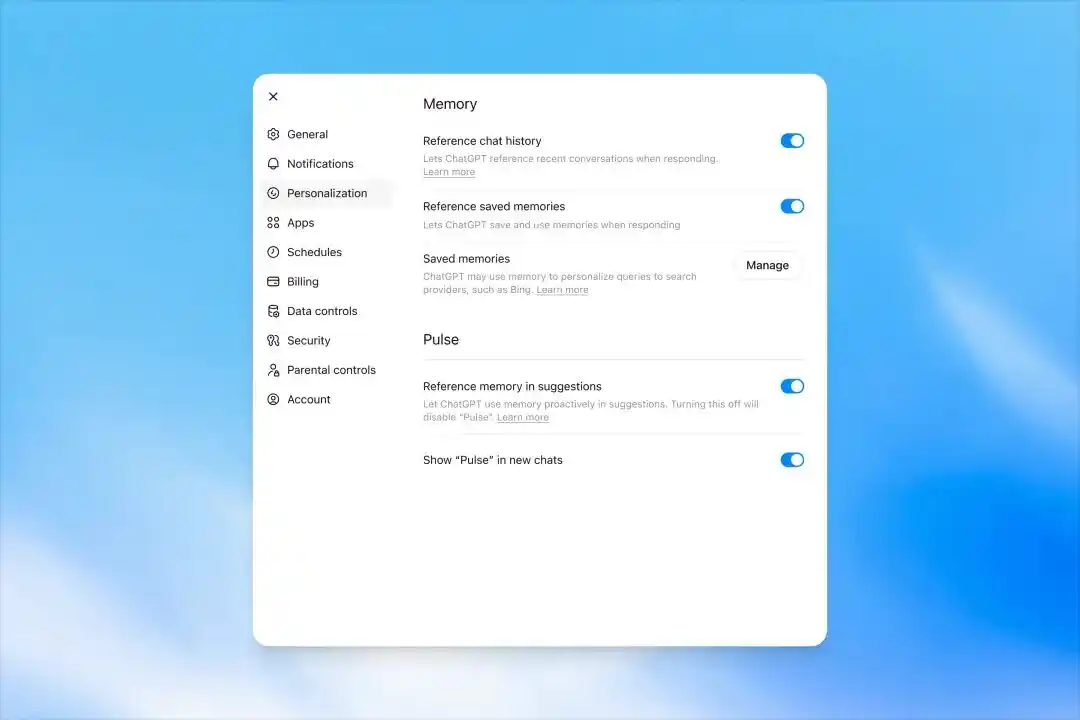
The new version builds upon Dreaming with the goal of solving three problems simultaneously: maintaining useful context, adhering to user preferences, and staying accurate over time.

In its official blog, OpenAI provided several examples. If a user previously discussed photography equipment, later inquiries about underwater photography accessories would prompt ChatGPT to offer compatible suggestions based on the specific camera, housing, and flash, rather than just a generic list.

If a user is planning a trip to Singapore, the system can also incorporate past mentions of preferences for wildlife photography, hotel air conditioning needs, and quiet dining habits to provide a more personalized itinerary.

If a user was traveling somewhere, the system should also understand this might be a temporary state and not treat it as the current location months later.

Internal evaluation data reflects these changes.

In factual recall tests, the success rate was 41.5% for the 2024 Saved Memories system, 67.9% for 2025 Saved Memories + Dreaming V0, and 82.8% for the 2026 Dreaming V3.
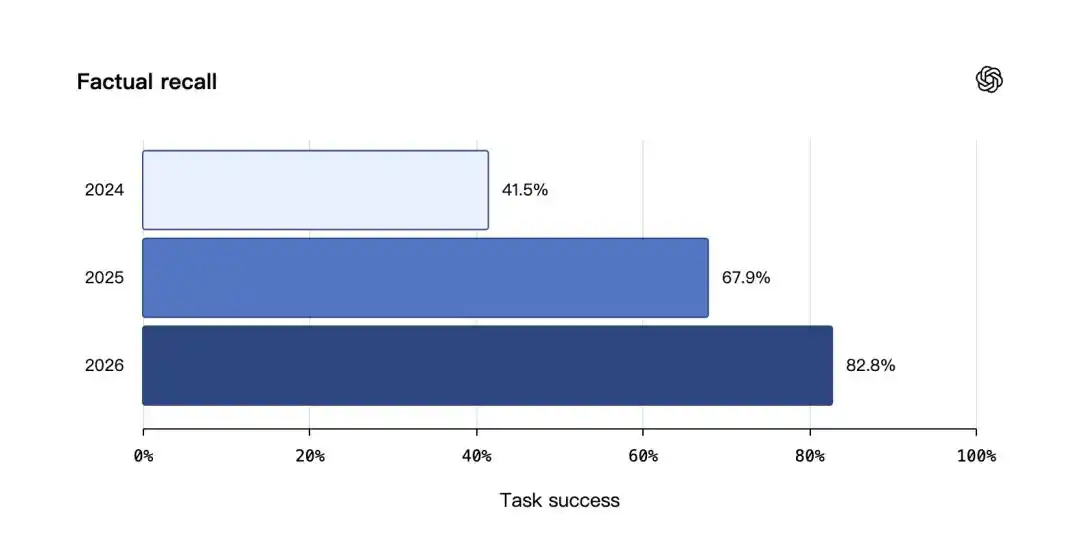
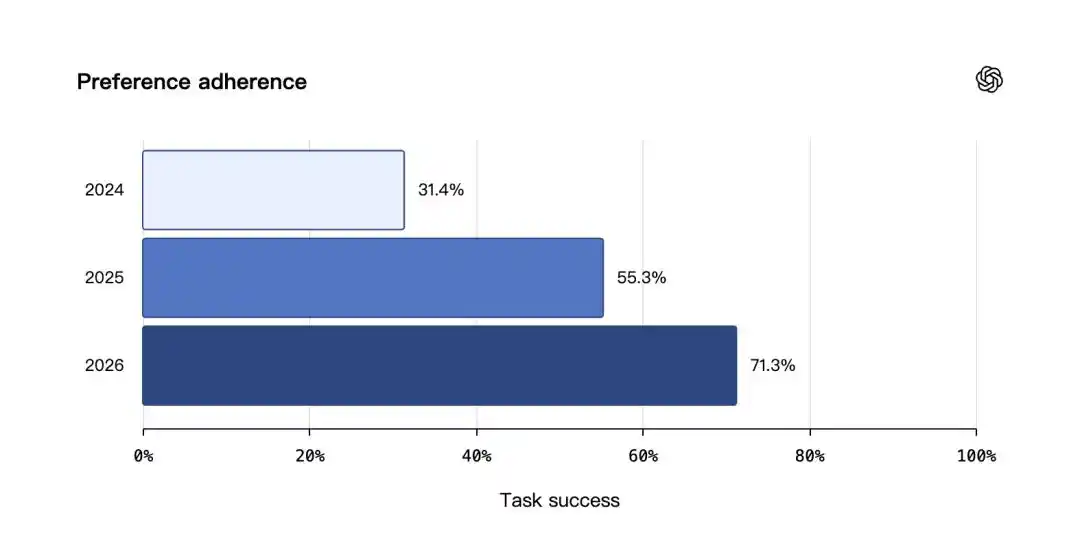
In preference adherence tests, the rates were 31.4%, 55.3%, and 71.3% respectively.
The improvement was even more significant in tests for staying correct over time: 9.4% in 2024, 52.2% in 2025, and 75.1% in 2026.
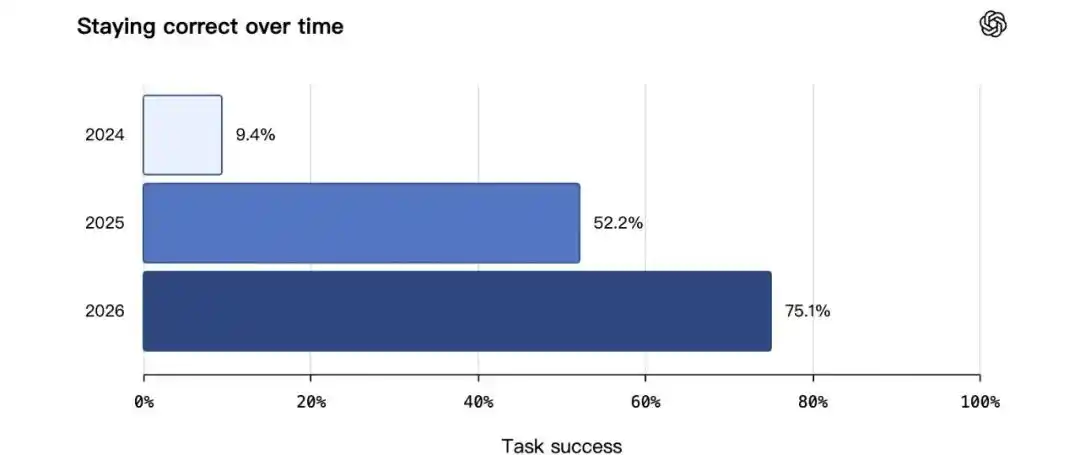
This data shows that OpenAI's goal isn't just for ChatGPT to remember more information. The real key is for the system to know which information is still fresh, which has expired, and which is suitable for inclusion in the current response.

The Endpoint of a Personal Assistant Is Becoming Another "You"

The most obvious product-level change is the addition of "Memory Summary."

OpenAI stated that memories synthesized by Dreaming can be viewed via the Memory Summary page. Users can see the personal information ChatGPT deems important, including work, interests, travel plans, long-term projects, and response preferences. They can also add or modify information in the summary.
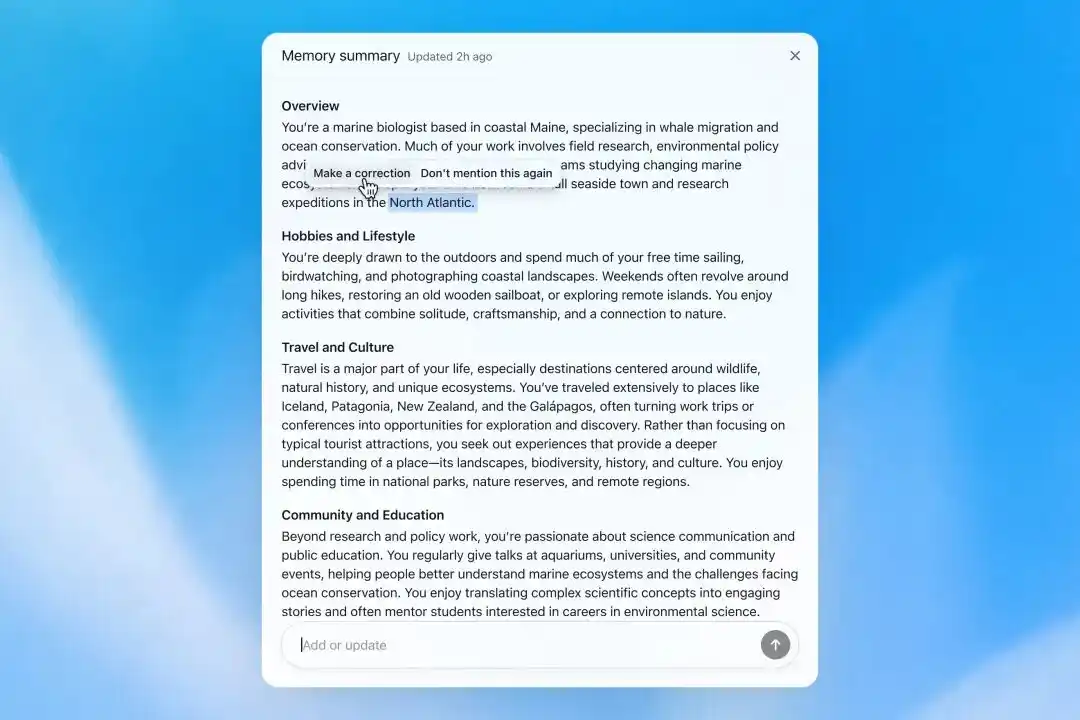
The Memory Summary updates automatically and shows the last update time.

Users can directly input modification requests, select specific text to correct, or choose "Don't mention this again." However, OpenAI emphasizes that such actions will only reduce future active mentions and do not equate to completely deleting the relevant information.
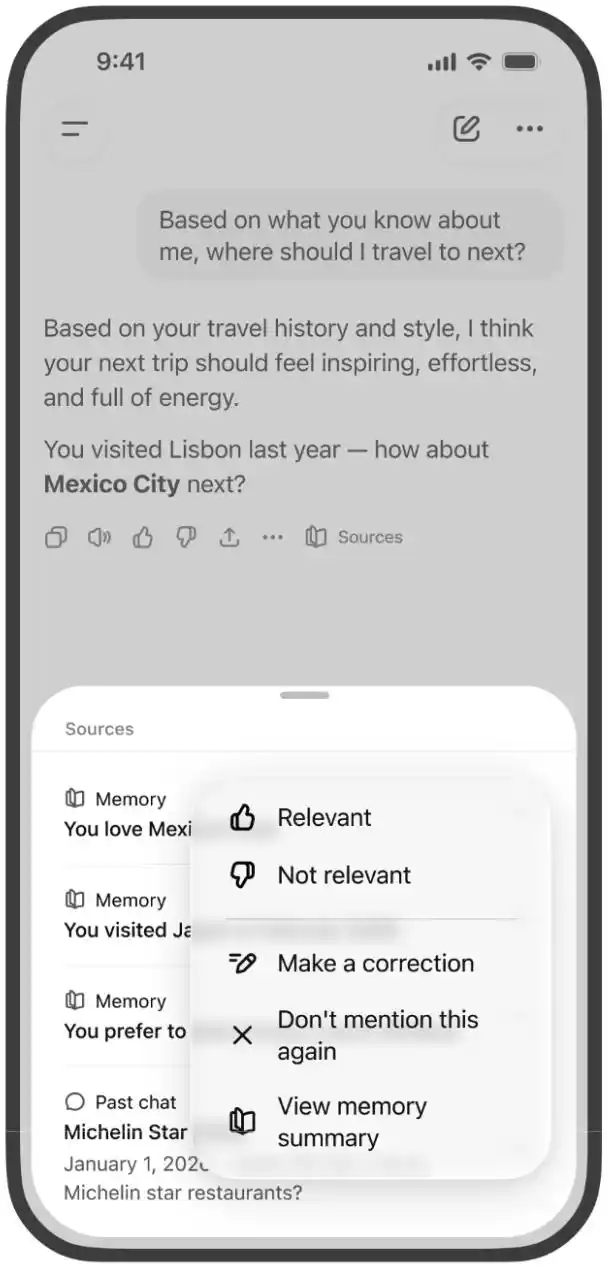
If a user wants to completely remove a piece of information, they need to delete all potential sources, including saved memories, past chats, archived chats, uploaded files, the memory summary, and relevant content in connected applications.

Of course, if you feel the new automatic summary isn't controllable enough, OpenAI still retains the old "Saved memories" system for Plus and Pro users on the web.

As usual, more relevant, frequently mentioned information is kept in the foreground, while less important content is moved to the background to reduce memory capacity issues. When judging priority, the system considers the recency of information and how often the user discusses related topics.
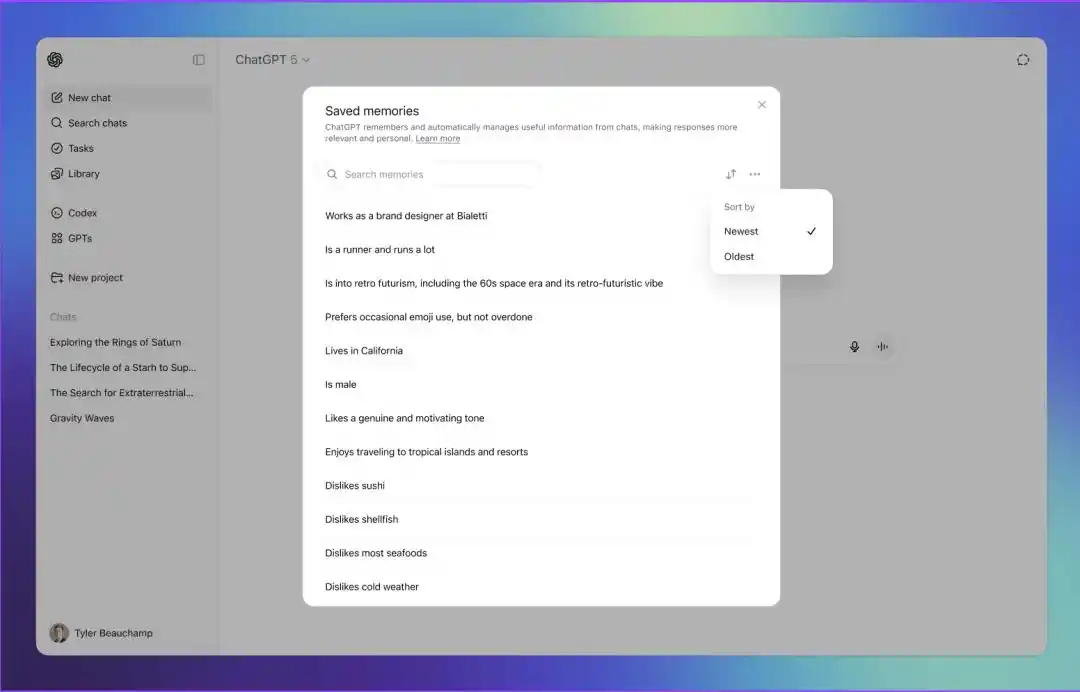
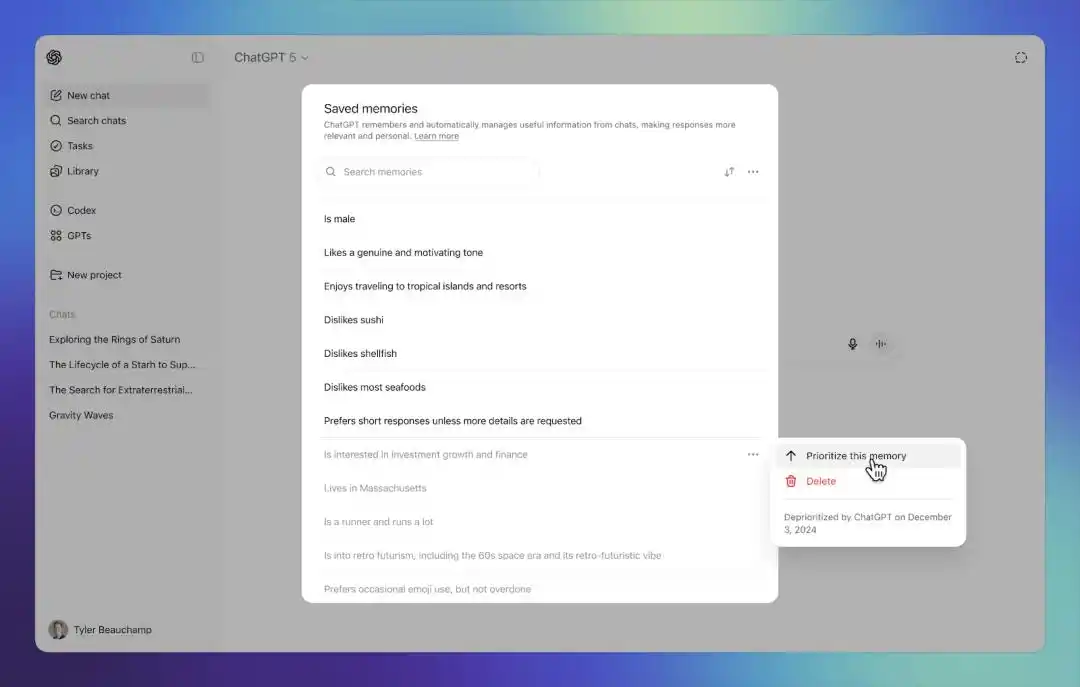
Users can also intervene manually. In the Saved memories page, they can search memories, sort by newest or oldest, and raise or lower the priority of individual memories. Memories in the background are displayed in gray. Users can also delete a single memory or all memories at once.
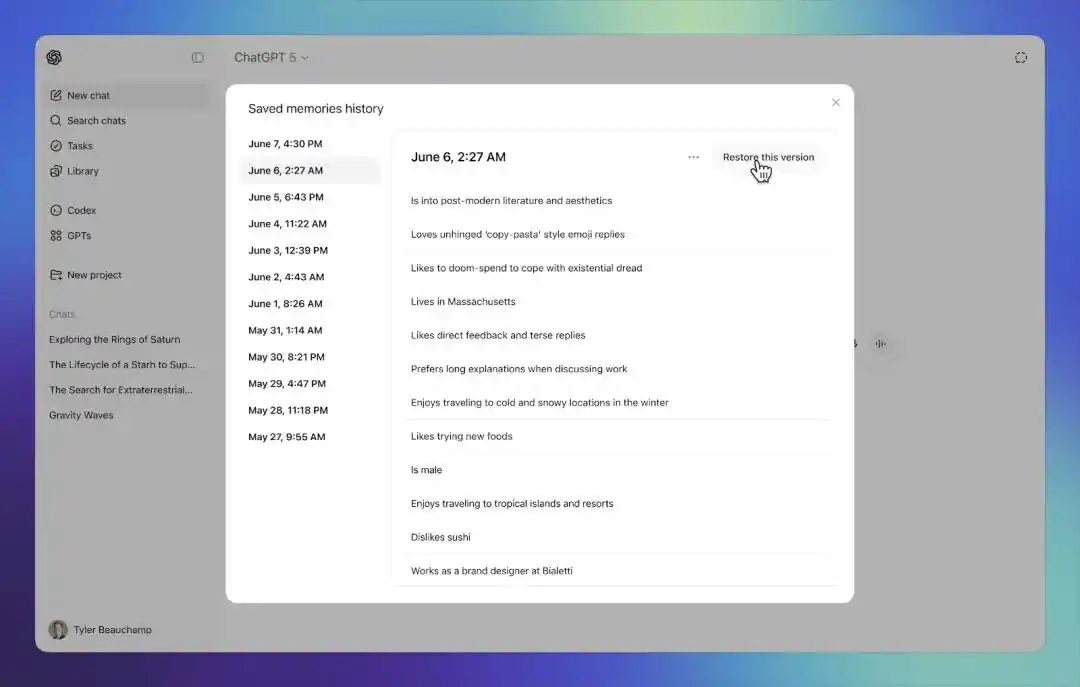
Additionally, OpenAI provides a Memory History feature. Users can view different versions of saved memories from various points in time and revert to a previous version. This means that as memory begins to update automatically, users can at least see how it changes and pull the system back to a past state.
OpenAI has also added a "Memory Sources" feature.

Users can click the book icon below an answer to see which sources contributed to the personalized response. Sources may include past chats, saved memories, custom instructions, files, and Gmail. The source display won't list every influencing factor, but it helps users better understand why ChatGPT gave a particular personalized answer.

The range of available sources varies by subscription plan.

Free and Go users can access past chats, saved memories, and custom instructions. Plus and Pro users in some regions can also use File Libraries and Gmail. Gmail requires active connection by the user; once connected, it can help identify travel confirmation emails, project threads, or schedule context. Notably, File and Gmail sources are not available in the European Economic Area, Switzerland, and the UK.

Memory controls remain in the Memory page within Settings.

Users can turn memory on or off, and can use Temporary Chat. Temporary Chat does not use existing memories or create new ones.
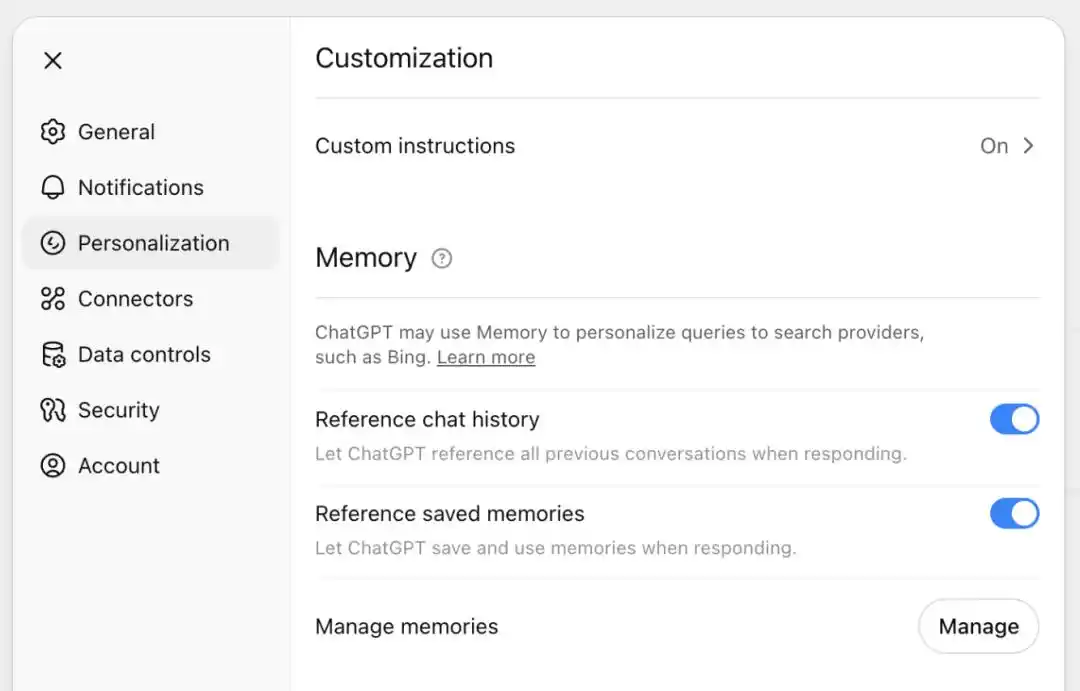
Turning off saved memories does not automatically delete already saved content, and deleting chats does not automatically delete saved memories generated from those chats. Users need to delete related memories separately or ask ChatGPT to forget.

Privacy thus becomes more critical.

OpenAI acknowledges that sensitive information shared in chats may appear in memories. If users do not want related content used for future personalized answers, they can turn off memory, use temporary chat, delete related chats, delete files, or disconnect linked applications.

Regarding model training, if users enable "Improve the model for everyone," past chats, saved memories, and related memory content may be used to improve the model. Content from ChatGPT Business, Enterprise, and Edu customers is not used for training by default.

On the deployment front, OpenAI stated that recent improvements have reduced the computational resources required for Dreaming by approximately 5 times. Therefore, OpenAI now also offers a quality-appropriate version to Free users while increasing memory capacity for Plus and Pro users.

For OpenAI, memory is a key step in ChatGPT's evolution from a model to an assistant.

A true assistant cannot start from scratch every time. It needs to know what the user is doing, how they prefer to communicate, which plans have ended, and which preferences remain valid. Otherwise, so-called personalization is just a more polite set of generic responses.

But memory also alters the relationship between the user and the product.

As ChatGPT begins to remember your projects, travels, files, emails, and life constraints, it ceases to be just a chat window. It increasingly becomes a long-standing personal interface, helping you access information, arrange tasks, interpret the world, and also, imperceptibly, accumulating an understanding of you.

In a sense, memory is a coming-of-age ceremony for AI assistants.

This also evokes the classic theme repeatedly explored in the *Blade Runner* series: whether memory (whether real or implanted) is sufficient to define humanity, constitute self-identity, and serve as a criterion to distinguish humans from replicants.

The memory system launched by ChatGPT today poses a similar question: when an AI preserves your experiences, preferences, and ways of judgment over the long term, will it gradually become your externalized self?

The endpoint of an AI assistant might be an editable version of yourself.

Attached reference links:

1. https://openai.com/index/chatgpt-memory-dreaming/

2. https://help.openai.com/en/articles/8590148-memory-faq

This article is from the WeChat public account "ifanr," author: ifanr, discovering tomorrow's products.


Preguntas relacionadas

QWhat is the new ChatGPT memory system based on, and what key problem does it aim to solve?

AThe new ChatGPT memory system is based on the latest 'Dreaming' technology. Its core aim is to solve the problem of how to automatically extract useful personal information (preferences, projects, plans) from extended conversations, and critically, to determine which information remains relevant and up-to-date for future responses.

QHow does the new 'memory summary' feature work and what can users do with it?

AThe 'memory summary' feature is a page that displays the key personal information ChatGPT has synthesized through Dreaming, such as work, interests, travel plans, and preferences. It updates automatically. Users can view it, add or modify information directly on the page, or select specific text to correct or request the AI to avoid mentioning it in the future.

QWhat are the key improvements in the new memory system's performance compared to previous versions, according to OpenAI's internal tests?

AAccording to OpenAI's internal evaluations, the new Dreaming V3 system showed significant improvements. Fact recall success increased from 41.5% (2024 saved memories) to 82.8%. Preference following improved from 31.4% to 71.3%. Most notably, the ability to remain correct over time jumped dramatically from 9.4% to 75.1%.

QWhat options do users have to control their privacy and manage what information ChatGPT remembers?

AUsers have several privacy and control options: they can turn memory on/off, use temporary chats (which don't use or create memories), delete specific saved memories or entire chat histories, remove connected apps (like Gmail), and edit or request deletion of information via the memory summary page. Users can also revert to previous versions of saved memories.

QAccording to the article, how does the author view the philosophical implication of ChatGPT's advanced memory system?

AThe author suggests that an AI with a sophisticated, long-term memory of a user's experiences, preferences, and judgments begins to function like an 'externalized self.' They draw a parallel to themes in 'Blade Runner,' questioning whether such memory accumulation could make the AI a kind of editable version of the user, representing the 'coming of age' for AI assistants.

Lecturas Relacionadas

He Was the Hero of Shanghai's Two Major Industries, Yet Passed Away Quietly in Regret

He was a pivotal figure in the development of two major Shanghai industries—semiconductors and commercial aircraft—yet passed away in quiet regret. Jiang Shangzhou, son of a veteran revolutionary and a Swiss-educated technocrat, became Deputy Director of the Shanghai Economic Commission in 1997. Tasked with identifying strategic industries, he championed integrated circuits (ICs) despite a climate of skepticism. Countering a national plan for just two 8-inch chip production lines, he boldly declared Shanghai would build ten within five years. He masterminded the Zhangjiang microelectronics zone, personally recruited top talent like Morris Chang, and helped establish SMIC. Through innovative financing that circumvented Western embargoes, SMIC grew rapidly, with Shanghai exceeding its target by building 18 lines. Simultaneously, while battling lung cancer, Jiang led the push for China's large commercial aircraft program as head of a state major projects panel. He argued it was a strategic imperative that would drive advancements across multiple industries. His relentless advocacy culminated in the 2006 state approval that paved the way for the C919. Jiang's career was marked by foresight often deemed too超前. Earlier postings in Sanya and Yangpu saw his ideas for tourism and economic reform initially rejected, only to be validated years later. In 2009, he became Chairman of the embattled SMIC. Despite his deteriorating health, he steered the company until his death in 2011, leaving a final insight for the chip industry: China need not master every process but must lead in key areas. He did not live to see the C919 fly or SMIC's full recovery, but his foundational work made Shanghai a national leader in both semiconductors and aerospace. Colleagues remembered him as a visionary whose impact shaped the three decades that followed.

marsbitHace 8 min(s)

He Was the Hero of Shanghai's Two Major Industries, Yet Passed Away Quietly in Regret

marsbitHace 8 min(s)

Illustrating the Cloudflare Wallet: The New Player in Stablecoin Payments Using x402

On August 4th, Cloudflare announced the launch of "Wallets," though the initial offering is limited to claiming a user handle. Full functionality for topping up, making payments, and using a Virtual Wallet via API keys is marked "Soon." The announcement clarifies that this handle is not yet a functional wallet. It represents a key piece in Cloudflare's broader payments strategy, alongside the Stripe Projects service (currently in open beta for agent-assisted purchases) and the Monetization Gateway for merchants (on a waitlist). The Wallet is positioned as the payer-side component for managing identity, balances, and authorization rules. While the underlying x402 protocol shows activity (75.41 million transactions, $24.24M volume in 30 days, averaging ~$0.32 per transaction), this data reflects the open network's usage, not specifically Cloudflare Wallet adoption. These metrics indicate suitability for frequent micro-payments like API calls. Cloudflare's documentation uses a $0.01 per-call example to illustrate the x402 flow: a server returns HTTP 402, the agent signs the payment, a facilitator verifies it, and the server delivers the result. Currently, developers must manage private keys and use test networks/USDC for agent payments. The Wallet roadmap aims to separate the user's Account Wallet from an agent's Virtual Wallet, adding controls for spending limits, whitelists, and per-transaction caps. This design resembles a corporate card with approval rules. However, these controls are not yet available for configuration. In summary, Cloudflare Wallet's current launch is a preliminary step. Critical details like supported stablecoins, blockchains, regions, KYC, custody, and fees remain undisclosed. The announcement primarily establishes a payer identity framework, with the full payment and agent autonomy system still under development.

marsbitHace 29 min(s)

Illustrating the Cloudflare Wallet: The New Player in Stablecoin Payments Using x402

marsbitHace 29 min(s)

TradeXYZ and Hyperliquid: Unveiling the Symbiotic Relationship Under a 50% Revenue Share

Market sentiment is cautious. AI investments are rewarded only when they drive growth without severely harming cash flow, while crypto markets face pressure from ETF outflows and rising yields. Within crypto, leadership has rotated to Solana and DEXs. Solana's ecosystem gained 8.5%, driven by tokens like META, while DEXs, led by Uniswap, rose 5.2%. A key debate centers on TradeXYZ's dominant role on the Hyperliquid exchange, where it generates over 50% of the volume in RWA perpetuals. TradeXYZ, an independent team, is required to share 50% of its HIP-3 protocol revenue with Hyperliquid. Concerns range from the sustainability of this split to Hyperliquid's long-term monetization. The argument that TradeXYZ might leave due to the 50% share is considered weak, as it would require rebuilding its entire platform and abandoning its user base, damaging its reputation. Conversely, Hyperliquid replacing TradeXYZ would signal bad faith to other builders. Their relationship is seen as symbiotic. Regarding monetization, Hyperliquid benefits not only from the 50% fee split but also from priority write fees, read fees from market makers, and second-order effects like increased USDC supply, which generates significant adjusted revenue. The more pertinent question is how both parties will transition from a growth-focused, low-fee model to a more stable, higher-fee structure.

marsbitHace 44 min(s)

TradeXYZ and Hyperliquid: Unveiling the Symbiotic Relationship Under a 50% Revenue Share

marsbitHace 44 min(s)

Report: DeepSeek Resumes Financing, Pre-money Valuation at 500 Billion Yuan

Several transaction sources revealed to Caijing that AI company DeepSeek has restarted its second round of financing, aiming to raise 50 billion yuan with a pre-money valuation of approximately 500 billion yuan. The signing is planned for late August. DeepSeek completed its first funding round of 50 billion yuan in June with a valuation over 350 billion yuan, marking the largest first-round financing in China's AI large model history. The second round was reportedly paused in late July, partly due to the founder's dissatisfaction with leaked investor meeting details circulating online. It has since been restarted with a desire for a more discreet process. The second-round valuation represents a 43% increase from the first round. If successful, DeepSeek will have raised over 100 billion yuan across both rounds. Investor interest remains high; the first round saw over 100 billion yuan in expressed intent, leaving significant unmet demand. DeepSeek's fundraising scale surpasses competitors like Moonshot AI, which recently raised funds at a $31.5 billion valuation and is planning a Pre-IPO round. Market pricing for these model companies is seen more as an "option" on reaching AGI rather than based on traditional financial metrics. Regarding model development, DeepSeek recently publicly tested the DeepSeek-V4-Flash official version in late July, featuring enhanced Agent capabilities and strong performance on benchmarks. It follows a high-value, low-cost strategy, with its pricing being competitive against rivals like Zhipu GLM-5.2 and OpenAI's GPT-4o. On the OpenRouter platform, DeepSeek-V4-Flash recently ranked first in weekly token consumption. The company faces pressure in training new models, and the release timeline for the V4-Pro official version remains unannounced.

marsbitHace 1 hora(s)

Report: DeepSeek Resumes Financing, Pre-money Valuation at 500 Billion Yuan

marsbitHace 1 hora(s)

Trading

Spot
活动图片