Charles Hoskinson Blasts Ripple For Backing Bill That Could Crush Competition

bitcoinistPublicado a 2026-03-31Actualizado a 2026-03-31

Resumen

Cardano founder Charles Hoskinson has sharply criticized Ripple and its CEO Brad Garlinghouse for supporting proposed U.S. legislation that would classify most new tokens as securities by default. Hoskinson argues this approach would harm competition, protect established players like Ripple through exemptions, and remove legal protections for DeFi and open-source developers. He warns the bill replicates the SEC’s aggressive regulatory stance and could expose software creators to unreasonable liability. Hoskinson also addressed the XRP community, clarifying that his criticism targets Ripple’s lobbying—not the token itself—and contrasted Ripple’s “mammoth premine” with Cardano’s more distributed token distribution.

Cardano founder Charles Hoskinson used a lengthy weekly livestream to level one of his sharpest recent attacks at Ripple, arguing that the company is backing legislation that could entrench incumbents, weaken DeFi protections, and make it harder for new crypto projects to compete.

The core of Hoskinson’s complaint was not aimed at XRP holders, but at what he described as Ripple’s policy posture in Washington and the behavior of CEO Brad Garlinghouse. In Hoskinson’s telling, Ripple is pushing for rules that would classify new tokens as securities by default while benefiting from carve-outs that would leave larger, established players in a stronger position.

Hoskinson Takes Aim At Ripple Over Competition Fight

Hoskinson said Garlinghouse was “trying to pass a bill that makes everything by default a security until proven otherwise,” calling that framework a non-starter for the broader market. He argued that such an approach would effectively recreate the kind of regulatory pressure that former SEC Chair Gary Gensler brought to the sector, only this time through legislation supported by industry actors rather than enforcement alone.

“He’s trying to pass a bill that makes everything by default a security until proven otherwise, which was the treatment Gary Gensler inflicted on his own ecosystem,” Hoskinson said. “It’s a non-starter, because he knows that he’s going to get an exemption and it reduces competition. So, [expletive] the whole industry. It’s bad behavior.”

That argument sat at the center of a wider rant about market structure, lobbying, and what Hoskinson sees as crypto’s growing willingness to trade open competition for regulatory protection. He said he had already laid out “four different attack vectors” the SEC could use if such a bill were enacted, and warned that the damage would not stop with token issuers.

According to Hoskinson, the proposal would also leave open-source developers exposed by stripping out protections for DeFi builders. “The bill also removed all developer protections for DeFi developers,” he said. “Who takes care of the Tornado Cash people and these other people writing open-source software? We can’t live in a space where you have transitive unlimited liability.”

He extended that point with one of the livestream’s longer analogies, arguing that holding software developers liable for downstream use of their code would amount to a category error. “You write code and people you’ve never met use that code in places you’ve never been to and you’re held absolutely liable for that,” Hoskinson said. “That’s equivalent to you writing a book, someone reads the book and murders somebody based on a character in your book and then you get charged with murder. It’s basically the same thing.”

Hoskinson also took aim at what he described as the XRP community’s reflexive defense of Ripple whenever he criticizes the company. He said there is “no path for people to listen to the content” of his argument because any criticism of Garlinghouse is treated as an attack on XRP itself. He pushed back on that framing by noting that he publicly supported Ripple when the SEC sued the company years ago, but said that did not obligate him to back its current lobbying goals.

“Guys, I did support you when you got sued by the Securities Exchange Commission,” he said. “There’s videos of me. You can pull them up from years ago where I said it was the wrong decision.”

From there, Hoskinson shifted into one of crypto’s oldest fault lines: token distribution. He argued that Ripple had no need for outside help in its legal fight because the organization “gave themselves a mammoth premine,” saying the company already had the resources to defend itself and pursue acquisitions. He contrasted that with Cardano, saying, “I didn’t give myself 70% of the ADA supply.”

At press time, XRP traded at $1.35.
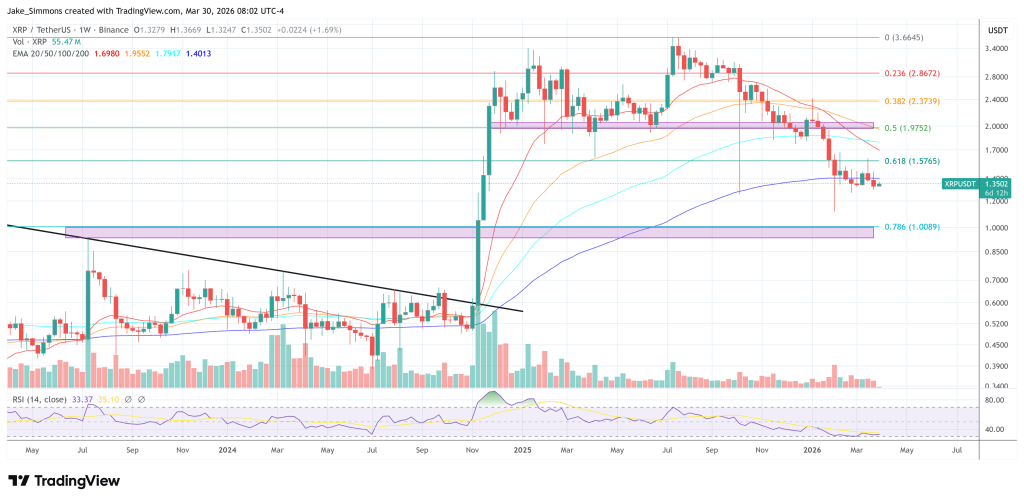
XRP falls below the 200-week EMA again, 1-week chart | Source: XRPUSDT on TradingView.com

Preguntas relacionadas

QWhat is Charles Hoskinson's main criticism against Ripple in this article?

ACharles Hoskinson criticizes Ripple for backing legislation that would classify new tokens as securities by default, which he believes would entrench incumbents, weaken DeFi protections, reduce competition, and benefit established players like Ripple through exemptions.

QAccording to Hoskinson, what negative consequences would the proposed bill have for DeFi developers?

AHoskinson states the bill would remove developer protections for DeFi builders, exposing open-source developers to 'transitive unlimited liability' where they could be held liable for how others use their code, similar to holding an author responsible if someone committed murder after reading their book.

QHow does Hoskinson contrast Cardano's token distribution with Ripple's?

AHoskinson contrasts the two by stating that Ripple 'gave themselves a mammoth premine' of XRP, giving them ample resources, while emphasizing 'I didn't give myself 70% of the ADA supply' for Cardano.

QWhat does Hoskinson say about the XRP community's response to his criticism of Ripple?

AHoskinson says the XRP community has a reflexive defense mechanism where any criticism of Ripple CEO Brad Garlinghouse is treated as an attack on XRP itself, making it difficult for people to actually listen to the content of his arguments.

QWhat historical support does Hoskinson mention he provided to Ripple, and how does it relate to his current stance?

AHoskinson mentions he publicly supported Ripple years ago when the SEC sued the company, calling it 'the wrong decision,' but clarifies that this past support does not obligate him to back Ripple's current lobbying efforts for what he considers anti-competitive legislation.

Lecturas Relacionadas

Should You Buy SpaceX Stock at $1.7 Trillion? Here's What the Market Is Worried About

SpaceX is preparing for a massive IPO aiming to raise around $75 billion at a valuation of approximately $1.75 trillion. While its achievements in reusable rockets and the profitable Starlink satellite internet service are clear, the market is concerned about the aggressive valuation. Key issues include: the current $1.75 trillion valuation, which is about 94 times 2025 revenue, seems to price in not just existing businesses but also unproven future ventures like AI infrastructure and orbital data centers. Financially, while Starlink is profitable, the AI division, bolstered by the acquisition of xAI, is incurring massive losses and consuming the majority of capital expenditures. This acquisition also introduced complex related-party financing arrangements and debt onto SpaceX's balance sheet. Furthermore, corporate governance poses a challenge. SpaceX's dual-class share structure ensures founder Elon Musk retains absolute control, limiting ordinary shareholders' influence over high-risk, long-term strategic decisions. The future success of ambitious projects like the Starship rocket—critical for lowering costs and enabling new services—remains a significant variable for the valuation. In summary, the market's apprehension (FUD) centers not on doubting SpaceX's past technological triumphs but on questioning how much premium public investors should pay for a future that combines proven profits with highly speculative and capital-intensive new ventures, all under a governance structure that offers limited shareholder oversight.

marsbitHace 58 min(s)

Should You Buy SpaceX Stock at $1.7 Trillion? Here's What the Market Is Worried About

marsbitHace 58 min(s)

Breaking the DeFi Cascading Liquidation Curse: Vitalik Proposes a New Solution

Vitalik Buterin has proposed a new DeFi design to eliminate the automatic liquidation mechanism that causes market instability during sharp downturns. The current system, used by protocols like Aave, triggers forced sales when collateral value falls below a threshold, often exacerbating price drops and creating systemic selling pressure. Buterin's alternative model is based on splitting an asset like ETH into two synthetic option-like tokens, P and N, pegged to a price index. Their combined value always equals one ETH. Instead of sudden liquidation, a position's value gradually drifts from its target peg if the market moves. Users must proactively rebalance their holdings to maintain their desired exposure, transferring the management burden from the protocol to the user or automated tools. A key advantage is the reduced reliance on real-time oracles. Pricing decisions are deferred until contract expiry, allowing for more robust, fault-tolerant oracle designs. This removes a clear liquidation threshold that speculators can target for manipulation or MEV extraction. However, significant challenges remain. Frequent rebalancing could incur high slippage and transaction costs, necessitating new liquidity provider models. The design is better suited for hedging instruments than for stablecoins requiring a rigid 1:1 peg. While not an immediate replacement for existing systems, the proposal challenges the foundational assumption that instantaneous forced liquidation is an unavoidable necessity in DeFi, opening the door for fundamentally different risk management architectures.

marsbitHace 1 hora(s)

Breaking the DeFi Cascading Liquidation Curse: Vitalik Proposes a New Solution

marsbitHace 1 hora(s)

The End of Single-Factor Cryptography

The article "The End of Single-Factor Crypto" posits a fundamental shift in the cryptocurrency ecosystem. It argues the era where crypto asset valuations were predominantly driven by, and correlated with, Bitcoin's price is ending. The space is bifurcating into two distinct economies: endogenous and exogenous. The endogenous economy represents traditional crypto, where token and project values are directly tied to crypto market prices. The emerging exogenous economy comprises projects and businesses that may utilize blockchain technology or tokens but derive their fundamental value from external, non-crypto factors like consumer demand, subscription revenue, or real-world utility. Examples include AI inference platforms like Venice, fintech lenders using blockchain for efficiency, and stablecoin/payment infrastructure companies acquired by giants like Mastercard and Stripe. This shift means investment analysis must change. For exogenous assets, evaluating traditional business fundamentals—such as revenue streams, unit economics, and competitive moats—becomes more critical than tracking Bitcoin charts. While endogenous assets like Bitcoin remain relevant, the growth of the exogenous category is driven by measurable demand independent of crypto price cycles, paving the way for a new, more diversified market phase. Consequently, crypto is evolving from a single-factor, reflexive asset class into a multifaceted ecosystem with varied drivers and investment theses.

marsbitHace 1 hora(s)

The End of Single-Factor Cryptography

marsbitHace 1 hora(s)

Morning Post | Bitmine Plans to Raise $300 Million Through Preferred Stock Issuance; Polymarket Accuses Kalshi of Commercial Espionage

ChainCatcher's Daily Crypto Brief: Key developments from the past 24 hours include significant funding moves, regulatory actions, and market predictions. Bitmine announced a $300 million preferred stock fundraising. Polymarket accused rival prediction platform Kalshi of corporate espionage, citing numerous suspicious coincidences in product launches, a claim Kalshi strongly denied. The U.S. Department of Justice, in a joint "Disruption Week" anti-fraud operation with companies like Coinbase and Meta, froze over $3.8 million in cryptocurrency linked to scams. In infrastructure news, Macau completed its integration with the multi-central bank digital currency bridge, mBridge, aiming to build efficient cross-border payment channels. Cosmos Labs acquired the block explorer Mintscan. Market-wise, Geoffrey Kendrick, Standard Chartered's Head of Digital Assets Research, stated Bitcoin is nearing a bottom around $63,000, maintaining a year-end target of $100,000. He noted stability in U.S. spot Bitcoin ETF holdings. Ahead of SpaceX's anticipated IPO, internal insiders at Rocket Lab (RKLB) sold over $18.41 million in stock. In tokenization, Goldman Sachs partnered with Apex and Archax to launch a tokenized real estate fund. The meme token tracker GMGN reported the top trending tokens: on Ethereum, HEX, SHIB, LINK, PEPE, mUSD; on Solana, TROLL, swarms, WORLDCUP, neet, Buttcoin; and on Base, PEPE, toby, ODDS, ELSA, SKI.

链捕手Hace 1 hora(s)

Morning Post | Bitmine Plans to Raise $300 Million Through Preferred Stock Issuance; Polymarket Accuses Kalshi of Commercial Espionage

链捕手Hace 1 hora(s)

Trading

Spot
Futuros
活动图片





