Chainlink’s ‘$80T update’ sees LINK reserves, Open Interest climb – Details

ambcryptoPublicado a 2026-01-23Actualizado a 2026-01-23

Resumen

Chainlink has significantly expanded its blockchain infrastructure by introducing real-time U.S. stock and ETF prices on-chain, a development projected to unlock $80 trillion in assets for DeFi. This positions Chainlink as a primary data layer for on-chain financial products. Key metrics show strong growth: LINK reserves increased by over 88,000 tokens in 24 hours, Open Interest climbed to $233 million, and the number of holders reached 177,000. These trends signal accumulation, rising institutional participation, and broader adoption, reinforcing Chainlink's critical role in bridging traditional markets and decentralized finance.

The Chainlink (LINK) network has taken a major step in expanding and growing blockchain infrastructure with the introduction of real-time U.S stock and ETF prices on-chain. The recent announcement by the firm claims to unlock $80 trillion worth of assets in equities for decentralised finance, as stated in a recent update.

By further connecting traditional markets and blockchain technology, Chainlink will confidently position itself within the primary data layer for on-chain financial product support.

Most importantly, the development will enable DeFi projects to rely on live equity prices through a support provided by Chainlink’s oracle solution.

As tokenization continues to attract widespread interest, reliable token prices remain a foundational element. Especially for token-based products that include settlements, derivatives and synthetic assets.

LINK reserve activity signals accumulation

While infrastructure expansion is on its way, there has also been a considerable hike in LINK reserve balances recently. In fact, the reserve balance on the network gained by 88,845.86 LINK in just 24 hours.

At press time, the total holdings stood at 1,675,112.67 LINK – Reflecting a steady increase in reserve-controlled supply.
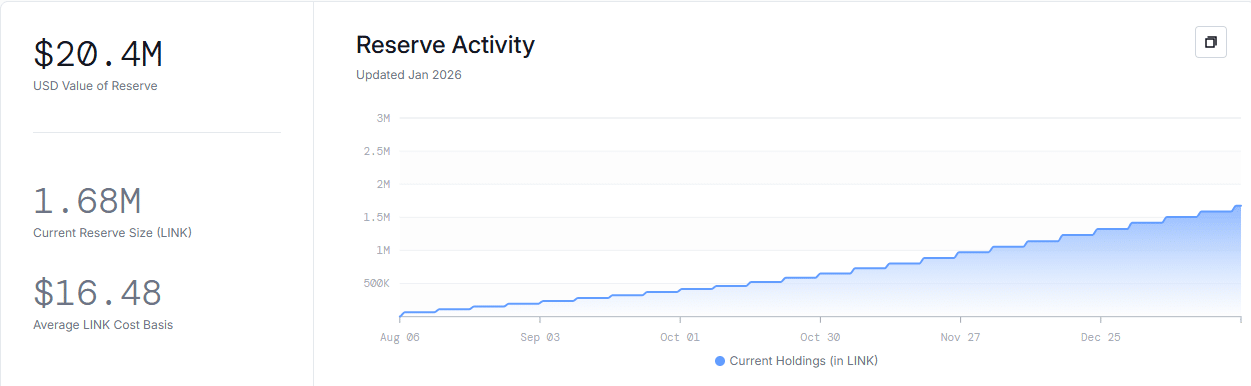
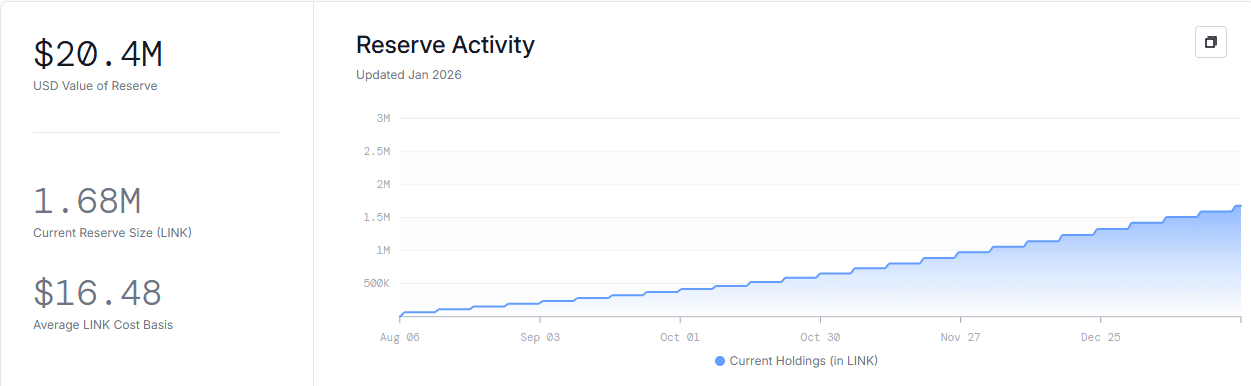
Historically, such movements have highlighted active treasury management during a period of growing network adoption. For LINK, the reserve accumulation coincides with periods of structural expansion. Especially as infrastructure providers align resources with long-term usage growth.

Derivatives point to a rising institutional participation

Adding to the aforemential bullish indicators, the token’s market participation metrics have also shifted. LINK’s Open Interest, for instance, had climbed to $233 million at the time of writing.

The hike in Open Interest levels highlight LINK’s growing capital mobilization in the derivative markets as traders and investors ramp up their trading activities.

Also, the institutional demand increase aligns with the timing of Chainlink’s latest infrastructure rollout. In the long rum, this can seen as a positive signal for LINK’s price.

What about the number of holders?

Beyond derivatives data, holders’ metrics is worth looking at too. The number of LINK holders has continued to rise steadily, indicating growing distribution across the network.

In fact, the number of holders stood at 177k at press time. LINK holders’ count surge mirrors broader participation, especially during periods when adoption narratives gain visibility.

The expansion into real-time equity pricing, the hike in reserve balances, the upswing in derivatives interest, and the sustained growth in holders all highlight the growing relevance of Chainlink’s network in the context of the tokenized finance industry.

As the line between traditional markets and DeFi continues to blur, Chainlink’s role as a data backbone will remain firmly in focus.


Final Thoughts

  • LINK is strengthening its infrastructure role as it brings real-time U.S. stock and ETF prices on-chain.
  • Network also recorded greater participation as reserves, Open Interest, and holder counts all registered an uptick.


Preguntas relacionadas

QWhat major infrastructure expansion did Chainlink announce, and what value of assets does it claim to unlock?

AChainlink announced the introduction of real-time U.S. stock and ETF prices on-chain, which it claims will unlock $80 trillion worth of assets in equities for decentralized finance.

QHow much did the LINK reserve balance increase in 24 hours, and what was the total holding at press time?

AThe LINK reserve balance increased by 88,845.86 LINK in 24 hours, with total holdings standing at 1,675,112.67 LINK at press time.

QWhat was the value of LINK's Open Interest at the time of writing, and what does this indicate?

ALINK's Open Interest climbed to $233 million at the time of writing, indicating growing capital mobilization in the derivative markets and increased trading activity.

QHow many LINK holders were there at press time, and what does this trend signify?

AThere were 177,000 LINK holders at press time, signifying growing distribution across the network and broader participation during periods of adoption.

QWhat are the key factors highlighted that demonstrate Chainlink's growing relevance in the tokenized finance industry?

AThe key factors are the expansion into real-time equity pricing, the increase in reserve balances, the rise in derivatives interest, and the sustained growth in the number of holders.

Lecturas Relacionadas

In-Depth Report on the On-Chain Lending Market: When Off-Chain Credit Meets On-Chain Liquidation

The on-chain lending market has evolved from a peripheral DeFi niche into core financial infrastructure. As of early 2026, total value locked (TVL) in on-chain lending protocols has reached $64.3 billion, accounting for 53.54% of total DeFi TVL, making it the largest and most mature vertical within decentralized finance. Aave dominates the sector with approximately $32.9 billion in TVL, commanding nearly half of the market—a leadership position that is unlikely to be challenged in the foreseeable future. However, the path of on-chain lending forward is not without risk. Liquidation cascades, credit defaults, and cross-chain vulnerabilities remain systemic threats hanging over the industry. At the same time, a deeper structural transformation is underway: on-chain lending is shifting from a “leverage tool for crypto-native users” to a “compliant gateway for institutional capital”. The scale of RWA (Real World Asset) lending has surpassed $18.5 billion, with U.S. Treasuries and government securities increasingly serving as core collateral. Institutional capital inflows are reshaping both the user base and risk appetite of the sector. This report systematically analyzes the evolution of on-chain lending definitions, competitive dynamics, core risks, and future trends, providing a comprehensive industry outlook for investors and trade practitioners. Key findings suggest that the “one dominant player with several strong challengers” structure will persist in the short term, while fixed-rate lending, compliant collateral, and institutional credit underwriting will define the next phase of competition. For investors focused on DeFi infrastructure, three key opportunity tracks stand out, namely, the Aave ecosystem (Morpho, Spark), RWA lending protocols (Ondo, Maple) and fixed-rate innovation (Notional, Pendle).

HTX LearnHace 32 min(s)

In-Depth Report on the On-Chain Lending Market: When Off-Chain Credit Meets On-Chain Liquidation

HTX LearnHace 32 min(s)

Fu Peng's First Public Speech in 2026: What Exactly Are Crypto Assets? Why Did I Join the Crypto Asset Industry?

Fu Peng, a renowned macroeconomist and now Chief Economist at New火 Group, delivered his first public speech of 2026 at the Hong Kong Web3 Festival. He explained his perspective on crypto assets and why he joined the industry, framing it within the context of macroeconomic trends and financial evolution. Fu emphasized that crypto assets are transitioning from an early, belief-driven phase to a mature, institutionally integrated asset class. He drew parallels to the 1970s-80s, when technological advances (like computing) revolutionized traditional finance, leading to the rise of FICC (Fixed Income, Currencies, and Commodities). Similarly, current advancements in AI, data, and blockchain are reshaping finance, with crypto assets becoming part of a new "FICC + C" (C for Crypto) framework. He noted that institutional capital, including traditional hedge funds, avoided early crypto due to its speculative nature but are now engaging as regulatory clarity emerges (e.g., stablecoin laws, CFTC classifying crypto as a commodity). Fu predicted that 2025-2026 marks a turning point where crypto becomes a standardized, financially viable asset for diversified portfolios, akin to commodities or derivatives in traditional finance. Fu defined Bitcoin not as "digital gold" in a simplistic sense but as a value-preserving, financially tradable asset. He highlighted that crypto's future lies in regulated, institutional adoption, moving away from retail-dominated trading. His entry into crypto signals this maturation, where traditional finance integrates crypto into mainstream asset management.

marsbitHace 1 hora(s)

Fu Peng's First Public Speech in 2026: What Exactly Are Crypto Assets? Why Did I Join the Crypto Asset Industry?

marsbitHace 1 hora(s)

Justin Sun Sues Trump Family: What $75 Million Bought Was Only a Blacklist

Justin Sun, founder of Tron, has filed a lawsuit in federal court against World Liberty Financial (WLF), alleging he was made the "primary target of a fraudulent scheme" after investing $75 million. Sun claims the investment secured him an advisor title and WLFI tokens, which were later frozen by WLF, causing "hundreds of millions in losses." The dispute began in late 2024 when Sun's investment helped revive WLF's struggling token sale, which ultimately raised $550 million. Shortly after, the SEC dropped its lawsuit against Sun following Donald Trump's inauguration. However, relations soured when Sun refused WLF's demands for additional funding. In August 2025, WLF added a "blacklist" function to its smart contract, allowing it to unilaterally freeze tokens. Sun's holdings, worth approximately $107 million, were frozen, and he was threatened with token destruction. The lawsuit highlights WLF's structure, which directs 75% of token sale profits to the Trump family, who had earned $1 billion by December 2025. WLF's CEO is Zach Witkoff, son of U.S. Middle East envoy Steve Witkoff. The project faces scrutiny for opaque operations, including a controversial loan arrangement on the Dolomite platform, co-founded by a WLF advisor. Despite Sun's history with the SEC, the case underscores centralization risks within DeFi, as WLF controls governance and holds powers to freeze assets arbitrarily. Sun's tokens remain frozen as legal proceedings begin.

marsbitHace 1 hora(s)

Justin Sun Sues Trump Family: What $75 Million Bought Was Only a Blacklist

marsbitHace 1 hora(s)

Trading

Spot
Futuros

Artículos destacados

Cómo comprar LINK

¡Bienvenido a HTX.com! Hemos hecho que comprar ChainLink (LINK) sea simple y conveniente. Sigue nuestra guía paso a paso para iniciar tu viaje de criptos.Paso 1: crea tu cuenta HTXUtiliza tu correo electrónico o número de teléfono para registrarte y obtener una cuenta gratuita en HTX. Experimenta un proceso de registro sin complicaciones y desbloquea todas las funciones.Obtener mi cuentaPaso 2: ve a Comprar cripto y elige tu método de pagoTarjeta de crédito/débito: usa tu Visa o Mastercard para comprar ChainLink (LINK) al instante.Saldo: utiliza fondos del saldo de tu cuenta HTX para tradear sin problemas.Terceros: hemos agregado métodos de pago populares como Google Pay y Apple Pay para mejorar la comodidad.P2P: tradear directamente con otros usuarios en HTX.Over-the-Counter (OTC): ofrecemos servicios personalizados y tipos de cambio competitivos para los traders.Paso 3: guarda tu ChainLink (LINK)Después de comprar tu ChainLink (LINK), guárdalo en tu cuenta HTX. Alternativamente, puedes enviarlo a otro lugar mediante transferencia blockchain o utilizarlo para tradear otras criptomonedas.Paso 4: tradear ChainLink (LINK)Tradear fácilmente con ChainLink (LINK) en HTX's mercado spot. Simplemente accede a tu cuenta, selecciona tu par de trading, ejecuta tus trades y monitorea en tiempo real. Ofrecemos una experiencia fácil de usar tanto para principiantes como para traders experimentados.

1.0k Vistas totalesPublicado en 2024.12.13Actualizado en 2025.03.21

Cómo comprar LINK

Discusiones

Bienvenido a la comunidad de HTX. Aquí puedes mantenerte informado sobre los últimos desarrollos de la plataforma y acceder a análisis profesionales del mercado. A continuación se presentan las opiniones de los usuarios sobre el precio de LINK (LINK).

活动图片