Chainlink reserves grow, yet LINK fails to break above $10: Why?

ambcryptoPublicado a 2026-03-27Actualizado a 2026-03-27

Resumen

Chainlink's LINK reserve has grown by 131,905 tokens (worth over $1.1 million), bringing total holdings to 2.79 million LINK. This reflects strategic accumulation and reduces circulating supply, yet the price remains stuck below the key $10 resistance level. LINK is trading in a bearish pennant pattern with lower highs and fragile support. A breakdown could push prices toward $5.77. The RSI at 46.37 indicates weakening momentum, with buyers failing to regain control. Exchange netflows have declined by 15.31%, reducing immediate sell-side pressure, but demand remains subdued. Liquidation data shows long positions ($55.8K) are being closed more aggressively than shorts ($24.59K), reinforcing bearish sentiment. Despite improving fundamentals like supply and reduced exchange inflows, price action and market positioning suggest continued downside risk unless buyers break above $10.

Chainlink’s [LINK] reserve has added 131,905 LINK worth over $1.1 million, pushing total holdings to 2.79 million LINK while price continues consolidating below key resistance levels. This expansion reflects sustained strategic accumulation rather than short-term positioning.

As tokens move into reserve custody, circulating supply across active markets continues shrinking. This shift directly reduces the volume available for immediate selling pressure.

However, the LINK price has not reacted with strength, which suggests that demand has not matched this tightening supply yet. Instead, the market continues absorbing supply changes without triggering upward expansion.

Chainlink capped below $10 under pressure

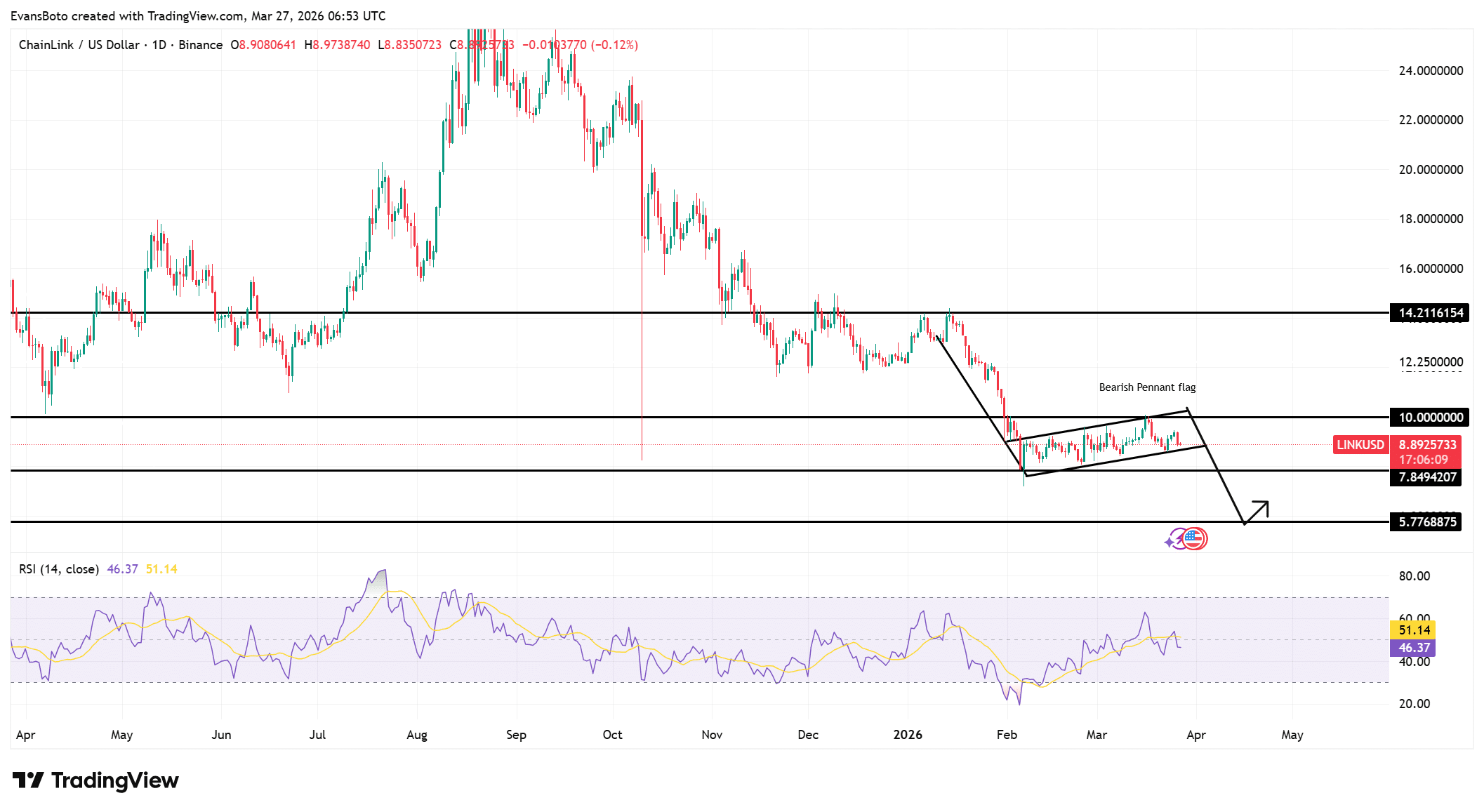
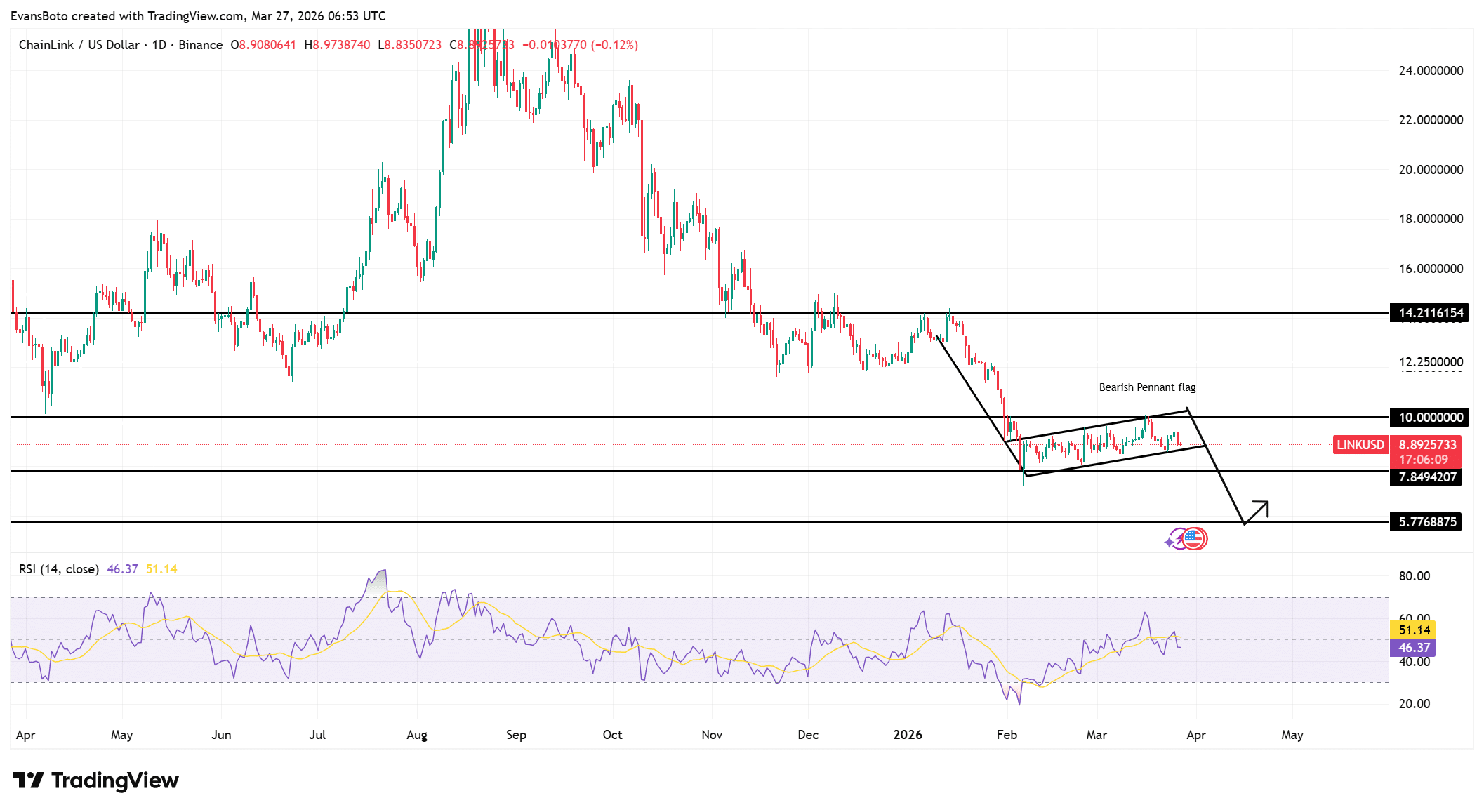
LINK continues trading below the $10 resistance while forming a bearish pennant structure. Price recently declined toward $7.84 before stabilizing near $8.89, which reflects ongoing compression after a sharp drop.

The pennant formation shows lower highs pressing against horizontal resistance, keeping upside attempts limited. However, support remains fragile as the structure leans toward continuation rather than reversal.

A breakdown from this formation would expose the $5.77 level as the next downside target. Although price attempts minor recoveries, rejection near the upper boundary keeps pressure intact. This structure continues guiding direction as sellers defend key resistance levels consistently.

At press time, RSI read 46.37, which reflects weakening strength across recent sessions. Instead of building upward pressure, the indicator has rolled over, aligning with price compression inside the pennant. This behavior signals that buyers have not regained control despite short-term stabilization.
Source: TradingView

Outflows rise as exchange pressure eases

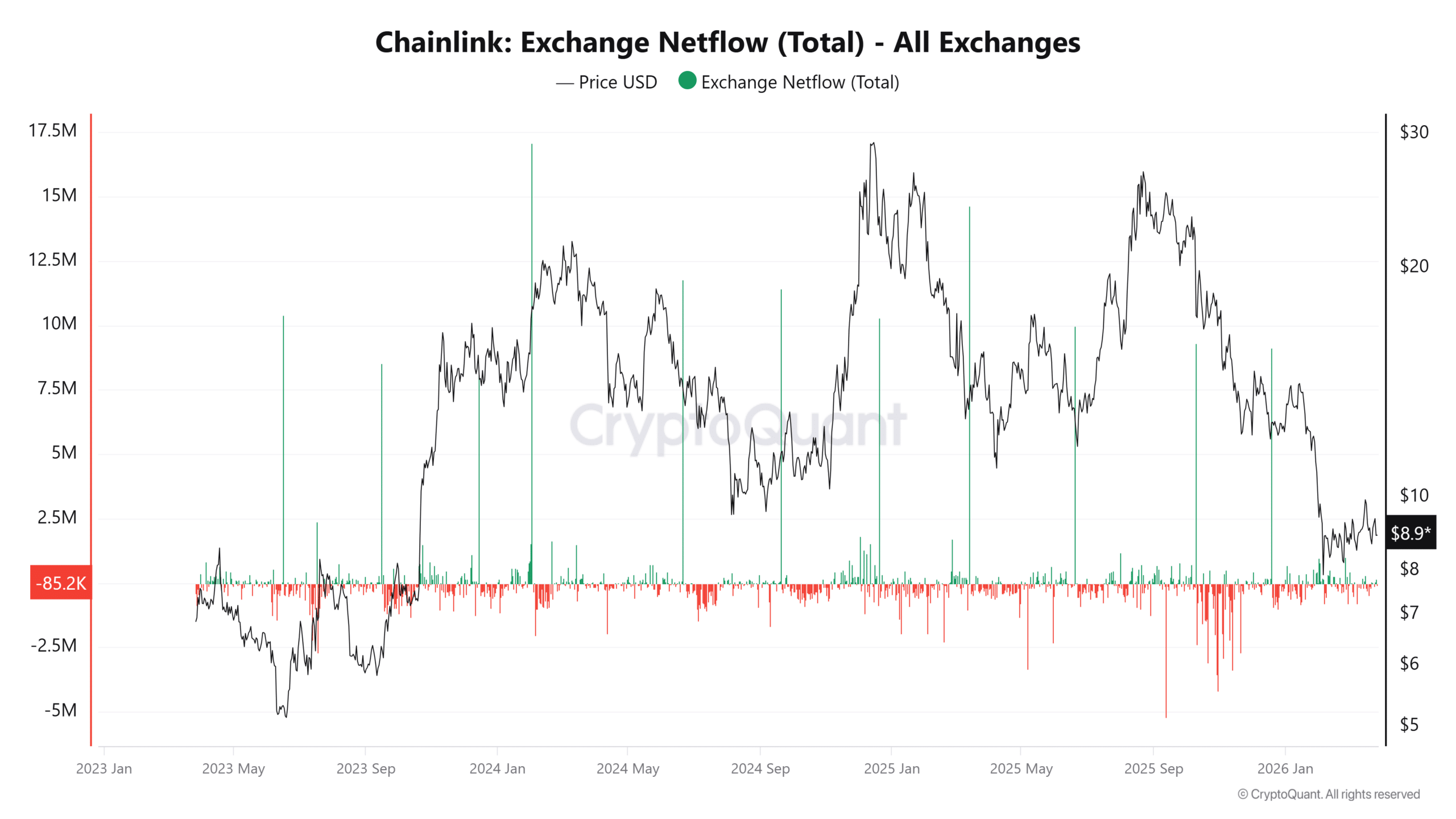
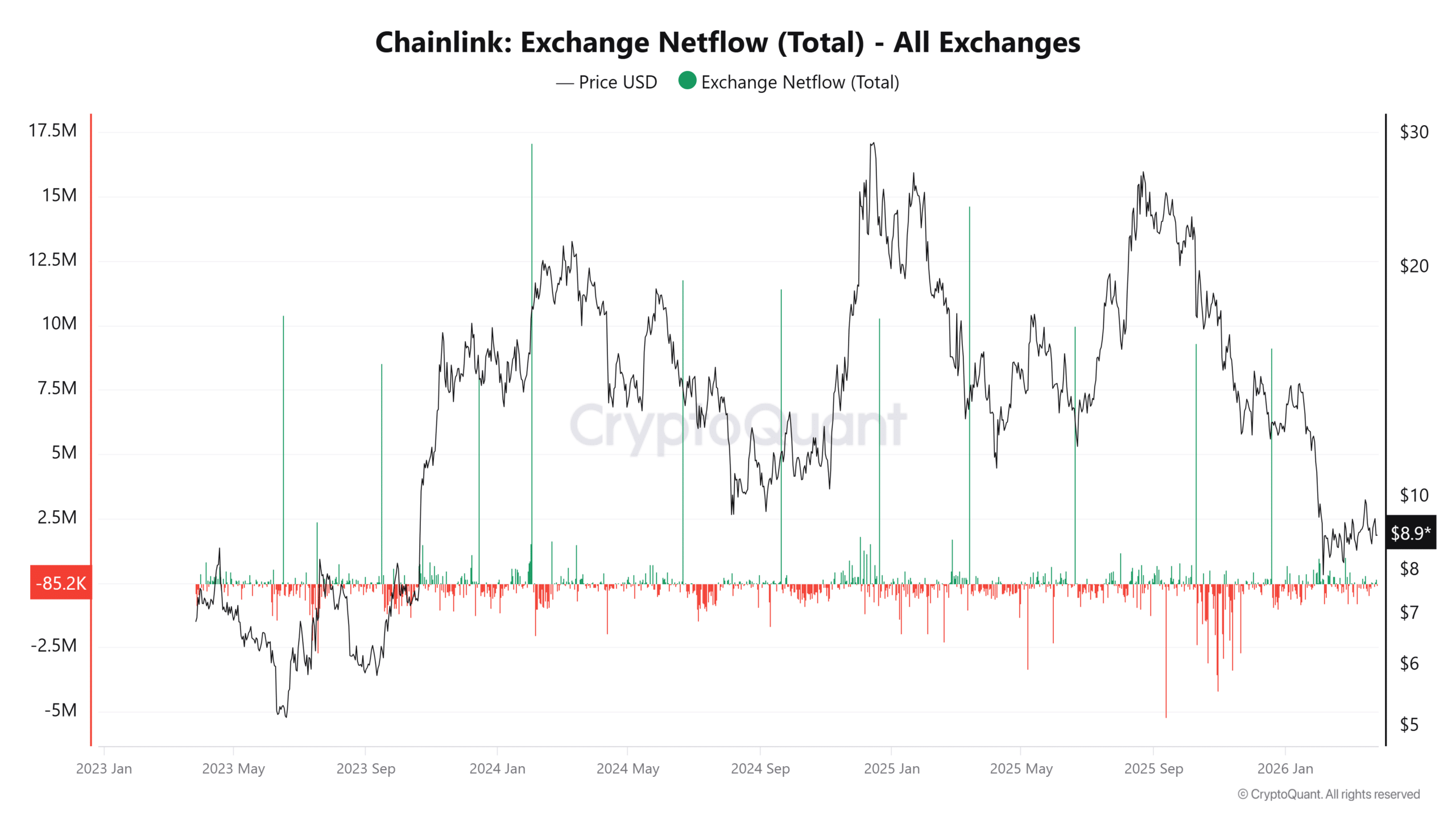
At press time, Exchange Netflows declined by 15.31%, signaling that fewer tokens are entering exchanges for potential selling. This shift reflects increasing outflows, which reduces immediate sell-side pressure across trading platforms.

As tokens move away from exchanges, available liquidity for quick distribution declines. However, price has not responded with upward expansion, which suggests that demand remains subdued. This creates a condition where supply tightens without triggering aggressive accumulation from buyers.

Still, reduced inflows limit the risk of sudden sell-offs, which may slow the pace of downside moves rather than reverse direction entirely.
Source: CryptoQuant

Chainlink long liquidations dominate as downside persists

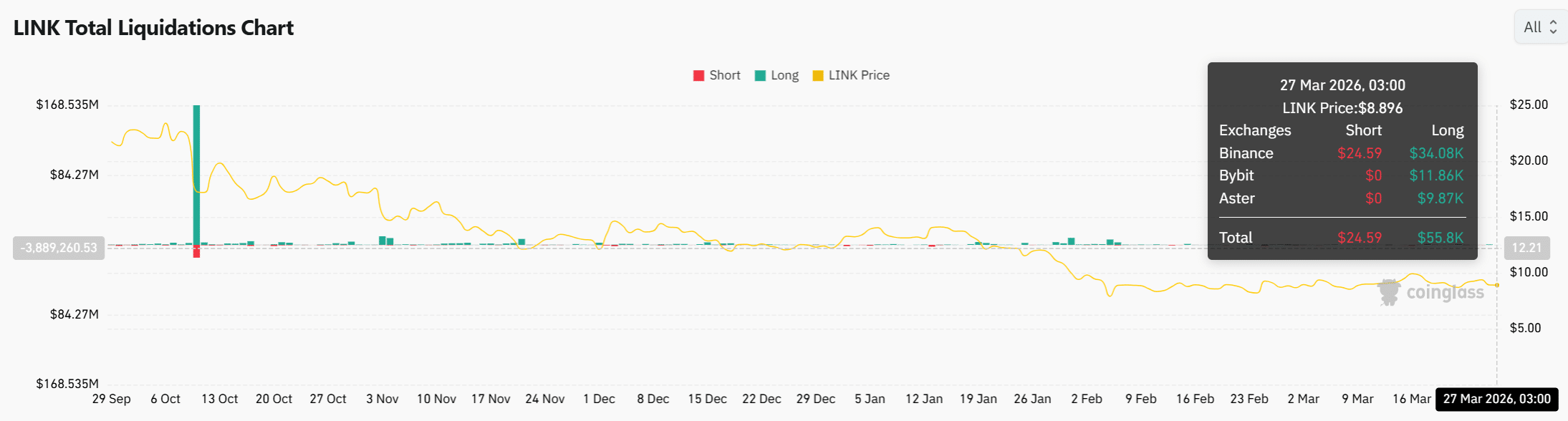
Liquidation data shows that long positions have faced greater pressure compared to shorts. Recent figures indicate $55.8K in long liquidations versus $24.59 in short liquidations. This imbalance confirms that bullish traders continue exiting positions under pressure.

As long positions get cleared, downside continuation becomes easier since fewer leveraged buyers remain to support price.

Additionally, the lack of significant short liquidations shows that sellers have not faced forced exits, which limits the chances of a short squeeze. This positioning structure reinforces the broader bearish outlook, as market dynamics continue to favor downside over recovery.
Source: CoinGlass

Chainlink’s accumulation and declining exchange supply suggest tightening fundamentals, yet price structure and derivatives positioning continue favoring downside.

As long as LINK remains below $10 and long liquidations dominate, the market leans bearish, with a potential move toward $5.77 remaining structurally supported unless buyers reclaim control.


Final Summary

  • Accumulation continues building in the background, yet price structure still reflects seller dominance and unresolved downside pressure.
  • Unless buyers reclaim control above resistance, current positioning would continue favoring downside expansion toward lower support zones.


Preguntas relacionadas

QWhy hasn't the price of LINK reacted strongly despite the increase in Chainlink's reserves and reduction in circulating supply?

AThe price has not reacted with strength because demand has not matched the tightening supply yet. The market continues absorbing supply changes without triggering upward expansion, indicating subdued buyer interest.

QWhat technical pattern is LINK currently forming, and what does it suggest about its price direction?

ALINK is forming a bearish pennant structure, which suggests a continuation of the downtrend rather than a reversal. A breakdown from this formation could expose the next downside target at $5.77.

QHow have exchange netflows changed, and what does this indicate for selling pressure?

AExchange Netflows declined by 15.31%, signaling fewer tokens entering exchanges for potential selling. This reduces immediate sell-side pressure but hasn't triggered upward price movement due to lack of demand.

QWhat does the liquidation data reveal about market positioning for LINK?

ALiquidation data shows long positions faced greater pressure with $55.8K in long liquidations versus $24.59K in short liquidations. This indicates bullish traders are exiting under pressure, favoring downside continuation.

QWhat key resistance level must buyers reclaim to shift the bearish market structure?

ABuyers need to reclaim control above the $10 resistance level to shift the bearish outlook. Until then, the market leans bearish with potential downside toward $5.77.

Lecturas Relacionadas

ETFs Are Just the Ticket: The True Institutionalization of Bitcoin Is Happening Where You Can't See It

Beyond the Bitcoin ETF spotlight, a deeper institutionalization is underway, leveraging Bitcoin as a foundational financial primitive. Institutions are using Bitcoin for purposes long reserved for assets like U.S. Treasuries and gold: as collateral for loans, insurance reserves, and the backbone of rated bonds. Examples include a Barbados-based insurer capitalizing with $40M in Bitcoin reserves and Ledn's $188M securitization of Bitcoin-backed loans, which received the first-ever investment-grade rating (BBB-) from S&P for a digital asset-backed security. This structure was stress-tested during a 27% price drop in early 2026, triggering automatic liquidations that functioned as designed but revealed the systemic risk of synchronized selling across leveraged positions. Infrastructure is evolving to support this, with platforms like Anchorage Digital's Atlas network enabling secure, institutional-grade settlement and collateral management. Strategies like basis trades and corporate treasuries (exemplified by companies like MicroStrategy issuing billions in equity and debt to fund Bitcoin acquisitions) further integrate Bitcoin into financial mechanics. While ETFs solved "how to own" Bitcoin, these developments answer "what to do with it," embedding the asset into the working machinery of finance—as collateral upon which loans, derivatives, and structured products are built. The real, enduring institutional shift is happening in these largely invisible plumbing and financing systems.

marsbitHace 6 min(s)

ETFs Are Just the Ticket: The True Institutionalization of Bitcoin Is Happening Where You Can't See It

marsbitHace 6 min(s)

ZEC Co-Founder Responds to Orchard Vulnerability: No Signs of Theft, Orchard Pool to Be Sealed

ZEC Co-Founder Addresses Orchard Vulnerability: No Signs of Theft, Plans to Sunset Orchard Pool A security vulnerability was recently discovered in Zcash's Orchard shielded pool, raising key concerns. The primary questions are whether the flaw was exploited, if user funds are safe, whether users can verify the total ZEC supply, and if other similar vulnerabilities exist. Analysis suggests the vulnerability was likely not exploited prior to its discovery. It was found proactively by a researcher using specialized tools, not due to an active breach. The development team and mining pools acted quickly to contain the issue. Typical financially-motivated attacks would likely have left visible on-chain evidence, which has not been observed. User funds in Orchard are considered safe and should be recoverable, assuming no prior exploitation. If the flaw was never used, all legitimate funds can be withdrawn. The article outlines risks associated with moving funds to transparent addresses or other pools, but concludes that leaving assets in place is a reasonable option. Currently, users cannot independently verify that the total ZEC supply hasn't been inflated due to this bug. However, the planned Ironwood network upgrade is designed to resolve this. It will permanently close the Orchard pool to new deposits and internal transfers, allowing only withdrawals. This mechanism will cap total withdrawals at the amount of legitimately deposited funds, enabling anyone to cryptographically verify the supply post-upgrade. Multiple teams, including Shielded Labs, have conducted extensive audits focused on counterfeiting vulnerabilities, assisted by advanced AI tools. No additional flaws of this type have been found so far, increasing confidence that no other similar undisclosed vulnerabilities exist. In summary, evidence indicates the Orchard bug was probably not used, user funds are secure, and no other counterfeiting flaws are currently known. The upcoming Ironwood upgrade will restore users' ability to independently verify the total ZEC supply, closing this chapter.

Foresight NewsHace 11 min(s)

ZEC Co-Founder Responds to Orchard Vulnerability: No Signs of Theft, Orchard Pool to Be Sealed

Foresight NewsHace 11 min(s)

Microsoft Announces Commercial-Grade Quantum Computer to be Completed in Three Years: Will the Boots Land?

Microsoft announces plans to build a commercially viable quantum computer by 2029, a significant acceleration from the previous industry consensus of a decade. The breakthrough is fueled by their new Majorana 2 quantum chip, which boasts a record-breaking average qubit lifetime of 20 seconds—a 1,000-fold reliability improvement over its predecessor. This leap was achieved by leveraging topological qubits, a theoretically more stable technology using Majorana zero modes, and switching the core superconducting material from aluminum to lead. Crucially, Microsoft's "Discovery" agentic AI platform accelerated the R&D process. AI agents autonomously analyzed vast experimental data, optimized manufacturing parameters (like the lead alloy composition), and solved issues like "ghost noise," dramatically speeding up experimentation. While the 20-second coherence time is a landmark, challenges remain: scaling from 12 qubits to the millions needed for practical applications, managing compilation costs, and verifying quantum results. Skeptics call for peer-reviewed data, and questions persist about whether even 20 seconds is sufficient for complex algorithms like breaking RSA encryption. The race is on with other approaches (superconducting, trapped ions), but Microsoft's confidence in its topological roadmap signals a potential shortcut to a scalable quantum future.

marsbitHace 29 min(s)

Microsoft Announces Commercial-Grade Quantum Computer to be Completed in Three Years: Will the Boots Land?

marsbitHace 29 min(s)

Trading

Spot
Futuros

Artículos destacados

Cómo comprar LINK

¡Bienvenido a HTX.com! Hemos hecho que comprar ChainLink (LINK) sea simple y conveniente. Sigue nuestra guía paso a paso para iniciar tu viaje de criptos.Paso 1: crea tu cuenta HTXUtiliza tu correo electrónico o número de teléfono para registrarte y obtener una cuenta gratuita en HTX. Experimenta un proceso de registro sin complicaciones y desbloquea todas las funciones.Obtener mi cuentaPaso 2: ve a Comprar cripto y elige tu método de pagoTarjeta de crédito/débito: usa tu Visa o Mastercard para comprar ChainLink (LINK) al instante.Saldo: utiliza fondos del saldo de tu cuenta HTX para tradear sin problemas.Terceros: hemos agregado métodos de pago populares como Google Pay y Apple Pay para mejorar la comodidad.P2P: tradear directamente con otros usuarios en HTX.Over-the-Counter (OTC): ofrecemos servicios personalizados y tipos de cambio competitivos para los traders.Paso 3: guarda tu ChainLink (LINK)Después de comprar tu ChainLink (LINK), guárdalo en tu cuenta HTX. Alternativamente, puedes enviarlo a otro lugar mediante transferencia blockchain o utilizarlo para tradear otras criptomonedas.Paso 4: tradear ChainLink (LINK)Tradear fácilmente con ChainLink (LINK) en HTX's mercado spot. Simplemente accede a tu cuenta, selecciona tu par de trading, ejecuta tus trades y monitorea en tiempo real. Ofrecemos una experiencia fácil de usar tanto para principiantes como para traders experimentados.

1.1k Vistas totalesPublicado en 2024.12.13Actualizado en 2026.06.02

Cómo comprar LINK

Discusiones

Bienvenido a la comunidad de HTX. Aquí puedes mantenerte informado sobre los últimos desarrollos de la plataforma y acceder a análisis profesionales del mercado. A continuación se presentan las opiniones de los usuarios sobre el precio de LINK (LINK).

活动图片












