CFTC Partners With SEC On ‘Project Crypto’ For Unified Regulatory Approach

bitcoinistPublicado a 2026-01-31Actualizado a 2026-01-31

Resumen

The U.S. SEC and CFTC are relaunched "Project Crypto" as a joint initiative to create a unified regulatory framework for crypto assets. The effort aims to harmonize oversight, clarify jurisdictional boundaries, eliminate redundant compliance requirements, and enhance interagency coordination. Both agencies emphasized the need for precise, innovation-friendly regulation that supports economic growth while protecting investors. Additionally, the SEC delayed its anticipated innovation exemption for crypto firms, originally expected by early 2026, citing the need for careful implementation and potential disruptions from government shutdowns. The exemption would allow crypto products to launch under principles-based conditions rather than prescriptive rules. Both chairs reaffirmed their commitment to ensuring that the U.S. remains a leader in the evolving digital asset landscape.

The Securities and Exchange Commission (SEC) and Commodity Futures Trading Commission (CFTC) have announced they are relaunching the Project Crypto initiative as a joint policy effort to prepare US markets for the digital era.

SEC-CFTC Joint Efforts For Project Crypto

On Thursday, CFTC Chairman Michael Selig revealed that the regulatory agency is partnering with the SEC on its Project Crypto initiative to bring “coordination, coherence, and a unified approach to the federal oversight of crypto asset markets.”

At a joint event on regulatory harmonization, Selig and SEC Chairman Paul Atkins outlined their plan to advance a clear crypto asset taxonomy, clarify jurisdictional lines, remove duplicative compliance requirements, and reduce regulatory fragmentation through their partnership.

The SEC-CFTC harmonization agenda will focus on the fundamentals, as the chairmen detailed, including aligned definitions, coordinated oversight, and seamless, secure data sharing between agencies. “Harmonization strengthens standards through coherence, predictability, and economic rationality.”

The agencies aim to ensure that “innovation takes root on American soil, under American law, and in service of American investors, customers, and businesses,” Selig affirmed during his opening remarks.

He added that he had directed the CFTC staff to work with the SEC to study “joint codification” of the common-sense crypto asset taxonomy recently laid by Atkins, “as an interim measure while Congress finalizes legislation.”

In a joint statement shared by the CFTC, the pro-industry chairmen explained that Project Crypto was designed to ensure that the US is ready to reinforce its global financial leadership when Congress acts:

At its core, Project Crypto and our broader harmonization efforts reflect a shared philosophy: financial regulation must be precise, not punitive. Rules must be narrowly tailored to address material risks, nimble enough to adapt to technological change and remain anchored in our agencies’ statutory authorities.

Innovation Exemption Timeline Pushed Back

During the panel, Chair Atkins discussed the timeline for the Commission’s long-awaited innovation exemption for the crypto industry, which was initially expected to come before the end of January.

As reported by Bitcoinist, the SEC chair said in December that the regulatory agency could issue innovation exemption rules for crypto firms in early 2026. Notably, the Commission has been studying a rule exemption since July 2025.

The measure would allow crypto firms to quickly launch products by complying with “certain principles-based conditions designed to achieve the core policy aims of the federal securities laws” instead of “burdensome prescriptive regulatory requirements that hinder productive economic activity.”

Atkins affirmed that the agency is still working on the innovation exemption, arguing that they “need to measure twice and cut once.” As he outlined, the agency wants to deliver a rule change that is “fit for purpose that will allow enough people to be able to develop their products, you know, within a predictable ambit of maneuver and then with an end date, an off-ramp, that sort of thing.”

In addition, he noted that last year’s government shutdown delayed progress on crypto regulation, adding that the potential new shutdown could further delay the highly anticipated measure.

Atkins denied that the SEC is waiting on the market structure bill to put out the innovation exemption, arguing that it is within the agency’s authority. However, he emphasized that they are taking the upcoming regulation into account because “there are a lot of moving parts to the situation.”

“I just want to make sure that we keep the train going forward at full speed and for all parties’ sake,” he asserted, but did not offer a new potential timeline for the innovation exemption rollout.

Meanwhile, Chair Selig also shared his plan to explore “ways in which the agency can encourage innovation in software development and support builders as they work toward product market fit.” This includes assessing whether an innovation exemption “may be appropriate in certain circumstances.”
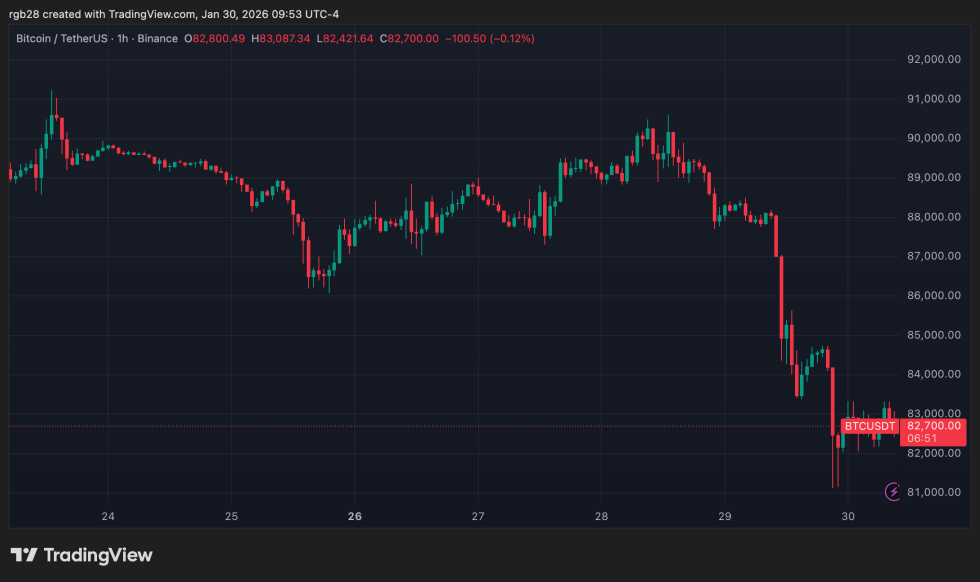
Bitcoin (BTC) trades at $82,700 in the one-week chart. Source: BTCUSDT on TradingView


Preguntas relacionadas

QWhat is the main purpose of the relaunched 'Project Crypto' initiative announced by the SEC and CFTC?

AThe main purpose is to bring coordination, coherence, and a unified approach to the federal oversight of crypto asset markets, preparing US markets for the digital era.

QWhat are the key focus areas of the SEC-CFTC harmonization agenda as detailed by the chairmen?

AThe key focus areas include advancing a clear crypto asset taxonomy, clarifying jurisdictional lines, removing duplicative compliance requirements, reducing regulatory fragmentation, and ensuring aligned definitions, coordinated oversight, and secure data sharing.

QWhat did CFTC Chairman Michael Selig direct his staff to study in collaboration with the SEC?

AHe directed CFTC staff to work with the SEC to study 'joint codification' of the common-sense crypto asset taxonomy recently laid out by SEC Chairman Atkins, as an interim measure while Congress finalizes legislation.

QWhat is the initial expected timeline for the SEC's innovation exemption for crypto firms, and what was the reason for the delay mentioned?

AThe innovation exemption was initially expected by the end of January but is now anticipated in early 2026. The delay was attributed to the need for careful development ('measure twice and cut once') and was further impacted by last year's government shutdown.

QAccording to the chairmen's joint statement, what is the core philosophy behind Project Crypto and their broader harmonization efforts?

AThe core philosophy is that financial regulation must be precise, not punitive, with rules narrowly tailored to address material risks, nimble enough to adapt to technological change, and anchored in the agencies' statutory authorities.

Lecturas Relacionadas

In Jinjiang, Fujian, a Storage Super Unicorn Lies Quiet

In Fujian's Jinjiang, a city known for sportswear, lies a quiet semiconductor giant: Fujian Jinhua Integrated Circuit Co. (JHICC). Once a promising domestic DRAM manufacturer alongside Yangtze Memory and ChangXin Memory Technologies (CXMT), its journey was derailed in 2018 when the U.S. placed it on an Entity List and filed criminal charges for alleged trade secret theft. This halted production for years. A turning point came in February 2024 when a U.S. federal court found JHICC not guilty. However, it had lost crucial time. While CXMT soared to become a top-valued A-share company in 2024, JHICC, with an estimated valuation of 80 billion RMB, was just restarting. Its current output is primarily customized DDR4 chips, not the advanced DDR5/HBM demanded for AI, but it still benefits from the broader memory chip upcycle. JHICC's story is tied to Chen Zhengkun, a veteran engineer who left Micron to lead the venture. Founded in 2016 with state-backed funding, JHICC partnered with Taiwan's UMC to develop DRAM technology. Rapid progress was cut short by the U.S. actions, which Micron initiated, partly due to its heavy reliance on the Chinese market. Post-sanctions, Chen's team worked to rebuild the production line with reduced reliance on U.S. technology. According to its records, JHICC achieved small-scale production and revenue growth under immense pressure. It now focuses on the stable "niche" DRAM market (e.g., TVs, routers) with a monthly capacity of ~40,000 wafers, aiming for 60,000 by 2026. It holds over 1,000 patents but remains on the Entity List. For Jinjiang, investing in JHICC was a bold industrial leap. The local government provided unwavering financial and logistical support during the crisis, helping the company survive. JHICC has become the anchor for a growing local semiconductor cluster. Though its scale lags behind domestic peers, JHICC's persistence symbolizes a hard-won foothold in a global market long dominated by Samsung, SK Hynix, and Micron. Having missed one boom, it seeks a place in the new AI-driven memory supercycle.

marsbitHace 3 min(s)

In Jinjiang, Fujian, a Storage Super Unicorn Lies Quiet

marsbitHace 3 min(s)

Must-Watch Events Next Week|CLARITY Act Could Face Senate Vote; SpaceX, Circle to Report Earnings (8.3-8.9)

**Summary: Key Events and Developments to Watch (August 3-9)** The upcoming week is marked by significant financial disclosures, key legislative deadlines, and notable product updates. **Major Financial Events:** Several companies are scheduled to release their Q2 2026 earnings. American Bitcoin (ABTC) will report on August 3, followed by SpaceX and Hut 8 Mining Corp. on August 4, and Circle on August 5. Notably, a significant portion of SpaceX shares (up to 12% of total shares) will be unlocked on August 6 following their earnings release. **Key Legislative Deadline:** The U.S. Senate faces an August 7 deadline to secure 60 votes for the CLARITY Act, a bipartisan bill aiming to establish a federal regulatory framework for cryptocurrencies. The Senate may hold a full vote on the bill during the week. **Economic Data:** The U.S. July Non-Farm Payrolls report will be released on August 7, providing crucial labor market data. **Technology & Product Updates:** * **Shutdowns:** DeFi portfolio tracker Zapper and wallet app Ctrl Wallet will cease operations on August 3. * **Upgrades:** LayerZero will deprecate its v1 relayers on August 3. XRP Ledger's new version 3.3.0, featuring five new functions, is expected next week. * **AI:** Elon Musk announced that the advanced Grok 4.6 AI model is set for release around August 7. * **Bitcoin:** The BIP-110 forced signaling for a potential Bitcoin network change is scheduled to begin around August 8. **Other Notable Events:** Chinese robotics firm Unitree Tech has set its preliminary price inquiry for its IPO for August 5. South Korean exchange Upbit will delist AQT and AERGO tokens on August 3.

marsbitHace 2 hora(s)

Must-Watch Events Next Week|CLARITY Act Could Face Senate Vote; SpaceX, Circle to Report Earnings (8.3-8.9)

marsbitHace 2 hora(s)

Trading

Spot
活动图片




