Cardano Isn’t ‘Fading,’ Hoskinson Says: ‘I’ve Lost Over $3B’ And Still Building

bitcoinistPublicado a 2026-02-06Actualizado a 2026-02-06

Resumen

Charles Hoskinson, during a livestream from Tokyo, refuted claims that Cardano is "fading" or "dead," emphasizing that the project is transitioning into a phase of commercialization after years of infrastructure development. Despite the bear market, he highlighted that key building blocks like decentralization and governance are complete, and efforts are now focused on developing real-world use cases such as Hydra for scaling and the privacy-focused sidechain Midnight. Hoskinson argued that global economic shifts and institutional mistrust make blockchain-based systems essential for a neutral global settlement layer. Addressing critics who attribute his optimism to wealth, he revealed he has lost over $3 billion but remains committed to Cardano, stating he is "here for life" regardless of financial outcomes. At the time of reporting, ADA was trading at $0.2521.

Charles Hoskinson used a Feb. 6 livestream from Tokyo to push back on a familiar narrative he says he’s hearing on the ground in Japan: that Cardano is “fading” or “dead,” and that the bear market has drained the ecosystem’s momentum.

Speaking midway through a multi-city tour tied to Cardano’s third cohort of ambassadors, Hoskinson said long-time community members and newcomers alike have been approaching him with relief that the project is still active. He framed the trip as a signal that Cardano, after years of protocol work, is shifting into what he called a commercialization phase, building products that feel less like infrastructure demos and more like mainstream use cases.

Hoskinson Rallies Cardano Through The Downturn

“We’ve been on tour all throughout Japan,” Hoskinson said, describing meetings with “a lot of investors, a lot of developers,” including people who have followed Cardano “for more than 10 years.” The message he said he’s delivering is that major building blocks are in place: “The infrastructure is strong. We’re fully decentralized. Governance has been done. So now it’s the time to go build some fun, exciting, real use cases and get them into the ecosystem.”

Hoskinson name-checked Hydra, Cardano’s scaling effort, and pointed to projects he characterized as the “vanguard” of the next phase, including Midnight — the privacy-focused sidechain he has promoted as a cornerstone of Cardano’s broader roadmap. He also referenced “Starstream,” a WASM-based zero-knowledge virtual machine (zkVM) designed for the Cardano blockchain to enable private, scalable smart contracts.

The backdrop, he acknowledged, is a market environment that “is red, red, red,” with sentiment weak enough that some attendees told him they had assumed Cardano’s best days were behind it. Hoskinson’s response was less a price defense than a thesis about why crypto persists through cycles and why he believes the longer-term direction of global finance makes open networks unavoidable.

“Globalism has finally reached its peak, accelerated by AI and accelerated by demographic changes,” he said. “The human race is starting to think in terms of we instead of nation by nation... And the old guard and the old way of doing things is fading. And they’re kicking and screaming as they’re being dragged off the stage.”

He argued that a more integrated global economy ultimately needs a neutral settlement layer: an “economic franca,” in his words and that blockchain-based systems are the practical option. “The only way to run a world like this is through cryptocurrency. Full stop,” Hoskinson said. “Otherwise, you have to build an empire and no one’s strong enough to conquer the world right now... We need an economic franca. And you tell me how we’re going to do that without a blockchain.”

The livestream veered into broader institutional mistrust, with Hoskinson citing political instability, corruption, and high-profile scandals as evidence that “deep down inside, we all know this can’t last.” He cast crypto as a mechanism to constrain human behavior through “rules” and “regulating functions,” rather than relying on institutional goodwill.

But the most pointed moment came when he anticipated a common critique that his optimism is easy because he’s wealthy and responded with a personal financial claim and a commitment to keep building regardless of market outcomes:

“Every now and then you hear something like this, you say, ‘Yes, but it’s easy for you to say, Charles, you’re rich. You can ride it out.’ I’ve lost more money than anyone listening to this. Over $3 billion now. It would have been real easy to cash out. Just walk away. And do you think I honestly care if I lose it all? Do you think I’m doing this for money? You’re pretty mistaken if you do.”

Hoskinson also portrayed his distance from past industry blowups as a matter of personal discipline rather than luck. “There’s a reason I didn’t get rolled up in FTX,” he said, adding that his “default answer is no” when it comes to the kinds of deals that later become liabilities.

In closing, Hoskinson urged builders and community members to treat the drawdown as an endurance test rather than a verdict, tying Cardano’s ambassador programs, including a call to become a Midnight ambassador and engage via Intersect.

His core message was simple: the market may get “more red” but he isn’t leaving. “I’m here for life,” Hoskinson said. “As long as I’m alive, I’m just going to keep going.”

At press time, ADA traded at $0.2521.
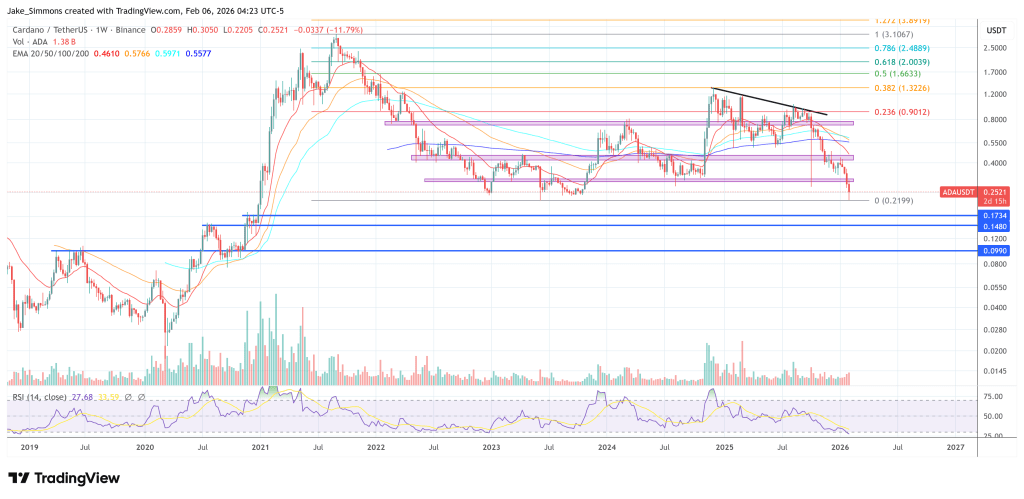
ADA fell to the June 2023 low again, 1-week chart | Source: ADAUSDT on TradingView.com

Criptos en tendencia

Preguntas relacionadas

QWhat is the main narrative that Charles Hoskinson is pushing back against during his livestream from Tokyo?

AHoskinson is pushing back against the narrative that Cardano is 'fading' or 'dead,' and that the bear market has drained the ecosystem's momentum.

QAccording to Hoskinson, what phase is Cardano now entering after years of protocol work?

AHoskinson stated that Cardano is shifting into a 'commercialization phase,' building products that feel more like mainstream use cases rather than infrastructure demos.

QWhat was Hoskinson's personal financial claim to counter the critique that his optimism is due to his wealth?

AHoskinson claimed that he has lost over $3 billion and stated that he is not doing this for money, emphasizing that he would continue building even if he lost it all.

QWhat did Hoskinson argue is the only practical way to run a more integrated global economy?

AHoskinson argued that the only way to run a more integrated global economy is through cryptocurrency, which he called an 'economic franca,' as a neutral settlement layer.

QWhat two specific Cardano projects did Hoskinson name-check as part of the 'vanguard' of its next phase?

AHoskinson name-checked Hydra, Cardano's scaling effort, and Midnight, a privacy-focused sidechain.

Lecturas Relacionadas

Misjudged A-Shares: Resilience, Expectations, and Confidence

China's A-share market recently faced selling pressure, especially in tech sectors, initially triggered by a global tech sell-off that began in South Korea. However, the article argues this is a case of "mistaken injury" and highlights the market's underlying resilience. This resilience stems from three main pillars: **1) Tech Sector Fundamentals:** Unlike Korea's market dominated by a few memory chip stocks, China's tech sector is diversified across computing, communications, electronics, and semiconductors, supported by dual narratives of global AI supply chains and domestic substitution. Core areas like optical modules and fiber optics continue to show strong earnings growth. **2) "National Team" Support:** State-backed institutions and large corporations have made significant market purchases and announced buybacks, providing liquidity and signaling confidence. This is seen as a stabilizing policy signal, often associated with market bottoms. **3) Broader Market Pillars:** Other major sectors are showing endogenous recovery momentum. Consumer stocks benefit from stabilizing CPI and signs of sector recovery (e.g., liquor price hikes). Cyclical sectors like aluminum have high earnings, potential price increases due to tight supply, and low valuations. The financial sector offers stable dividends and low valuations. The conclusion is that the sell-off was driven by external contagion, not a collapse in fundamentals. With strong policy support and recovering momentum across key sectors, the A-share market possesses the toughness to regain stability.

marsbitHace 26 min(s)

Misjudged A-Shares: Resilience, Expectations, and Confidence

marsbitHace 26 min(s)

The Clarity Act's Journey Through Congress: The Thorny Path of Bipartisan Compromise in the U.S.

The U.S. Congress is struggling to advance the crypto market structure bill known as the Clarity Act, with bipartisan compromise proving difficult. Key hurdles include unresolved disputes over "yield" products and, more critically, the inclusion of strong ethics provisions for elected officials—a non-negotiable demand for many Democrats. While a compromise on yield was reached in May, securing only limited Democratic support in committee, the separate Senate Agriculture Committee version later passed with no Democratic votes due to the ethics impasse. As Republicans push for a full Senate vote in July, demands for ethics rules have expanded, and other contentious issues like developer protections and concerns from law enforcement and large banks further complicate negotiations. Despite consensus on the need for legislation, the path forward is unclear. Recent discussions between senators and White House officials aim to find acceptable ethics language. Some lawmakers question whether a compromise text can garner enough bipartisan support, with one Democrat stating the current proposal lacks the strong ethics provisions required for their vote. Potential short-term goals for the crypto community include symbolic Senate action before the August recess, a longer-term aim for passage by 2026, or establishing a detailed framework that addresses ethics and other compromises. The process remains arduous, relying on the traditional, vote-by-vote effort to build bipartisan support.

marsbitHace 46 min(s)

The Clarity Act's Journey Through Congress: The Thorny Path of Bipartisan Compromise in the U.S.

marsbitHace 46 min(s)

Are Kalshi and Polymarket Founders at Odds? This Business Rivalry Is More Brutal Than You Think

"The Rivalry Between Kalshi and Polymarket Founders Turns Bitter and Litigious" The intense feud between Tarek Mansour, CEO of Kalshi, and Shayne Coplan, founder of Polymarket, has escalated far beyond typical business competition into personal animosity and regulatory battles. Both lead billion-dollar prediction market platforms, but their approaches differ sharply. Kalshi positions itself as the compliant operator, securing U.S. regulatory approval before launching. In contrast, Polymarket initially operated offshore, allowing U.S. users to access its platform via VPN, which drew regulatory scrutiny. The conflict reached a peak in November 2024 when FBI agents raided Coplan's New York apartment. While Coplan publicly blamed political motives, his team privately suspected Kalshi was involved. According to sources, Kalshi's lawyers had previously reported Polymarket's operations to federal prosecutors, highlighting its accessibility to U.S. users despite a ban. This incident fueled mutual accusations and underhanded tactics, including social media smear campaigns and attempts to sabotage each other's major business deals. Their rivalry also played out in Washington, influencing regulatory debates. Kalshi actively lobbied against Polymarket's practices, framing them as illegal and unethical. Polymarket, after facing a CFTC fine and investigation, later acquired a licensed U.S. firm to launch a domestic app, regaining a foothold. Despite the hostility, both companies have seen massive growth, with combined trading volumes soaring. However, increased regulatory scrutiny, particularly around insider trading on Polymarket's platform, continues to pose challenges. The founders' deep-seated mutual disdain ensures their battle for market dominance remains as much a personal vendetta as a commercial one.

marsbitHace 55 min(s)

Are Kalshi and Polymarket Founders at Odds? This Business Rivalry Is More Brutal Than You Think

marsbitHace 55 min(s)

Trading

Spot

Artículos destacados

Cómo comprar T

¡Bienvenido a HTX.com! Hemos hecho que comprar Threshold Network Token (T) sea simple y conveniente. Sigue nuestra guía paso a paso para iniciar tu viaje de criptos.Paso 1: crea tu cuenta HTXUtiliza tu correo electrónico o número de teléfono para registrarte y obtener una cuenta gratuita en HTX. Experimenta un proceso de registro sin complicaciones y desbloquea todas las funciones.Obtener mi cuentaPaso 2: ve a Comprar cripto y elige tu método de pagoTarjeta de crédito/débito: usa tu Visa o Mastercard para comprar Threshold Network Token (T) al instante.Saldo: utiliza fondos del saldo de tu cuenta HTX para tradear sin problemas.Terceros: hemos agregado métodos de pago populares como Google Pay y Apple Pay para mejorar la comodidad.P2P: tradear directamente con otros usuarios en HTX.Over-the-Counter (OTC): ofrecemos servicios personalizados y tipos de cambio competitivos para los traders.Paso 3: guarda tu Threshold Network Token (T)Después de comprar tu Threshold Network Token (T), guárdalo en tu cuenta HTX. Alternativamente, puedes enviarlo a otro lugar mediante transferencia blockchain o utilizarlo para tradear otras criptomonedas.Paso 4: tradear Threshold Network Token (T)Tradear fácilmente con Threshold Network Token (T) en HTX's mercado spot. Simplemente accede a tu cuenta, selecciona tu par de trading, ejecuta tus trades y monitorea en tiempo real. Ofrecemos una experiencia fácil de usar tanto para principiantes como para traders experimentados.

650 Vistas totalesPublicado en 2024.12.10Actualizado en 2026.06.02

Cómo comprar T

Discusiones

Bienvenido a la comunidad de HTX. Aquí puedes mantenerte informado sobre los últimos desarrollos de la plataforma y acceder a análisis profesionales del mercado. A continuación se presentan las opiniones de los usuarios sobre el precio de T (T).

活动图片













