Cardano Is Already Running Behind 200 German Companies, Foundation CEO Says

bitcoinistPublicado a 2026-04-17Actualizado a 2026-04-17

Resumen

Cardano Foundation CEO Frederik Gregaard revealed that approximately 200 large German companies are already using Cardano’s blockchain infrastructure—without being aware of it—through agentic AI deployments. These firms leverage Cardano as a security, digital identity, and accountability layer, particularly for verifying AI agents and ensuring data privacy without disclosure. Gregaard emphasized blockchain’s evolving role as a foundational trust layer for AI systems rather than just a payment rail. He noted that regulated stablecoins like USDM are used for microtransactions between AI agents, aligning incentives and enhancing security. He also highlighted Cardano’s regulatory positioning as a commodity, its quantum security features, and potential growth under emerging US and EU legislation. At the time of reporting, ADA was trading at $0.2566.

Cardano is already being used by roughly 200 large companies in Germany through agentic AI deployments, even if those firms do not realize the blockchain is sitting underneath their stack, according to Cardano Foundation CEO Frederik Gregaard. The claim, made during an interview with Jane King on GBBC’s Markets on Chain series from the New York Stock Exchange published April 16, points to a version of blockchain adoption that is less visible to end users but potentially more embedded in enterprise infrastructure.

200 German Companies Use Cardano Without Even Knowing It

Gregaard framed the Cardano Foundation’s role as pushing blockchain into systems people use without necessarily recognizing it. “We have about 200 companies in Germany who live on agentic AI, fairly large companies, and they don’t even know they’re using Cardano as a security layer, as a digital identity layer and as an accountability layer,” he said. “Part of when you have, for instance, agentic AI who’s using data from two different databases, [is] ensuring that the agentic AI is who they say they are, that they have the data they claim without disclosing it, because we want privacy.”

That argument was central to Gregaard’s broader pitch: blockchain, in his view, is becoming an underlying trust and coordination layer for AI-driven systems rather than simply a rails story for tokens or payments. He described a model where users could interact with seamless consumer applications while Cardano handles provenance, identity and compliance in the background. The point was less about visible crypto branding than about infrastructure-level deployment.

Payments still featured prominently. Gregaard said AI agents in some of these systems are already transacting using a regulated stablecoin called USDM, with microtransactions used to meter prompt activity and align incentives between participants. “The AIs are actually paying themselves using regulatory compliant stablecoins,” he said. “There’s a microtransaction happening just to do the prompts. And that’s also part of the security layer, which ensures that one database who has more computing power than the other doesn’t do unlimited prompts and can circumvent the security.”

Why Cardano Could Strive In The EU And US

The interview also tied that enterprise and AI narrative to policy. Gregaard said the US stablecoin framework under the GENIUS Act had moved the market closer to Europe’s MiCA regime, but argued the more consequential shift could come from the Clarity Act. He said he expects that legislation, if passed, to unlock materially broader blockchain usage beyond financial applications, adding that “hundreds of companies” are already waiting on that kind of legal certainty. He further claimed that recent regulatory language had made clear that “Cardano is a commodity,” and suggested the US could move faster than Europe on this front.

Alongside adoption, Gregaard leaned heavily on security. He said Cardano’s on-chain governance model and distributed validator base make it harder to compromise through a single point of failure, a contrast with networks he described as effectively controlled by a small number of insiders. He also argued that Cardano is emerging as a “first level quantum secure environment” through its interoperability with legal entity identity standards, which he said is drawing interest from banks, brokers, exchanges and central securities depositories.

At press time, Cardano traded at $0.2566.
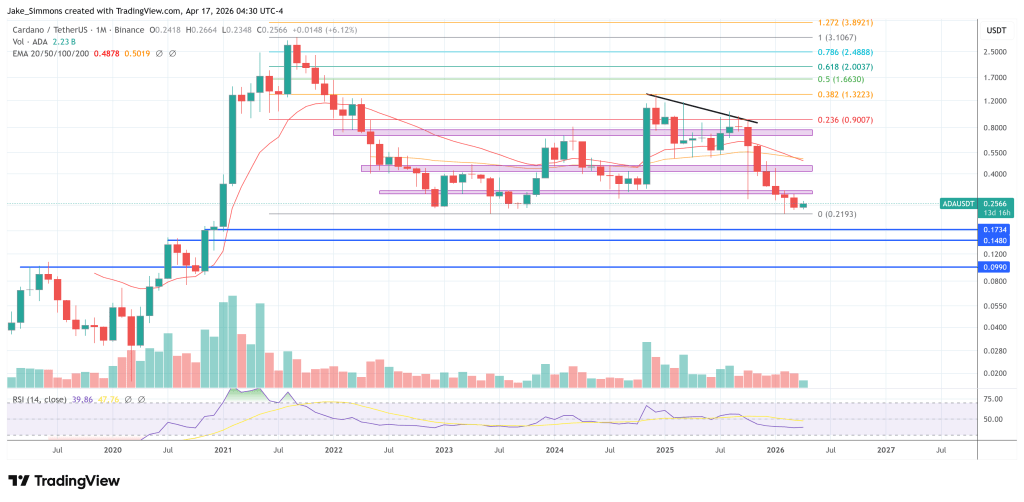
ADA hovers below key resistance, 1-monthly chart | Source: ADAUSDT on TradingView.com

Preguntas relacionadas

QAccording to the Cardano Foundation CEO, how many large companies in Germany are using Cardano without realizing it, and for what purposes?

AAccording to Cardano Foundation CEO Frederik Gregaard, roughly 200 large companies in Germany are using Cardano as a security layer, a digital identity layer, and an accountability layer in their agentic AI deployments, without even knowing the blockchain is underneath their stack.

QWhat specific type of digital currency are the AI agents using for microtransactions in these systems, and what is its purpose?

AThe AI agents are using a regulated stablecoin called USDM for microtransactions. These microtransactions are used to meter prompt activity and align incentives between participants, and they form part of the security layer to prevent abuse.

QWhat US legislation does Gregaard suggest could unlock significantly broader blockchain usage beyond financial applications?

AGregaard suggests that the Clarity Act, if passed, could unlock materially broader blockchain usage beyond financial applications. He claims that 'hundreds of companies' are waiting for this kind of legal certainty.

QHow does Gregaard contrast Cardano's security model with that of other networks?

AGregaard contrasts Cardano's security by highlighting its on-chain governance model and distributed validator base, which make it harder to compromise through a single point of failure. He contrasts this with networks he describes as effectively controlled by a small number of insiders.

QWhat two key regulatory frameworks does the article mention in the context of stablecoins, and which region does Gregaard suggest might move faster on classifying assets like Cardano?

AThe article mentions the US stablecoin framework under the GENIUS Act and Europe's MiCA regime. Gregaard suggests that the US could move faster than Europe on providing regulatory clarity, recently stating that regulatory language has made clear that 'Cardano is a commodity.'

Lecturas Relacionadas

STRC Breaks Below $95: Why Does It Continue to Depeg? Is There Default Risk?

"STRC Falls Below $95: Why the Persistent Depegging and Is There Default Risk?" The article discusses the recent decline in the price of STRC, a perpetual preferred stock issued by Strategy (MSTR) designed to trade around a $100 par value. As of publication, STRC traded at $94.65, raising market concerns. STRC is described as a high-yield cash flow product, offering an 11.50% annual dividend paid monthly. Its "preferred" status grants it priority over common stock for dividends and in liquidation. Key reasons cited for the price depegging include: 1. **Bitcoin's Price Drop:** MSTR's assets are heavily tied to Bitcoin (BTC), which fell over 21% from its recent high, pressuring all Strategy-related products. 2. **Competitive Pressure:** Rival Strive Asset Management's similar product, SATA, offers daily dividends and has maintained its $100 par value with a ~13% yield. In response, Strategy has proposed changing STRC's dividend frequency from monthly to bi-weekly, pending shareholder vote. 3. **Technical Selling:** A break below $100 may have triggered algorithmic selling and stop-losses, exacerbating the decline. Regarding default risk, the analysis suggests it is currently low. Strategy founder Michael Saylor confirmed the June 2026 dividend rate remains at 11.50% with no cuts or suspensions. The company's massive reserve of 843,706 BTC provides a significant backstop for its obligations. Industry opinions are mixed. Some analysts view the BTC holdings as reliable support for dividends, while critics like Peter Schiff warn of potential dividend cuts leading to price crashes and lawsuits. Others highlight inflation risk and the company's ability to reduce dividends without a formal default. In summary, STRC's drop is attributed to BTC volatility, competition, and technical factors. While immediate default risk appears contained, the product faces challenges from market conditions and competitive dynamics.

marsbitHace 1 hora(s)

STRC Breaks Below $95: Why Does It Continue to Depeg? Is There Default Risk?

marsbitHace 1 hora(s)

AI Trading Cools, South Korean Stocks Plunge 1.8%, Spot Gold Rises 1%, Bitcoin Dives

A sell-off in AI-related stocks, triggered by Broadcom's disappointing earnings forecast, sent shockwaves through global markets. South Korea's KOSPI led Asia's decline, plunging 1.8% as the risks from concentrated chip stock gains and surging leveraged investments came to the fore. The tech-heavy Nasdaq 100 futures fell 0.5% following Broadcom's 14% after-hours plunge, which signaled a slower-than-expected transition to AI clients. This pullback extended Wall Street's weakness, halting the S&P 500's nine-day rally amid hawkish Fed signals and renewed Middle East tensions. South Korean authorities convened an emergency meeting, pledging "immediate measures" against market volatility and warning of record-high stock margin debt. The adjustment rippled across assets: Bitcoin fell to around $64,000, its lowest since February, while safe-haven gold rose 1% on bargain hunting. Oil prices dipped on Middle East ceasefire news. Market analysts noted the sell-off was driven by profit-taking after massive gains, particularly in chip stocks like Samsung and SK Hynix, which now dominate the KOSPI. Wall Street banks are divided on Korea's outlook, with Goldman Sachs raising its target while Citigroup and others warn of overvaluation and a potential bubble. Bridgewater's Ray Dalio noted that great technological shifts often create bubbles. Meanwhile, Fed officials' hints at potential future rate hikes added to the cautious mood ahead of key U.S. jobs data.

华尔街日报Hace 2 hora(s)

AI Trading Cools, South Korean Stocks Plunge 1.8%, Spot Gold Rises 1%, Bitcoin Dives

华尔街日报Hace 2 hora(s)

Trading

Spot
Futuros

Artículos destacados

Cómo comprar ADA

¡Bienvenido a HTX.com! Hemos hecho que comprar Cardano (ADA) sea simple y conveniente. Sigue nuestra guía paso a paso para iniciar tu viaje de criptos.Paso 1: crea tu cuenta HTXUtiliza tu correo electrónico o número de teléfono para registrarte y obtener una cuenta gratuita en HTX. Experimenta un proceso de registro sin complicaciones y desbloquea todas las funciones.Obtener mi cuentaPaso 2: ve a Comprar cripto y elige tu método de pagoTarjeta de crédito/débito: usa tu Visa o Mastercard para comprar Cardano (ADA) al instante.Saldo: utiliza fondos del saldo de tu cuenta HTX para tradear sin problemas.Terceros: hemos agregado métodos de pago populares como Google Pay y Apple Pay para mejorar la comodidad.P2P: tradear directamente con otros usuarios en HTX.Over-the-Counter (OTC): ofrecemos servicios personalizados y tipos de cambio competitivos para los traders.Paso 3: guarda tu Cardano (ADA)Después de comprar tu Cardano (ADA), guárdalo en tu cuenta HTX. Alternativamente, puedes enviarlo a otro lugar mediante transferencia blockchain o utilizarlo para tradear otras criptomonedas.Paso 4: tradear Cardano (ADA)Tradear fácilmente con Cardano (ADA) en HTX's mercado spot. Simplemente accede a tu cuenta, selecciona tu par de trading, ejecuta tus trades y monitorea en tiempo real. Ofrecemos una experiencia fácil de usar tanto para principiantes como para traders experimentados.

1.5k Vistas totalesPublicado en 2024.12.10Actualizado en 2026.06.02

Cómo comprar ADA

Discusiones

Bienvenido a la comunidad de HTX. Aquí puedes mantenerte informado sobre los últimos desarrollos de la plataforma y acceder a análisis profesionales del mercado. A continuación se presentan las opiniones de los usuarios sobre el precio de ADA (ADA).

活动图片









