Cardano Hard Fork Expected Next Month, Leios Still ‘This Year’: Hoskinson

bitcoinistPublicado a 2026-02-20Actualizado a 2026-02-20

Resumen

In a February 19 livestream, Charles Hoskinson announced that the Cardano blockchain is expected to undergo a hard fork "next month," while the Leios scalability solution remains on track for release "this year." He highlighted several key developments, including the upcoming launch of the Midnight network, a LayerZero integration connecting Cardano to over 80 blockchains, and the introduction of USDCx—a stablecoin-like asset emphasizing privacy and non-freezability. Hoskinson also discussed ongoing ecosystem growth, such as Plutus upgrades, Aiken development, and the integration of Pyth as a tier-one oracle. Additionally, he expressed concerns about the industry's shift toward permissioned networks controlled by financial institutions, warning against centralized control over user assets. At the time of reporting, ADA was trading at $0.2748.

Charles Hoskinson said Cardano is tracking toward a hard fork “next month,” while the long-discussed Leios scalability work remains on schedule for “this year,” in a Feb. 19 livestream recorded after a trip through Japan and a stop at Consensus in Hong Kong.

Hoskinson framed the next few weeks as a convergence point for two parallel roadmaps: Cardano’s protocol and developer-stack upgrades on one side, and the Midnight network launch he expects “coming next month” on the other, an effort he described as unusually difficult to execute even for teams with prior experience shipping major chains.

Cardano Momentum: Midnight, LayerZero And USDCx

In the livestream, Hoskinson spent his opening stretch recapping what he characterized as a productive Consensus week, pointing to “a lot of great announcements” and relationships around the Midnight ecosystem, including infrastructure and distribution names he said were involved with the network. He argued that the ability to launch a large, exchange-listed project like Midnight is itself a signal about Cardano’s maturity as a platform for “tier one” efforts.

On the Cardano side, he highlighted a newly announced LayerZero integration that he said connects Cardano “to more than 80 blockchains,” positioning it as a step away from the perception that the network operates in isolation. In the same segment, Hoskinson pointed to USDCx as a stablecoin-like asset he said is designed for “these non-EVM systems,” and emphasized the user-experience work around exchange flows—“autoconvert,” as he described it, so users can move value “straight to the exchange, straight back from the exchange.”

He also drew a distinction between USDCx and “basically USDC,” saying the tradeoff for Cardano users is an asset that, in his telling, preserves “privacy” and “can’t be frozen.” Hoskinson positioned that as “the best compromise” available for a “tier one stablecoin of that nature” in the Cardano ecosystem, while arguing that the LayerZero integration could open the door to “eight major stablecoins” over time, depending on integration sequencing.

Hard Fork ‘Next Month,’ Leios ‘This Year’

The most concrete near-term timing signal came when Hoskinson addressed the protocol schedule directly, saying: “Cardano hard fork is happening I believe next month. But you know the community is kind of working its way through that and getting these things done.”

In the same breath, he reiterated that Leios, Cardano’s scalability initiative, remains on track, noting recent travel and discussions with product manager Michael Smolenski about progress. “All things considered we’re pretty happy with the rate of progress of Cardano,” Hoskinson said, while also pointing to a new Plutus version, continued development of Aiken, and “node diversity coming this year,” alongside Leios.

Hoskinson also flagged developer activity he expects in March, referencing a “Dev Builder Fest down in Argentina” and describing the “integration of Pyth” into the ecosystem, which he presented as the arrival of a “tier one Oracle” for Cardano.

Beyond shipping timelines, Hoskinson used the livestream to argue that the industry’s central fight is shifting from enforcement actions to culture and narrative, particularly around non-custodial wallets and permissionless settlement. He warned about what he called “factions” that want crypto transactions routed through “permission federated networks owned and operated by large financial institutions,” and singled out US policy debates as part of that backdrop.

“What’s not okay is to build a network that’s forever owned and operated by five or 10 or 20 banks and they basically lord and leverage that power and position over the users,” he said. “And once they have absolute control, they just simply flip a switch and you’re at their mercy and they own all your money. And unfortunately, the system is moving in that direction right now.”

At press time, ADA traded at $0.2748.
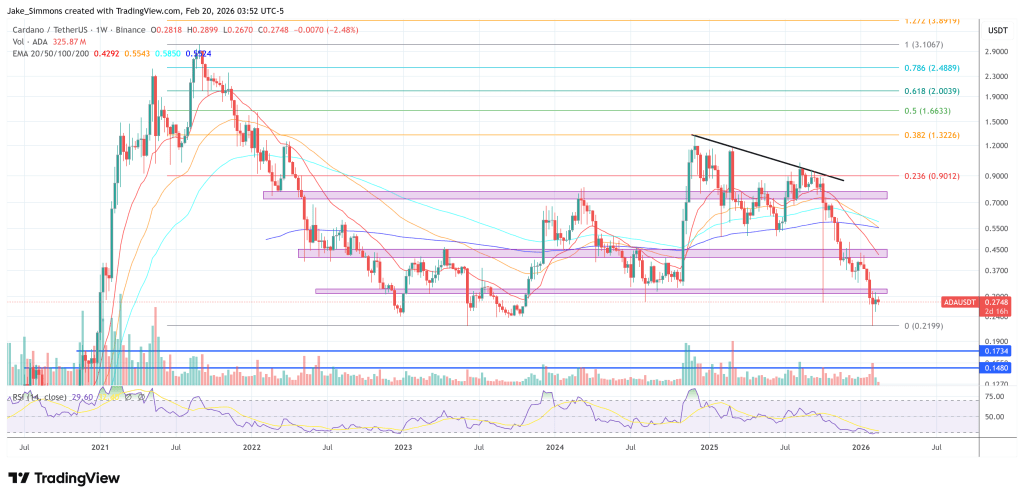
ADA hovers above key support, 1-week chart | Source: ADAUSDT on TradingView.com

Preguntas relacionadas

QWhen is the Cardano hard fork expected to occur according to Charles Hoskinson?

ANext month.

QWhat is the expected timeline for the Leios scalability initiative?

AThis year.

QWhich major integration did Hoskinson highlight that connects Cardano to over 80 blockchains?

ALayerZero integration.

QWhat is the name of the stablecoin-like asset mentioned that is designed for non-EVM systems on Cardano?

AUSDCx.

QWhat did Hoskinson identify as the central fight shifting to in the crypto industry?

AThe fight is shifting from enforcement actions to culture and narrative, particularly around non-custodial wallets and permissionless settlement.

Lecturas Relacionadas

From Banning Doubao to Embracing Honor: Why Did WeChat Suddenly 'Change Its Face'?

The article explores the sudden shift in WeChat's strategy towards AI assistants from mobile phone manufacturers, transitioning from strict opposition to active collaboration. For over a year, WeChat fiercely resisted attempts by phone AI assistants (like ByteDance's Doubao in late 2025) to control its features via GUI automation ("simulated clicking"), citing security and data control concerns. This stance created a significant barrier for system-level AI integration. Now, Tencent has initiated A2A (Agent-to-Agent) partnerships with major phone brands like Honor, Xiaomi, OPPO, and vivo. This model allows a phone's system AI (e.g., Honor's YOYO) to parse a user's voice command and send a structured request directly to WeChat's own internal AI agent via secure APIs. WeChat then executes the action (e.g., sending a message) and returns the result. The article attributes Tencent's "change of face" to strategic pressure. While leading in social app usage, Tencent trails rivals like ByteDance and Alibaba in standalone AI app popularity. WeChat, with its vast mini-program ecosystem, is Tencent's key asset for an AI comeback. The upcoming WeChat AI agent aims to handle tasks like booking and payments within the app. However, phone system assistants remain the primary AI entry point for most users. The A2A collaboration allows Tencent to extend WeChat's AI reach to this crucial system layer while maintaining control over its core functions and data. For phone manufacturers, embracing A2A is a pragmatic move. The GUI route proved unviable due to WeChat's blocks. A2A offers a compliant path to integrate a vital service, enhancing their AI assistants' usefulness. It allows them to focus on developing their own AI ecosystems for other services while cooperating on WeChat access. The collaboration is framed as a mutual, strategic necessity: Tencent gains a distribution channel, and manufacturers gain a key functionality. The partnership relies on a "dual authorization" mechanism for security, requiring both user and app consent for each action. While questions about long-term data privacy practices remain, experts note A2A is more secure and compliant than GUI automation. Ultimately, this cooperation is seen as a tentative, calculated truce. Tencent's long-term goal is to make WeChat an AI-powered "service OS." Phone manufacturers aim to make their system AI the central user interface. Their paths may converge or clash in the future, but for now, the A2A deal represents the opening chapter in the battle for the AI-era user入口, driven by necessity and strategic calculus on both sides.

marsbitHace 56 min(s)

From Banning Doubao to Embracing Honor: Why Did WeChat Suddenly 'Change Its Face'?

marsbitHace 56 min(s)

On-Chain Figures on the Eve of Kickoff: 1.6 Billion Traded Before the World Cup Even Begins

"On-Chain Numbers on the Eve of the World Cup: $1.6 Billion Traded Before Kick-off" Analysis of on-chain markets before the 2026 FIFA World Cup reveals significant crypto integration into football. The most striking figure is the approximately **$1.6 billion** in total trading volume on the single "World Cup Winner" contract on the Polymarket prediction market platform, accumulated before a single match was played. This represents explosive growth for a sector whose annual volume surged from ~$16B in 2024 to ~$64B in 2025. The ecosystem is maturing beyond speculation. Key developments include: 1) **Infrastructure upgrades** like Polymarket's migration to native, regulated USDC stablecoin for settlements; 2) **Reliable data oracles**, such as Chainlink, being used to resolve real-world match outcomes on-chain; and 3) **Official recognition**, with FIFA appointing its first-ever "Prediction Markets" partner. Over 100 contracts now cover everything from the outright winner to individual match results and even non-sporting risks like venue relocation. This evolution marks a fundamental shift. While crypto firms are absent from FIFA's top-tier sponsor list, the technology has deeply penetrated the tournament's financial and predictive infrastructure through regulated stablecoin settlements, decentralized oracles, and new official partnership categories. The regulatory landscape remains complex and varies by jurisdiction, but on-chain markets for the World Cup are already a multi-billion-dollar reality.

marsbitHace 1 hora(s)

On-Chain Figures on the Eve of Kickoff: 1.6 Billion Traded Before the World Cup Even Begins

marsbitHace 1 hora(s)

From SpaceX's IPO to the Future of Crypto: Which Crypto Sectors Will Host the Trillion-Dollar Narrative?

From the SpaceX IPO, which targets a $750 billion raise at a $1.77 trillion valuation, we can extrapolate capital flow trends relevant to crypto. The focus shifts from speculative narratives to foundational infrastructure and real-world asset (RWA) integration. Key crypto sectors poised to benefit include: 1. **AI Infrastructure**: The narrative is moving from consumer-facing AI applications to underlying, scarce resources like compute power and decentralized GPU networks (e.g., TAO, RENDER, AKT, IO). These protocols are positioning as the essential "picks and shovels" providers for the AI economy. 2. **Real-World Assets (RWA)**: Beyond tokenized treasury bonds, RWA's future lies in on-chain equity and pre-IPO assets like SpaceX. This could democratize access to high-growth assets and reshape global capital flows, benefiting infrastructure projects like ONDO, LINK, and Plume that facilitate issuance, data, and liquidity. 3. **Core Financial Infrastructure**: Stablecoins, payment networks, and DePIN (Decentralized Physical Infrastructure Networks) are critical for settling the future on-chain economy. Their role expands from internal trading tools to foundational layers for global finance, AI systems, and real-world asset networks, leading to potential value reassessment. In summary, the next cycle may prioritize long-term infrastructure value—AI compute, asset tokenization networks, and settlement layers—over short-lived application hype, mirroring the broader market's shift towards funding the foundational systems of the future.

marsbitHace 2 hora(s)

From SpaceX's IPO to the Future of Crypto: Which Crypto Sectors Will Host the Trillion-Dollar Narrative?

marsbitHace 2 hora(s)

Trading

Spot
Futuros

Artículos destacados

Cómo comprar ADA

¡Bienvenido a HTX.com! Hemos hecho que comprar Cardano (ADA) sea simple y conveniente. Sigue nuestra guía paso a paso para iniciar tu viaje de criptos.Paso 1: crea tu cuenta HTXUtiliza tu correo electrónico o número de teléfono para registrarte y obtener una cuenta gratuita en HTX. Experimenta un proceso de registro sin complicaciones y desbloquea todas las funciones.Obtener mi cuentaPaso 2: ve a Comprar cripto y elige tu método de pagoTarjeta de crédito/débito: usa tu Visa o Mastercard para comprar Cardano (ADA) al instante.Saldo: utiliza fondos del saldo de tu cuenta HTX para tradear sin problemas.Terceros: hemos agregado métodos de pago populares como Google Pay y Apple Pay para mejorar la comodidad.P2P: tradear directamente con otros usuarios en HTX.Over-the-Counter (OTC): ofrecemos servicios personalizados y tipos de cambio competitivos para los traders.Paso 3: guarda tu Cardano (ADA)Después de comprar tu Cardano (ADA), guárdalo en tu cuenta HTX. Alternativamente, puedes enviarlo a otro lugar mediante transferencia blockchain o utilizarlo para tradear otras criptomonedas.Paso 4: tradear Cardano (ADA)Tradear fácilmente con Cardano (ADA) en HTX's mercado spot. Simplemente accede a tu cuenta, selecciona tu par de trading, ejecuta tus trades y monitorea en tiempo real. Ofrecemos una experiencia fácil de usar tanto para principiantes como para traders experimentados.

1.5k Vistas totalesPublicado en 2024.12.10Actualizado en 2026.06.02

Cómo comprar ADA

Discusiones

Bienvenido a la comunidad de HTX. Aquí puedes mantenerte informado sobre los últimos desarrollos de la plataforma y acceder a análisis profesionales del mercado. A continuación se presentan las opiniones de los usuarios sobre el precio de ADA (ADA).

活动图片