Cardano Founder Unveils Midnight Rollout Plan As Mainnet Launch Begins

bitcoinistPublicado a 2026-03-24Actualizado a 2026-03-24

Resumen

Cardano founder Charles Hoskinson has announced the start of the federated mainnet phase for Midnight, a privacy-focused blockchain. The launch is being conducted gradually with daily operational checkpoints to ensure network stability. Initially, the mainnet is running in a guarded mode with limited transactions and dApp deployments. Federated node operators, including Google Cloud, Telegram, and MoneyGram, are managing the rollout. The first user-facing feature is DUST generation, accessible via Lace wallet. Hoskinson emphasized Midnight's complex architecture, which integrates zero-knowledge proofs and spans both public and private ledgers. Future upgrades will introduce composable contracts, cross-chain intents, and governance features, though full decentralization is expected to take 6–12 months due to the broad distribution of tokens via a "glacier drop."

Cardano founder Charles Hoskinson says Midnight has entered its federated mainnet phase, marking the start of a guarded rollout that he described as the first step in turning on one of the most technically ambitious networks in crypto.

In a March 23 livestream, the Cardano founder framed the week as “Midnight Week” and said the network was being activated gradually with daily operational checkpoints. “What’s happening this week is the federated launch and this is basically the mainnet network and it’s turning on step by step,” Hoskinson said. “Every day we have a go no-go meeting and based upon what we’re getting back from the federated mainnet nodes, they tell us a whole bunch of stuff. ... Basically the goal here is to get to a stable network.”

Cardano’s Midnight Launch Week Begins

That first phase is intentionally restrictive. Hoskinson said Midnight is live as a mainnet rather than a testnet, but operating in a guarded mode where transactions and decentralized application deployments are limited until the team is satisfied that consensus, block production, and core cryptographic components are working as intended. The immediate user-facing milestone, he said, is DUST generation, which should become visible through an update to Lace after the earlier Glacier Drop period ended.

The rollout is being handled by federated node operators, or FNOs, rather than an open validator set from day one. Hoskinson said those operators include firms such as Google Cloud, Telegram and MoneyGram, drawing a parallel to Cardano’s Byron era, when a small group of entities initially ran the network before control was broadened over time. Once the network proves stable, Midnight plans to lower its guardrails in stages and begin deploying applications in waves.

“So you go from just dust generation to Lace plus DApps and you can actually start using some of these experiences,” he said. “You’re basically looking for a stable consensus. You’re looking for stable block generation in the mainnet environment. And then as that gets stable, everybody’s happy, you go from guarded to less guarded to less guarded to less guarded.”

Hoskinson argued that Midnight’s launch path is more complicated than Cardano’s because the system spans both Cardano and Midnight, with separate roles for its assets and multiple address formats across public and private ledgers. He also pointed to its layered design, naming consensus components such as Aura, Grandpa and Beefy, while describing Compact as “basically Zcash with smart contracts.”

That framing is central to the pitch. Midnight, in Hoskinson’s telling, is not just another chain launch but a privacy-preserving smart contract system being opened in phases. The first version shipping with the federated mainnet includes zero-knowledge tooling such as Plonk and Halo 2, while later upgrades are expected to bring composable contracts, Nightstream-related infrastructure, capacity exchange, crosschain intents and the Midnight passport system.

The decentralization roadmap comes later. Hoskinson said Midnight is now entering phase two, with phase three set to introduce an incentivized testnet for stake pool operators, allowing them to begin making blocks in parallel with ongoing federated mainnet upgrades. Governance experiments are also expected to begin in that phase, although he cautioned that Midnight’s broad token distribution through its “glacier drop” means the ecosystem needs time to mature before full governance can be safely turned on.

“One of the problems with Midnight, and this is why you need at least 6 to 12 months to stabilize, is that Midnight was distributed with a glacier drop,” he said. “That’s a huge benefit because you get lots of people. The problem is that those people haven’t decided whether they want to be a good-faith member of the Midnight ecosystem community or if they just want to dump their NIGHT or be adversarial.”

Hoskinson also used the livestream to make a much broader claim about Midnight’s long-term role, describing it as infrastructure for privacy, compliance and AI-driven commerce. He said the system’s mix of zero-knowledge proofs, multi-party computation and trusted execution environments could make it a natural framework for autonomous software agents to transact and verify one another.

At press time, Cardano traded at $0.2611.
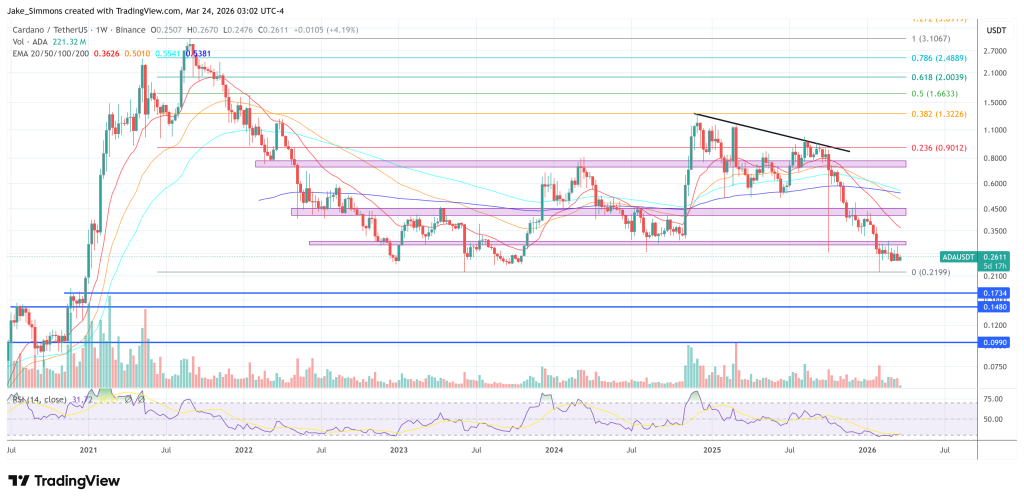
ADA hovers below key resistance, 1-week chart | Source: ADAUSDT on TradingView.com

Criptos en tendencia

Preguntas relacionadas

QWhat is the current phase of Midnight's launch as announced by Charles Hoskinson?

AMidnight has entered its federated mainnet phase, which is the start of a guarded rollout.

QWhich companies are mentioned as federated node operators (FNOs) for the initial launch?

AGoogle Cloud, Telegram, and MoneyGram are mentioned as federated node operators.

QWhat is the first user-facing milestone expected after the Glacier Drop period?

AThe first user-facing milestone is DUST generation, which should become visible through an update to Lace.

QAccording to Hoskinson, why does Midnight need 6 to 12 months to stabilize after launch?

AIt needs time to stabilize because the broad token distribution through the 'glacier drop' means the ecosystem needs to mature before determining if participants will be good-faith members or adversarial.

QWhat broader long-term role did Hoskinson claim for Midnight beyond being a blockchain?

AHe described Midnight as infrastructure for privacy, compliance, and AI-driven commerce, using zero-knowledge proofs, multi-party computation, and trusted execution environments for autonomous software agents.

Lecturas Relacionadas

L2 'Recalibration': When L1 Becomes Its Own Rollup, What Is Ethereum's Endgame?

The article discusses the evolving relationship between Ethereum's Layer 1 (L1) and Layer 2 (L2) solutions, moving beyond the initial "L2 for scaling" model. As Ethereum L1 itself scales (increasing Gas Limit, statelessness, zkEVM), the unique value proposition of L2s shifts from merely providing cheap execution to offering differentiated features like application-specific optimization, privacy, and flexible governance. The piece explores three key themes: 1. **L2's New Role:** L2s are transitioning from a pure scaling technology to a spectrum of execution environments with varying degrees of security inheritance from Ethereum L1. 2. **Interoperability as State Trust:** Solving L2 fragmentation is less about cross-chain bridges and more about enabling faster, trust-minimized state verification between environments. This involves initiatives like faster L1 finality, intent-based architectures (Open Intents Framework), and native account abstraction. 3. **Blurring Layers:** With the potential integration of zk-proofs into L1 validation (making L1 akin to its own "Rollup") and the concept of "Native Rollups," the rigid boundary between L1 and L2 may fade. The future could be a unified system with multiple execution domains (for DeFi, gaming, privacy, etc.) sharing a common security, settlement, and state framework. In conclusion, Ethereum's goal is not to abandon L2s or re-centralize everything on L1, but to re-integrate the fragmented user experience—liquidity, accounts, applications—while preserving the scaling benefits of a multi-environment ecosystem. The endgame is a cohesive "one chain" feeling for users, powered by diverse but securely interconnected execution layers.

marsbitHace 25 min(s)

L2 'Recalibration': When L1 Becomes Its Own Rollup, What Is Ethereum's Endgame?

marsbitHace 25 min(s)

The Encryption Bill Clarity's Challenge: A Thorny Path of Bipartisan Compromise in the U.S.

U.S. lawmakers are attempting to advance the Clarity Act, a significant crypto market structure bill, but its path is fraught with partisan hurdles. The process has been rocky since January, when a prior bipartisan deal in the Senate Banking Committee was upended. A key compromise in May on "yield" issues allowed the bill to move forward in committee, but only with the conditional support of two Democratic senators, Angela Alsobrooks and Ruben Gallego. They emphasized that their final vote depends on reaching an agreement on ethics provisions for elected officials. Ultimately, the Senate Agriculture Committee passed its version along party lines without Democratic support. As Republicans push for a full Senate vote in July, the demand for strong ethics language has expanded beyond Democrats. Additional controversies surround provisions related to yields (aligning some Republicans with large banks) and developer protections (opposed by enforcement agencies). Core concerns about illicit finance and consumer protection remain central to the debate. Despite consensus on the need for legislation, achieving the necessary bipartisan compromise is proving difficult. While momentum exists—including recent meetings between senators and White House officials—a reconciled bill text faces skepticism. Senator Gallego has stated that without ethics terms acceptable to Democrats, they will not provide the needed votes. The immediate goals for the crypto community in Congress are unclear: a symbolic Senate vote before the August recess, eventual passage into law by 2026, or forging a final compromise framework. The arduous, vote-by-vote effort to build bipartisan support continues, mirroring the traditional legislative grind the industry must now navigate.

Foresight NewsHace 1 hora(s)

The Encryption Bill Clarity's Challenge: A Thorny Path of Bipartisan Compromise in the U.S.

Foresight NewsHace 1 hora(s)

Trading

Spot

Artículos destacados

Cómo comprar ADA

¡Bienvenido a HTX.com! Hemos hecho que comprar Cardano (ADA) sea simple y conveniente. Sigue nuestra guía paso a paso para iniciar tu viaje de criptos.Paso 1: crea tu cuenta HTXUtiliza tu correo electrónico o número de teléfono para registrarte y obtener una cuenta gratuita en HTX. Experimenta un proceso de registro sin complicaciones y desbloquea todas las funciones.Obtener mi cuentaPaso 2: ve a Comprar cripto y elige tu método de pagoTarjeta de crédito/débito: usa tu Visa o Mastercard para comprar Cardano (ADA) al instante.Saldo: utiliza fondos del saldo de tu cuenta HTX para tradear sin problemas.Terceros: hemos agregado métodos de pago populares como Google Pay y Apple Pay para mejorar la comodidad.P2P: tradear directamente con otros usuarios en HTX.Over-the-Counter (OTC): ofrecemos servicios personalizados y tipos de cambio competitivos para los traders.Paso 3: guarda tu Cardano (ADA)Después de comprar tu Cardano (ADA), guárdalo en tu cuenta HTX. Alternativamente, puedes enviarlo a otro lugar mediante transferencia blockchain o utilizarlo para tradear otras criptomonedas.Paso 4: tradear Cardano (ADA)Tradear fácilmente con Cardano (ADA) en HTX's mercado spot. Simplemente accede a tu cuenta, selecciona tu par de trading, ejecuta tus trades y monitorea en tiempo real. Ofrecemos una experiencia fácil de usar tanto para principiantes como para traders experimentados.

1.5k Vistas totalesPublicado en 2024.12.10Actualizado en 2026.06.02

Cómo comprar ADA

Discusiones

Bienvenido a la comunidad de HTX. Aquí puedes mantenerte informado sobre los últimos desarrollos de la plataforma y acceder a análisis profesionales del mercado. A continuación se presentan las opiniones de los usuarios sobre el precio de ADA (ADA).

活动图片