Cardano Founder Says This Midnight Deal Could Bring Billions In TVL

bitcoinistPublicado a 2026-03-26Actualizado a 2026-03-26

Resumen

Cardano founder Charles Hoskinson announced a major partnership between the privacy-focused blockchain Midnight and UK-based Monument Bank, which plans to tokenize up to £250 million in retail deposits. This initial phase could expand into billions in Total Value Locked (TVL) as Monument aims to later offer tokenized investment products and Lombard-style lending. The deal is positioned as a breakthrough for regulated finance on public blockchains, using Midnight’s privacy features to balance transparency with banking confidentiality while operating within existing regulatory frameworks.

Cardano founder Charles Hoskinson says Midnight’s new partnership with Monument Bank could become one of the biggest commercial wins yet for the privacy-focused network, after the UK lender unveiled plans to put retail customer deposits on a public blockchain. In a post on X, the Cardano founder wrote:

“This is one of the largest deals we’ve ever done and could bring hundreds of millions to billions of TVL to the Midnight ecosystem. I’m extremely proud of Fahmi Syed and his team at the Midnight Foundation for the hard work they put into the negotiations with Monument. Midnight is the home of Web 2.5 ventures.”

Why The Cardano So Enthusiastic

Monument, a UK digital bank serving the mass-affluent segment, said it plans to become the first UK bank to tokenize retail customer deposits on a public blockchain, with Midnight providing the underlying network and privacy-preserving architecture.

The first phase is concrete. Monument said it is targeting up to £250 million in tokenized deposits, with each token representing a one-to-one claim on funds held at the bank. Those deposits are intended to remain interest-bearing, redeemable in pounds sterling and protected within the existing regulatory framework, including the Financial Services Compensation Scheme. Monument says it currently serves more than 100,000 clients and has over £7 billion in savings deposits, giving the project a real balance-sheet base rather than a purely experimental starting point.

That setup is central to Midnight’s pitch. The tokenized deposits are not being framed as a new synthetic asset or an offshore wrapper, but as a blockchain mirror of traditional bank deposits. According to the release, transaction data on Midnight will be shielded and visible only to Monument and its customers, an architecture aimed at preserving the confidentiality banks need while still using public-chain rails.

Midnight Foundation President Fahmi Syed used the deal to make a broader point about institutional blockchain adoption. Financial firms, he said, have struggled with the tension between openness and banking-grade confidentiality. Midnight, in his words, is designed to “represent assets on public networks” while protecting “sensitive financial information,” and Monument’s rollout is meant to show that regulated products can move on-chain without stepping outside existing compliance and consumer-protection frameworks.

The longer-term roadmap explains why Hoskinson is talking in terms of billions rather than the initial £250 million. Phase two would expand beyond tokenized deposits into tokenized investment products delivered through the Monument app, including access to private equity, commodity funds and structured products. Phase three would introduce Lombard-style lending, allowing clients to borrow against investments without selling them. Monument also said its technology affiliate aims to extend tokenized-deposit functionality to other institutions through its Banking-as-a-Service platform.

In that sense, Hoskinson’s TVL projection reads less like a claim about day-one inflows and more like a statement about the size of the pipeline if the rollout expands as planned. The hard figure disclosed so far is £250 million in the first phase. But if Monument can move from deposit tokenization into investment products, lending and third-party enablement, Midnight would be competing for balance-sheet-linked activity that is structurally different from mercenary DeFi liquidity.

For Midnight, the partnership is also a live test of its core thesis: that privacy-enhancing infrastructure can make public blockchains usable for regulated finance. If Monument executes beyond the pilot, the deal would give the Cardano-linked network something many crypto projects still lack, a banking use case tied to real deposits, real customers and a product roadmap built to stay inside the guardrails of traditional finance.

At press time, Cardano traded at $0.26.
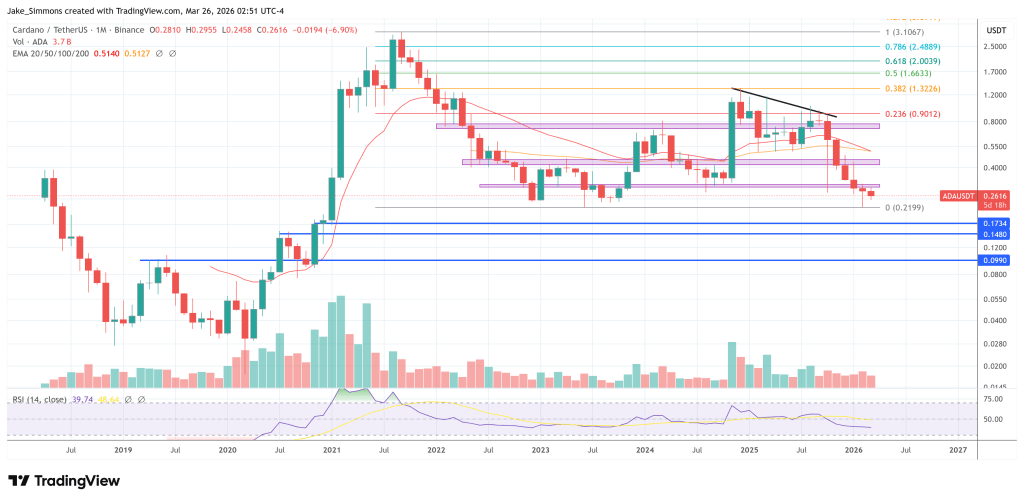
Cardano hovers below key resistance, 1-month chart | Source: ADAUSDT on TradingView.com

Criptos en tendencia

Preguntas relacionadas

QWhat is the significance of the partnership between Midnight and Monument Bank according to Cardano founder Charles Hoskinson?

ACharles Hoskinson believes this partnership could become one of the largest deals for Midnight, potentially bringing hundreds of millions to billions in Total Value Locked (TVL) to its ecosystem.

QWhat specific service does Monument Bank plan to implement using Midnight's network?

AMonument Bank plans to become the first UK bank to tokenize retail customer deposits on a public blockchain, using Midnight's network and privacy-preserving architecture.

QWhat is the initial target amount for tokenized deposits in the first phase of the project?

AThe initial target for the first phase is up to £250 million in tokenized deposits.

QHow does Midnight's technology address the conflict between openness and confidentiality for financial institutions?

AMidnight is designed to represent assets on public networks while protecting sensitive financial information through its privacy-enhancing infrastructure, allowing transaction data to be shielded and visible only to the bank and its customers.

QWhat are the future phases of the project beyond tokenizing deposits?

APhase two will expand into tokenized investment products like private equity and commodity funds, while phase three will introduce Lombard-style lending, allowing clients to borrow against their investments without selling them.

Lecturas Relacionadas

Dan Koe: The Counterintuitive Truth—You Don't Need to Remember Everything You Read

Dan Koe: The Counterintuitive Truth — You Don't Need to Remember Everything You Read The central idea is that deliberately trying to remember information is often misguided. True learning isn't about memorizing facts but about having important knowledge surface naturally when needed through use. Most forgetting is normal, not a failure. The article reframes learning using a control theory framework—a four-step feedback loop: having a clear Goal, accurately Sensing your current state, Comparing the gap, and Acting to close it. Most learning stalls because people only do step 2 (blind input) without a goal to create the necessary "error signal" for focused action. The most effective method is to start with output, not input. Begin a meaningful personal project first, and learn only what's necessary to complete it. This project-driven, "just-in-time" learning ensures knowledge is contextual and retained. The concept of a "Second Brain" often fails because it becomes a digital graveyard—over-collected and under-utilized. The goal should be building a "Second Subconscious"—a dynamic system that proactively surfaces relevant ideas during creation, not a static storage vault. Tools like Obsidian+Claude or Eden can help by automating organization and enabling semantic search, but their value depends on linking knowledge to active projects. Ultimately, what matters is not what you store, but what you filter and internalize. Focus on ideas that shape your worldview, use projects as filters, and transform collected material through writing and sharing. AI should be used to reduce friction in research and editing, not to formulate your core views. In conclusion, remembering is a byproduct, not the goal. Knowledge that sticks comes from pursuing personal goals, applying it in real projects, and digesting it through creation. The tools are merely aids; the crucial step is to start doing meaningful work and let the necessary knowledge find you.

marsbitHace 59 min(s)

Dan Koe: The Counterintuitive Truth—You Don't Need to Remember Everything You Read

marsbitHace 59 min(s)

A New Era: The Fundamental Transformation of China's Entrepreneurs

A profound generational shift is underway among Chinese entrepreneurs. The wealth and influence once dominated by real estate and internet giants is now being claimed by a new wave of founders driving breakthroughs in AI, semiconductors, and robotics. This change is vividly reflected in 2026's wealth rankings. Figures like Zhang Yiming (ByteDance), Liang Wenfeng (DeepSeek), Chen Tianshi (Cambricon), and Wang Xingxing (Unitree Robotics) are ascending. Their wealth stems not from traditional business models but from market expectations for future technological competitiveness, with AI, chips, and smart hardware becoming the primary engines of wealth creation. Their common trait is a foundational focus on technology, often starting from the laboratory rather than a business plan. Examples include Chen Tianshi's decade-long push in AI chips, Liang Wenfeng's core algorithmic innovations at DeepSeek with a compact team, and Zhu Yiming's "no salary until profitable" 9-year journey to build Changxin Memory into a global DRAM player. This transition marks a fundamental shift in China's economic imperative: from commercial expansion and learning to indigenous innovation and deep industrial capability. While the previous generation built the foundational market and infrastructure, this new cohort is tasked with achieving global leadership in core technologies, moving China from "keeping pace" to pioneering original, breakthrough innovations that are industrialized at scale. The baton is being passed to those competing on the world stage through technological originality.

marsbitHace 59 min(s)

A New Era: The Fundamental Transformation of China's Entrepreneurs

marsbitHace 59 min(s)

Trading

Spot

Artículos destacados

Cómo comprar ADA

¡Bienvenido a HTX.com! Hemos hecho que comprar Cardano (ADA) sea simple y conveniente. Sigue nuestra guía paso a paso para iniciar tu viaje de criptos.Paso 1: crea tu cuenta HTXUtiliza tu correo electrónico o número de teléfono para registrarte y obtener una cuenta gratuita en HTX. Experimenta un proceso de registro sin complicaciones y desbloquea todas las funciones.Obtener mi cuentaPaso 2: ve a Comprar cripto y elige tu método de pagoTarjeta de crédito/débito: usa tu Visa o Mastercard para comprar Cardano (ADA) al instante.Saldo: utiliza fondos del saldo de tu cuenta HTX para tradear sin problemas.Terceros: hemos agregado métodos de pago populares como Google Pay y Apple Pay para mejorar la comodidad.P2P: tradear directamente con otros usuarios en HTX.Over-the-Counter (OTC): ofrecemos servicios personalizados y tipos de cambio competitivos para los traders.Paso 3: guarda tu Cardano (ADA)Después de comprar tu Cardano (ADA), guárdalo en tu cuenta HTX. Alternativamente, puedes enviarlo a otro lugar mediante transferencia blockchain o utilizarlo para tradear otras criptomonedas.Paso 4: tradear Cardano (ADA)Tradear fácilmente con Cardano (ADA) en HTX's mercado spot. Simplemente accede a tu cuenta, selecciona tu par de trading, ejecuta tus trades y monitorea en tiempo real. Ofrecemos una experiencia fácil de usar tanto para principiantes como para traders experimentados.

1.6k Vistas totalesPublicado en 2024.12.10Actualizado en 2026.06.02

Cómo comprar ADA

Discusiones

Bienvenido a la comunidad de HTX. Aquí puedes mantenerte informado sobre los últimos desarrollos de la plataforma y acceder a análisis profesionales del mercado. A continuación se presentan las opiniones de los usuarios sobre el precio de ADA (ADA).

活动图片