Cardano Founder Says Pentad Faces $40 Million Shortfall After ADA Price Crash

bitcoinistPublicado a 2026-03-09Actualizado a 2026-03-09

Charles Hoskinson says Cardano’s Pentad initiative is dealing with a roughly $40 million funding gap after ADA fell from around $0.83 at the time of the original proposal to roughly $0.25. In a March 6 video update, the Cardano founder said the plan was initially working with the equivalent of about $58 million in value from 70 million ADA, but that figure has since dropped to about $18 million.

That repricing, he argued, has fundamentally changed the economics of the program. “The reality is that there’s a $40 million shortfall between when we wanted to do it and where we’re at today,” Hoskinson said. “Every single member of the Pentad has to accept that shortfall, meaning out of pocket for commitments and obligations. They have to make it up.”

Hoskinson Defends The Cardano Pentad

Pentad was designed as a coordinated effort between five core Cardano ecosystem entities to secure commercially important integrations for the network more efficiently and at scale. Hoskinson said the original logic was that Cardano and Midnight could negotiate together and get better aggregate terms, but the collapse in ADA’s dollar value means even the Cardano-side integrations now cost more than the treasury-backed funding effectively covers. Midnight, he said, is also paying for its own integrations out of pocket, with liabilities exceeding $10 million.

A central point of the update was a reimbursement dispute tied to Fireblocks. Hoskinson said one party had negotiated separately with Fireblocks outside the Pentad process, reached its own fee arrangement, and then later sought reimbursement. That, he argued, is not comparable to the more expansive and expensive integration the Midnight Foundation had been negotiating and was never part of the original governance-approved structure.

“Everyone in the Pentad is at a loss. We did not make a profit,” he said. “The vast majority of the integrations will require out-of-pocket expenses from the Cardano Foundation, the Midnight Foundation, Input Output, Emergo, and Intersect and long-term liabilities because many of these things required multi-year contracts.” By contrast, he added, external actors who were not signers to those liabilities cannot reasonably expect to be made whole simply because earlier public comments were made under different assumptions.

Hoskinson nevertheless cast Pentad V1 as an operational success. He said Cardano went from signing a deal with Circle to having USDCX live on the network in 84 days, calling it the number one stablecoin on Cardano already. He also pointed to integrations with LayerZero, Pyth, Dune Analytics and custodians, arguing the effort has moved Cardano from being “an island” to being connected to the broader crypto market.

Related Reading: Cardano Founder Sounds Alarm Over New US Crypto Bill

That shift matters because, in Hoskinson’s view, Cardano’s next challenge is no longer core infrastructure. It is utility, user experience and DeFi traction. He said the ecosystem still needs strategic capital deployment to help applications survive and compete, and floated Pentad V2 as a possible treasury-backed “weighted index” of Cardano DApps and DeFi projects rather than a grant program.

“We don’t have an infrastructure problem,” he said later in the video. “We have DApps and DeFi and we have an experience problem. We were an island. We’re no longer an island. We built those bridges. That’s what you paid for with Pentad.”

The broader message was political as much as financial. Hoskinson framed the reimbursement fight as a test of whether Cardano’s on-chain governance can function under stress without collapsing into public infighting. If the ecosystem can align behind difficult capital-allocation decisions despite lower token prices, he argued, Pentad could become less a funding controversy than an early demonstration of whether Cardano’s governance model can actually execute.

At press time, ADA traded at $0.2548.
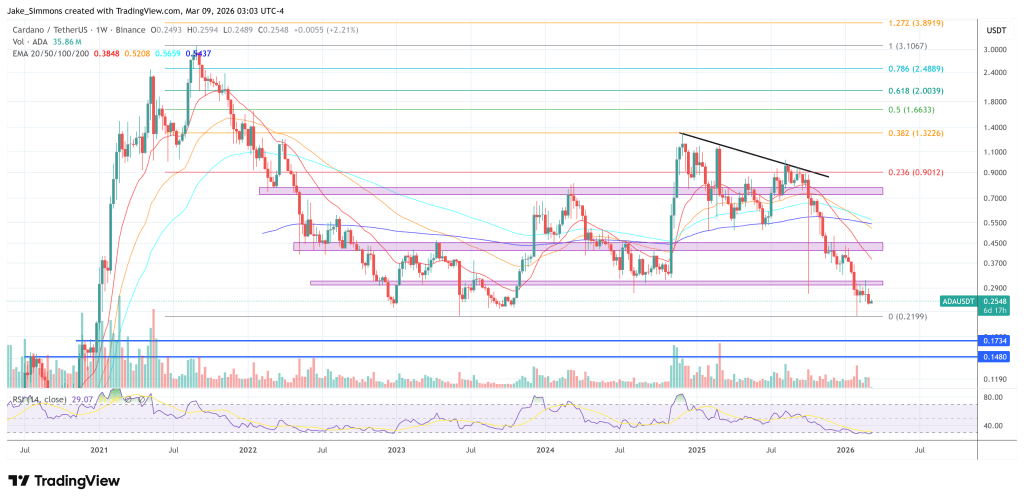
ADA hovers below key resistance, 1-week chart | Source: ADAUSDT on TradingView.com

Criptos en tendencia

Preguntas relacionadas

QWhat is the main financial issue facing Cardano's Pentad initiative according to Charles Hoskinson?

AThe main financial issue is a roughly $40 million funding shortfall due to the sharp decline in ADA's price, which has reduced the value of the treasury from an initial $58 million to about $18 million.

QWhat was the original purpose of the Pentad initiative?

APentad was designed as a coordinated effort between five core Cardano ecosystem entities to secure commercially important integrations for the network more efficiently and at scale.

QHow did Hoskinson defend the operational success of Pentad V1 despite the financial shortfall?

AHe cited the rapid 84-day integration of USDCX, making it the number one stablecoin on Cardano, and pointed to successful integrations with LayerZero, Pyth, Dune Analytics, and custodians, which connected Cardano to the broader crypto market.

QWhat did Hoskinson identify as Cardano's next major challenge after improving its infrastructure?

AHe stated that the next challenge is no longer core infrastructure, but rather utility, user experience, and DeFi traction for the ecosystem.

QWhat broader, non-financial test did Hoskinson say the reimbursement dispute represents for the Cardano ecosystem?

AHe framed it as a test of whether Cardano's on-chain governance can function under stress without public infighting and if it can execute difficult capital-allocation decisions despite lower token prices.

Lecturas Relacionadas

Bernstein Analysis: Can the $142 Billion Long-Term Order Hold Up the Memory Cycle?

Bernstein revisits long-term agreements (LTAs) in the memory industry, highlighting new contracts with purchase commitments, minimum prices, and financial guarantees signed by Micron and SanDisk. These aim to provide an earnings floor for the coming years. Micron has 16 strategic customer agreements, with 14 representing approximately $100 billion in minimum revenue and about $22 billion in cash deposits/commitments. SanDisk has contracts for around $42 billion in minimum revenue and over $11 billion in guarantees. Combined, these ~$33 billion in guarantees make it more costly for major clients to walk away. However, Bernstein models that the potential revenue needing protection over 3-5 years is around $5.2 trillion. The existing guarantees thus cover only about 0.6% of that scale. While LTAs provide a cushion, they cannot fully shield profits in a severe downturn, as clients may still find it cheaper to breach contracts if spot prices fall deeply below floor prices. LTAs are most suitable for large, credit-worthy customers like U.S. cloud service providers with stable, high-volume AI infrastructure needs. Consumer segments (phones, PCs) and some Chinese clients are less likely to adopt them, leaving an estimated 30-50% of the DRAM/NAND market exposed to spot price volatility. AI demand (e.g., HBM for training, storage for inference) supports higher valuations and makes LTAs more attractive for locking in high-demand customers. Yet, Bernstein stresses that LTAs soften, but do not eliminate, the memory cycle. Their true test will come in the next downturn, revealing whether clients honor contracts and whether guarantees provide sufficient pain to maintain supplier discipline.

marsbitHace 3 min(s)

Bernstein Analysis: Can the $142 Billion Long-Term Order Hold Up the Memory Cycle?

marsbitHace 3 min(s)

Dialogue with Jia Hang | Looking Back at Two Decades of Chinese Payment Going Global

**Summary: A Conversation with Jia Hang on Two Decades of China's Payment Globalization** Jia Hang, a veteran with over twenty years in payments, reflects on China's attempts to build a global payment network through three key phases: UnionPay (card networks), Alipay+ (digital wallets), and now, stablecoins. His journey began at UnionPay International, aiming to establish China's card network abroad. While successful in following Chinese tourists ("where Chinese go, UnionPay goes"), it struggled to achieve true global scale. The core lesson: card networks like Visa/Mastercard's unassailable advantage isn't just technical standards, but their deeply entrenched **governance and profit-sharing models** that create powerful network effects. Competing as the "same species" is nearly impossible. At Ant Group, he led Alipay+, a strategy to bypass card networks by interconnecting local e-wallets worldwide. While innovative, it faced a similar ceiling. Mobile QR payments and card swipes were essentially **the same species competing for the same pie**, lacking a disruptive value proposition for users or a sustainable new incentive model to replace the card networks' established flywheel. Today, at Singapore's DCS, Jia focuses on stablecoin-based payments. He argues stablecoins represent a fundamental shift. They are not competing with Visa for consumer payments but challenging the **traditional banking and account system for value movement**. Products like "U Cards" (stablecoin-linked payment cards) are transitional, leveraging existing card networks for acceptance while building new rails. The real potential lies in stablecoins enabling seamless, low-cost global value transfer, potentially reorganizing the financial infrastructure around **accounts rather than cards**. Jia believes stablecoin adoption for local retail payments, cross-border transactions, and as high-yield savings vehicles is becoming irreversible. This could gradually reduce reliance on traditional fiat channels, especially in regions with weak currencies or capital controls. The quest for the "next global payment network" continues, now centered on whether stablecoins can successfully bridge Web2 and Web3, establish new governance, and create compelling user value beyond mere cost reduction.

marsbitHace 26 min(s)

Dialogue with Jia Hang | Looking Back at Two Decades of Chinese Payment Going Global

marsbitHace 26 min(s)

Circle's Stock Price Plunges 76%, Hong Kong Dollar Stablecoin Set to Launch Within Two Weeks

Circle's stock price has plunged approximately 76% from its 2023 peak, reflecting a major market revaluation. Despite this, Circle President Heath Tarbert emphasized the company's focus on long-term execution and its dominant position with USDC's $73 billion circulation across 34 blockchains. The competitive landscape is intensifying. A new consortium-backed stablecoin, Open USD, is attempting to challenge incumbents by sharing reserve yields with partners. More significantly, Visa's new stablecoin platform, initially supporting Open USD while also being compatible with USDC, could erode Circle's network effects. In response, Circle is expanding into real-world payments through partnerships like the one with Japan's JCB. Separately, Tether (USDT) faces a two-year compliance window under new U.S. regulations, requiring it to adjust its reserve composition away from assets like Bitcoin and loans towards cash and U.S. Treasuries. Meanwhile, in Hong Kong, Standard Chartered-backed fintech firm Dian Dian is poised to launch a licensed HKD-pegged stablecoin (HKDAP), moving the industry into a phase where the real test is integrating licensed stablecoins into actual payment flows and corporate treasury systems. The sharp decline in Circle's stock underscores a broader shift: the stablecoin market is moving from a winner-takes-all dynamic to a multi-player competitive arena where execution, compliance, and real-world utility are becoming paramount.

marsbitHace 27 min(s)

Circle's Stock Price Plunges 76%, Hong Kong Dollar Stablecoin Set to Launch Within Two Weeks

marsbitHace 27 min(s)

Trading

Spot

Artículos destacados

Cómo comprar ADA

¡Bienvenido a HTX.com! Hemos hecho que comprar Cardano (ADA) sea simple y conveniente. Sigue nuestra guía paso a paso para iniciar tu viaje de criptos.Paso 1: crea tu cuenta HTXUtiliza tu correo electrónico o número de teléfono para registrarte y obtener una cuenta gratuita en HTX. Experimenta un proceso de registro sin complicaciones y desbloquea todas las funciones.Obtener mi cuentaPaso 2: ve a Comprar cripto y elige tu método de pagoTarjeta de crédito/débito: usa tu Visa o Mastercard para comprar Cardano (ADA) al instante.Saldo: utiliza fondos del saldo de tu cuenta HTX para tradear sin problemas.Terceros: hemos agregado métodos de pago populares como Google Pay y Apple Pay para mejorar la comodidad.P2P: tradear directamente con otros usuarios en HTX.Over-the-Counter (OTC): ofrecemos servicios personalizados y tipos de cambio competitivos para los traders.Paso 3: guarda tu Cardano (ADA)Después de comprar tu Cardano (ADA), guárdalo en tu cuenta HTX. Alternativamente, puedes enviarlo a otro lugar mediante transferencia blockchain o utilizarlo para tradear otras criptomonedas.Paso 4: tradear Cardano (ADA)Tradear fácilmente con Cardano (ADA) en HTX's mercado spot. Simplemente accede a tu cuenta, selecciona tu par de trading, ejecuta tus trades y monitorea en tiempo real. Ofrecemos una experiencia fácil de usar tanto para principiantes como para traders experimentados.

1.5k Vistas totalesPublicado en 2024.12.10Actualizado en 2026.06.02

Cómo comprar ADA

Discusiones

Bienvenido a la comunidad de HTX. Aquí puedes mantenerte informado sobre los últimos desarrollos de la plataforma y acceder a análisis profesionales del mercado. A continuación se presentan las opiniones de los usuarios sobre el precio de ADA (ADA).

活动图片