Cardano Founder Hoskinson Says Midnight Mainnet Is Now Live

bitcoinistPublicado a 2026-04-01Actualizado a 2026-04-01

Resumen

Cardano founder Charles Hoskinson announced the mainnet launch of Midnight, a privacy-focused blockchain within the Cardano ecosystem. The network, which has already produced over 163,000 blocks, is currently in a controlled "guarded era" with federated node operators ensuring stability. It features programmable privacy through zero-knowledge proofs, allowing selective data sharing. The ecosystem uses a dual-token model: NIGHT for governance and DUST for renewable transaction fees. Institutional partners include Worldpay, Google Cloud, and eToro. Hoskinson also released a free book on zero-knowledge proofs and confirmed upcoming Lace wallet updates.

Cardano founder Charles Hoskinson said Monday that Midnight is now live, marking the mainnet debut of the privacy-focused network that has been one of the highest-profile infrastructure bets tied to the broader Cardano ecosystem. In his March 30 livestream, Hoskinson said the chain had already been running for a while, with average block times holding at roughly six seconds, more than 163,000 blocks produced, and a finality gap of about two blocks.

Midnight Launch Marks Major Cardano Ecosystem Milestone

The launch itself was formally announced by Midnight via X. The project said the genesis block had been produced and that developers, partners and institutions would now be able to deploy applications and migrate assets onto the network. The release lands on the timeline the team had previously outlined in February, when Midnight said mainnet was scheduled for late March 2026. It also follows the December 2025 launch of NIGHT, the network’s native token, on Cardano.

Hoskinson framed the current phase as a controlled production launch rather than an instant jump to open decentralization. He described Midnight as being in a “guarded era,” with a strong federated network and an active post-launch bug-fix queue already numbering more than 130 items. None, he said, were showstoppers, but the team expects to spend the next two to three weeks hardening the system while partners and developers begin building against a live environment.

That characterization matches Midnight’s official rollout plan. The foundation said the network is entering production through a phased application deployment period designed to prioritize operational stability and security before later stages of decentralization. In this initial setup, federated node operators run the core infrastructure under explicit participation rules, with the longer-term goal of progressing toward a more decentralized and permissionless model.

Midnight’s launch post highlights a roster of federated node partners that includes Worldpay, Bullish, MoneyGram, Pairpoint by Vodafone, eToro, AlphaTON Capital, Google Cloud, Blockdaemon and Shielded Technologies. That institutional mix is central to Midnight’s pitch: a privacy-preserving public blockchain intended to support live applications without asking enterprises to accept the data exposure typical of fully transparent ledgers.

Midnight’s technical proposition is built around programmable privacy. According to the project’s launch materials, the network combines public and private data through a hybrid ledger architecture, uses client-side generation of zero-knowledge proofs so sensitive data remains on user devices, and supports both shielded and unshielded assets depending on the application’s needs. The protocol also supports selective disclosure, allowing counterparties, auditors or regulators to view specific records when application logic requires it, without exposing all underlying transaction data by default.

Economically, Midnight is also trying to differentiate itself from conventional gas-token networks. The chain uses a dual-component model in which NIGHT acts as the unshielded governance and utility token, while DUST functions as the renewable transaction resource consumed by applications. Midnight says DUST regenerates over time based on NIGHT holdings, with a full recharge reached over seven days, a design meant to make transaction costs more predictable for businesses and allow developers to subsidize usage for end users.

Hoskinson used the livestream to pair the launch announcement with a broader educational push. He said he has published a free book, Proving Nothing: A Complete Guide to Zero-Knowledge Proof Systems, aimed at non-technical readers who want a comprehensive overview of how ZK systems work.

On the product side, Hoskinson said Lace would receive an update tied to Midnight mainnet support, with version 136.2 already submitted for approval at the browser extension store. He added that Lace v2 and a mobile release are both expected in April.

At press time, Cardano traded at $0.24.
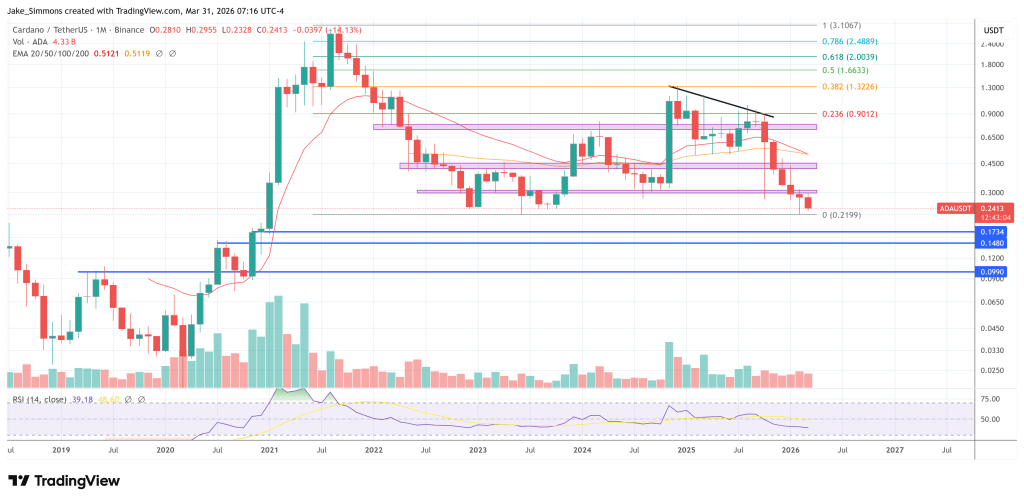
Cardano hovers below key resistance, 1-monthly chart | Source: ADAUSDT on TradingView.com

Criptos en tendencia

Preguntas relacionadas

QWhat is the significance of the mainnet launch for Midnight, as announced by Charles Hoskinson?

AThe mainnet launch marks the debut of the privacy-focused network Midnight, a high-profile infrastructure project within the Cardano ecosystem, and represents a major milestone for the broader Cardano ecosystem.

QHow does Midnight's initial 'guarded era' phase operate, according to the announcement?

AIn the initial 'guarded era,' Midnight operates with a strong federated network of node operators under explicit participation rules, prioritizing operational stability and security. This controlled production phase includes an active bug-fix queue and is designed to harden the system before progressing toward a more decentralized model.

QWhat key technical feature does Midnight use to ensure privacy for its users?

AMidnight uses a hybrid ledger architecture that combines public and private data, employs client-side generation of zero-knowledge proofs to keep sensitive data on user devices, and supports selective disclosure for authorized viewing of specific records without exposing all transaction data.

QWhat is the economic model of Midnight, and how does it differ from conventional blockchain networks?

AMidnight uses a dual-token model: NIGHT acts as the unshielded governance and utility token, while DUST functions as a renewable transaction resource that regenerates over time based on NIGHT holdings. This design aims to make transaction costs more predictable and allow developers to subsidize end-user usage, differentiating it from conventional gas-token networks.

QWhat did Charles Hoskinson announce alongside the mainnet launch to support broader education on the technology?

ACharles Hoskinson announced the publication of a free book titled 'Proving Nothing: A Complete Guide to Zero-Knowledge Proof Systems,' aimed at providing a comprehensive overview of ZK systems for non-technical readers.

Lecturas Relacionadas

Misjudged A-Shares: Resilience, Expectations, and Confidence

China's A-share market recently faced selling pressure, especially in tech sectors, initially triggered by a global tech sell-off that began in South Korea. However, the article argues this is a case of "mistaken injury" and highlights the market's underlying resilience. This resilience stems from three main pillars: **1) Tech Sector Fundamentals:** Unlike Korea's market dominated by a few memory chip stocks, China's tech sector is diversified across computing, communications, electronics, and semiconductors, supported by dual narratives of global AI supply chains and domestic substitution. Core areas like optical modules and fiber optics continue to show strong earnings growth. **2) "National Team" Support:** State-backed institutions and large corporations have made significant market purchases and announced buybacks, providing liquidity and signaling confidence. This is seen as a stabilizing policy signal, often associated with market bottoms. **3) Broader Market Pillars:** Other major sectors are showing endogenous recovery momentum. Consumer stocks benefit from stabilizing CPI and signs of sector recovery (e.g., liquor price hikes). Cyclical sectors like aluminum have high earnings, potential price increases due to tight supply, and low valuations. The financial sector offers stable dividends and low valuations. The conclusion is that the sell-off was driven by external contagion, not a collapse in fundamentals. With strong policy support and recovering momentum across key sectors, the A-share market possesses the toughness to regain stability.

marsbitHace 23 min(s)

Misjudged A-Shares: Resilience, Expectations, and Confidence

marsbitHace 23 min(s)

The Clarity Act's Journey Through Congress: The Thorny Path of Bipartisan Compromise in the U.S.

The U.S. Congress is struggling to advance the crypto market structure bill known as the Clarity Act, with bipartisan compromise proving difficult. Key hurdles include unresolved disputes over "yield" products and, more critically, the inclusion of strong ethics provisions for elected officials—a non-negotiable demand for many Democrats. While a compromise on yield was reached in May, securing only limited Democratic support in committee, the separate Senate Agriculture Committee version later passed with no Democratic votes due to the ethics impasse. As Republicans push for a full Senate vote in July, demands for ethics rules have expanded, and other contentious issues like developer protections and concerns from law enforcement and large banks further complicate negotiations. Despite consensus on the need for legislation, the path forward is unclear. Recent discussions between senators and White House officials aim to find acceptable ethics language. Some lawmakers question whether a compromise text can garner enough bipartisan support, with one Democrat stating the current proposal lacks the strong ethics provisions required for their vote. Potential short-term goals for the crypto community include symbolic Senate action before the August recess, a longer-term aim for passage by 2026, or establishing a detailed framework that addresses ethics and other compromises. The process remains arduous, relying on the traditional, vote-by-vote effort to build bipartisan support.

marsbitHace 42 min(s)

The Clarity Act's Journey Through Congress: The Thorny Path of Bipartisan Compromise in the U.S.

marsbitHace 42 min(s)

Are Kalshi and Polymarket Founders at Odds? This Business Rivalry Is More Brutal Than You Think

"The Rivalry Between Kalshi and Polymarket Founders Turns Bitter and Litigious" The intense feud between Tarek Mansour, CEO of Kalshi, and Shayne Coplan, founder of Polymarket, has escalated far beyond typical business competition into personal animosity and regulatory battles. Both lead billion-dollar prediction market platforms, but their approaches differ sharply. Kalshi positions itself as the compliant operator, securing U.S. regulatory approval before launching. In contrast, Polymarket initially operated offshore, allowing U.S. users to access its platform via VPN, which drew regulatory scrutiny. The conflict reached a peak in November 2024 when FBI agents raided Coplan's New York apartment. While Coplan publicly blamed political motives, his team privately suspected Kalshi was involved. According to sources, Kalshi's lawyers had previously reported Polymarket's operations to federal prosecutors, highlighting its accessibility to U.S. users despite a ban. This incident fueled mutual accusations and underhanded tactics, including social media smear campaigns and attempts to sabotage each other's major business deals. Their rivalry also played out in Washington, influencing regulatory debates. Kalshi actively lobbied against Polymarket's practices, framing them as illegal and unethical. Polymarket, after facing a CFTC fine and investigation, later acquired a licensed U.S. firm to launch a domestic app, regaining a foothold. Despite the hostility, both companies have seen massive growth, with combined trading volumes soaring. However, increased regulatory scrutiny, particularly around insider trading on Polymarket's platform, continues to pose challenges. The founders' deep-seated mutual disdain ensures their battle for market dominance remains as much a personal vendetta as a commercial one.

marsbitHace 51 min(s)

Are Kalshi and Polymarket Founders at Odds? This Business Rivalry Is More Brutal Than You Think

marsbitHace 51 min(s)

Trading

Spot

Artículos destacados

Cómo comprar ADA

¡Bienvenido a HTX.com! Hemos hecho que comprar Cardano (ADA) sea simple y conveniente. Sigue nuestra guía paso a paso para iniciar tu viaje de criptos.Paso 1: crea tu cuenta HTXUtiliza tu correo electrónico o número de teléfono para registrarte y obtener una cuenta gratuita en HTX. Experimenta un proceso de registro sin complicaciones y desbloquea todas las funciones.Obtener mi cuentaPaso 2: ve a Comprar cripto y elige tu método de pagoTarjeta de crédito/débito: usa tu Visa o Mastercard para comprar Cardano (ADA) al instante.Saldo: utiliza fondos del saldo de tu cuenta HTX para tradear sin problemas.Terceros: hemos agregado métodos de pago populares como Google Pay y Apple Pay para mejorar la comodidad.P2P: tradear directamente con otros usuarios en HTX.Over-the-Counter (OTC): ofrecemos servicios personalizados y tipos de cambio competitivos para los traders.Paso 3: guarda tu Cardano (ADA)Después de comprar tu Cardano (ADA), guárdalo en tu cuenta HTX. Alternativamente, puedes enviarlo a otro lugar mediante transferencia blockchain o utilizarlo para tradear otras criptomonedas.Paso 4: tradear Cardano (ADA)Tradear fácilmente con Cardano (ADA) en HTX's mercado spot. Simplemente accede a tu cuenta, selecciona tu par de trading, ejecuta tus trades y monitorea en tiempo real. Ofrecemos una experiencia fácil de usar tanto para principiantes como para traders experimentados.

1.5k Vistas totalesPublicado en 2024.12.10Actualizado en 2026.06.02

Cómo comprar ADA

Discusiones

Bienvenido a la comunidad de HTX. Aquí puedes mantenerte informado sobre los últimos desarrollos de la plataforma y acceder a análisis profesionales del mercado. A continuación se presentan las opiniones de los usuarios sobre el precio de ADA (ADA).

活动图片













