Cardano Founder Hoskinson Says Midnight Mainnet Is Now Live

bitcoinistPublicado a 2026-04-01Actualizado a 2026-04-01

Resumen

Cardano founder Charles Hoskinson announced the mainnet launch of Midnight, a privacy-focused blockchain within the Cardano ecosystem. The network, which has already produced over 163,000 blocks, is currently in a controlled "guarded era" with federated node operators ensuring stability. It features programmable privacy through zero-knowledge proofs, allowing selective data sharing. The ecosystem uses a dual-token model: NIGHT for governance and DUST for renewable transaction fees. Institutional partners include Worldpay, Google Cloud, and eToro. Hoskinson also released a free book on zero-knowledge proofs and confirmed upcoming Lace wallet updates.

Cardano founder Charles Hoskinson said Monday that Midnight is now live, marking the mainnet debut of the privacy-focused network that has been one of the highest-profile infrastructure bets tied to the broader Cardano ecosystem. In his March 30 livestream, Hoskinson said the chain had already been running for a while, with average block times holding at roughly six seconds, more than 163,000 blocks produced, and a finality gap of about two blocks.

Midnight Launch Marks Major Cardano Ecosystem Milestone

The launch itself was formally announced by Midnight via X. The project said the genesis block had been produced and that developers, partners and institutions would now be able to deploy applications and migrate assets onto the network. The release lands on the timeline the team had previously outlined in February, when Midnight said mainnet was scheduled for late March 2026. It also follows the December 2025 launch of NIGHT, the network’s native token, on Cardano.

Hoskinson framed the current phase as a controlled production launch rather than an instant jump to open decentralization. He described Midnight as being in a “guarded era,” with a strong federated network and an active post-launch bug-fix queue already numbering more than 130 items. None, he said, were showstoppers, but the team expects to spend the next two to three weeks hardening the system while partners and developers begin building against a live environment.

That characterization matches Midnight’s official rollout plan. The foundation said the network is entering production through a phased application deployment period designed to prioritize operational stability and security before later stages of decentralization. In this initial setup, federated node operators run the core infrastructure under explicit participation rules, with the longer-term goal of progressing toward a more decentralized and permissionless model.

Midnight’s launch post highlights a roster of federated node partners that includes Worldpay, Bullish, MoneyGram, Pairpoint by Vodafone, eToro, AlphaTON Capital, Google Cloud, Blockdaemon and Shielded Technologies. That institutional mix is central to Midnight’s pitch: a privacy-preserving public blockchain intended to support live applications without asking enterprises to accept the data exposure typical of fully transparent ledgers.

Midnight’s technical proposition is built around programmable privacy. According to the project’s launch materials, the network combines public and private data through a hybrid ledger architecture, uses client-side generation of zero-knowledge proofs so sensitive data remains on user devices, and supports both shielded and unshielded assets depending on the application’s needs. The protocol also supports selective disclosure, allowing counterparties, auditors or regulators to view specific records when application logic requires it, without exposing all underlying transaction data by default.

Economically, Midnight is also trying to differentiate itself from conventional gas-token networks. The chain uses a dual-component model in which NIGHT acts as the unshielded governance and utility token, while DUST functions as the renewable transaction resource consumed by applications. Midnight says DUST regenerates over time based on NIGHT holdings, with a full recharge reached over seven days, a design meant to make transaction costs more predictable for businesses and allow developers to subsidize usage for end users.

Hoskinson used the livestream to pair the launch announcement with a broader educational push. He said he has published a free book, Proving Nothing: A Complete Guide to Zero-Knowledge Proof Systems, aimed at non-technical readers who want a comprehensive overview of how ZK systems work.

On the product side, Hoskinson said Lace would receive an update tied to Midnight mainnet support, with version 136.2 already submitted for approval at the browser extension store. He added that Lace v2 and a mobile release are both expected in April.

At press time, Cardano traded at $0.24.
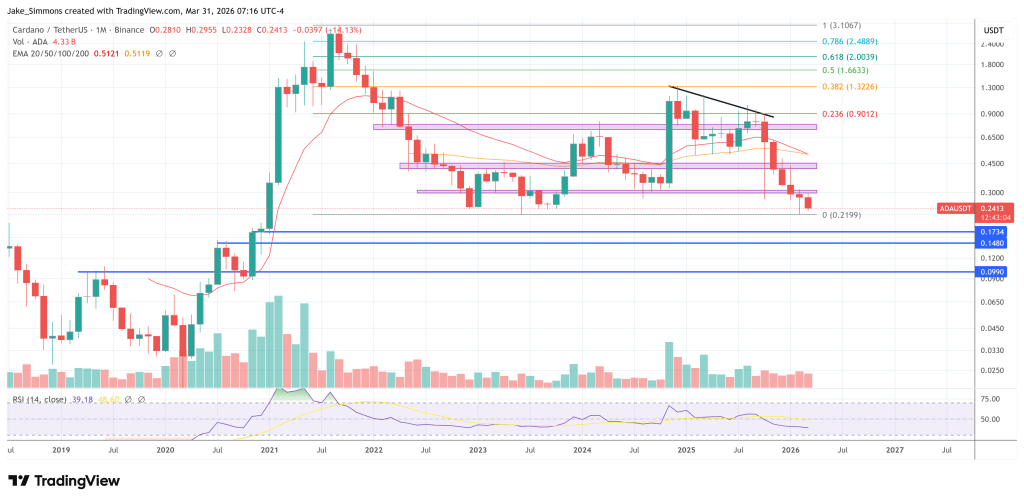
Cardano hovers below key resistance, 1-monthly chart | Source: ADAUSDT on TradingView.com

Criptos en tendencia

Preguntas relacionadas

QWhat is the significance of the mainnet launch for Midnight, as announced by Charles Hoskinson?

AThe mainnet launch marks the debut of the privacy-focused network Midnight, a high-profile infrastructure project within the Cardano ecosystem, and represents a major milestone for the broader Cardano ecosystem.

QHow does Midnight's initial 'guarded era' phase operate, according to the announcement?

AIn the initial 'guarded era,' Midnight operates with a strong federated network of node operators under explicit participation rules, prioritizing operational stability and security. This controlled production phase includes an active bug-fix queue and is designed to harden the system before progressing toward a more decentralized model.

QWhat key technical feature does Midnight use to ensure privacy for its users?

AMidnight uses a hybrid ledger architecture that combines public and private data, employs client-side generation of zero-knowledge proofs to keep sensitive data on user devices, and supports selective disclosure for authorized viewing of specific records without exposing all transaction data.

QWhat is the economic model of Midnight, and how does it differ from conventional blockchain networks?

AMidnight uses a dual-token model: NIGHT acts as the unshielded governance and utility token, while DUST functions as a renewable transaction resource that regenerates over time based on NIGHT holdings. This design aims to make transaction costs more predictable and allow developers to subsidize end-user usage, differentiating it from conventional gas-token networks.

QWhat did Charles Hoskinson announce alongside the mainnet launch to support broader education on the technology?

ACharles Hoskinson announced the publication of a free book titled 'Proving Nothing: A Complete Guide to Zero-Knowledge Proof Systems,' aimed at providing a comprehensive overview of ZK systems for non-technical readers.

Lecturas Relacionadas

Base Under Pressure

**Title: The Pressure Mounts for Base** Base, the Ethereum Layer 2 scaling solution backed by Coinbase, is facing significant pressure and public scrutiny from its leadership following the launch of Robinhood Chain. Base co-founder Jesse Pollak recently acknowledged strategic missteps, admitting that the chain's past focus on social and creator tokens (e.g., through Farcaster, Zora) failed to deliver sustainable adoption. He has refocused on core infrastructure, handing leadership of the Base App back to Coinbase's Cobie. While Base remains a top L2 contender alongside OP Mainnet and Arbitrum, and boasts the highest TVL (nearly $12B), its weaknesses are being highlighted by the new competitor. Key criticisms include its slow progress on decentralization. Base has faced issues with its single sequencer causing block production halts, and L2BEAT is reportedly considering downgrading its decentralization rating from Stage 1 to Stage 0. This contrasts sharply with the rapid initial success of Robinhood Chain, whose DEX quickly entered the top five by volume. The leadership styles of the parent companies are also being compared: Robinhood's CEO actively engages with new projects, while a recent incident where Coinbase's Brian Armstrong briefly changed his profile picture—sparking and then crashing a related meme token—drew community ire and mockery. Pollak stated Base is working with Coinbase on tokenized stocks backed 1:1 by real equity, differentiating it from Robinhood's derivatives model. However, the article argues that Base's most urgent task is to address its long-standing technical and trust issues. With more traditional finance players likely to emulate Robinhood's path, Base must use this competitive pressure to solidify its position as long-term financial infrastructure.

Foresight NewsHace 10 min(s)

Base Under Pressure

Foresight NewsHace 10 min(s)

White House Concession Removes Ethical Hurdle, Clarity Act Races Against Final Window Before Recess?

On July 21st, industry sources reported that the Trump administration has agreed to include an ethics provision in the "Clarity Act" (Digital Asset Market Clarity Act of 2025). This concession addresses the long-standing conflict-of-interest concerns regarding government officials and the crypto industry, potentially removing the final major obstacle to the bill's progress. Additionally, Patrick Witt, the executive director of the White House's Digital Asset Advisory Committee, confirmed he will remain in his role to help finalize the bill, alleviating previous concerns about his potential departure. The Clarity Act aims to establish a unified federal regulatory framework for the U.S. digital asset market. Its core objective is to resolve regulatory ambiguity by defining different types of digital assets (digital commodities, investment contract assets, and permitted payment stablecoins) and clarifying the respective oversight roles of the SEC and CFTC. This would end the long-running jurisdictional dispute between the two agencies and provide clearer compliance paths for the industry. With the ethics issue moving toward resolution, the most urgent challenge now is time. The U.S. Congress is set to begin its August recess in mid-August, leaving only a few working weeks to finalize the text and advance the bill through the Senate. Industry advocates, like the Blockchain Association's Kristin Smith, stress that this is a critical moment. If negotiations conclude successfully in the coming weeks, the Clarity Act could pass a key hurdle before the recess; otherwise, it may face significant delays. If enacted, the Clarity Act could mark a historic turning point in crypto regulation. By providing a clearer and more predictable legal framework, it aims to reduce uncertainty for businesses, developers, and traditional financial institutions looking to enter the digital asset space, potentially setting a global benchmark for market structure regulation.

Odaily星球日报Hace 16 min(s)

White House Concession Removes Ethical Hurdle, Clarity Act Races Against Final Window Before Recess?

Odaily星球日报Hace 16 min(s)

AI Era, Industrial Revolution, and Future Civilization Interview — Zhang Dingwen: The Future Does Not Belong to Chasers

"AI Era, Industrial Revolution and Future Civilization: An Interview with Zhang Dingwen – The Future Does Not Belong to Those Who Chase" In this interview, entrepreneur Zhang Dingwen reflects on his entrepreneurial journey and philosophy, moving beyond discussions of financing or success to emphasize understanding the "era" itself. He argues that true entrepreneurs should not chase short-term trends ("winds"), but position themselves in the direction of long-term technological and societal evolution. Zhang shares key lessons from his early days, including the realization that user value does not automatically translate to commercial value. For him, the core of entrepreneurship is not building a company but constantly upgrading one's own "cognition" – the ability to interpret information, ask the right questions, and understand the underlying "causes" behind business outcomes, not just the effects. His thinking has evolved from a focus on creating good products to a strategic focus on building "entrances" – platforms that naturally connect users to digital services. He sees smart wearables, like watches, not merely as hardware but as potential future gateways combining technological, financial, social, and even fashion attributes to create sustained user relationships and ecosystems. Ultimately, Zhang's vision transcends individual products or companies. He discusses business competition in three stages: product, platform, and finally, "civilization" – where the greatest companies influence how society operates by defining new rules and ways of life. He believes the mission of a truly great enterprise is to solve problems of its time, build enduring trust, and contribute lasting value, leaving behind not just wealth but a positive impact on how the world works. The future, he concludes, belongs not to the fastest, but to those with the correct long-term direction and a commitment to continuous learning and evolution.

marsbitHace 27 min(s)

AI Era, Industrial Revolution, and Future Civilization Interview — Zhang Dingwen: The Future Does Not Belong to Chasers

marsbitHace 27 min(s)

Cryptocurrency & Stock Market Barometer丨Strategy Cash Reserves Increase to $3.23 Billion, Halting BTC Purchases; Vanguard and Other Asset Managers Increase Holdings in Strategy Stock (July 21)

Market Overview & Warnings: The article warns of high volatility in South Korean stocks and continued dependence on U.S. stocks on geopolitics. Chinese A-shares remain under pressure. It advises against using leverage in current equity markets. For crypto-linked stocks, most have limited growth except Robinhood, with caution advised. U.S. Stock Market: Bearish bets on U.S. stocks, particularly targeting AI-related companies, have reached record highs since 2010, signaling deep skepticism about the sustainability of the AI-driven rally. Tech and chip stocks led a market decline, with the Philadelphia Semiconductor Index potentially entering a bear market. Increased expectations for Federal Reserve interest rate hikes and geopolitical tensions contributed to the negative sentiment. Bitcoin Treasury Company Updates: * Strategy: Increased its cash reserves to $3.23 billion and paused Bitcoin purchases. Several major asset managers, including Vanguard Group and Capital Group, increased their holdings of Strategy (MSTR) stock. * Global corporate Bitcoin buying slowed significantly to just $1.33 million last week. * Other notable activity: Strive purchased 21 BTC; ORANGE JUICE raised $40 million for Bitcoin acquisitions; Bitcoin Japan Corp. raised $60 million, allocating $4.08 million for its first BTC purchase. Other Crypto Treasury Holdings: * Ethereum: BitMine increased its ETH holdings to 5.78 million, nearing its 5% of supply goal. Its total crypto assets, cash, and securities are valued at $11.5 billion. * Solana: No significant corporate treasury activity reported. * Altcoins: HypeStrat made no adjustments to its treasury; its mNAV ratio fell to a long-term low. (Note: This summary is for informational purposes only and does not constitute investment advice.)

marsbitHace 28 min(s)

Cryptocurrency & Stock Market Barometer丨Strategy Cash Reserves Increase to $3.23 Billion, Halting BTC Purchases; Vanguard and Other Asset Managers Increase Holdings in Strategy Stock (July 21)

marsbitHace 28 min(s)

Trading

Spot

Artículos destacados

Cómo comprar ADA

¡Bienvenido a HTX.com! Hemos hecho que comprar Cardano (ADA) sea simple y conveniente. Sigue nuestra guía paso a paso para iniciar tu viaje de criptos.Paso 1: crea tu cuenta HTXUtiliza tu correo electrónico o número de teléfono para registrarte y obtener una cuenta gratuita en HTX. Experimenta un proceso de registro sin complicaciones y desbloquea todas las funciones.Obtener mi cuentaPaso 2: ve a Comprar cripto y elige tu método de pagoTarjeta de crédito/débito: usa tu Visa o Mastercard para comprar Cardano (ADA) al instante.Saldo: utiliza fondos del saldo de tu cuenta HTX para tradear sin problemas.Terceros: hemos agregado métodos de pago populares como Google Pay y Apple Pay para mejorar la comodidad.P2P: tradear directamente con otros usuarios en HTX.Over-the-Counter (OTC): ofrecemos servicios personalizados y tipos de cambio competitivos para los traders.Paso 3: guarda tu Cardano (ADA)Después de comprar tu Cardano (ADA), guárdalo en tu cuenta HTX. Alternativamente, puedes enviarlo a otro lugar mediante transferencia blockchain o utilizarlo para tradear otras criptomonedas.Paso 4: tradear Cardano (ADA)Tradear fácilmente con Cardano (ADA) en HTX's mercado spot. Simplemente accede a tu cuenta, selecciona tu par de trading, ejecuta tus trades y monitorea en tiempo real. Ofrecemos una experiencia fácil de usar tanto para principiantes como para traders experimentados.

1.5k Vistas totalesPublicado en 2024.12.10Actualizado en 2026.06.02

Cómo comprar ADA

Discusiones

Bienvenido a la comunidad de HTX. Aquí puedes mantenerte informado sobre los últimos desarrollos de la plataforma y acceder a análisis profesionales del mercado. A continuación se presentan las opiniones de los usuarios sobre el precio de ADA (ADA).

活动图片