Cardano Founder Hoskinson Says He’s ‘Taking A Break’: Here’s What Happened

bitcoinistPublicado a 2026-06-04Actualizado a 2026-06-04

Resumen

Cardano founder Charles Hoskinson announced he is "taking a break" on X, following a tense livestream where he expressed frustration over his limited power within Cardano's decentralized governance system. This comes amid growing ecosystem pressures, highlighted by the shutdown of the key analytics platform TapTools due to senior departures and rising costs. Hoskinson argued that Cardano's governance, designed to shift control to the community, now leaves him with no unilateral authority over the treasury, protocol upgrades, or brand infrastructure. He noted he is often blamed for ADA's price and ecosystem issues despite having no direct control. This dynamic was recently seen when a Cardano Foundation funding proposal for a 2026 summit was rejected by the community vote. The situation underscores a central tension for Cardano: its governance can reject major spending but may struggle to act swiftly to support critical infrastructure during a downturn. Hoskinson's break reflects the personal strain of this decentralized model, where founder influence is intentionally limited.

Charles Hoskinson, the founder of Cardano and CEO of Input Output, abruptly told followers on X that he is “taking a break,” following a tense livestream on June 2 in which he questioned what power he actually has to stop project failures and funding disputes inside Cardano’s decentralized governance system.

The post was brief: “I’m taking a break. TTYL.” Hoskinson gave no explicit explanation. But the timing points to a broader frustration that has been building around Cardano’s ecosystem funding, the shutdown of TapTools, and the practical consequences of Voltaire-era governance moving authority away from founding entities and toward on-chain decision-making.

TapTools Shutdown Puts Cardano Governance Under Pressure

TapTools, one of the most visible analytics and data platforms in the Cardano ecosystem, said it would wind down operations after nearly four years, citing a series of senior departures and rising operating costs. According to the platform, both co-founders, its chief operating officer and chief technology officer had already left earlier this year. A backend developer who stepped into the CTO role later also departed, leaving the company without technical capacity it said could not be replaced quickly enough to keep the platform running responsibly.

The shutdown clearly hit a nerve. In his livestream, Hoskinson warned that the second half of the year could bring further stress across Cardano DeFi.

“So this year is going to be very hard. The second half of the year for Cardano, we’re probably going to see more dApps in DeFi die and a consolidation happen. I’m not exactly sure what my role or place is to resolve this.”

His core argument was not that Cardano lacked resources, but that the network’s governance and funding architecture no longer gives him unilateral control over those resources. Hoskinson said he is often blamed for ADA’s market performance and ecosystem setbacks, while having no direct command over the treasury, protocol upgrades or brand infrastructure.

“You know, I keep getting criticized relentlessly online. People every single day post on my Twitter feed the price of ADA and blame me for it collapsing. And I’d really like to know, I just like to understand what my agency is here.”

Hoskinson Says He Lacks Control

The comments reflect a deeper tension in Cardano’s current phase. Cardano’s governance system was designed to shift control from founding entities to ADA holders, delegated representatives and other governance bodies. That structure gives the community more formal authority over treasury withdrawals and protocol decisions, but it also makes emergency coordination more difficult when key ecosystem companies are under pressure.

The same governance dynamic was visible days earlier when the Cardano Foundation canceled Cardano Summit 2026 in Singapore after its treasury funding proposal failed to reach the required two-thirds approval threshold. A revised request for roughly 7.8 million ADA received majority support but still fell short, while a smaller EMURGO proposal for a Cardano presence at TOKEN2049 Singapore was approved.

For Hoskinson, TapTools appears to have become a case study in the limits of founder influence after decentralization. He said the resources intended to grow and govern the ecosystem were assigned to separate entities, not to him personally.

“I don’t have any special powers with Cardano. I don’t have any governance keys. I don’t have any ability to even initiate a hard fork, much less a protocol parameter change. I don’t have access to the treasury. I don’t even own the trademark for the name Cardano.”

He continued: “All of the funding that was given for growing the ecosystem and governing the ecosystem was given to separate entities. And at the all-time high, it was billions of dollars. It was not given to me.”

The episode leaves Cardano facing an uncomfortable test. Its governance system is now powerful enough to reject major spending requests, including those from core ecosystem institutions. The harder question is whether it can also move quickly enough to preserve critical infrastructure during a market downturn without recreating the centralized dependency it was designed to remove.

At press time, ADA traded at $0.1886.
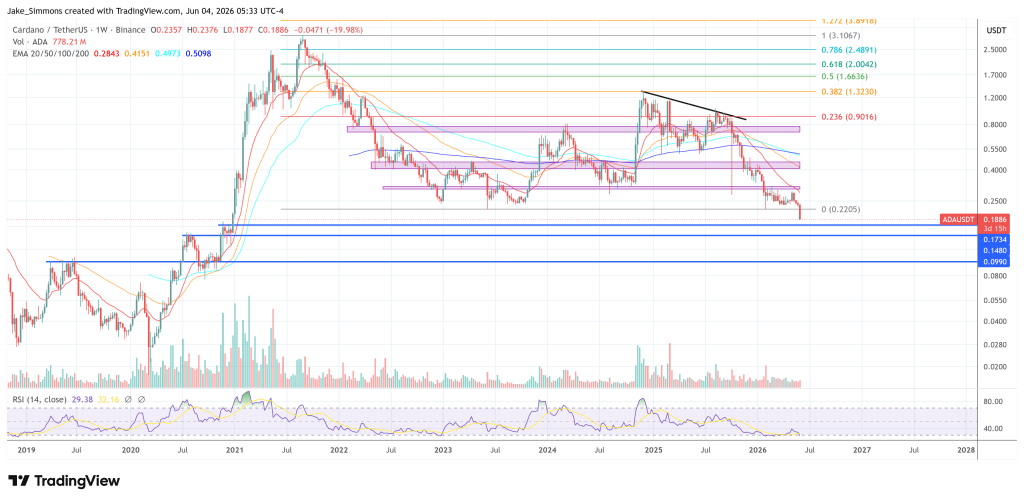
ADA drops below key support, 1-day chart | Source: ADAUSDT on TradingView.com

Preguntas relacionadas

QWhy did Charles Hoskinson announce he is taking a break?

ACharles Hoskinson announced he is taking a break after a tense livestream where he expressed frustration over his limited power to intervene in project failures and funding disputes within Cardano's decentralized governance system.

QWhat recent event contributed to the pressure on Cardano's governance?

AThe recent shutdown of TapTools, a major analytics and data platform in the Cardano ecosystem, contributed significantly to the pressure. It highlighted challenges in ecosystem funding and the practical difficulties of decentralized governance during market stress.

QAccording to Hoskinson, what does he lack control over in the Cardano ecosystem?

AHoskinson stated he lacks unilateral control over key aspects of Cardano. He has no governance keys, cannot initiate hard forks or protocol changes, has no access to the treasury, and does not own the Cardano trademark. Funding for ecosystem growth was allocated to separate entities, not to him personally.

QWhat was the outcome of the Cardano Foundation's proposal for Cardano Summit 2026?

AThe Cardano Foundation's treasury funding proposal for Cardano Summit 2026 in Singapore failed to reach the required two-thirds approval threshold. A revised request for about 7.8 million ADA received majority support but still fell short, leading to the event's cancellation.

QWhat broader challenge for Cardano does the TapTools shutdown and funding disputes illustrate?

AThese events illustrate the broader challenge of whether Cardano's decentralized governance system, while effective at preventing centralized control, can act quickly and decisively enough to preserve critical ecosystem infrastructure and respond to emergencies during a market downturn.

Lecturas Relacionadas

Will the Next Crypto Bull Run Start with On-Chain Trading of SpaceX?

This article presents a scenario-based forecast for the crypto industry from 2026 to 2029, arguing that the next major cycle will be driven not by technological narratives but by legal access to real-world assets. The author predicts that by mid-2026, pre-IPO perpetual contracts for top private companies like SpaceX, OpenAI, and Anthropic on platforms like Hyperliquid will become the primary gateway for accessing quality assets, as most crypto-native tokens fail to capture real value. The much-hyped AI x Crypto intersection largely fails except for prediction markets, which thrive on betting on AI model supremacy. By 2027, public blockchain foundations are forced to choose between catering to retail speculation or building compliant infrastructure for institutions, with many opting for the latter. Growth in stablecoins and tokenized private credit/equity hits a "triple ceiling" due to regulatory and political uncertainty rather than market demand. The pivotal shift is forecast for 2028. A major liquidation event in pre-IPO perpetuals exposes the structural flaw of synthetic markets lacking a real underlying asset anchor. In response, regulatory changes finally allow the public solicitation of private securities resales to verified accredited investors. This creates a legitimate secondary market for real company equity, which then becomes the core asset class of the new bull market, relegating synthetic perps to a niche role. By 2029, the industry becomes "boring" but foundational. Tokens without claims on real cash flows or assets cease trading. Stablecoin growth is steady but politically capped. Crypto infrastructure fades from view as it gets absorbed into traditional finance backends. The article's central thesis is that the key bottleneck for crypto's next phase is legal and regulatory channels for real asset ownership, not technology.

marsbitHace 25 min(s)

Will the Next Crypto Bull Run Start with On-Chain Trading of SpaceX?

marsbitHace 25 min(s)

The Value Distribution of Stablecoins

**Summary: The Value Distribution of Stablecoins** The article argues that stablecoins are evolving from mere trading tools into broader channels for dollar access. It divides the stablecoin ecosystem into four layers to analyze how value is distributed: 1. **Issuance Layer:** Mints stablecoins, holds reserve assets, and captures the spread between reserve yield and user costs (e.g., Tether, Circle). This layer currently earns the largest profit margin. 2. **Infrastructure Layer:** Connects stablecoins to the traditional financial system, handling fiat on/off-ramps, banking integration, compliance (KYC/AML), and asset management (e.g., Bridge, BVNK). This is the "unglamorous" but critical work, building the essential bridges between crypto and real-world finance. 3. **Acquiring/Distribution Layer:** Integrates stablecoins into merchant systems, manages payment flows, and provides enterprise financial software (e.g., Stripe, Coinbase). They act as the access point for businesses. 4. **Application Layer:** The end-users and businesses that ultimately use stablecoins for payments, settlements, or as a store of value. They benefit from convenience but have little pricing power. The core thesis is that while the issuance layer currently dominates profits, the often-overlooked **infrastructure layer holds significant long-term potential**. The real challenge and barrier to mass adoption is not the on-chain transfer of stablecoins (which is simple), but the complex "last mile" integration into existing business workflows, banking systems, and regulatory frameworks across different countries. Companies in this layer are currently in a "land grab" phase, investing heavily to build networks, secure bank partnerships, and establish compliance pathways. While their position is currently pressured by the profitable issuers above and distribution platforms below, the article suggests that if stablecoins become a default financial rail for businesses, the infrastructure providers who have done the hard work of integration will ultimately gain strong pricing power and become entrenched, essential players.

marsbitHace 7 hora(s)

The Value Distribution of Stablecoins

marsbitHace 7 hora(s)

The Value Distribution of Stablecoins

The Value Distribution of Stablecoins The article argues that stablecoins are evolving from a mere trading tool into a broad "dollar channel." It analyzes the industry's value chain through four layers: 1. **Issuance Layer (e.g., Tether, Circle):** The top layer that mints stablecoins, holds reserve assets, and captures the thickest interest rate spread. 2. **Infrastructure Layer (e.g., Bridge, BVNK):** Connects stablecoins to the traditional financial system, handling critical but complex "dirty work" like fiat on/off-ramps, banking integration, compliance (KYC/AML), and cross-border settlement. 3. **Acquiring/Distribution Layer (e.g., Stripe, Coinbase):** Embeds stablecoins into merchant systems, manages payment flows, and integrates with enterprise software. 4. **Application Layer:** End-users and businesses that ultimately use stablecoins for payments, settlement, or storing value. The author posits that while the issuance layer currently captures the most profit, the most overlooked and potentially critical layer is infrastructure. The core challenge for stablecoin adoption isn't the on-chain transfer (which is simple), but bridging the gap between blockchain and the real-world financial system. This involves solving practical problems for businesses: fiat conversion, reconciliation, tax handling, and user onboarding. Infrastructure companies are currently in a difficult "land-grab" phase—building networks, securing banking relationships, and achieving compliance country-by-country. They face pressure from both the profitable issuance layer above and distribution platforms below. However, the author suggests this layer is building a crucial moat. Once stablecoins become a default business rail, the infrastructure players who have done the hard work of integration may gain significant, durable value and pricing power.

链捕手Hace 7 hora(s)

The Value Distribution of Stablecoins

链捕手Hace 7 hora(s)

Trading

Spot
Futuros

Artículos destacados

Cómo comprar ADA

¡Bienvenido a HTX.com! Hemos hecho que comprar Cardano (ADA) sea simple y conveniente. Sigue nuestra guía paso a paso para iniciar tu viaje de criptos.Paso 1: crea tu cuenta HTXUtiliza tu correo electrónico o número de teléfono para registrarte y obtener una cuenta gratuita en HTX. Experimenta un proceso de registro sin complicaciones y desbloquea todas las funciones.Obtener mi cuentaPaso 2: ve a Comprar cripto y elige tu método de pagoTarjeta de crédito/débito: usa tu Visa o Mastercard para comprar Cardano (ADA) al instante.Saldo: utiliza fondos del saldo de tu cuenta HTX para tradear sin problemas.Terceros: hemos agregado métodos de pago populares como Google Pay y Apple Pay para mejorar la comodidad.P2P: tradear directamente con otros usuarios en HTX.Over-the-Counter (OTC): ofrecemos servicios personalizados y tipos de cambio competitivos para los traders.Paso 3: guarda tu Cardano (ADA)Después de comprar tu Cardano (ADA), guárdalo en tu cuenta HTX. Alternativamente, puedes enviarlo a otro lugar mediante transferencia blockchain o utilizarlo para tradear otras criptomonedas.Paso 4: tradear Cardano (ADA)Tradear fácilmente con Cardano (ADA) en HTX's mercado spot. Simplemente accede a tu cuenta, selecciona tu par de trading, ejecuta tus trades y monitorea en tiempo real. Ofrecemos una experiencia fácil de usar tanto para principiantes como para traders experimentados.

1.5k Vistas totalesPublicado en 2024.12.10Actualizado en 2026.06.02

Cómo comprar ADA

Discusiones

Bienvenido a la comunidad de HTX. Aquí puedes mantenerte informado sobre los últimos desarrollos de la plataforma y acceder a análisis profesionales del mercado. A continuación se presentan las opiniones de los usuarios sobre el precio de ADA (ADA).

活动图片