Cardano Founder Hoskinson Just Released A Free Book On Zero-Knowledge

bitcoinistPublicado a 2026-03-30Actualizado a 2026-03-30

Resumen

Cardano founder Charles Hoskinson has released a free, 357-page book titled "Proving Nothing: A Layered Guide to Zero-Knowledge Proof Systems" under a Creative Commons license. Designed as a non-technical introduction, the book uses a seven-layer framework to explain ZK systems, covering topics from cryptography and proof systems to private smart contracts and zkVMs. Hoskinson stated the project aims to address the low understanding of ZK technology and also serves as an introduction to Midnight, Cardano’s privacy-focused network. The book is intended to be a living document, with plans to update it as Midnight develops and new advancements emerge.

Cardano founder Charles Hoskinson has released a free book aimed at explaining zero-knowledge systems to a broader crypto audience, framing it as both an educational project and an on-ramp into Midnight, Cardano’s privacy-focused network. The linked GitHub repository shows the work is being published under a Creative Commons Attribution 4.0 license, while the latest public release is now titled Proving Nothing: A Layered Guide to Zero-Knowledge Proof Systems.

Cardano Founder Drops Free 337-Page ZK Book

In a March 27 livestream, Hoskinson said the project grew out of what he described as a “shockingly low level of understanding” around zero-knowledge proofs and ZK cryptography. “So I wrote a 337 page book over the last few months,” he said. He described it as a non-technical manual, though one that still contains a significant amount of technical material, built around a seven-layer framework for understanding how ZK systems are designed from setup and languages down to proof systems, cryptography, and the verification environment.

That structure is central to the pitch. The Cardano founder said the framework is meant to help readers “understand all ZK systems from that lens,” then move upward into adjacent privacy-enhancing technologies and, eventually, Midnight itself. The repository’s README makes the same case in more formal language, describing the book as a guide to “the entire zero-knowledge stack from the ground up” and arguing that ZK systems do not remove trust so much as decompose it into smaller, testable pieces.

The Midnight angle is not incidental. Hoskinson explicitly presented the book as “a good way of introducing Midnight to people,” and said one chapter is dedicated to the network, even if the broader work is designed as a general introduction to zero-knowledge.

He also said the book goes beyond the seven-layer model into private smart contracts, the Aleo-linked ZEXE model, Midnight’s Kachina system, zkVMs, STARK-to-SNARK pipelines, and the wider market landscape for privacy and proof systems.

That scope has already expanded since the version Hoskinson described on video. The GitHub release notes for v1.10, published on March 30, show the book was renamed from The Seven-Layer Magic Trick to Proving Nothing, and now ships in both EPUB and PDF formats. The file inventory in that release lists a 357-page dark-mode PDF, while the chapter notes show edits and additions across 14 chapters, including sections on zkVMs, market structure, eIDAS 2.0, rollups, and a more detailed Midnight case study.

Hoskinson also made clear that this is not a static publication. “This is the first edition, version 1.01,” he said in the livestream. “I’ll keep adding and changing and work on it throughout the weekends as more things come up and as more stuff in Midnight gets launched, I’ll add to this.” That matters because the book appears designed less as a one-off manifesto than as a living educational document tied to Midnight’s rollout and the broader commercialization of privacy tech.

At press time, Cardano traded at $0.2468.
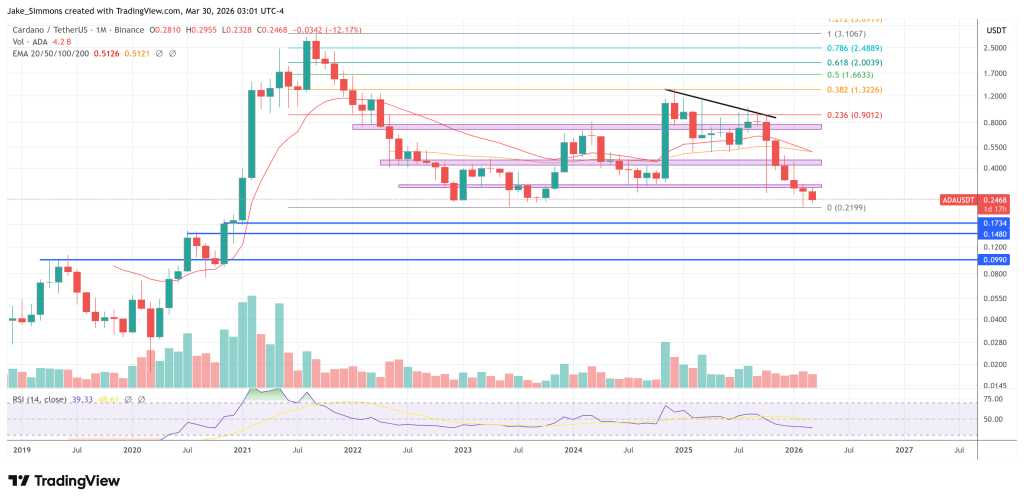
Cardano hovers below key resistance, 1-monthly chart | Source: ADAUSDT on TradingView.com

Preguntas relacionadas

QWho is the author of the free book on zero-knowledge systems and what is the book's title?

AThe author is Charles Hoskinson, the founder of Cardano, and the book is titled 'Proving Nothing: A Layered Guide to Zero-Knowledge Proof Systems'.

QWhat was the primary motivation for Charles Hoskinson to write this book?

AHe was motivated by what he described as a 'shockingly low level of understanding' around zero-knowledge proofs and ZK cryptography, aiming to provide an educational resource for a broader audience.

QHow is the book structured to help readers understand zero-knowledge systems?

AThe book is built around a seven-layer framework that explains how ZK systems are designed, from setup and languages down to proof systems, cryptography, and the verification environment.

QWhat is the connection between this book and the Midnight network?

AThe book is framed as an educational on-ramp into Midnight, Cardano's privacy-focused network, with one chapter dedicated to it and the broader work designed to introduce people to the technology behind it.

QIs the book a static publication, and what is its current version and format?

ANo, it is a living document that will be updated. The current version at the time of the article is v1.10, and it is available in both EPUB and PDF formats.

Lecturas Relacionadas

Anthropic's IPO Launch: Commercial Miracle or Valuation Bubble?

Anthropic has confidentially filed for an IPO, led by Morgan Stanley and Goldman Sachs, potentially going public by October. Following its latest $650 billion funding round, its pre-IPO valuation stands at $965 billion, with projections reaching up to $2 trillion at listing, which would make it the highest-valued private company ever. The article, written by Fu Sheng, addresses skepticism that this represents an AI bubble akin to the 2000 dot-com crash. It argues the current situation differs fundamentally. Unlike the internet bubble era, which relied on speculative narratives with little revenue, Anthropic's valuation is backed by unprecedented, measurable financial performance. Key data points include: * **Revenue Growth:** ARR skyrocketed from $10 billion in early 2025 to $470 billion by May 2026, targeting $100 billion by year-end—a growth curve unmatched in business history. * **Profitability:** It achieved operating profitability in Q2 2026 with an estimated $5.6 billion profit. * **Efficiency:** With ~3,000 employees and ~$470 billion ARR, its revenue per employee exceeds $10 million. Products like Claude Code, launched less than a year ago, already generate $25 billion in annualized revenue. * **Enterprise Adoption:** It boasts a strong enterprise client base, with 8 of the Fortune 10 and over 1,000 large firms spending over $1 million annually on Claude. The valuation is framed using a traditional SaaS model (e.g., a 10x Price-to-Sales multiple on $100 billion revenue). The author contends the core question for analysts has shifted from "How big could this be?" to "How much is it earning and will earn next quarter?" The discussion extends beyond Anthropic to a broader paradigm shift: the transition from a "carbon-based" to a "silicon-based" economy. Companies are increasingly prioritizing investment in compute and AI capabilities over human resources, as these directly scale productivity and competitive advantage. Anthropic's IPO is thus positioned not just as a corporate milestone, but as a price anchor for this new economic era.

链捕手Hace 1 hora(s)

Anthropic's IPO Launch: Commercial Miracle or Valuation Bubble?

链捕手Hace 1 hora(s)

Near Returns to the AI Stage: Transformation into a Public Chain Due to 'Payroll Difficulties,' Agent and Privacy Emerge as New Growth Narratives

NEAR Returns to AI Origins: From Payroll Struggles to Blockchain, Now Focusing on AI Agents and Privacy NEAR Protocol's journey began not with grand blockchain ambitions, but from a practical hurdle: its AI startup founders, including Transformer paper co-author Illia Polosukhin, couldn't efficiently pay international developers in 2017. This led them to pivot and build a high-performance, scalable blockchain. After years navigating various crypto narratives like sharding and cross-chain interoperability, NEAR is now leveraging its AI roots to re-enter the AI arena. A key driver is its "NEAR Intents" layer, which abstracts complex cross-chain transactions. Users simply state their goal (e.g., swap BTC for ETH), and a solver network finds the optimal route. This system has processed over $20B in cross-chain volume, generating significant fee revenue. A major growth area is private transactions via "Confidential Intents/Swaps," which hide trade details until settlement to protect against MEV and front-running. Remarkably, private swaps recently accounted for over 40% of NEAR's transaction volume, highlighting strong demand but also potential regulatory scrutiny. With its AI-founder pedigree, NEAR is positioning itself at the intersection of blockchain, AI agents, and privacy, aiming to become infrastructure for the emerging agent economy while navigating the challenges of its rapid adoption.

marsbitHace 3 hora(s)

Near Returns to the AI Stage: Transformation into a Public Chain Due to 'Payroll Difficulties,' Agent and Privacy Emerge as New Growth Narratives

marsbitHace 3 hora(s)

From Ethereum to AI's 'CROPS': What Exactly is This Set of 'Slow Variables' That Vitalik Repeatedly Emphasizes?

In recent discussions, Vitalik Buterin has frequently emphasized the concept of "CROPS," a framework defining core values for Ethereum's development. CROPS stands for Censorship Resistance, Capture Resistance, Open Source, Privacy, and Security. Initially outlined in the Ethereum Foundation's "EF Mandate," it represents a commitment to user sovereignty, ensuring that the network resists external control, remains open, protects privacy, and prioritizes security. The relevance of CROPS extends beyond Ethereum's foundational principles, becoming crucial in the context of AI integration. As AI agents begin handling wallet operations and automated transactions, the risk increases that users may cede control over their digital assets, privacy, and intentions to centralized AI service providers. A "CROPS AI" would therefore emphasize local execution where possible, privacy-preserving remote model calls (e.g., using zero-knowledge proofs), and transparent, verifiable processes to maintain user agency. Vitalik highlights a significant convergence between "CROPS Ethereum access layer" and "CROPS AI." Both address the same fundamental challenge: how users can access powerful services—be it blockchain data via RPCs or AI models—without exposing sensitive information or relinquishing ultimate control. This intersection points toward a future digital entry point that is more private, secure, and user-controlled. Ultimately, CROPS is not merely an abstract ideal but a practical guidepost. It steers development—from protocol resilience and wallet design to AI agent safety—towards a future where users retain self-sovereignty even as digital systems grow more complex and powerful. In an era of accelerating AI adoption, these "slow variables" of censorship resistance, openness, privacy, and security may define Ethereum's enduring value.

marsbitHace 3 hora(s)

From Ethereum to AI's 'CROPS': What Exactly is This Set of 'Slow Variables' That Vitalik Repeatedly Emphasizes?

marsbitHace 3 hora(s)

Trading

Spot
Futuros

Artículos destacados

Cómo comprar ADA

¡Bienvenido a HTX.com! Hemos hecho que comprar Cardano (ADA) sea simple y conveniente. Sigue nuestra guía paso a paso para iniciar tu viaje de criptos.Paso 1: crea tu cuenta HTXUtiliza tu correo electrónico o número de teléfono para registrarte y obtener una cuenta gratuita en HTX. Experimenta un proceso de registro sin complicaciones y desbloquea todas las funciones.Obtener mi cuentaPaso 2: ve a Comprar cripto y elige tu método de pagoTarjeta de crédito/débito: usa tu Visa o Mastercard para comprar Cardano (ADA) al instante.Saldo: utiliza fondos del saldo de tu cuenta HTX para tradear sin problemas.Terceros: hemos agregado métodos de pago populares como Google Pay y Apple Pay para mejorar la comodidad.P2P: tradear directamente con otros usuarios en HTX.Over-the-Counter (OTC): ofrecemos servicios personalizados y tipos de cambio competitivos para los traders.Paso 3: guarda tu Cardano (ADA)Después de comprar tu Cardano (ADA), guárdalo en tu cuenta HTX. Alternativamente, puedes enviarlo a otro lugar mediante transferencia blockchain o utilizarlo para tradear otras criptomonedas.Paso 4: tradear Cardano (ADA)Tradear fácilmente con Cardano (ADA) en HTX's mercado spot. Simplemente accede a tu cuenta, selecciona tu par de trading, ejecuta tus trades y monitorea en tiempo real. Ofrecemos una experiencia fácil de usar tanto para principiantes como para traders experimentados.

1.5k Vistas totalesPublicado en 2024.12.10Actualizado en 2026.06.02

Cómo comprar ADA

Discusiones

Bienvenido a la comunidad de HTX. Aquí puedes mantenerte informado sobre los últimos desarrollos de la plataforma y acceder a análisis profesionales del mercado. A continuación se presentan las opiniones de los usuarios sobre el precio de ADA (ADA).

活动图片