Cardano Foundation Advances Decentralized Governance With New ADA Delegations To 11 Community DReps

bitcoinistPublicado a 2026-01-22Actualizado a 2026-01-22

Resumen

Cardano Foundation has significantly advanced its decentralization efforts by delegating over 220 million ADA to 11 community Delegated Representatives (DReps). This move strengthens on-chain governance and broadens community participation in decision-making. Additionally, the Foundation self-delegated 171 million ADA to actively engage in governance rather than auto-abstaining. Currently, 36.9% of circulating ADA is delegated to DReps, reflecting growing trust in Cardano’s community-driven model. A recent governance vote saw 67.8% of participants (representing 3.77 billion ADA) supporting the network’s direction, signaling strong community confidence in its future.

Cardano and its vibrant ecosystem are becoming more decentralized as several moves are consistently being made to improve the leading blockchain network. One of these efforts is clearly indicated by the steady expansion of ADA delegation to multiple community DReps across the sector.

More Cardano Delegation To DReps

In a bold and exciting move, the Cardano Foundation has taken another step forward toward deeper and robust decentralization. The Foundation’s goal for deeper decentralization is being carried by expanding its ADA delegation to about 11 community DReps, which strengthens on-chain governance and community participation.

The recent delegation activity was disclosed on Cexplorer, the biggest and most featured OG blockchain explorer, via the social media platform X. The action is in line with Cardano’s changing governance structure, where elected representatives hold a growing amount of decision-making authority instead of fundamental entities.
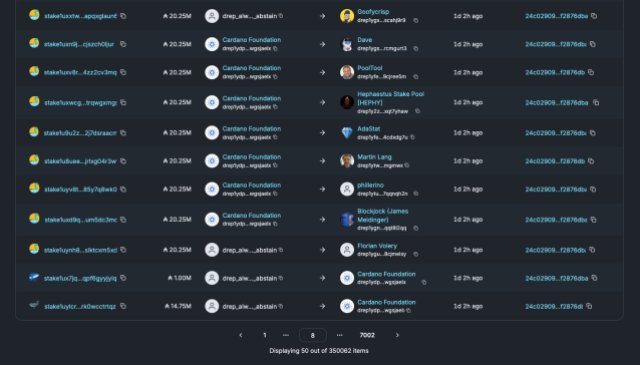
ADA delegations to 11 communities | Source: Chart from Cexplorer on X

As reported by the popular explorer, the Cardano Foundation has delegated over 220 million ADA to the 11 community DReps. By expanding its ADA delegation, the foundation is reaffirming its dedication to openness, diversity, and long-term network resilience, thereby making Cardano more decentralized.

These are the most crucial pillars in the move as the network persistently shifts toward a full community-driven ecosystem. According to the explorer, the Foundation has also self-delegated about 171 million ADA, moving it from an auto-abstain in order for all funds to actively participate in governance.

Delegation Operations Snags A Notable Supply

Following the move, the amount of ADA that has been utilized for delegation activity has increased sharply. A massive wave of ADA delegation signals a growing acceptance of on-chain governance across the broader Cardano ecosystem.

Cexplorer reported that the number has seen steady growth over the past several months. Current data shows that over 36.9% of circulating ADA has been delegated to Cardano DReps, which reflects mounting conviction in the network’s model.

Furthermore, it is a sign that more participants are willing to play a crucial role in shaping the blockchain’s future. Thus, decision-making power is shifting from concentrated entities to community voices as more holders pledge their tokens to designated representatives.

When compared to the stake pool, the explorer data shows that roughly 56% of ADA in circulation is delegated to the area. In the meantime, for delegators to be able to take out their staking rewards, they are expected to delegate to a DRep.

After a recent voting operation, Cardano’s future direction is now quite clear. Over 700 community members and 200 DReps participated in the voting process to decide where the ecosystem should be by 2030.

At the end, 67.80%, representing over 3.77 billion ADA, voted yes to the proposal that the network is moving in the right direction. Meanwhile, the rest, representing 491 million ADA, voted No to the proposal.

ADA trading at $0.36 on the 1D chart | Source: ADAUSDT on Tradingview.com

Criptos en tendencia

Preguntas relacionadas

QWhat is the Cardano Foundation's recent move to advance decentralized governance?

AThe Cardano Foundation has expanded its ADA delegation to 11 community DReps, delegating over 220 million ADA to strengthen on-chain governance and community participation.

QHow much ADA has been delegated to DReps in total according to current data?

ACurrent data shows that over 36.9% of circulating ADA has been delegated to Cardano DReps.

QWhat percentage of ADA in circulation is delegated to stake pools compared to DReps?

ARoughly 56% of circulating ADA is delegated to stake pools, while 36.9% is delegated to DReps.

QWhat was the outcome of the recent voting operation regarding Cardano's future direction?

A67.80% of voters, representing over 3.77 billion ADA, voted 'Yes' that the network is moving in the right direction, while 491 million ADA voted 'No'.

QHow did the Cardano Foundation adjust its own ADA holdings for governance participation?

AThe Foundation self-delegated about 171 million ADA, moving it from an auto-abstain to ensure all funds actively participate in governance.

Lecturas Relacionadas

Claude's Major New Feature: Screen Recording + Voice, Distilling Your Skills into AI Tasks in One Click

Claude has introduced a major new feature called "Record a Skill," available for Pro, Max, and Team users. This function, found in the Claude desktop app's CoWork menu, allows users to create reusable AI skills simply by recording their screen and providing voice narration while performing a task. Claude then automatically analyzes the recording and generates a functional Skill. A hands-on test confirmed the feature works seamlessly. Users start recording via the Skills manager, perform their workflow while verbally explaining the steps and logic, and avoid including sensitive information. After recording, Claude processes the content and creates the Skill, which can be saved and later invoked with a slash command (/). This eliminates the need for manual adjustments or writing complex instruction files. The innovation goes beyond mere efficiency. Previously, creating a Skill required writing a detailed SKILL.md file in Markdown—a significant barrier for non-technical users. "Record a Skill" bypasses this by directly capturing both actions and the implicit reasoning shared in the narration. This lowers the barrier to knowledge transfer and automation, addressing a core challenge in corporate knowledge management: the difficulty of getting experts to write and maintain documentation. However, the feature also highlights a shift in the nature of work. A case study from March 2026 showed a freelancer whose five-year client relationship was effectively replaced by a hand-coded Claude Skill automating their content workflow. With the even lower barrier of screen recording, the ability to distill personal expertise into automatable skills accelerates this trend. The "moat" for work is moving from simply knowing how to do a task to mastering tasks that are difficult or impossible to automate.

marsbitHace 5 min(s)

Claude's Major New Feature: Screen Recording + Voice, Distilling Your Skills into AI Tasks in One Click

marsbitHace 5 min(s)

Feeding AI "Noise" Can Also Boost Scores, This Work Enables Positive Transfer with Noise

Feeding "Noise" to AI Can Improve Performance: A Method Enables Positive Transfer from Noise This work, Semi-Supervised Noise Adaptation (SSNA), introduces a Noise Adaptation Framework (NAF) that challenges traditional transfer learning. Instead of requiring a labeled source domain of real data (e.g., images, text), NAF uses randomly generated Gaussian noise as the source. For a target task with C classes, it constructs C noise clusters by sampling from Gaussian distributions. Although this synthetic noise contains no semantic meaning, NAF trains it to form a discriminative class structure in a shared representation space—clustering same-class noise and separating different classes. The key is aligning this learned structure from the noise domain to the real, sparsely labeled target domain. A small number of target labels are still essential to establish the correspondence between noise clusters and actual classes. The training objective combines: 1) supervised loss on the few labeled target samples, 2) classification loss for the noise to build its structure, and 3) a distribution alignment loss (using Negative Domain Similarity) to minimize the gap between the noise and target domains in the shared space. Experiments show significant gains in few-label settings. With just 4 labels per class, NAF with a ResNet-18 backbone improves accuracy over a standard supervised baseline (ERM) by +12.35% on CIFAR-10, +7.61% on CIFAR-100, +4.38% on DTD-47, and +2.74% on Caltech-101. It also benefits fine-grained datasets and scales to ImageNet-1K (with 100 labels/class) and text classification (AG News). NAF can be integrated into existing semi-supervised methods like FixMatch for further gains. Ablation studies confirm the transferred benefit comes from the discriminative structure of the noise, not randomness itself. Collapsing all noise into a single point causes negative transfer, while increasing separation between noise cluster centers improves performance. The amount of noise per class is less critical once a basic structure forms. In conclusion, this work demonstrates that for positive transfer, the semantic content of source data may not be necessary. What can be effectively transferred is the *organizational structure* of categories within a representation space. This offers a promising alternative for scenarios where real source data is unavailable due to privacy, copyright, or procurement constraints.

marsbitHace 6 min(s)

Feeding AI "Noise" Can Also Boost Scores, This Work Enables Positive Transfer with Noise

marsbitHace 6 min(s)

Trading

Spot

Artículos destacados

Cómo comprar ADA

¡Bienvenido a HTX.com! Hemos hecho que comprar Cardano (ADA) sea simple y conveniente. Sigue nuestra guía paso a paso para iniciar tu viaje de criptos.Paso 1: crea tu cuenta HTXUtiliza tu correo electrónico o número de teléfono para registrarte y obtener una cuenta gratuita en HTX. Experimenta un proceso de registro sin complicaciones y desbloquea todas las funciones.Obtener mi cuentaPaso 2: ve a Comprar cripto y elige tu método de pagoTarjeta de crédito/débito: usa tu Visa o Mastercard para comprar Cardano (ADA) al instante.Saldo: utiliza fondos del saldo de tu cuenta HTX para tradear sin problemas.Terceros: hemos agregado métodos de pago populares como Google Pay y Apple Pay para mejorar la comodidad.P2P: tradear directamente con otros usuarios en HTX.Over-the-Counter (OTC): ofrecemos servicios personalizados y tipos de cambio competitivos para los traders.Paso 3: guarda tu Cardano (ADA)Después de comprar tu Cardano (ADA), guárdalo en tu cuenta HTX. Alternativamente, puedes enviarlo a otro lugar mediante transferencia blockchain o utilizarlo para tradear otras criptomonedas.Paso 4: tradear Cardano (ADA)Tradear fácilmente con Cardano (ADA) en HTX's mercado spot. Simplemente accede a tu cuenta, selecciona tu par de trading, ejecuta tus trades y monitorea en tiempo real. Ofrecemos una experiencia fácil de usar tanto para principiantes como para traders experimentados.

1.5k Vistas totalesPublicado en 2024.12.10Actualizado en 2026.06.02

Cómo comprar ADA

Discusiones

Bienvenido a la comunidad de HTX. Aquí puedes mantenerte informado sobre los últimos desarrollos de la plataforma y acceder a análisis profesionales del mercado. A continuación se presentan las opiniones de los usuarios sobre el precio de ADA (ADA).

活动图片