Cardano, Avalanche, Sui And IOTA Submit Joint UK Crypto Rules Response

bitcoinistPublicado a 2026-02-13Actualizado a 2026-02-13

Resumen

Cardano, Avalanche, Sui, and IOTA have jointly responded to the UK Financial Conduct Authority’s crypto consultation, advocating for regulations that clearly distinguish between custodial and non-custodial crypto activities. They argue that rules should target intermediaries who control user assets—requiring disclosures, consent, and record-keeping—while exempting developers and infrastructure providers who don’t hold custody or exercise unilateral control. The submission emphasizes that staking and DeFi should be regulated uniformly, and obligations should align with actual risks. The goal is to protect consumers without stifling non-custodial, decentralized innovation, ensuring the UK remains a competitive jurisdiction for blockchain technology.

Organisations around Cardano, Avalanche, Sui and IOTA have filed a joint response to the UK Financial Conduct Authority’s CP25/40 consultation, arguing that the rulebook should draw hard lines around “custody and control” and avoid sweeping non-custodial crypto activity into regimes designed for intermediaries.

The submission, led by the IOTA Foundation alongside the Sui Foundation, Cardano Foundation and the Avalanche Policy Coalition, is a targeted push on two areas the group says are most exposed to “scope, proportionality and technical interpretation” problems: staking and decentralized finance.

In a post on X, IOTA framed the core message as a scoping exercise as much as a policy one: “focus on custody & control, keep it proportionate, and support non-custodial, decentralized innovation for UK.”

Cardano, Avalanche, Sui And IOTA Warn Against Overregulation

The open letter expands that into a broader architecture: “A consistent theme across our feedback on both staking and decentralized finance is the importance of clearly distinguishing between infrastructure functions and intermediary functions. We recommend that regulatory obligations remain focused on entities that exercise custody, discretion, or commercial intermediation, while preserving the neutrality of public blockchain infrastructure.”

The letter adds that developers and infrastructure providers should be exempted: “[They] deliver software development, validation, communications, or other protocol-level services without controlling client assets or exercising unilateral decision-making are performing infrastructure roles rather than financial intermediation, and warrant a proportionate and differentiated regulatory treatment.”

That distinction matters, the group argues, because staking and DeFi aren’t single business models. They sit on a spectrum from fully custodial services where a firm safeguards assets and intermediates execution to protocol-native activity where users retain control of keys and assets.

On staking, IOTA’s X thread distilled the policy ask into a binary: “regulation must clearly distinguish custodial vs non-custodial/models.” It adds that custodial staking “where firms safeguard assets” warrants “appropriate retail disclosures, consent + record-keeping,” while “non-custodial/protocol-level staking (no control of user assets/keys) should not be swept into the same regime.”

The letter mirrors that framing and narrows it to where the risk sits: “Where staking is provided through a custodial arrangement, and the firm safeguards client assets and intermediates the staking process, we recommend applying the proposed requirements on information provision, key contractual terms, express prior consent for retail clients, and record-keeping.”

It then draws the line the signatories want the FCA to adopt: “For non-custodial and delegated staking arrangements, where firms do not control client assets or private keys, we recommend that such activities remain outside the scope of regulated staking activity, as this maintains proportionality and aligns regulatory obligations with the actual sources of risk.”

The second pressure point is the FCA’s concept of a “clear controlling person” in DeFi. IOTA’s post argues the term needs a “technical, objective definition,” warning that obligations should scale with “custody, discretion, and unilateral control; not with writing code, participating in governance, or providing neutral infrastructure.”

The open letter keeps the same structure: it accepts the FCA’s intent to capture cases where an identifiable party is “effectively carrying on regulated cryptoasset activities,” but pushes back on triggering regulatory status based on development and infrastructure. Instead, it urges the FCA to anchor expectations to “demonstrable, unilateral control over protocol operation, governance or economic outcomes,” particularly because DeFi “rel[ies] on self-custody, automated execution and open participation.”

IOTA positioned the argument as pro-scope, not anti-rules: “smarter scoping = better consumer protection where risk is real, plus legal certainty that keeps non-custodial innovation from being regulated out of existence.”
The letter closes on the same trade-off: obligations tied to “custody, discretion and unilateral control” would, the group says, “strengthen legal certainty, enhance consumer protection where it is most needed, and reinforce the UK’s position as a jurisdiction that understands the architectural realities of decentralized technologies.”

At press time, Cardano traded at $0.264.
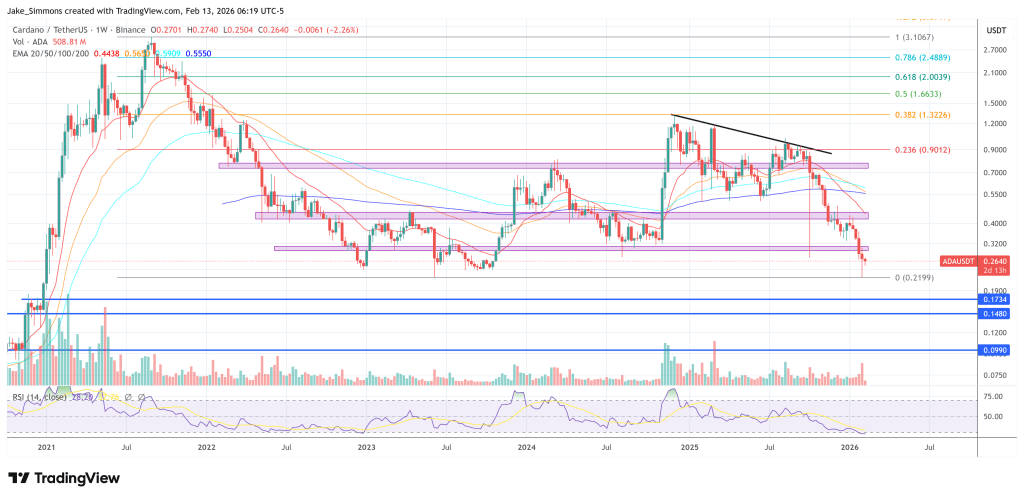
Cardano hovers above key support, 1-week chart | Source: ADAUSDT on TradingView.com

Criptos en tendencia

Preguntas relacionadas

QWhich blockchain organizations jointly submitted a response to the UK Financial Conduct Authority's CP25/40 consultation?

AThe IOTA Foundation, Sui Foundation, Cardano Foundation, and the Avalanche Policy Coalition.

QWhat two areas did the joint submission identify as most exposed to problems of scope, proportionality, and technical interpretation?

AStaking and decentralized finance (DeFi).

QAccording to the open letter, what is the key distinction that should be made in regulation between different types of staking services?

AA clear distinction between custodial staking, where a firm safeguards assets, and non-custodial or protocol-level staking, where users retain control of their keys and assets.

QWhat term used by the FCA in relation to DeFi did the group argue needs a 'technical, objective definition'?

AThe term 'clear controlling person'.

QWhat core principle does the group argue should determine regulatory obligations, rather than writing code or providing neutral infrastructure?

AObligations should be tied to custody, discretion, and unilateral control over assets or protocol operation.

Lecturas Relacionadas

Stablecoins Finally Find Real Yield: An In-Depth Look at On-Chain Reinsurance Re | A Conversation with Re Founder Karan Saroya

Stablecoin Real Yield Found: A Deep Dive into On-Chain Reinsurance with Re's Karan Saroya As stablecoin supply exceeds $170 billion, the search for sustainable, non-speculative yield intensifies. Re, an on-chain reinsurance platform, provides an answer: connecting stablecoin capital to the trillion-dollar traditional reinsurance market. Re operates as a regulated reinsurer, accepting stablecoin deposits as collateral to back US insurance companies. These insurers pay premiums, generating yield that flows back to on-chain depositors. Currently supporting 35 insurers and underwriting $500 million, Re projects scaling to over $1 billion soon. Key insights from a Bankless podcast with founder Karan Saroya and investor Avichal of Electric Capital: 1. **Uncorrelated, Real-World Yield:** Re offers stablecoin holders access to reinsurance returns (targeting 12-14%+), an asset class entirely separate from crypto or equity markets. 2. **Operational Efficiency via Smart Contracts:** Re replaces traditional, labor-intensive capital fundraising with smart contracts, allowing a ~12-person team to compete with industry giants. 3. **Regulatory Leverage:** For every $1 of collateral, regulations allow backing $5-7 in written premiums. This leverage amplifies returns from the underlying risk-free rate. 4. **DeFi Integration:** Depositors receive receipt tokens, which can be used in protocols like Morpho for "looping," potentially pushing yields to 18-20%+. 5. **The "DeFi Mullet" Model:** A compliant front-end (regulated reinsurer) paired with a decentralized back-end (smart contracts, DeFi capital markets). 6. **RE Governance Token:** Modeled on Lloyd's of London, the token governs the central capital pool's allocation, counterparty acceptance, and parameters. 7. **Real Economic Impact:** Capital funds real-world productivity (factories, clinics, businesses) via insurance, moving beyond crypto's internal loops. The discussion highlights a pivotal moment: DeFi's supply-side infrastructure is now met by real demand for productive yield, potentially kickstarting a flywheel where vast on-chain stablecoin capital seeks these real-world returns.

链捕手Hace 32 min(s)

Stablecoins Finally Find Real Yield: An In-Depth Look at On-Chain Reinsurance Re | A Conversation with Re Founder Karan Saroya

链捕手Hace 32 min(s)

1996 or 1999? Walsh's First Test is 'How to View AI'

"1996 or 1999? Wall's First Big Test Is 'How to View AI'" Federal Reserve Chairman Wall's initial challenge is not whether to raise or cut rates, but a more fundamental judgment: what kind of boom is the current AI boom? This will determine the Fed's policy path and define his legacy. Economics is split between two opposing views, according to reporter Nick Timiraos. One sees imminent productivity gains that will increase supply and cool inflation, allowing the Fed to hold steady. The other argues that while productivity benefits are distant, demand shocks are here now, and waiting for data confirmation risks missing the intervention window, forcing sharper rate hikes later. Wall has signaled a leaning toward the first view, echoing 1996-era Alan Greenspan, who embraced strong, productivity-driven growth without fear of inflation. However, Wall faces a different macro environment than Greenspan did, with tariff pressures, expanding fiscal deficits, and diminishing globalization benefits, which could force more significant inflation pressures even if AI benefits materialize. Wall's logic, expressed before taking office, is that AI-driven productivity gains won't show in official data for years. If the Fed waits for confirmation, it might mistakenly tighten policy and choke off the very growth that could suppress inflation. This argues for using forward-looking narratives over lagging data. Chicago Fed President Austan Goolsbee presents a key counter-argument. He distinguishes between expected and unexpected productivity booms. A widely anticipated boom, like the current AI wave, can cause people to spend future wealth gains in advance, overheating the economy before productivity actually rises, thus requiring preemptive rate hikes. He cites rising costs for AI data centers as evidence of such overheating. Fed Governor Christopher Waller offers a rebuttal to Goolsbee, noting the "expected spending" mechanism only works if people can borrow against future income, which many households cannot do due to borrowing constraints. Wall also faces a paradox related to his desire to reduce the Fed's use of "forward guidance" (pre-announcing policy moves). This practice was established in 1999 when Greenspan began signaling hikes to avoid market shocks. If the economy follows a less optimistic path, Wall may be forced to choose between using the guidance he wants to abolish or risking market volatility by staying silent. The ultimate question defining Wall's first major test remains: Is this 1996 or 1999?

marsbitHace 1 hora(s)

1996 or 1999? Walsh's First Test is 'How to View AI'

marsbitHace 1 hora(s)

Ethereum Q1 2026 Report: Fees Decline, Users and Transaction Volume Hit New Highs

Ethereum Q1 2026 Report: Fees Down, Users & Transactions Hit New Highs Token Terminal's Q1 2026 report on Ethereum presents a pivotal development: the network achieved record highs in monthly active users (13.2M, +85.9% YoY), total transactions (200.4M, +81.5% YoY), and throughput (25.78 TPS), while transaction fees on the mainnet plummeted by 47.9% quarter-over-quarter. This shift is attributed to the network's strategic move into a "low fees for scale" phase, exemplified by the Fusaka upgrade which increased data capacity and lowered block space costs, releasing pent-up demand (a manifestation of Jevons's Paradox). The report highlights a core narrative shift for Ethereum: from a DeFi-centric blockchain to a global financial settlement layer. It maintains a dominant position in tokenized assets, holding majority market shares among top chains in stablecoins (61.8%), tokenized funds (73.0%), and tokenized commodities (84.0%). Growth in tokenized funds (+73.1% YoY) and commodities (+325.9% YoY) was particularly strong, driven by institutions like BlackRock and JPMorgan entering the space. Contrasting these usage gains, several USD-denominated value metrics declined in Q1: fully diluted market cap fell 30.3% QoQ, total value locked (TVL) dropped 11.0%, and ecosystem transaction volume decreased 24.0%. The report interprets this as Ethereum prioritizing long-term network expansion and cementing its role as the default settlement layer for finance over short-term fee capture. The commentary from Etherealize argues that, much like the early internet, Ethereum's open, permissionless model is poised to win over closed alternatives as institutional tokenization accelerates.

marsbitHace 3 hora(s)

Ethereum Q1 2026 Report: Fees Decline, Users and Transaction Volume Hit New Highs

marsbitHace 3 hora(s)

He Just Raised 2.7 Billion, and Li Fei-Fei Also Invested

Pete Florence, a former senior research scientist at Google DeepMind and a key contributor to the Vision-Language-Action (VLA) model architecture, is deliberately distancing his startup, Generalist AI, from the trendy "world model" label. He argues that the industry should prioritize concrete goals over buzzwords. His goal is to create robots that can perform a vast range of unseen tasks with high speed and success rates, without needing task-specific training data. Recently, his company raised $400 million (¥2.7 billion) at a $2 billion valuation. Notable investors include NVIDIA's NVentures, Bezos Expeditions, NFDG, as well as Xiaomi co-founder Lin Bin, Zoom founder Eric Yuan, and renowned AI scientist Fei-Fei Li. Florence's approach stems from his academic background at MIT under Professor Russ Tedrake, focusing on understanding the physical world. After joining DeepMind, he developed models like Transporter Network and co-created the VLA framework. He left in 2025 to found Generalist AI. The company has launched two models: GEN-0, which demonstrated that scaling laws apply to physical motion, and GEN-1. GEN-1 was trained on over 500,000 hours of physical interaction data collected via a specialized wearable device. It achieves a 99% success rate on precise mechanical tasks like folding boxes and maintains performance three times faster than its predecessor. Florence believes GEN-1 is reaching a commercial utility threshold similar to the GPT-3 inflection point. The substantial funding round, following GEN-1's release, signifies strong investor confidence in Generalist AI's practical, goal-driven path to creating versatile, useful robots, regardless of the "world model" terminology.

marsbitHace 3 hora(s)

He Just Raised 2.7 Billion, and Li Fei-Fei Also Invested

marsbitHace 3 hora(s)

Trading

Spot
Futuros

Artículos destacados

Cómo comprar ADA

¡Bienvenido a HTX.com! Hemos hecho que comprar Cardano (ADA) sea simple y conveniente. Sigue nuestra guía paso a paso para iniciar tu viaje de criptos.Paso 1: crea tu cuenta HTXUtiliza tu correo electrónico o número de teléfono para registrarte y obtener una cuenta gratuita en HTX. Experimenta un proceso de registro sin complicaciones y desbloquea todas las funciones.Obtener mi cuentaPaso 2: ve a Comprar cripto y elige tu método de pagoTarjeta de crédito/débito: usa tu Visa o Mastercard para comprar Cardano (ADA) al instante.Saldo: utiliza fondos del saldo de tu cuenta HTX para tradear sin problemas.Terceros: hemos agregado métodos de pago populares como Google Pay y Apple Pay para mejorar la comodidad.P2P: tradear directamente con otros usuarios en HTX.Over-the-Counter (OTC): ofrecemos servicios personalizados y tipos de cambio competitivos para los traders.Paso 3: guarda tu Cardano (ADA)Después de comprar tu Cardano (ADA), guárdalo en tu cuenta HTX. Alternativamente, puedes enviarlo a otro lugar mediante transferencia blockchain o utilizarlo para tradear otras criptomonedas.Paso 4: tradear Cardano (ADA)Tradear fácilmente con Cardano (ADA) en HTX's mercado spot. Simplemente accede a tu cuenta, selecciona tu par de trading, ejecuta tus trades y monitorea en tiempo real. Ofrecemos una experiencia fácil de usar tanto para principiantes como para traders experimentados.

1.5k Vistas totalesPublicado en 2024.12.10Actualizado en 2026.06.02

Cómo comprar ADA

Discusiones

Bienvenido a la comunidad de HTX. Aquí puedes mantenerte informado sobre los últimos desarrollos de la plataforma y acceder a análisis profesionales del mercado. A continuación se presentan las opiniones de los usuarios sobre el precio de ADA (ADA).

活动图片