Canopy Introduces ‘Progressive Autonomy’: A New Framework That Makes Launching a Blockchain Easy

TheNewsCryptoPublicado a 2025-12-15Actualizado a 2025-12-15

Resumen

Canopy has introduced "Progressive Autonomy," a new framework designed to simplify blockchain deployment while preserving long-term sovereignty and value capture. This model allows developers to launch a sub-chain secured by Canopy’s validator network, customize it as it grows, and eventually graduate to a fully independent Layer 1 (L1) without rewriting core infrastructure or assembling a costly security budget. The framework addresses the limitations of both L2 rollups, which often sacrifice decentralization and value retention, and traditional L1s, which require significant time, capital, and engineering effort. With shared restaked security from a network of professional validators, projects can launch quickly without relying on token inflation or external security markets. Canopy’s VM-less architecture also supports development in any language and allows execution environment customization. When ready, projects can transition to a sovereign L1, retaining their history, state, and economics while gaining full control over governance and performance. The Betanet is already live with support from leading validators, and mainnet launch is planned for 2026.

Florida, USA, [15 December 2025] Canopy, the company building a next-gen Layer 1 (L1) framework with the simplicity of a Layer 2 (L2), introduces Progressive Autonomy, a new deployment model built to make launching a blockchain dramatically easier while preserving full long-term sovereignty and value capture. The framework provides developers with a complete lifecycle: teams can launch as a sub-chain secured by Canopy’s validator network, customize their chain as it matures, and graduate to an independent L1 without rewriting core infrastructure or assembling a costly security budget.

Progressive Autonomy debuts at a time when the limitations of both L2 rollups and traditional L1 development increasingly constrain teams. Rollups have made deployment simple, but at the cost of centralized sequencers, governance-only tokens, fragmentation, and ecosystems that struggle to retain value.

Sovereign L1s remain the only architecture that consistently captures long-term economics, but building one typically requires over a year of engineering, substantial upfront capital, and custom consensus development. Overall, this clunky and expensive process forces builders to make early trade-offs: either prioritize ease and sacrifice ownership, or pursue sovereignty at prohibitive cost.

Adam Liposky, CEO of Canopy, said:

“Teams were forced into a false choice between simplicity and sovereignty, so we built Canopy to remove that trade off. Sovereignty should mean developers control their network economics and capture value on their own rails. Progressive Autonomy lets teams launch fast, retain long term ownership of their chain, and build toward a future of hundreds of specialized sovereign sub chains owned by the communities behind them.”

The Progressive Autonomy model eliminates the compromises, ensuring that all chains launched on Canopy inherit shared restaked security from a growing network of professional validators, including more than 20 top-tier operators who already joined the platform’s Betanet. This gives new chains protection from day one, without relying on token inflation or external security markets.

Validator sharing removes the need for early-stage projects to assemble and incentivize their own validator sets. This reduces both the time it takes to launch and the operational complexity that’s associated with the process. Canopy’s VM-less architecture enables developers to build in any language and tailor their execution environment as their application scales, without touching consensus or modifying the underlying network.
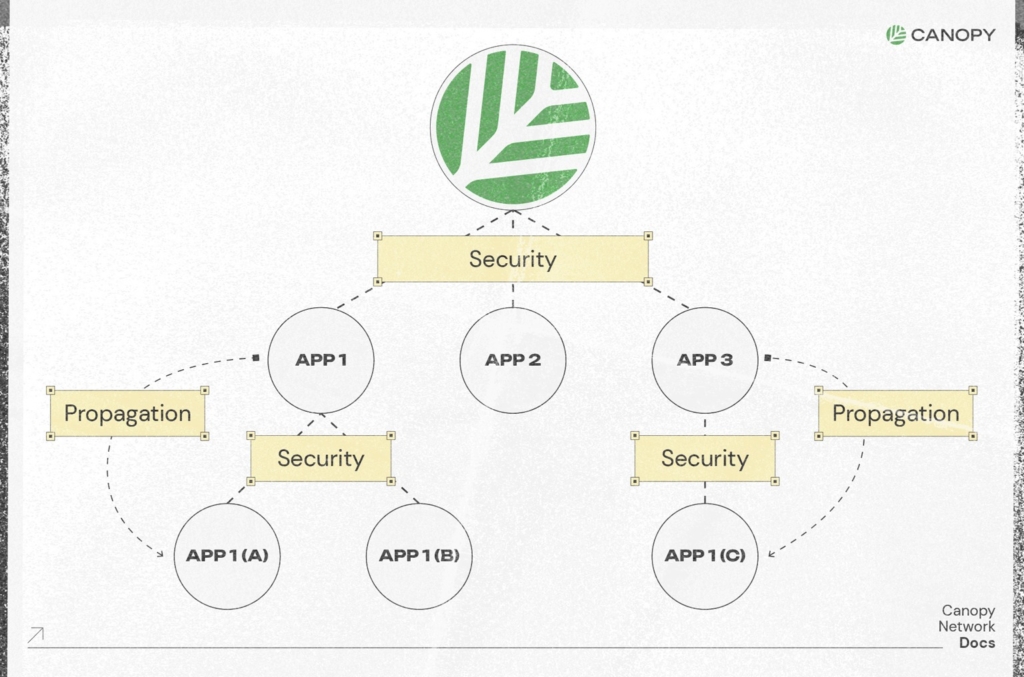
When a project is ready, it can detach from Canopy’s shared security and transition into a full sovereign L1, carrying its history, state, community, and economics with it. The upgrade path preserves continuity for users and developers while granting teams complete control over governance, performance, and value capture. Canopy positions this as a structural shift for the industry. Rather than choosing between an L1 or an L2 at the start, teams can now naturally evolve from incubation to independence as their needs grow.

Andrew Nguyen, Co-Founder and CTO of Canopy, said:

“Progressive Autonomy allows developers to focus entirely on building useful, high-performing applications instead of wrestling with infrastructure. Our goal was to take the security and operational burdens away from the traditional L1 creation and make them completely invisible. When sovereignty becomes accessible, the entire ecosystem will expand and benefit mutually.”

Canopy’s Betanet is already live and supported by leading validators including PierTwo, Stakely, Rhino, Lavender Five, Nodes.Guru, Kingnode, Easy2Stake, and others, signalling early momentum for the shared security approach. The full mainnet launch is planned for 2026, following more than 18 months of development across the core protocol and supporting infrastructure.

About Canopy Network

Canopy makes launching a sovereign blockchain as simple as spinning up an app. Teams can deploy in days, own their network economics, and connect across chains without bridges or wrapped assets. Powered by NestBFT and layerless mesh security, Canopy provides shared protection and built in atomic swaps for every chain on the network. Developers get predictable costs, fast deployment templates, and interoperability from day one.
Website | Twitter/X | Discord | Github


Lecturas Relacionadas

Why Do You Always Lose Money on Polymarket? Because You're Betting on News, While the Pros Read the Rules

Why do you always lose money on Polymarket? Because you bet on news, while the pros study the rules. This article explains how top traders ("che tou") profit by meticulously analyzing market rules, not just predicting events. Polymarket, a prediction market platform, often sees disputes over event outcomes due to ambiguous rule wording. For instance, a market asking "Who will be the leader of Venezuela by the end of 2026?" was misinterpreted by many who bet on Delcy Rodríguez, assuming she held power. However, the rules specified "officially holds" as the formally appointed, sworn-in individual. Since Nicolás Maduro was still recognized as president officially, he won the market—even being in prison. To resolve such disputes, Polymarket uses a decentralized arbitration system via UMA protocol. The process involves: 1. Proposal: Anyone can propose a market outcome by staking 750 USDC, earning 5 USDC if unchallenged. 2. Dispute: A 2-hour window allows challenges with a 750 USDC stake; successful challengers earn 250 USDC. 3. Discussion: A 48-hour period on UMA Discord for evidence and debate. 4. Voting: UMA token holders vote in two 24-hour phases (blind then public). Outcomes require >65% consensus and 5M tokens voted; otherwise, four re-votes occur before Polymarket intervention. 5. Settlement: Results are final and automatic. Unlike traditional courts, Polymarket’s system lacks separation between arbitrators and stakeholders—voters often hold market positions, creating conflicts of interest. This leads to herd mentality in discussions and non-transparent outcomes without explanatory rulings, preventing precedent formation. Thus, success on Polymarket hinges on deep rule interpretation, not just event prediction, exploiting gaps between reality and contractual wording.

marsbitHace 1 hora(s)

Why Do You Always Lose Money on Polymarket? Because You're Betting on News, While the Pros Read the Rules

marsbitHace 1 hora(s)

DeepSeek Funding: Liang Wenfeng's 'Realist' Pivot

DeepSeek, a leading Chinese AI company, has initiated its first external funding round, aiming to raise at least $300 million at a valuation of no less than $10 billion. This move marks a significant shift from its founder Liang Wenfeng’s previous idealistic stance of rejecting external capital to maintain independence. Despite strong financial backing from its parent company, quantitative trading firm幻方量化 (Huanfang Quant), which provided an estimated $700 million in revenue in 2025 alone, DeepSeek faces mounting challenges. Key issues include a 15-month gap in major model updates, delays in its flagship V4 release, and the loss of several core researchers to competitors offering significantly higher compensation. The company is also undergoing a strategic pivot by migrating its infrastructure from NVIDIA’s CUDA to Huawei’s Ascend platform, a move aligned with China’s push for technological self-reliance amid U.S. export controls. However, DeepSeek lags behind rivals like智谱AI and MiniMax—both now publicly listed—in areas such as product ecosystem, multimodal capabilities, and commercialization. The funding round, though relatively small in scale, is seen as a way to establish a market-validated valuation anchor, making employee stock options more competitive and facilitating talent retention. It also signals DeepSeek’s transition from a pure research-oriented organization to a commercially-driven player in the global AI ecosystem.

marsbitHace 2 hora(s)

DeepSeek Funding: Liang Wenfeng's 'Realist' Pivot

marsbitHace 2 hora(s)

Trading

Spot
Futuros

Artículos destacados

Cómo comprar FRAX

¡Bienvenido a HTX.com! Hemos hecho que comprar FRAX (FRAX) sea simple y conveniente. Sigue nuestra guía paso a paso para iniciar tu viaje de criptos.Paso 1: crea tu cuenta HTXUtiliza tu correo electrónico o número de teléfono para registrarte y obtener una cuenta gratuita en HTX. Experimenta un proceso de registro sin complicaciones y desbloquea todas las funciones.Obtener mi cuentaPaso 2: ve a Comprar cripto y elige tu método de pagoTarjeta de crédito/débito: usa tu Visa o Mastercard para comprar FRAX (FRAX) al instante.Saldo: utiliza fondos del saldo de tu cuenta HTX para tradear sin problemas.Terceros: hemos agregado métodos de pago populares como Google Pay y Apple Pay para mejorar la comodidad.P2P: tradear directamente con otros usuarios en HTX.Over-the-Counter (OTC): ofrecemos servicios personalizados y tipos de cambio competitivos para los traders.Paso 3: guarda tu FRAX (FRAX)Después de comprar tu FRAX (FRAX), guárdalo en tu cuenta HTX. Alternativamente, puedes enviarlo a otro lugar mediante transferencia blockchain o utilizarlo para tradear otras criptomonedas.Paso 4: tradear FRAX (FRAX)Tradear fácilmente con FRAX (FRAX) en HTX's mercado spot. Simplemente accede a tu cuenta, selecciona tu par de trading, ejecuta tus trades y monitorea en tiempo real. Ofrecemos una experiencia fácil de usar tanto para principiantes como para traders experimentados.

618 Vistas totalesPublicado en 2026.03.03Actualizado en 2026.03.03

Cómo comprar FRAX

Qué es MANTRA

I. Introducción al ProyectoMANTRA es una Blockchain de Capa 1 centrada en la Seguridad, capaz de adherirse y hacer cumplir los requisitos regulatorios del mundo real. Construida para Instituciones y Desarrolladores, MANTRA ofrece una Blockchain sin permisos para aplicaciones con permisos.Características Clave: * Construida utilizando Cosmos SDK, compatible con IBC, con soporte para CosmWasm * Asegurada a través de un conjunto de validadores PoS soberanos * Escalable hasta 10k TPS * Módulos, SDKs y APIs integrados para crear, comerciar y gestionar RWAs que cumplan con la regulación * Experiencia de Usuario Mejorada para integrar a usuarios e instituciones no nativas en Web3.1) Información BásicaNombre: MANTRA (OM)III. Enlaces RelacionadosDocumento Técnico:https://docs.mantrachain.io/Sitio web oficial:https://www.mantrachain.io/Exploradores:https://mintscan.io/mantraRedes Sociales:https://x.com/MANTRA_ChainNota: La introducción al proyecto proviene de los materiales publicados o proporcionados por el equipo oficial del proyecto, que es solo para referencia y no constituye asesoramiento de inversión. HTX no se hace responsable de ninguna pérdida directa o indirecta resultante.

507 Vistas totalesPublicado en 2026.03.04Actualizado en 2026.03.04

Qué es MANTRA

Cómo comprar MANTRA

¡Bienvenido a HTX.com! Hemos hecho que comprar Mantra (MANTRA) sea simple y conveniente. Sigue nuestra guía paso a paso para iniciar tu viaje de criptos.Paso 1: crea tu cuenta HTXUtiliza tu correo electrónico o número de teléfono para registrarte y obtener una cuenta gratuita en HTX. Experimenta un proceso de registro sin complicaciones y desbloquea todas las funciones.Obtener mi cuentaPaso 2: ve a Comprar cripto y elige tu método de pagoTarjeta de crédito/débito: usa tu Visa o Mastercard para comprar Mantra (MANTRA) al instante.Saldo: utiliza fondos del saldo de tu cuenta HTX para tradear sin problemas.Terceros: hemos agregado métodos de pago populares como Google Pay y Apple Pay para mejorar la comodidad.P2P: tradear directamente con otros usuarios en HTX.Over-the-Counter (OTC): ofrecemos servicios personalizados y tipos de cambio competitivos para los traders.Paso 3: guarda tu Mantra (MANTRA)Después de comprar tu Mantra (MANTRA), guárdalo en tu cuenta HTX. Alternativamente, puedes enviarlo a otro lugar mediante transferencia blockchain o utilizarlo para tradear otras criptomonedas.Paso 4: tradear Mantra (MANTRA)Tradear fácilmente con Mantra (MANTRA) en HTX's mercado spot. Simplemente accede a tu cuenta, selecciona tu par de trading, ejecuta tus trades y monitorea en tiempo real. Ofrecemos una experiencia fácil de usar tanto para principiantes como para traders experimentados.

231 Vistas totalesPublicado en 2026.03.04Actualizado en 2026.03.04

Cómo comprar MANTRA

Discusiones

Bienvenido a la comunidad de HTX. Aquí puedes mantenerte informado sobre los últimos desarrollos de la plataforma y acceder a análisis profesionales del mercado. A continuación se presentan las opiniones de los usuarios sobre el precio de A (A).

活动图片