Canadian Prime Minister's Davos Speech: The Old Order Is Dead, Middle Powers Must Stop 'Living a Lie'

marsbitPublicado a 2026-01-21Actualizado a 2026-01-21

Resumen

Canadian Prime Minister delivered a forceful speech at the World Economic Forum in Davos, declaring that the old U.S.-led, rules-based international order is over. He argued that middle powers like Canada must abandon the illusion that the old rules still function, as powerful nations now weaponize economic interdependence. Instead of living in what he termed a "lie," countries should pursue strategic autonomy through collective action and domestic strength-building. He emphasized that Canada is adopting a "value-based realism" approach—upholding principles while pragmatically engaging globally. This includes diversifying international partnerships, boosting defense spending, cutting taxes, and removing trade barriers. The goal is to form flexible, issue-based coalitions with like-minded nations to reduce vulnerability and increase influence. The Prime Minister concluded that middle powers must cooperate to avoid being marginalized in an era of great power competition, asserting that nostalgia is not a strategy. Canada invites other nations to join this path of honest engagement and shared resilience.

Source: Phoenix News

Canadian Prime Minister Mark Carney delivered a strongly-worded speech at the World Economic Forum in Davos, Switzerland, on Tuesday, making the significant assertion: "The old order will not return." He stated that the long-standing U.S.-led, rules-based international order has ended, and middle powers like Canada must shift their strategies to avoid becoming victims of further coercion by powerful forces.

Carney did not directly name U.S. President Trump but referred to "American hegemony," noting that major powers are using economic integration as a "weapon." He called on middle powers to stop "pretending the rules still work" and to strive for genuine strategic autonomy through collective action.
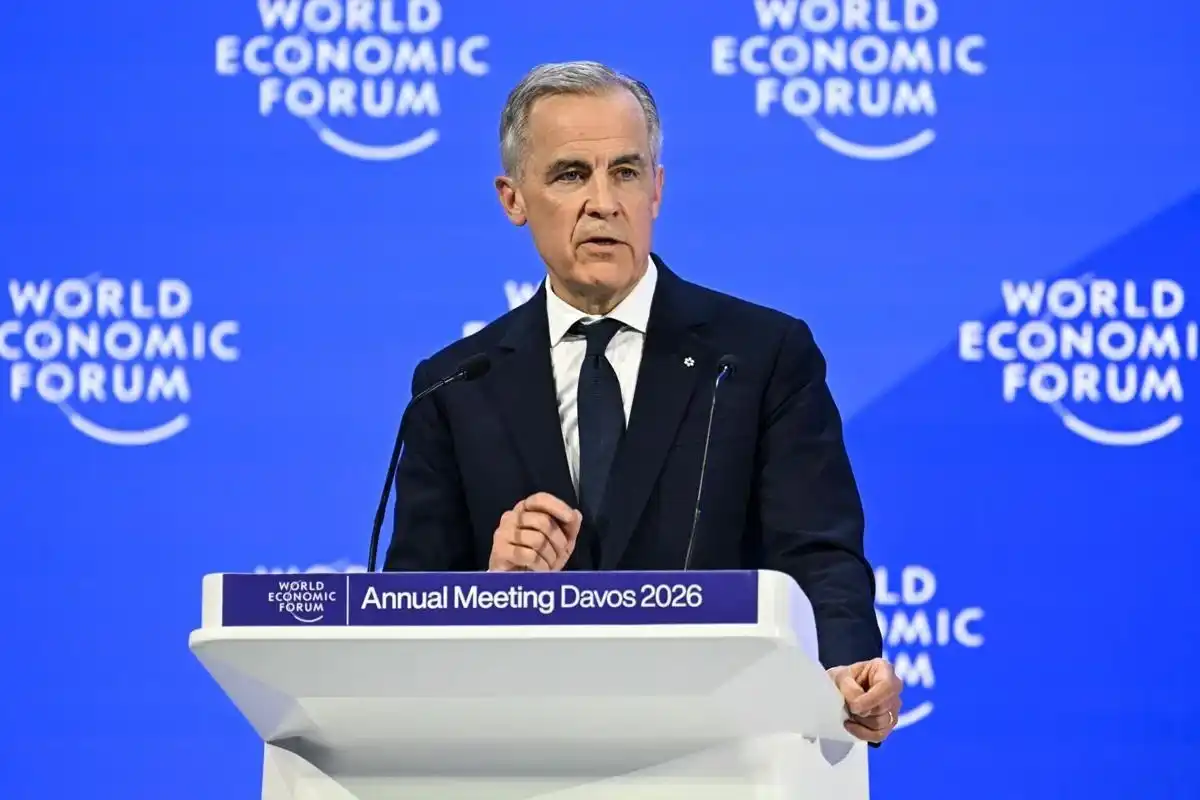
Below is a compilation by Phoenix News "World Affairs" (abridged):

We seem to be reminded daily: we are living in an era of great power competition—the so-called "rules-based order" is fading, the strong can do as they please, and the weak must endure the consequences they have to bear.

Thucydides' adage is presented as an inevitable reality, as if it were the re-emergence of the natural logic of international relations. Faced with this logic, countries often tend to go with the flow, accommodate each other, avoid trouble, and hope that compliance will buy security.

But that is not the case. So, what are our choices?

In 1978, Czech politician Václav Havel wrote an essay about a greengrocer.

Every morning, the shop owner would place a sign in his window with a symbolic slogan. He did not believe in the message. But he still displayed it to avoid trouble, show compliance, and keep the peace. And because every shopkeeper on every street did the same, the system persisted—not just through force, but through ordinary people participating in rituals they privately knew were false.

Havel called this state "living a lie." The system's strength came not from its truthfulness, but from everyone's willingness to pretend it was true. And its fragility lay precisely in this: if even one person stopped performing, if that greengrocer took the sign out of the window, the illusion would begin to crumble.

Friends, it is time for businesses and countries to take these signs down.

For decades, countries like Canada have thrived under what we call the "rules-based international order." We joined these institutions, praised their principles, and benefited from their predictability. Because of this, we were able to pursue value-based foreign policies under their protection.

We also knew that this story of an international rules-based order was, to some extent, a fiction: the most powerful nations would exempt themselves when convenient, trade rules were enforced asymmetrically, and the application of international law depended on the identity of the accused or the victim.

This fiction was once useful. Particularly, American hegemony helped provide public goods—open sea lanes, a stable financial system, collective security, and an institutional framework for dispute resolution.

So, we put the sign in the window. We participated in these rituals and largely avoided pointing out the gap between rhetoric and reality.

But that bargain is no longer working.

Let me be blunt: we are in a rupture, not a transition.

Over the past two decades, successive crises in finance, public health, energy, and geopolitics have exposed the risks of highly global integration. More recently, major powers have begun to turn economic integration into a weapon, using tariffs as leverage, financial infrastructure as a tool of coercion, and supply chains as vulnerabilities to be exploited.

When integration itself becomes the source of your vulnerability, you can no longer live in the lie of "mutual benefit and win-win."

The multilateral institutions on which middle powers rely—the WTO, the UN, the climate conference mechanism, and the entire institutional architecture of collective problem-solving—are under threat. As a result, many countries have reached the same conclusion: they must develop greater strategic autonomy in energy, food, critical minerals, finance, and supply chains. This impulse is understandable.

A country that cannot feed itself, power itself, or defend itself has very limited choices. When the rules no longer protect you, you must protect yourself.

But we must be clear-eyed about where this path leads. A world of fortresses will be poorer, more fragile, and less sustainable.

There is also the fact: if major powers abandon even the pretense of rules and values, pursuing only unconstrained power and interest, then the gains from transactional diplomacy will become increasingly difficult to replicate.

Hegemonic powers cannot constantly monetize relationships. Allies will hedge against uncertainty through diversification, buying "insurance," and increasing options to rebuild sovereignty—a sovereignty once built on rules will increasingly depend on the ability to withstand pressure.

Everyone here understands that this is classic risk management. Risk management has a cost, but the cost of strategic autonomy and sovereignty can be shared. Collective investment in resilience is much cheaper than each building their own fortress. Common standards can reduce fragmentation, and complementarity creates positive-sum effects.

For middle powers like Canada, the question is not whether to adapt to this new reality—we must adapt.

The question is, will we merely build higher walls, or can we be more ambitious?

Canada was among the first to hear this alarm, which prompted us to fundamentally adjust our strategic posture. Canadians understand that our old comfortable assumptions—that geography and alliance membership automatically brought prosperity and security—are no longer valid. Our new path is based on what Finnish President Stubb calls "value-based realism."

In other words, we adhere to principles while acting pragmatically. In principle, we firmly defend fundamental values, sovereignty, territorial integrity, adherence to the prohibition of the use of force unless in accordance with the UN Charter, and respect for human rights.

Pragmatically, we also recognize that progress is often gradual, interests diverge, and not all partners share all our values.

Therefore, we engage with the world broadly and strategically, with clear eyes. We proactively face the world as it is, rather than waiting for the ideal world to arrive.

We are calibrating relationships so their depth reflects our values, while maximizing our influence in today's fluid and risky world through broad engagement.

We no longer rely solely on the strength of our values, but also on the value of strength itself.

We are building that strength at home. Since this government took office, we have cut personal income taxes, capital gains taxes, and taxes on business investment; eliminated all federal-level interprovincial trade barriers; and accelerated investments totaling one trillion dollars in energy, AI, critical minerals, new trade corridors, and other areas. We plan to double defense spending by the end of this decade and are advancing this process with the goal of strengthening domestic industry. At the same time, we are rapidly advancing external diversification.

We have reached a comprehensive strategic partnership with the EU, including joining the European defense procurement mechanism SAFE, and have signed 12 trade and security agreements across four continents in six months.

In the past few days, we have reached new strategic partnerships with China and Qatar, and are negotiating free trade agreements with India, ASEAN, Thailand, the Philippines, and Mercosur.

We are also doing something else: to address global issues, we are promoting "variable geometry," meaning forming different coalitions on different issues based on shared values and interests. On Ukraine, we are one of the core members of the "coalition of the willing" and one of the largest per capita contributors to defense and security.

On Arctic sovereignty, we stand firmly with Greenland and Denmark, fully supporting their unique right to determine Greenland's future.

Our commitment to NATO Article 5 is unwavering, so we are working with NATO allies, including the "Nordic-Baltic Eight," to enhance security on the alliance's northern and western flanks, including Canada's unprecedented investments in over-the-horizon radar, submarines, aircraft, and ground forces—ice-capable troops.

Canada firmly opposes tariffs related to the Greenland issue and calls for targeted dialogue to achieve our shared security and prosperity goals in the Arctic.

In multilateral trade, we are promoting bridges between the CPTPP and the EU to create a new trade bloc covering 1.5 billion people, with critical minerals at its core.

We are building a "buyers' club" based on the G7 to help the world break free from dependence on highly concentrated supplies. In AI, we are working with like-minded democracies to ensure we are not ultimately forced to choose between a hegemonic power and hyper-scale platforms.

This is not naive multilateralism, nor mere reliance on existing institutions, but building viable coalitions with partners who share enough common ground on specific issues. In some cases, this will include the vast majority of the world's countries. The goal is to build a dense network of connections in trade, investment, culture, and other areas to address future challenges and opportunities.

Our view is that middle powers must act together because if we are not at the table, we will be on the menu.

Let me also say that major powers still have the ability to go it alone for now. They have market size, military capability, and leverage, which middle powers lack. But when we negotiate bilaterally only with hegemonic powers, we negotiate from a position of weakness, accepting what we are given, and competing with each other to see who is more compliant.

This is not sovereignty; it is performing sovereignty while accepting subordination.

In a world of great power competition, countries caught in the middle have a choice: compete with each other for favor, or unite to carve out a third path with real influence. We should not let the rise of hard power blind us to the strength of legitimacy, integrity, and rules—which remain powerful if we choose to wield them together.

This brings me back to Havel. What does "living in truth" mean for middle powers?

First, it means facing reality. Stop pretending the "rules-based international order" still works as advertised, and instead be honest: this is a system of intensifying great power competition where the strongest use economic integration to coerce and pursue self-interest.

It means acting consistently, applying the same standards to allies and adversaries. When middle powers criticize economic coercion from one direction but remain silent about another, we are still hanging the sign in the window.

It means building what we claim to believe in, not waiting for the old order to return. It means creating institutions and agreements that actually function as described, reducing the leverage that makes coercion possible.

It means building a strong domestic economy—this should be the top priority of every government.

And international diversification is not just economic prudence; it is the material basis for an honest foreign policy. A country can only take principled stands if it reduces its vulnerability to retaliation.

So, Canada. Canada has what the world needs. We are an energy superpower, with vast reserves of critical minerals, one of the world's most highly educated populations, and our pension funds are among the largest and most sophisticated global investors. In other words, we have capital and talent. We also have a government with significant fiscal capacity and the ability to act decisively, and values that many countries aspire to.

Canada is a well-functioning pluralistic society. Our public space is noisy, diverse, and free. Canadians remain committed to sustainable development. We are a stable and reliable partner in an extremely unstable world, a partner that values and cultivates relationships for the long term.

And one more thing: we understand what is happening and are determined to act accordingly. We understand that this rupture requires not just adaptation, but honesty about the real world.

We are taking the sign out of the window.

We know the old order will not return, and we should not mourn it. Nostalgia is not a strategy. But we believe that from this rupture, a larger, better, stronger, and more just order can be built. This is the task of middle powers—those who stand to lose the most in a fortress world and gain the most from genuine cooperation.

The strong have their power. But we also have our own power: the ability to stop pretending, face reality, build strength at home, and act together collectively.

This is the path Canada has chosen. We walk it openly and confidently, and we welcome any country willing to join us.

Thank you very much.

Preguntas relacionadas

QWhat is the main argument made by Canadian Prime Minister Mark Carney in his Davos speech?

ACarney argues that the old US-led, rules-based international order is over, and middle powers like Canada must stop 'living in the lie' that the old rules still function. They need to pursue strategic autonomy through collective action to avoid coercion by powerful nations.

QAccording to the speech, how have powerful nations been using economic integration?

APowerful nations have weaponized economic integration by using tariffs as leverage, financial infrastructure as tools of coercion, and supply chains as vulnerabilities to be exploited for their own interests.

QWhat does Carney suggest is the alternative to building higher walls (fortress world) for middle powers?

ACarney suggests that instead of building isolated fortresses, middle powers should collectively invest in resilience, share the costs of strategic autonomy, establish common standards to reduce fragmentation, and form flexible coalitions based on shared values and interests across different issues.

QWhat specific actions has Canada taken to adapt to the new geopolitical reality as mentioned in the speech?

ACanada has cut taxes, removed interprovincial trade barriers, pursued massive investments in energy and AI, plans to double defense spending, signed numerous trade and security agreements globally (e.g., with EU, China, Qatar), and is negotiating deals with India, ASEAN, and others. It is also building issue-based coalitions.

QWhat does 'living within the truth' mean for middle powers according to Carney's reference to Havel?

A'Living within the truth' means facing reality by no longer pretending the rules-based order works as advertised, applying consistent standards to allies and adversaries, building institutions that function as promised, strengthening domestic economies, and pursuing international diversification to reduce vulnerability to coercion.

Lecturas Relacionadas

How Many Tokens Away Is Yang Zhilin from the 'Moon Chasing the Light'?

The article explores the intense competition between two leading Chinese AI companies, DeepSeek and Kimi (Moon Dark Side), and the mounting pressure on Yang Zhilin, the founder of Kimi. While DeepSeek re-emerged after 15 months of silence with its powerful V4 model—boasting 1.6 trillion parameters and low-cost, long-context capabilities—Kimi has been focusing on long-context processing and multi-agent systems with its K2.6 model. Yang faces a threefold challenge: technological rivalry, commercialization pressure, and investor expectations. Despite Kimi’s high valuation (reaching $18 billion), its revenue heavily relies on a single product with low paid conversion rates, while DeepSeek’s strategic silence and open-source influence have strengthened its market position and valuation prospects, now targeting over $20 billion. Both companies reflect broader trends in China’s AI ecosystem: Kimi aims for global influence through open-source contributions and agent-based advancements, while DeepSeek prioritizes foundational innovation and hardware independence, notably shifting to Huawei’s chips. Their competition is seen as vital for China’s AI progress, with the gap between top Chinese and U.S. models narrowing to just 2.7% on the Elo rating scale. Ultimately, the article argues that this rivalry, though anxiety-inducing for leaders like Zhilin, is essential for driving innovation and solidifying China’s role in the global AI landscape.

marsbitHace 58 min(s)

How Many Tokens Away Is Yang Zhilin from the 'Moon Chasing the Light'?

marsbitHace 58 min(s)

TechFlow Intelligence Bureau: ChatGPT Helps Amateur Mathematician Crack 60-Year-Old Problem, CFTC Sues New York Regulator Over Coinbase and Gemini

An amateur mathematician, with the assistance of ChatGPT, has solved a combinatorial mathematics puzzle originally proposed by Hungarian mathematician Paul Erdős in the 1960s. This marks another milestone in AI-aided mathematical research, demonstrating the evolving capabilities of large language models in formal reasoning. In other AI developments, OpenAI introduced a new privacy filter tool for enterprise API usage, automatically screening sensitive data. Meanwhile, the Qwen3.6-27B model achieved 100 tokens per second on a single RTX 5090 GPU using quantization, significantly lowering the cost barrier for local AI deployment. In crypto and Web3, the U.S. CFTC sued New York’s financial regulator, challenging its oversight of Coinbase and Gemini—a first-of-its-kind federal-state regulatory clash. Following a vulnerability, KelpDAO and major DeFi protocols established a recovery fund. Tether froze $344 million in assets linked to Iran’s central bank upon U.S. Treasury request, highlighting the centralized control risks in stablecoins. Separately, Litecoin underwent a 3-hour chain reorganization to undo a privacy-layer exploit. In the U.S., former President Trump invoked the Defense Production Act to address power grid bottlenecks affecting AI data centers and dismissed the entire National Science Board, raising concerns over research independence. A retail trader gained 250% on a $600k Intel options bet amid AI-related speculation. Xiaomi announced its first performance electric vehicle, targeting rivals like Tesla. Meanwhile, iPhone users reported devices automatically reinstalling a hidden app daily, suspected to be MDM-related. A Chinese securities report noted that A-share institutional crowding has reached its second-longest streak since 2007, signaling high valuations and potential style rotation. The day’s developments reflect a dual narrative: AI is enabling unprecedented individual breakthroughs, while centralized power structures—whether governmental or corporate—are becoming more assertive, underscoring that decentralization is as much a political-economic challenge as a technical one.

marsbitHace 1 hora(s)

TechFlow Intelligence Bureau: ChatGPT Helps Amateur Mathematician Crack 60-Year-Old Problem, CFTC Sues New York Regulator Over Coinbase and Gemini

marsbitHace 1 hora(s)

Trading

Spot
Futuros

Artículos destacados

Qué es $S$

Entendiendo SPERO: Una Visión General Completa Introducción a SPERO A medida que el panorama de la innovación continúa evolucionando, la aparición de tecnologías web3 y proyectos de criptomonedas juega un papel fundamental en la configuración del futuro digital. Un proyecto que ha atraído la atención en este campo dinámico es SPERO, denotado como SPERO,$$s$. Este artículo tiene como objetivo reunir y presentar información detallada sobre SPERO, para ayudar a entusiastas e inversores a comprender sus fundamentos, objetivos e innovaciones dentro de los dominios web3 y cripto. ¿Qué es SPERO,$$s$? SPERO,$$s$ es un proyecto único dentro del espacio cripto que busca aprovechar los principios de descentralización y tecnología blockchain para crear un ecosistema que promueva la participación, la utilidad y la inclusión financiera. El proyecto está diseñado para facilitar interacciones de igual a igual de nuevas maneras, proporcionando a los usuarios soluciones y servicios financieros innovadores. En su esencia, SPERO,$$s$ tiene como objetivo empoderar a los individuos al proporcionar herramientas y plataformas que mejoren la experiencia del usuario en el espacio de las criptomonedas. Esto incluye habilitar métodos de transacción más flexibles, fomentar iniciativas impulsadas por la comunidad y crear caminos para oportunidades financieras a través de aplicaciones descentralizadas (dApps). La visión subyacente de SPERO,$$s$ gira en torno a la inclusividad, buscando cerrar brechas dentro de las finanzas tradicionales mientras aprovecha los beneficios de la tecnología blockchain. ¿Quién es el Creador de SPERO,$$s$? La identidad del creador de SPERO,$$s$ sigue siendo algo oscura, ya que hay recursos públicos limitados que proporcionan información de fondo detallada sobre su(s) fundador(es). Esta falta de transparencia puede derivarse del compromiso del proyecto con la descentralización, una ética que muchos proyectos web3 comparten, priorizando las contribuciones colectivas sobre el reconocimiento individual. Al centrar las discusiones en torno a la comunidad y sus objetivos colectivos, SPERO,$$s$ encarna la esencia del empoderamiento sin señalar a individuos específicos. Como tal, comprender la ética y la misión de SPERO sigue siendo más importante que identificar a un creador singular. ¿Quiénes son los Inversores de SPERO,$$s$? SPERO,$$s$ cuenta con el apoyo de una diversa gama de inversores que van desde capitalistas de riesgo hasta inversores ángeles dedicados a fomentar la innovación en el sector cripto. El enfoque de estos inversores generalmente se alinea con la misión de SPERO, priorizando proyectos que prometen avances tecnológicos sociales, inclusión financiera y gobernanza descentralizada. Estas fundaciones de inversores suelen estar interesadas en proyectos que no solo ofrecen productos innovadores, sino que también contribuyen positivamente a la comunidad blockchain y sus ecosistemas. El respaldo de estos inversores refuerza a SPERO,$$s$ como un contendiente notable en el dominio de proyectos cripto que evoluciona rápidamente. ¿Cómo Funciona SPERO,$$s$? SPERO,$$s$ emplea un marco multifacético que lo distingue de los proyectos de criptomonedas convencionales. Aquí hay algunas de las características clave que subrayan su singularidad e innovación: Gobernanza Descentralizada: SPERO,$$s$ integra modelos de gobernanza descentralizada, empoderando a los usuarios para participar activamente en los procesos de toma de decisiones sobre el futuro del proyecto. Este enfoque fomenta un sentido de propiedad y responsabilidad entre los miembros de la comunidad. Utilidad del Token: SPERO,$$s$ utiliza su propio token de criptomoneda, diseñado para servir diversas funciones dentro del ecosistema. Estos tokens permiten transacciones, recompensas y la facilitación de servicios ofrecidos en la plataforma, mejorando la participación y la utilidad general. Arquitectura en Capas: La arquitectura técnica de SPERO,$$s$ apoya la modularidad y escalabilidad, permitiendo la integración fluida de características y aplicaciones adicionales a medida que el proyecto evoluciona. Esta adaptabilidad es fundamental para mantener la relevancia en el cambiante paisaje cripto. Participación de la Comunidad: El proyecto enfatiza iniciativas impulsadas por la comunidad, empleando mecanismos que incentivan la colaboración y la retroalimentación. Al nutrir una comunidad sólida, SPERO,$$s$ puede abordar mejor las necesidades de los usuarios y adaptarse a las tendencias del mercado. Enfoque en la Inclusión: Al ofrecer tarifas de transacción bajas e interfaces amigables para el usuario, SPERO,$$s$ busca atraer a una base de usuarios diversa, incluyendo a individuos que anteriormente pueden no haber participado en el espacio cripto. Este compromiso con la inclusión se alinea con su misión general de empoderamiento a través de la accesibilidad. Cronología de SPERO,$$s$ Entender la historia de un proyecto proporciona información crucial sobre su trayectoria de desarrollo y hitos. A continuación se presenta una cronología sugerida que mapea eventos significativos en la evolución de SPERO,$$s$: Fase de Conceptualización e Ideación: Las ideas iniciales que forman la base de SPERO,$$s$ fueron concebidas, alineándose estrechamente con los principios de descentralización y enfoque comunitario dentro de la industria blockchain. Lanzamiento del Whitepaper del Proyecto: Tras la fase conceptual, se lanzó un whitepaper completo que detalla la visión, los objetivos y la infraestructura tecnológica de SPERO,$$s$ para generar interés y retroalimentación de la comunidad. Construcción de Comunidad y Primeras Interacciones: Se realizaron esfuerzos de divulgación activa para construir una comunidad de primeros adoptantes y posibles inversores, facilitando discusiones en torno a los objetivos del proyecto y obteniendo apoyo. Evento de Generación de Tokens: SPERO,$$s$ llevó a cabo un evento de generación de tokens (TGE) para distribuir sus tokens nativos a los primeros seguidores y establecer liquidez inicial dentro del ecosistema. Lanzamiento de la dApp Inicial: La primera aplicación descentralizada (dApp) asociada con SPERO,$$s$ se puso en marcha, permitiendo a los usuarios interactuar con las funcionalidades centrales de la plataforma. Desarrollo Continuo y Alianzas: Actualizaciones y mejoras continuas a las ofertas del proyecto, incluyendo alianzas estratégicas con otros actores en el espacio blockchain, han moldeado a SPERO,$$s$ en un jugador competitivo y en evolución en el mercado cripto. Conclusión SPERO,$$s$ se erige como un testimonio del potencial de web3 y las criptomonedas para revolucionar los sistemas financieros y empoderar a los individuos. Con un compromiso con la gobernanza descentralizada, la participación comunitaria y funcionalidades diseñadas de manera innovadora, allana el camino hacia un paisaje financiero más inclusivo. Como con cualquier inversión en el espacio cripto que evoluciona rápidamente, se anima a los posibles inversores y usuarios a investigar a fondo y participar de manera reflexiva con los desarrollos en curso dentro de SPERO,$$s$. El proyecto muestra el espíritu innovador de la industria cripto, invitando a una mayor exploración de sus innumerables posibilidades. Mientras el viaje de SPERO,$$s$ aún se desarrolla, sus principios fundamentales pueden, de hecho, influir en el futuro de cómo interactuamos con la tecnología, las finanzas y entre nosotros en ecosistemas digitales interconectados.

72 Vistas totalesPublicado en 2024.12.17Actualizado en 2024.12.17

Qué es $S$

Qué es AGENT S

Agent S: El Futuro de la Interacción Autónoma en Web3 Introducción En el paisaje en constante evolución de Web3 y las criptomonedas, las innovaciones están redefiniendo constantemente cómo los individuos interactúan con las plataformas digitales. Uno de estos proyectos pioneros, Agent S, promete revolucionar la interacción humano-computadora a través de su marco agente abierto. Al allanar el camino para interacciones autónomas, Agent S busca simplificar tareas complejas, ofreciendo aplicaciones transformadoras en inteligencia artificial (IA). Esta exploración detallada profundizará en las complejidades del proyecto, sus características únicas y las implicaciones para el dominio de las criptomonedas. ¿Qué es Agent S? Agent S se presenta como un marco agente abierto innovador, diseñado específicamente para abordar tres desafíos fundamentales en la automatización de tareas informáticas: Adquisición de Conocimiento Específico del Dominio: El marco aprende inteligentemente de diversas fuentes de conocimiento externas y experiencias internas. Este enfoque dual le permite construir un rico repositorio de conocimiento específico del dominio, mejorando su rendimiento en la ejecución de tareas. Planificación a Largo Plazo de Tareas: Agent S emplea planificación jerárquica aumentada por la experiencia, un enfoque estratégico que facilita la descomposición y ejecución eficiente de tareas complejas. Esta característica mejora significativamente su capacidad para gestionar múltiples subtareas de manera eficiente y efectiva. Manejo de Interfaces Dinámicas y No Uniformes: El proyecto introduce la Interfaz Agente-Computadora (ACI), una solución innovadora que mejora la interacción entre agentes y usuarios. Utilizando Modelos de Lenguaje Multimodal de Gran Escala (MLLMs), Agent S puede navegar y manipular diversas interfaces gráficas de usuario sin problemas. A través de estas características pioneras, Agent S proporciona un marco robusto que aborda las complejidades involucradas en la automatización de la interacción humana con las máquinas, preparando el terreno para una multitud de aplicaciones en IA y más allá. ¿Quién es el Creador de Agent S? Si bien el concepto de Agent S es fundamentalmente innovador, la información específica sobre su creador sigue siendo elusiva. El creador es actualmente desconocido, lo que resalta ya sea la etapa incipiente del proyecto o la elección estratégica de mantener a los miembros fundadores en el anonimato. Independientemente de la anonimidad, el enfoque sigue siendo en las capacidades y el potencial del marco. ¿Quiénes son los Inversores de Agent S? Dado que Agent S es relativamente nuevo en el ecosistema criptográfico, la información detallada sobre sus inversores y patrocinadores financieros no está documentada explícitamente. La falta de información disponible públicamente sobre las bases de inversión u organizaciones que apoyan el proyecto plantea preguntas sobre su estructura de financiamiento y hoja de ruta de desarrollo. Comprender el respaldo es crucial para evaluar la sostenibilidad del proyecto y su posible impacto en el mercado. ¿Cómo Funciona Agent S? En el núcleo de Agent S se encuentra una tecnología de vanguardia que le permite funcionar de manera efectiva en diversos entornos. Su modelo operativo se basa en varias características clave: Interacción Humano-Computadora Similar a la Humana: El marco ofrece planificación avanzada de IA, esforzándose por hacer que las interacciones con las computadoras sean más intuitivas. Al imitar el comportamiento humano en la ejecución de tareas, promete elevar las experiencias de los usuarios. Memoria Narrativa: Empleada para aprovechar experiencias de alto nivel, Agent S utiliza memoria narrativa para hacer un seguimiento de las historias de tareas, mejorando así sus procesos de toma de decisiones. Memoria Episódica: Esta característica proporciona a los usuarios una guía paso a paso, permitiendo que el marco ofrezca apoyo contextual a medida que se desarrollan las tareas. Soporte para OpenACI: Con la capacidad de ejecutarse localmente, Agent S permite a los usuarios mantener el control sobre sus interacciones y flujos de trabajo, alineándose con la ética descentralizada de Web3. Fácil Integración con APIs Externas: Su versatilidad y compatibilidad con varias plataformas de IA aseguran que Agent S pueda encajar sin problemas en ecosistemas tecnológicos existentes, convirtiéndolo en una opción atractiva para desarrolladores y organizaciones. Estas funcionalidades contribuyen colectivamente a la posición única de Agent S dentro del espacio cripto, ya que automatiza tareas complejas y de múltiples pasos con una intervención humana mínima. A medida que el proyecto evoluciona, sus posibles aplicaciones en Web3 podrían redefinir cómo se desarrollan las interacciones digitales. Cronología de Agent S El desarrollo y los hitos de Agent S pueden encapsularse en una cronología que resalta sus eventos significativos: 27 de septiembre de 2024: El concepto de Agent S fue lanzado en un documento de investigación integral titulado “Un Marco Agente Abierto que Usa Computadoras Como un Humano”, mostrando las bases del proyecto. 10 de octubre de 2024: El documento de investigación fue puesto a disposición del público en arXiv, ofreciendo una exploración profunda del marco y su evaluación de rendimiento basada en el benchmark OSWorld. 12 de octubre de 2024: Se lanzó una presentación en video, proporcionando una visión visual de las capacidades y características de Agent S, involucrando aún más a posibles usuarios e inversores. Estos marcadores en la cronología no solo ilustran el progreso de Agent S, sino que también indican su compromiso con la transparencia y la participación comunitaria. Puntos Clave Sobre Agent S A medida que el marco Agent S continúa evolucionando, varios atributos clave destacan, subrayando su naturaleza innovadora y potencial: Marco Innovador: Diseñado para proporcionar un uso intuitivo de las computadoras similar a la interacción humana, Agent S aporta un enfoque novedoso a la automatización de tareas. Interacción Autónoma: La capacidad de interactuar de manera autónoma con las computadoras a través de GUI significa un salto hacia soluciones informáticas más inteligentes y eficientes. Automatización de Tareas Complejas: Con su metodología robusta, puede automatizar tareas complejas y de múltiples pasos, haciendo que los procesos sean más rápidos y menos propensos a errores. Mejora Continua: Los mecanismos de aprendizaje permiten a Agent S mejorar a partir de experiencias pasadas, mejorando continuamente su rendimiento y eficacia. Versatilidad: Su adaptabilidad en diferentes entornos operativos como OSWorld y WindowsAgentArena asegura que pueda servir a una amplia gama de aplicaciones. A medida que Agent S se posiciona en el paisaje de Web3 y criptomonedas, su potencial para mejorar las capacidades de interacción y automatizar procesos significa un avance significativo en las tecnologías de IA. A través de su marco innovador, Agent S ejemplifica el futuro de las interacciones digitales, prometiendo una experiencia más fluida y eficiente para los usuarios en diversas industrias. Conclusión Agent S representa un audaz avance en la unión de la IA y Web3, con la capacidad de redefinir cómo interactuamos con la tecnología. Aunque aún se encuentra en sus primeras etapas, las posibilidades para su aplicación son vastas y atractivas. A través de su marco integral que aborda desafíos críticos, Agent S busca llevar las interacciones autónomas al primer plano de la experiencia digital. A medida que nos adentramos más en los reinos de las criptomonedas y la descentralización, proyectos como Agent S sin duda desempeñarán un papel crucial en la configuración del futuro de la tecnología y la colaboración humano-computadora.

353 Vistas totalesPublicado en 2025.01.14Actualizado en 2025.01.14

Qué es AGENT S

Cómo comprar S

¡Bienvenido a HTX.com! Hemos hecho que comprar Sonic (S) sea simple y conveniente. Sigue nuestra guía paso a paso para iniciar tu viaje de criptos.Paso 1: crea tu cuenta HTXUtiliza tu correo electrónico o número de teléfono para registrarte y obtener una cuenta gratuita en HTX. Experimenta un proceso de registro sin complicaciones y desbloquea todas las funciones.Obtener mi cuentaPaso 2: ve a Comprar cripto y elige tu método de pagoTarjeta de crédito/débito: usa tu Visa o Mastercard para comprar Sonic (S) al instante.Saldo: utiliza fondos del saldo de tu cuenta HTX para tradear sin problemas.Terceros: hemos agregado métodos de pago populares como Google Pay y Apple Pay para mejorar la comodidad.P2P: tradear directamente con otros usuarios en HTX.Over-the-Counter (OTC): ofrecemos servicios personalizados y tipos de cambio competitivos para los traders.Paso 3: guarda tu Sonic (S)Después de comprar tu Sonic (S), guárdalo en tu cuenta HTX. Alternativamente, puedes enviarlo a otro lugar mediante transferencia blockchain o utilizarlo para tradear otras criptomonedas.Paso 4: tradear Sonic (S)Tradear fácilmente con Sonic (S) en HTX's mercado spot. Simplemente accede a tu cuenta, selecciona tu par de trading, ejecuta tus trades y monitorea en tiempo real. Ofrecemos una experiencia fácil de usar tanto para principiantes como para traders experimentados.

716 Vistas totalesPublicado en 2025.01.15Actualizado en 2025.03.21

Cómo comprar S

Discusiones

Bienvenido a la comunidad de HTX. Aquí puedes mantenerte informado sobre los últimos desarrollos de la plataforma y acceder a análisis profesionales del mercado. A continuación se presentan las opiniones de los usuarios sobre el precio de S (S).

活动图片














