Bybit Regains Ground In 2025 After Historic Hack, CoinGecko Finds

bitcoinistPublicado a 2026-01-30Actualizado a 2026-01-30

Resumen

Bybit made a significant recovery in 2025, handling $1.5 trillion in trades and capturing 8% market share despite a historic $1.5 billion hack in February. The exchange's decision to keep withdrawals open and cover user losses helped rebuild trust and maintain liquidity. CEO Ben Zhou's public reassurances and transparent communication were key to its comeback. Overall, trading volumes rose across major exchanges, with MEXC seeing 90% growth due to zero-fee promotions. Binance remained the largest exchange with $7.3 trillion in volume, despite a slight 0.5% decline.

Bybit’s return to heavy trading was one of the stranger comeback stories of last year. Reports say the exchange moved back toward the top of the leaderboard after a massive security breach, and traders kept coming. That did not happen by accident. Quick decisions and public reassurances played a big role.

Bybit Bounces Back

According to CoinGecko, Bybit handled $1.5 trillion in trades during 2025 and ended the year with about 8% of total market share.

That is a solid showing given what happened in February, when attackers made off with $1.5 billion worth of Ether after finding a hole in the exchange’s cold wallet setup.

The theft has been linked to North Korean actors by several sources, and it stands as one of the largest losses in crypto history.

Many firms that face breaches do not recover. Reports note nearly eight out of 10 projects hit by hacks never fully bounce back.

Bybit’s choice to keep withdrawals open and to honor user balances changed the math. That move reduced panic and kept liquidity flowing.
Market Movers And Volume Gains

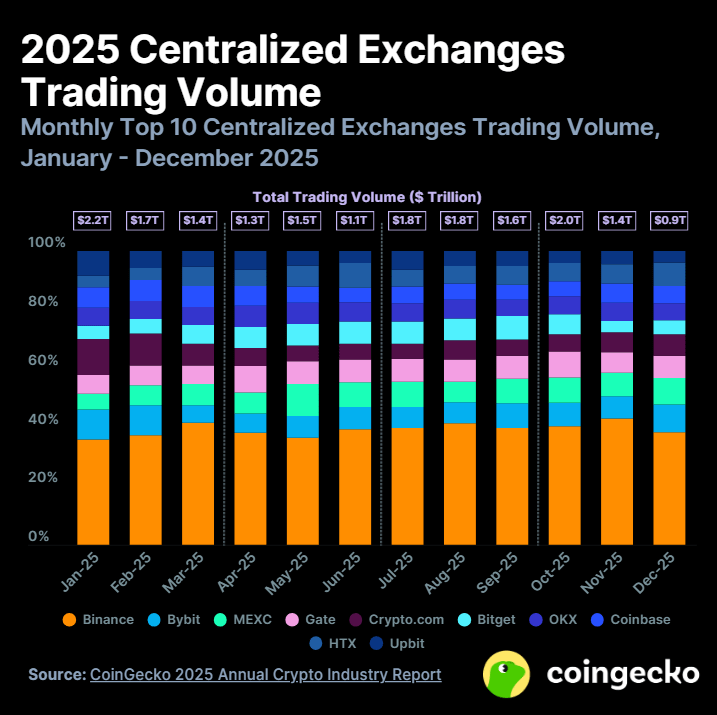
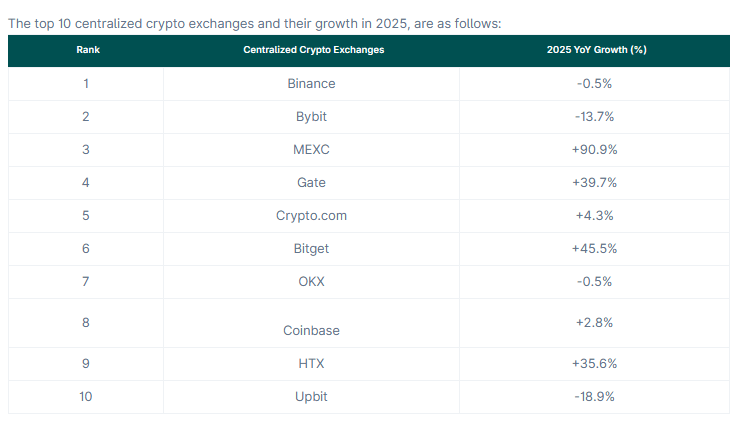
Trading volumes rose across multiple venues in 2025. CoinGecko’s research points out that six of the top 10 exchanges grew their yearly volume, and the total extra trades equaled about $1.3 trillion.

MEXC jumped sharply, reportedly rising 90% over the prior year, a gain blamed largely on aggressive zero-fee spot trading that pulled in high-frequency traders and new retail users.

Bullish price action for Bitcoin and several altcoins also pushed activity up; several coins reached fresh all-time highs during the year, which always sparks more trading and more headlines. For some platforms, promotions and fee policies had more immediate effect than brand reputation.

BTCUSD currently trading at $82,654. Chart: TradingView

How Bybit Handled The Crisis

The exchange’s leadership was visible. Ben Zhou, Bybit’s CEO, addressed customers on camera and promised the platform would cover losses and secure additional liquidity quickly.

Some of those promises were acted on behind the scenes, where external support was arranged to shore up funds.

Trust was not rebuilt overnight. It was rebuilt in small steps, transaction by transaction, and in public statements that reassured users their capital was safe.

The combination of keeping services running and having clear communication changed investor behavior.
Source: Coingecko

Binance And Rival Trends

Binance stayed the largest by a wide margin, with CoinGecko estimating about $7.3 trillion in annual volume. That massive figure hides a small drop from the prior year — a 0.5% decline — which analysts tied to a major liquidation event on October 10 that rattled markets.

Still, Binance’s user base was said to be over 300 million, and its ecosystem handles a vast range of products beyond spot trading.

Featured image from Pexels, chart from TradingView

Preguntas relacionadas

QWhat was the total trading volume handled by Bybit in 2025, according to CoinGecko?

ABybit handled $1.5 trillion in trades during 2025.

QWhat key action did Bybit take to reduce panic and maintain liquidity after the hack?

ABybit chose to keep withdrawals open and honor user balances, which reduced panic and kept liquidity flowing.

QWhich exchange saw a 90% increase in yearly volume, and what was the primary reason for this growth?

AMEXC jumped 90% over the prior year, a gain largely attributed to its aggressive zero-fee spot trading that attracted high-frequency traders and new retail users.

QHow did Bybit's CEO, Ben Zhou, respond to the security breach crisis?

ABen Zhou addressed customers on camera, promising that the platform would cover losses and secure additional liquidity quickly.

QWhat was Binance's estimated annual trading volume in 2025, and what minor change did it experience from the prior year?

ACoinGecko estimated Binance's annual volume at about $7.3 trillion, which represented a small 0.5% decline from the prior year.

Lecturas Relacionadas

The Gold Buy-on-the-Dip Guide: Watch Interest Rates, Not Just War

"Gold Buying Guide: Focus on Interest Rates, Not Just War" Four months ago, gold buyers likely didn't anticipate buying at a peak that even a war couldn't sustain. After hitting a record high of $5,596 on January 29, gold entered a bear market just 91 days later, its fastest decline since 2008. A key trigger was the Fed's hawkish shift, highlighting that monetary policy, not geopolitics, is the primary driver. The article argues that the traditional "buy gold in turmoil" script has changed. While the US-Iran conflict initially boosted prices, the sustained rally in oil prices heightened inflation fears, forcing central banks to maintain or consider tighter policy. Since gold yields no interest, higher rates increase its opportunity cost, eroding its appeal. This dynamic was evident when gold fell sharply on May 18 despite positive peace talks, as lower oil prices eased inflation and thus rate hike pressures. The recent sell-off is also part of a broader market deleveraging. Correlations between gold, Nasdaq, and Bitcoin spiked as leveraged investors sold liquid assets to cover losses, creating a synchronized downturn. Historically, gold bottoms align with policy shifts, not conflict resolutions. The 2008 and 2022 bear markets ended with shifts to extreme easing and peak inflation expectations, respectively. For potential buyers, the author suggests monitoring three signals: 1) Peak interest rate hike expectations, 2) Reopening of the Strait of Hormuz (to ease oil/inflation pressure), and 3) A return to net inflows for Gold ETFs, indicating the end of forced selling. While predicting the exact bottom is impossible, the author's personal strategy involves scaling into a position across price levels like $4000, $3700, and $3500, committing no more than 30% of the intended total allocation initially, and adding the remainder only if key signals emerge. The core conclusion: In turbulent times, watching interest rates is more crucial than watching wars.

marsbitHace 6 min(s)

The Gold Buy-on-the-Dip Guide: Watch Interest Rates, Not Just War

marsbitHace 6 min(s)

Recent On-Chain Review: No Clear Narrative Under U.S. Stock Market Pressure, Just Hype

This article analyzes the current state of the Solana meme coin and community token ecosystem, highlighting a market caught between two dominant forces: attention-based PvP and a gradual return to community-centric projects. The first part explores the "Attention PvP" dynamic, where success is driven by celebrity endorsements, viral events, and speed. Examples include $JOTCHUA, which surged after its meme creator's social media activity, and $WORLDCUP, which outperformed a similar Base chain project ($PITCH) largely due to influencer support. The recent "pump.fun GO" feature, allowing bounty tasks for token promotion, is critiqued for fostering sensationalist and often negative stunts—like people getting token tickers tattooed on their bodies for rewards—reminiscent of old internet shock content. In contrast, the article points to a resurgence of organic, community-driven tokens that survive market volatility through strong holder bases and shared ideology, not just hype. Influencer Ansem is cited, arguing that durable meme coins rely on communities willing to endure losses and promote their core message daily. Examples given are older tokens like $neet (anti-work ethos), $troll, $buttcoin, and $triplet, which have maintained relative price stability. A prime example of this community-build model is the new project $KINS, the token for the browser-based MMORPG Kintara. Its success stems not from advanced graphics but from consistently delivering updates, fostering player trust, and creating genuine engagement (e.g., in-game economies, events, property auctions). It has attracted a growing player base and even notable KOLs as participants, demonstrating that sustainable growth can come from building trust rather than orchestrating pumps. The article concludes by questioning whether the market is ultimately a game of mutual trust or mutual deception, expressing hope that such reflection might lead to a healthier ecosystem.

marsbitHace 6 min(s)

Recent On-Chain Review: No Clear Narrative Under U.S. Stock Market Pressure, Just Hype

marsbitHace 6 min(s)

On-Chain Scene on Opening Day: $20 Billion Already Staked, How Do On-Chain Contracts Know Who Wins?

On the opening day of the 2026 World Cup, over $2 billion had already been wagered on just the "tournament winner" contracts on platforms like Polymarket and Kalshi. This article explores how these blockchain-based prediction markets actually function once the games begin. It breaks down the massive volume and explains how single-game and tournament-long contracts are priced, with values moving between 1-99 cents to reflect implied probabilities. A key mechanism highlighted is "elimination zeroing," where a team's "champion yes" contract immediately settles to zero once they are mathematically eliminated. The core technical question answered is: how does a smart contract "know" who won a real-world match? The answer lies in oracles. The article details two primary paradigms: UMA's "optimistic oracle" (used by most of Polymarket), which allows a challenge period after a proposed result, and Chainlink's multi-source data aggregation (used by FIFA partners like ADI Predictstreet), which automates settlement with minimal dispute windows. Finally, the article injects a note of caution, citing research estimating that a significant portion of historical trading volume on these platforms might be "wash trading" to inflate numbers. It concludes by contrasting the legal status of these "event contracts" under CFTC rules in the U.S. versus traditional, state-regulated sports betting. As the tournament progresses, the real-time operation of this multi-billion dollar machine—its settlements, eliminations, and underlying mechanisms—becomes a story as compelling as the football itself.

marsbitHace 22 min(s)

On-Chain Scene on Opening Day: $20 Billion Already Staked, How Do On-Chain Contracts Know Who Wins?

marsbitHace 22 min(s)

Sequoia Dialogue with Jensen Huang: Computing Model Undergoes a 60-Year Transformation; You Won't Be Replaced by AI, But You Will Be Dimensionality-Reduced by 'Those Who Master AI'

NVIDIA founder and CEO Jensen Huang, in a conversation with Sequoia Capital's Konstantine Buhler, argues that we are witnessing the most significant computing shift in 60 years—from retrieval-based to generative computing. Instead of just storing and retrieving data, future systems will generate highly personalized content (text, images, video) on demand, powered by massive "AI factories." Huang envisions a global "intelligence network" that will envelop the planet, following the historical patterns of energy and communication grids. He outlines a five-layer investment framework: 1) Energy, 2) Chips/Computers, 3) Infrastructure (data centers), 4) AI Models, and 5) Applications. He predicts this ecosystem will reach a scale of $20 trillion annually. Crucially, Huang pushes back against fears of AI-driven job loss. He distinguishes between specific "tasks" (e.g., typing, analyzing images) and overall "jobs" (e.g., CEO, radiologist). While AI automates tasks, it increases efficiency and demand for the higher-value problem-solving aspects of professions, thus creating more jobs and "up-leveling" careers. The real risk, he asserts, is not being replaced by AI, but being outperformed by someone who effectively leverages it. He urges everyone to embrace AI as a tool for augmented capability and innovation.

marsbitHace 1 hora(s)

Sequoia Dialogue with Jensen Huang: Computing Model Undergoes a 60-Year Transformation; You Won't Be Replaced by AI, But You Will Be Dimensionality-Reduced by 'Those Who Master AI'

marsbitHace 1 hora(s)

Trading

Spot
Futuros

Artículos destacados

Cómo comprar ONE

¡Bienvenido a HTX.com! Hemos hecho que comprar Harmony (ONE) sea simple y conveniente. Sigue nuestra guía paso a paso para iniciar tu viaje de criptos.Paso 1: crea tu cuenta HTXUtiliza tu correo electrónico o número de teléfono para registrarte y obtener una cuenta gratuita en HTX. Experimenta un proceso de registro sin complicaciones y desbloquea todas las funciones.Obtener mi cuentaPaso 2: ve a Comprar cripto y elige tu método de pagoTarjeta de crédito/débito: usa tu Visa o Mastercard para comprar Harmony (ONE) al instante.Saldo: utiliza fondos del saldo de tu cuenta HTX para tradear sin problemas.Terceros: hemos agregado métodos de pago populares como Google Pay y Apple Pay para mejorar la comodidad.P2P: tradear directamente con otros usuarios en HTX.Over-the-Counter (OTC): ofrecemos servicios personalizados y tipos de cambio competitivos para los traders.Paso 3: guarda tu Harmony (ONE)Después de comprar tu Harmony (ONE), guárdalo en tu cuenta HTX. Alternativamente, puedes enviarlo a otro lugar mediante transferencia blockchain o utilizarlo para tradear otras criptomonedas.Paso 4: tradear Harmony (ONE)Tradear fácilmente con Harmony (ONE) en HTX's mercado spot. Simplemente accede a tu cuenta, selecciona tu par de trading, ejecuta tus trades y monitorea en tiempo real. Ofrecemos una experiencia fácil de usar tanto para principiantes como para traders experimentados.

284 Vistas totalesPublicado en 2024.12.12Actualizado en 2026.06.02

Cómo comprar ONE

Discusiones

Bienvenido a la comunidad de HTX. Aquí puedes mantenerte informado sobre los últimos desarrollos de la plataforma y acceder a análisis profesionales del mercado. A continuación se presentan las opiniones de los usuarios sobre el precio de ONE (ONE).

活动图片













