Bybit Partners with Stockholm Open as LiquidChain Redefines Cross-Chain Infrastructure

bitcoinistPublicado a 2026-02-10Actualizado a 2026-02-10

Resumen

Bybit has partnered with the Stockholm Open, rebranding it the 'BNP Paribas Nordic Open,' as part of a strategic move to target high-net-worth and institutional investors in Europe. This shift reflects a broader trend of crypto exchanges building credibility with sophisticated capital. However, this institutional interest highlights a critical weakness in the market: fragmented on-chain infrastructure and liquidity across major blockchains like Bitcoin, Ethereum, and Solana. This gap is driving demand for unified cross-chain solutions. LiquidChain ($LIQUID) is addressing this by building a Layer 3 infrastructure designed to fuse liquidity from these ecosystems into a single execution layer. Its 'Cross-Chain Virtual Machine' aims to enable 'Single-Step Execution,' allowing users to perform complex actions across chains in one transaction without manual bridging. The protocol is currently in its presale phase, having raised over $533K with tokens priced at $0.0136. This early capital inflow indicates investor interest in utility-driven infrastructure projects that solve liquidity fragmentation, positioning them to capture the next wave of DeFi volume as the need for interconnected blockchain rails intensifies.

Trusted Editorial content, reviewed by leading industry experts and seasoned editors. Ad Disclosure

Quick Facts:

  • ➡️ Bybit’s partnership with the Stockholm Open signals a strategic pivot toward high-net-worth and institutional demographics in Europe.
  • ➡️ The gap between institutional interest and on-chain user experience is driving demand for unified infrastructure solutions.
  • ➡️ LiquidChain is addressing liquidity fragmentation by fusing BTC, ETH, and SOL ecosystems into a single execution layer.
  • ➡️ Infrastructure projects are seeing steady capital inflows, with early backers focusing on utility-driven tokenomics over pure governance rights.

The intersection of digital assets and elite sports hit another milestone this week.

Bybit announced its title partnership with the Stockholm Open, rebranding the tournament to the ‘BNP Paribas Nordic Open’ with the exchange as a top-tier partner. This isn’t just about slapping a logo on a court; it’s a calculated push into high-net-worth territory.

By aligning with the oldest ATP indoor tournament, Bybit is positioning itself directly in front of a European institutional audience, a demographic that has historically been skittish about entering the volatile crypto fray.

Why the shift? Sports sponsorships have evolved from simple awareness plays to strategic credibility moves. Just as Crypto.com’s arena naming rights tried to normalize digital assets for retail, Bybit’s entry into the ‘gentleman’s sport’ of tennis targets a sophisticated, capital-rich investor class.

The data suggests exchanges are pivoting marketing spend toward trust-building, anticipating a market shift from retail speculators to long-term holders.

But there’s a catch. Bringing institutional capital on-chain exposes a glaring weakness in the current market structure: infrastructure fragmentation. While exchanges smooth the on-ramp, the actual on-chain experience is still plagued by complex bridging, wrapped asset risks, and liquidity that’s fractured across chains like Ethereum and Solana.

As traditional finance (TradFi) eyes the exit, the rails they’re expected to run on are still being built. This gap between marketing promise and technical reality has shifted smart money focus toward Layer 3 (L3) solutions capable of unifying these ecosystems.

Among the protocols addressing this friction is LiquidChain ($LIQUID), a cross-chain liquidity layer that has quietly started accumulating capital in its early presale stages.

Read more about $LIQUID here.

Unifying Fragmented Liquidity Across Bitcoin, Ethereum, and Solana

The current DeFi landscape effectively forces users and developers into silos. A developer building on Solana can’t easily access Ethereum liquidity without relying on cumbersome bridges or wrapped tokens, mechanisms that have historically been vectors for major hacks.

LiquidChain ($LIQUID) aims to solve this via its Layer 3 infrastructure, designed to fuse Bitcoin, Ethereum, and Solana liquidity into a single execution environment.

This distinction is critical. Most ‘interoperability’ protocols merely message between chains. LiquidChain operates as a Cross-Chain Virtual Machine (VM), enabling what the protocol calls ‘Single-Step Execution.’ In practice, a user could stake an asset on Ethereum and take a loan against it on Solana in a single transaction, without manually bridging funds.

For developers, the appeal lies in the ‘Deploy-Once’ architecture, writing code once that can simultaneously tap into the user bases of the three largest blockchains.

Of course, the risk here is execution complexity. Building an L3 that handles verifiable settlement across non-EVM (Bitcoin) and high-speed (Solana) chains is a heavy technical lift. Yet, the demand for a Unified Liquidity Layer is undeniable.

As liquidity fragmentation continues to dilute capital efficiency, protocols that can abstract away the underlying chain are positioned to capture the next wave of DeFi volume.

$LIQUID is available here.

Early Capital Flows Into LiquidChain’s $0.0135 Presale Round

While the broader market reacts to macro signals and exchange partnerships, on-chain metrics show a rotation into infrastructure plays.

LiquidChain has currently raised $533K in its ongoing presale, with tokens priced at $0.0136. This raise amount is notable not for its size relative to the massive ICOs of 2017, but for the steady accumulation during a period where capital is generally risk-averse.
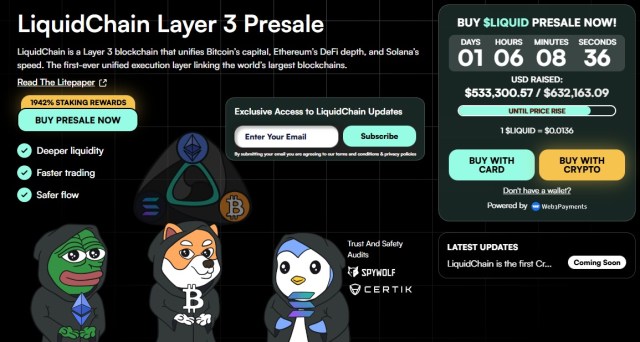
The pricing structure suggests early positioning before the protocol moves toward mainnet deployment. Investors seem to be betting on the ‘transaction fuel’ narrative, where the native $LIQUID token is required to power cross-chain operations and liquidity staking.

Unlike governance-only tokens, infrastructure tokens often derive value from network usage volume. If LiquidChain succeeds in capturing even a fraction of the cross-chain arbitrage and settlement market, the utility demand for the token could theoretically decouple from pure speculation.

What most coverage misses is the timing. With Bitcoin’s ecosystem expanding via L2s and Solana’s dominance in retail memes, the need for a connecting layer hasn’t been higher. The presale data points to a subset of the market hedging against the “winner takes all” chain thesis, opting instead to invest in the rails that connect them all.

$LIQUID is available here.

This article is not financial advice. Cryptocurrency investments, including presales and Layer 3 protocols, carry high risks, including total loss of capital. Always conduct independent due diligence before investing.

Editorial Process for bitcoinist is centered on delivering thoroughly researched, accurate, and unbiased content. We uphold strict sourcing standards, and each page undergoes diligent review by our team of top technology experts and seasoned editors. This process ensures the integrity, relevance, and value of our content for our readers.

patrubogdan

Follow

Full Profile

Related Posts

Meme Coins Outpace Blue Chips as Retail Liquidity Rotates, Igniting Maxi Doge’s $4.5M Rise

AI Can’t Save the Market Alone, But It Can Transform It: How SUBBD Token Redefines Content Economics

Russian Lawmaker Predicts Bitcoin Collapse While Smart Money Rotates into Layer 2 Utility

Solana’s Low Fees Create Strong Competition for Base, BNB, and Polygon and Fuel SUBBD Token

Chainlink Founder Sergey Nazarov Identifies 3 Trends That Will Define the Cryptosphere as Hyper Token Soars

Bitcoin Demand Plunges Per CryptoQuant, Yet Maxi Doge Endures

Preguntas relacionadas

QWhat is the strategic significance of Bybit's partnership with the Stockholm Open?

ABybit's partnership with the Stockholm Open, rebranding it to the 'BNP Paribas Nordic Open', is a strategic move to target a high-net-worth and institutional European audience. It's a calculated effort to build credibility and position itself in front of a sophisticated, capital-rich investor class that has been cautious about entering the volatile crypto market.

QWhat key problem in the crypto market is LiquidChain aiming to solve?

ALiquidChain is addressing the problem of liquidity fragmentation across different blockchains. It aims to unify the fractured liquidity silos of Bitcoin, Ethereum, and Solana into a single execution layer, eliminating the need for complex bridges and wrapped assets which are vectors for hacks.

QHow does LiquidChain's 'Single-Step Execution' work?

ALiquidChain's 'Single-Step Execution' is enabled by its Cross-Chain Virtual Machine (VM). It allows a user to perform a complex action, such as staking an asset on Ethereum and taking a loan against it on Solana, in a single transaction without manually bridging funds between the chains.

QWhat is the current status and price of LiquidChain's ($LIQUID) presale?

AAs detailed in the article, LiquidChain's presale has raised $533K. The tokens are currently priced at $0.0136 in this ongoing early funding round.

QAccording to the article, how are infrastructure project tokens like $LIQUID different from governance-only tokens?

AInfrastructure tokens like $LIQUID derive their value from network usage and utility, as they are required to power cross-chain operations and liquidity staking. This is in principle from governance-only tokens, whose value is more closely tied to speculation and voting rights rather than direct utility demand from transaction volume.

Lecturas Relacionadas

Must-Watch Events Next Week|CLARITY Act Could Face Senate Vote; SpaceX, Circle to Report Earnings (8.3-8.9)

**Summary: Key Events and Developments to Watch (August 3-9)** The upcoming week is marked by significant financial disclosures, key legislative deadlines, and notable product updates. **Major Financial Events:** Several companies are scheduled to release their Q2 2026 earnings. American Bitcoin (ABTC) will report on August 3, followed by SpaceX and Hut 8 Mining Corp. on August 4, and Circle on August 5. Notably, a significant portion of SpaceX shares (up to 12% of total shares) will be unlocked on August 6 following their earnings release. **Key Legislative Deadline:** The U.S. Senate faces an August 7 deadline to secure 60 votes for the CLARITY Act, a bipartisan bill aiming to establish a federal regulatory framework for cryptocurrencies. The Senate may hold a full vote on the bill during the week. **Economic Data:** The U.S. July Non-Farm Payrolls report will be released on August 7, providing crucial labor market data. **Technology & Product Updates:** * **Shutdowns:** DeFi portfolio tracker Zapper and wallet app Ctrl Wallet will cease operations on August 3. * **Upgrades:** LayerZero will deprecate its v1 relayers on August 3. XRP Ledger's new version 3.3.0, featuring five new functions, is expected next week. * **AI:** Elon Musk announced that the advanced Grok 4.6 AI model is set for release around August 7. * **Bitcoin:** The BIP-110 forced signaling for a potential Bitcoin network change is scheduled to begin around August 8. **Other Notable Events:** Chinese robotics firm Unitree Tech has set its preliminary price inquiry for its IPO for August 5. South Korean exchange Upbit will delist AQT and AERGO tokens on August 3.

marsbitHace 54 min(s)

Must-Watch Events Next Week|CLARITY Act Could Face Senate Vote; SpaceX, Circle to Report Earnings (8.3-8.9)

marsbitHace 54 min(s)

Stocks Are Plummeting More Sharply Than Cryptocurrencies. Where Has the Money Gone?

Stock Markets Plunge Deeper Than Cryptocurrencies: Where Did the Money Go? In late July, Seoul's Kospi index triggered circuit breakers for two consecutive days, plummeting over 40% from its June high. The collapse was led by heavyweight stocks like SK Hynix, whose record profits still disappointed investors, and devastating leveraged ETFs, with one major product losing over 83% of its value. This signaled a global, forced deleveraging targeting the most crowded trades. Interestingly, while stocks exhibited extreme volatility akin to crypto markets, Bitcoin rose nearly 15% in July after a prior steep drop. Analysis shows the money fleeing equities did not flow into Bitcoin. Instead, Bitcoin had already absorbed its sell-off in May-June, when U.S. spot Bitcoin ETFs saw historic outflows. The true safe-haven beneficiary was gold, whose price rose over 20% year-on-year, highlighting a decoupling between Bitcoin and gold as "digital gold." The sell-off was a targeted unwinding of leveraged positions in tech and semiconductors, accelerated by broker-dealer risk management and shifts in the AI narrative, including new competition from Chinese memory chipmakers. The retreat path was clear: from high-valuation tech stocks to cash and U.S. Treasuries, then to gold. For Bitcoin to attract sustained institutional inflows, conditions like eased global liquidity pressure, a "soft-landing" Fed rate cut, and U.S. regulatory clarity via legislation like the stalled CLARITY Act are needed. Currently, Bitcoin is not a safe haven but an already-cleared asset. Its low correlation with tech stocks, however, makes it a potential diversification play for institutional portfolios once the storm passes. The money isn't here yet, but the positioning is underway.

marsbitHace 54 min(s)

Stocks Are Plummeting More Sharply Than Cryptocurrencies. Where Has the Money Gone?

marsbitHace 54 min(s)

In Conversation with Ray Dalio: We Are Currently in an AI Bubble, with 1% of My Portfolio in Bitcoin

Ray Dalio, founder of Bridgewater Associates, warns in an interview that the current AI boom shows classic bubble characteristics, which could lead to significant economic downturns as seen in past cycles like 1929 or 2000. He explains that speculative enthusiasm, fueled by debt and overvaluation, often precedes a crash when rising rates or taxation force asset sales, causing widespread losses and recession. Dalio also outlines his "Big Cycle" theory, describing an approximate 80-year pattern where widening wealth gaps, massive government deficits, and shifting geopolitical power (like China's rise) create internal conflict and global instability. He emphasizes that we are in a late-cycle, transitional phase where traditional powers like the US and UK face decline. For personal wealth protection, Dalio advises diversification beyond cash into assets like stocks, bonds, real estate, and particularly gold, which he prefers over Bitcoin. While he holds about 1% of his portfolio in Bitcoin as a non-printable hard asset, he views gold as more secure from technological or governmental threats. Regarding AI's impact, Dalio believes it will disproportionately benefit capital owners, worsening inequality by replacing both physical and cognitive labor. He suggests that human intuition and emotional intelligence, combined with AI, will be key for future workers. On taxation, Dalio argues that wealth taxes are impractical and risk triggering asset sell-offs, reducing productive investment. He points to the UK as a cautionary example of debt, low productivity, and political strife. Geopolitically, Dalio foresees a more regionalized world, with the US showing weakness in prolonged conflicts like with Iran, akin to past imperial declines. The ideal outcome, he suggests, is coexisting powerful blocs (e.g., Americas, China-Asia Pacific) without major war.

marsbitHace 4 hora(s)

In Conversation with Ray Dalio: We Are Currently in an AI Bubble, with 1% of My Portfolio in Bitcoin

marsbitHace 4 hora(s)

Daily 7.2 Trillion KRW: Foreign Capital's Record Net Buying on Friday! Wall Street Says Headwinds for Korean Stock Fund Flows Have Subsided

South Korean stock market sees a dramatic shift in fund flows. On July 31, foreign investors made a record net purchase of approximately KRW 7.2 trillion in KOSPI stocks, marking a fundamental reversal from the persistent large-scale net outflows seen in previous months. This contributed to a significant narrowing of foreign net selling in July to KRW 9.8 trillion, down sharply from KRW 48.4 trillion in June and KRW 44.5 trillion in May. Simultaneously, domestic institutional pressure eased. South Korean pension funds and asset managers turned to a net buying position in July, purchasing KRW 1.0 trillion worth of KOSPI shares, contrasting with net sales in May and June. Market volatility is expected to be dampened by new financial regulations. Effective July 31, the Financial Services Commission tightened access for retail investors to single-stock leveraged ETFs by raising the minimum cash deposit requirement. Trading volumes for these products subsequently dropped to about 50% of their monthly average. Citigroup Research maintains its year-end KOSPI target of 10,000 points. The firm cites several supportive factors: the substantial easing of headwinds from capital outflows, a robust fundamental outlook for the semiconductor sector, historically low market valuations, strong economic fundamentals, and the potential for policy support from financial authorities if needed.

marsbitHace 4 hora(s)

Daily 7.2 Trillion KRW: Foreign Capital's Record Net Buying on Friday! Wall Street Says Headwinds for Korean Stock Fund Flows Have Subsided

marsbitHace 4 hora(s)

Trading

Spot
活动图片





