BTC Breaks Through $97,000, Crypto Market Stands at a New Structural Turning Point

marsbitPublicado a 2026-01-15Actualizado a 2026-01-15

Resumen

Bitcoin surged past $97,000, reaching a high of $97,924, while ETH and SOL also rose but remained below key resistance levels. The rally triggered significant liquidations, with shorts seeing the largest losses since the October 2021 crash. Notably, crypto-related stocks outperformed traditional equities. A key driver is renewed institutional interest: after weeks of outflows, U.S. Bitcoin ETFs recorded a substantial $750 million net inflow in a single day. Bitcoin’s strongest gains occurred during U.S. trading hours, a reversal from late 2025 trends. Macro conditions remain mixed: December CPI held steady at 2.7%, but strong retail data and persistent inflation suggest the Fed will hold rates in January, though 150 bps of cuts are expected in 2026. Regulatory developments are critical. The CLARITY Act, aimed at defining U.S. crypto regulations, faces a key Senate vote. Industry opinion is split, with Coinbase withdrawing support due to concerns over DeFi and stablecoin rules, while others back the bill for providing regulatory clarity. On-chain, Ethereum staking demand remains strong, with over 30% of ETH supply locked. MicroStrategy (now Strategy) continued accumulating Bitcoin, adding 13,627 BTC. Market structure may be shifting. Analysts note that the traditional four-year cycle has weakened, with altcoins underperforming. A sustained rally may require broader ETF adoption beyond BTC/ETH, renewed wealth effect from major cryptocurrencies, and a return of retail inves...

Original | Odaily Planet Daily (@OdailyChina)

Author | DingDang (@XiaMiPP)
Following yesterday's strong breakthrough of the $95,000 key resistance level, BTC continued its upward momentum early this morning, reaching a high of $97,924, and is currently trading at $96,484; ETH broke through $3,400 and is currently at $3,330; SOL rose to a high of $148 and is currently at $145. Compared to BTC, ETH and SOL are still hovering around key resistance levels and have not yet formed a clear trend breakthrough.

In derivatives, according to Coinglass data, yesterday's total liquidations reached $680 million, with short liquidations at $578 million and long liquidations at $101 million; Glassnode stated that the market rebound led to short liquidation volumes hitting a new high since the "10/11 crash".

According to msx.com data, while the three major U.S. stock indices closed lower, crypto-related stocks generally rose, with ALTS up over 30.94% and BNC up over 11.81%. This situation is not common. What is driving such a strong rally in the crypto market?

ETF Fund Shift

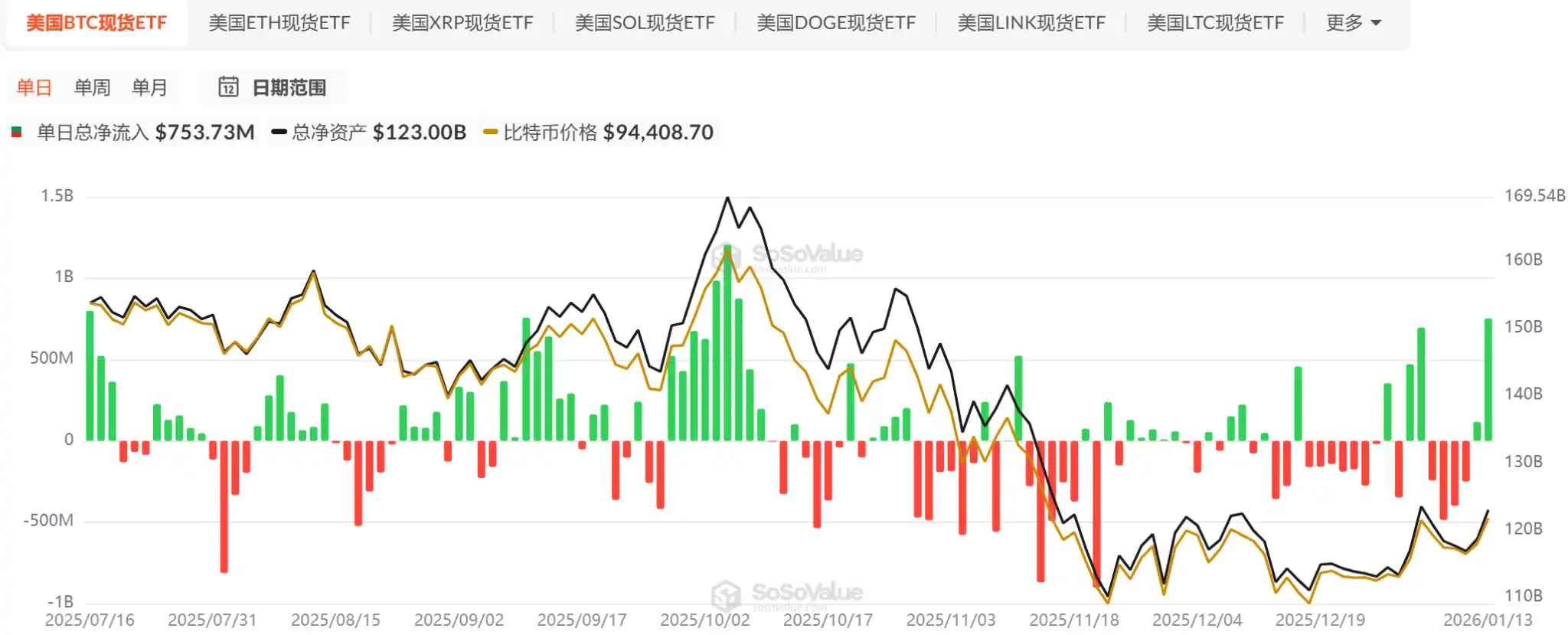
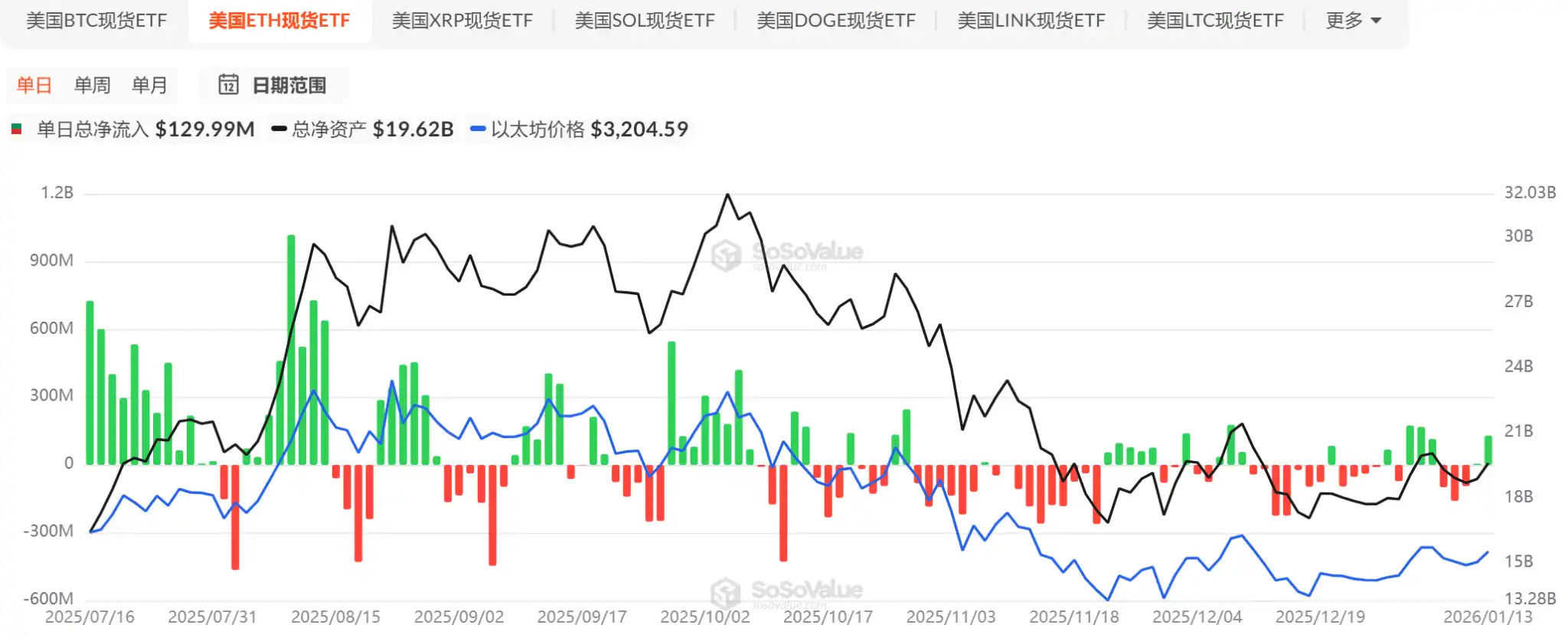
On the fund level, since mid-October 2025, BTC spot ETFs have generally been in a state of net outflows or small net inflows, indicating a lack of clear incremental fund signals in the market. However, after four consecutive trading days of net outflows last week, BTC spot ETFs turned to two consecutive days of net inflows, with a single-day net inflow of $750 million on January 13, becoming a significant signal for the phase. In contrast, ETH spot ETFs remain weak.
From a price action perspective, a noteworthy change is occurring. Bitcoin's cumulative return during North American trading hours is about 8%, while the European session recorded only a mild gain of about 3%, and the Asian trading session even dragged down the overall performance.

This phenomenon is in stark contrast to the end of 2025. At that time, Bitcoin accumulated a decline of up to 20% during North American hours, with prices once falling back to around $80,000. In the fourth quarter, U.S. market opening hours were often accompanied by selling pressure, and spot Bitcoin ETFs faced almost daily fund outflows.

Now, the strongest returns are occurring shortly after the U.S. stock market opens, which was precisely Bitcoin's weakest period over the past six months.

Macro Data: No Bad News, But Lacking Easing Catalysts

On the macro level, the December CPI year-on-year remained at 2.7% (unchanged from the previous reading, meeting market expectations), while the core CPI year-on-year slightly rose to 2.7% (previous 2.6%, slightly above some expectations), indicating that inflationary pressures still have some stickiness; however, the November PPI year-on-year unexpectedly rose to 3.0% (higher than the expected 2.7%), and retail sales month-on-month also recorded strong growth (exceeding market expectations), showing robust consumer data, which to some extent supports the view that economic growth remains resilient.

Although the December CPI data was generally mild (month-on-month 0.3% met expectations, year-on-year did not accelerate further), inflation has not clearly fallen back to the Fed's comfort zone. Combined with the labor market resilience shown in previous employment reports, the market widely believes that the probability of the Fed maintaining interest rates unchanged at the end-of-January FOMC meeting is extremely high, with almost no expectation of a rate cut. This also means that short-term policy easing catalysts are still lacking. According to CME's "FedWatch," the probability of the Fed keeping rates unchanged in January is 95%.

However, rate cut expectations for 2026 are worth anticipating, with Fed Governor Milan reiterating the need for 150 basis points of rate cuts this year.

Regulatory Legislative Progress: CLARITY Act in Focus

Beyond short-term market movements, the most noteworthy mid-to-long-term variable recently is the legislative progress of the 《CLARITY Act》. This bill aims to establish a comprehensive regulatory framework for the U.S. crypto market, with main objectives including:

  • Clarifying the regulatory boundaries between the SEC (security-like assets) and the CFTC (commodity-like digital assets);
  • Defining digital asset classifications (securities, commodities, stablecoins, etc.);
  • Introducing stricter disclosure, anti-money laundering, and investor protection requirements, while leaving room for innovation.

With the Senate Banking Committee's revision and voting scheduled for January 15, U.S. crypto legislation has officially entered the "final sprint." Committee Chairman Tim Scott (Republican) released a 278-page revised text on January 13, which followed months of bipartisan closed-door negotiations. It quickly sparked over 70 (some statistics say 137) proposed amendments, with disagreements over stablecoin yields and DeFi regulation heating up rapidly. The crypto industry, banking lobby groups, and consumer protection organizations are all involved.

Moreover, the crypto industry itself is not united. On January 14, Coinbase CEO Brian Armstrong publicly withdrew his support, stating that after reviewing the text, he believed the bill had "too many issues regarding DeFi bans, stifling stablecoin reward mechanisms, and excessive government surveillance, making it worse than the status quo." He emphasized that Stand With Crypto would score the Thursday revision vote to test whether senators "side with bank profits or consumer/innovation rewards." Industry insiders believe that Coinbase's public opposition is "significant" and could determine the bill's fate.

After Coinbase publicly opposed the bill, several leading institutions and associations including a16z, Circle, Kraken, Digital Chamber, Ripple, and Coin Center publicly expressed support for the Senate Republican version, believing that "any clear rules are better than the status quo," as they can inject long-term certainty into the market and position the U.S. as the "global crypto hub." (Recommended reading 《Why is the industry so severely divided as CLARITY deliberation is suddenly postponed?》)

Other Observations: Strengthening Ethereum Staking Demand and Strategy's Continued Accumulation

Ethereum staking demand continues to strengthen. Currently, the amount of ETH locked in the Beacon Chain has exceeded 36 million, accounting for nearly 30% of the network's circulating supply, with a staking market value exceeding $118 billion, continuously refreshing historical highs. The previous peak was 29.54%, reached in July 2025. The Ethereum network currently has about 900,000 active validators, with about 2.55 million ETH still queued waiting to enter the staking queue. This means that, at least from on-chain behavior observation, existing stakers still have limited short-term selling意愿, and the network overall tends to "lock rather than release."
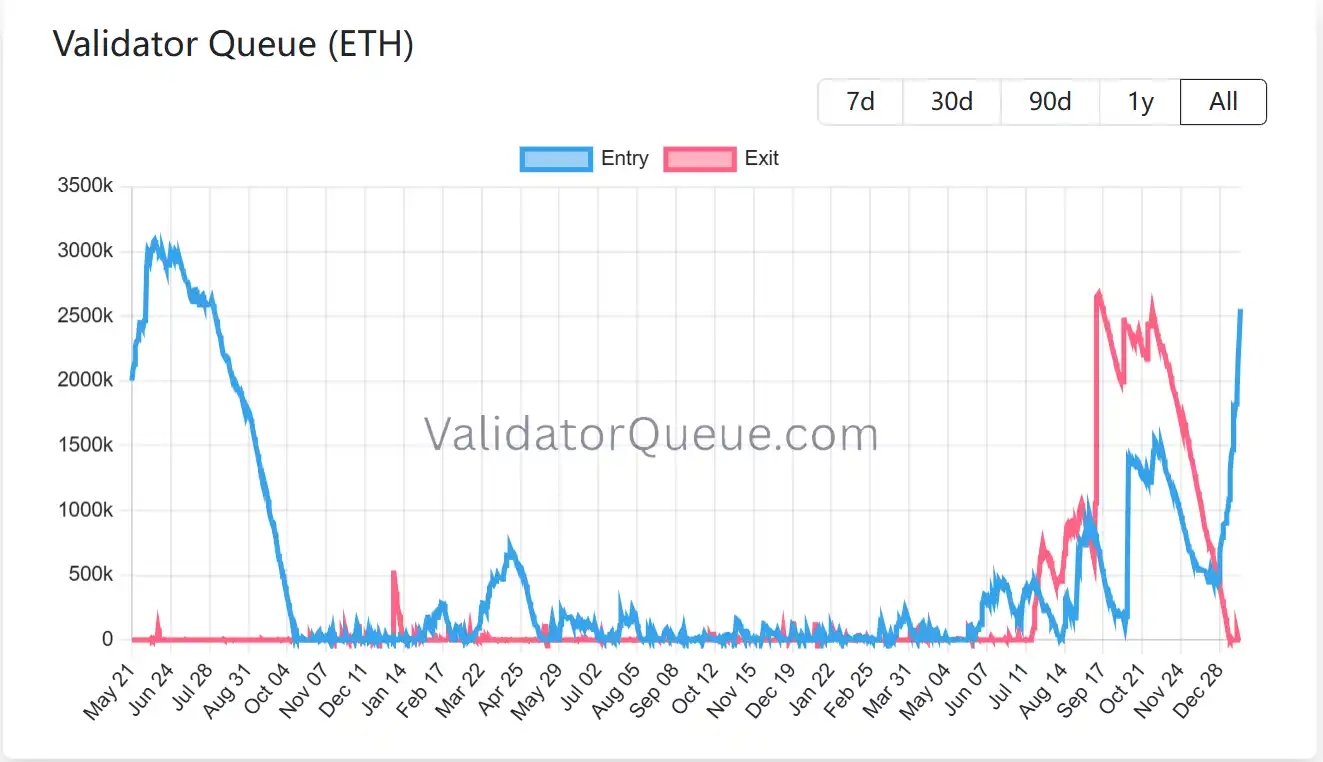
In addition, developer activity and stablecoin trading volume on Ethereum have both hit record highs. Recommended reading 《ETH Staking Data Reversal: Exits Zeroed Out VS Entries Surge 1.3 Million, When to Buy the Dip?》

Bitcoin reserve company Strategy (formerly MicroStrategy) continued its long-term accumulation strategy this week, spending approximately $1.25 billion to purchase 13,627 BTC at an average price of about $91,519. Thus, its total Bitcoin holdings have increased to 687,410 BTC, worth approximately $65.89 billion, with an overall average cost basis of about $75,353 per BTC.

Investment bank TD Cowen recently lowered its one-year price target from $500 to $440, citing dilution effects from continued issuance of common and preferred stock, which weakens Bitcoin yield expectations. Analysts expect Strategy to acquire approximately 155,000 more Bitcoin in fiscal year 2026, higher than previous forecasts, but a higher proportion of equity financing will reduce the growth in Bitcoin holdings per share.

TD Cowen also pointed out that although short-term yields are under pressure, related metrics are expected to improve in fiscal year 2027 as Bitcoin prices recover. The report also emphasized that Strategy chose to continue accumulating during the recent Bitcoin price pullback, with most financing proceeds directly used to purchase Bitcoin, indicating that its strategic goals remain unchanged. Overall, analysts remain relatively positive about Strategy's long-term value as a "Bitcoin exposure tool" and believe that some of its preferred stock has certain attractiveness in terms of yield and capital appreciation. Regarding index inclusion, MSCI has not yet removed Bitcoin reserve companies from its index system, which is seen as a short-term positive factor, but uncertainty remains in the medium to long term.

Arthur Hayes also stated that his core trading strategy this quarter is to go long on Strategy (MSTR) and Metaplanet (3350), using them as leveraged bets on BTC's return to an upward trend.

Market Outlook: Structural Changes and Rebound Conditions

Overall, the crypto market is standing at a critical turning point. Whether the traditional "four-year cycle" is still valid will likely be revealed in the coming months.

Crypto market maker Wintermute analyzed in its latest OTC market review: In 2025, Bitcoin did not exhibit the strong characteristics typical of a four-year cycle, and the altcoin cycle almost disappeared. In their view, this is not a short-term fluctuation or misalignment but a deeper structural change.

Under this premise, Wintermute believes that for a truly strong rebound to occur in 2026, the triggering conditions will be significantly higher than in previous cycles and will no longer rely on a single variable. Specifically, at least one of the following three outcomes needs to be validated.

First, the allocation scope of ETFs and crypto treasury (DAT) companies must expand beyond Bitcoin and Ethereum. Currently, U.S. spot BTC and ETH ETFs objectively concentrate a large amount of new liquidity on a few large-cap assets. While this enhances the stability of top assets, it also significantly compresses market breadth, leading to severe performance divergence. Only when more crypto assets are included in ETF products or corporate balance sheets can the market potentially regain broader participation and a liquidity foundation.

Second, core assets like BTC, ETH, as well as BNB and SOL, need to show sustained strong rallies again and recreate significant wealth effects. In 2025, the traditional transmission mechanism of "Bitcoin rising — funds spreading to altcoins" largely failed. The average uptrend cycle for altcoins was compressed to about 20 days (compared to about 60 days the previous year), with many tokens weakening under unlocking sell pressure. Without sustained rallies in top assets, funds lack the motivation to trickle down, making altcoin行情 naturally difficult to activate.

Third, and most crucially, retail attention needs to truly return to the crypto market. Although retail investors have not completely left, their new funds are currently flowing more into high-growth themes like the S&P 500, AI, robotics, and quantum computing. The extreme drawdowns of 2022-2023, memories of platform bankruptcies and liquidations, coupled with the reality that crypto assets overall underperformed traditional stocks in 2025, have significantly weakened the narrative appeal of "crypto = getting rich quick." Only when retail investors believe that the crypto market has the potential for超额 returns and return in a scaled manner can the market potentially regain the highly emotional,近乎狂热 upward momentum of the past.

In other words, against the backdrop of structural changes, the future rebound is no longer about "if it will come," but rather "under what conditions and through which path it will be reignited."


Preguntas relacionadas

QWhat was the key factor that led to the recent surge in Bitcoin's price above $97,000 according to the article?

AThe shift in BTC spot ETF flows from net outflows to significant net inflows, with a single-day net inflow of $750 million on January 13, was a key factor, particularly driven by strong buying during the North American trading session.

QWhat is the current market expectation for the Federal Reserve's interest rate decision at the end of the month, and why?

AThe market expects the Federal Reserve to almost certainly keep interest rates unchanged at the January meeting, with a 95%, due to persistent inflation and strong economic data that show a lack of clear catalysts for policy easing.

QWhat major U.S. regulatory bill is currently a focal point for the crypto industry, and what is its primary goal?

AThe CLARITY Act is the major regulatory bill. Its primary goals are to clarify the regulatory boundaries between the SEC and CFTC, define digital asset classifications, and introduce stricter disclosure, anti-money laundering, and investor protection requirements.

QHow does the article describe the current state of the Ethereum staking market?

AThe article states that Ethereum staking demand is strong, with over 36 million ETH locked on the beacon chain, representing nearly 30% of the circulating supply. The network is characterized by a tendency to 'lock rather than release,' with limited short-term selling pressure from existing stakers.

QAccording to market maker Wintermute, what are the necessary conditions for a true strong rebound in the crypto market in 2026?

AWintermute states that a true rebound requires at least one of three conditions: 1) ETF and corporate treasury allocations expanding beyond just Bitcoin and Ethereum, 2) sustained strong rallies in core assets to recreate wealth effect, or 3) a genuine return of retail investor attention and capital to the crypto market.

Lecturas Relacionadas

a16z: AI's 'Amnesia', Can Continuous Learning Cure It?

The article "a16z: AI's 'Amnesia' – Can Continual Learning Cure It?" explores the limitations of current large language models (LLMs), which, like the protagonist in the film *Memento*, are trapped in a perpetual present—unable to form new memories after training. While methods like in-context learning (ICL), retrieval-augmented generation (RAG), and external scaffolding (e.g., chat history, prompts) provide temporary solutions, they fail to enable true internalization of new knowledge. The authors argue that compression—the core of learning during training—is halted at deployment, preventing models from generalizing, discovering novel solutions (e.g., mathematical proofs), or handling adversarial scenarios. The piece introduces *continual learning* as a critical research direction to address this, categorizing approaches into three paths: 1. **Context**: Scaling external memory via longer context windows, multi-agent systems, and smarter retrieval. 2. **Modules**: Using pluggable adapters or external memory layers for specialization without full retraining. 3. **Weights**: Enabling parameter updates through sparse training, test-time training, meta-learning, distillation, and reinforcement learning from feedback. Challenges include catastrophic forgetting, safety risks, and auditability, but overcoming these could unlock models that learn iteratively from experience. The conclusion emphasizes that while context-based methods are effective, true breakthroughs require models to compress new information into weights post-deployment, moving from mere retrieval to genuine learning.

marsbitHace 29 min(s)

a16z: AI's 'Amnesia', Can Continuous Learning Cure It?

marsbitHace 29 min(s)

Can a Hair Dryer Earn $34,000? Deciphering the Reflexivity Paradox in Prediction Markets

An individual manipulated a weather sensor at Paris Charles de Gaulle Airport with a portable heat source, causing a Polymarket weather market to settle at 22°C and earning $34,000. This incident highlights a fundamental issue in prediction markets: when a market aims to reflect reality, it also incentivizes participants to influence that reality. Prediction markets operate on two layers: platform rules (what outcome counts as a win) and data sources (what actually happened). While most focus on rules, the real vulnerability lies in the data source. If reality is recorded through a specific source, influencing that source directly affects market settlement. The article categorizes markets by their vulnerability: 1. **Single-point physical data sources** (e.g., weather stations): Easily manipulated through physical interference. 2. **Insider information markets** (e.g., MrBeast video details): Insiders like team members use non-public information to trade. Kalshi fined a剪辑师 $20,000 for insider trading. 3. **Actor-manipulated markets** (e.g., Andrew Tate’s tweet counts): The subject of the market can control the outcome. Evidence suggests Tate’sociated accounts coordinated to profit. 4. **Individual-action markets** (e.g., WNBA disruptions): A single person can execute an event to profit from their pre-placed bets. Kalshi and Polymarket handle these issues differently. Kalshi enforces strict KYC, publicly penalizes insider trading, and reports to regulators. Polymarket, with its anonymous wallet-based system, has historically been more permissive, arguing that insider information improves market accuracy. However, it cooperated with authorities in the "Van Dyke case," where a user traded on classified government information. The core paradox is reflexivity: prediction markets are designed to discover truth, but their financial incentives can distort reality. The more valuable a prediction becomes, the more likely participants are to influence the event itself. The market ceases to be a mirror of reality and instead shapes it.

marsbitHace 1 hora(s)

Can a Hair Dryer Earn $34,000? Deciphering the Reflexivity Paradox in Prediction Markets

marsbitHace 1 hora(s)

Trading

Spot
Futuros

Artículos destacados

Qué es BITCOIN

Entendiendo HarryPotterObamaSonic10Inu (ERC-20) y Su Posición en el Espacio Cripto En los últimos años, el mercado de criptomonedas ha sido testigo de un aumento en la popularidad de las monedas meme, capturando el interés no solo de los comerciantes, sino también de aquellos que buscan compromiso comunitario y valor de entretenimiento. Entre estos tokens únicos se encuentra HarryPotterObamaSonic10Inu (ERC-20), un proyecto intrigante que mezcla referencias culturales en el tejido de las criptomonedas. Este artículo profundiza en los aspectos clave de HarryPotterObamaSonic10Inu, explorando sus mecanismos, ethos impulsado por la comunidad y su relación con el paisaje cripto más amplio. ¿Qué es HarryPotterObamaSonic10Inu (ERC-20)? Como su nombre sugiere, HarryPotterObamaSonic10Inu es una moneda meme construida sobre la blockchain de Ethereum, clasificada bajo el estándar ERC-20. A diferencia de las criptomonedas tradicionales que pueden enfatizar la utilidad práctica o el potencial de inversión, este token prospera en el valor de entretenimiento y la fuerza de su comunidad. El proyecto tiene como objetivo fomentar un entorno donde los usuarios comprometidos puedan reunirse, compartir ideas y participar en actividades inspiradas por diversos fenómenos culturales. Una característica notable de HarryPotterObamaSonic10Inu es su cero impuestos en las transacciones. Este atractivo elemento tiene como objetivo incentivar el comercio y la participación comunitaria, sin cargos adicionales que puedan disuadir a los comerciantes de pequeña escala. El suministro total de la moneda está establecido en mil millones de tokens, una cifra que marca su intención de mantener una circulación sustancial dentro de la comunidad. Creador de HarryPotterObamaSonic10Inu (ERC-20) Los orígenes de HarryPotterObamaSonic10Inu están algo envueltos en misterio; los detalles sobre el creador siguen siendo desconocidos. El desarrollo de este token carece de un equipo identificable o de un plan explícito, lo cual no es inusual dentro del sector de monedas meme. En cambio, el proyecto ha surgido de manera orgánica, con su progreso muy dependiente del entusiasmo y la participación de su comunidad. Inversores de HarryPotterObamaSonic10Inu (ERC-20) En cuanto a inversiones externas y respaldo, HarryPotterObamaSonic10Inu también sigue siendo ambiguo. El token no lista ninguna fundación de inversión conocida o apoyo organizacional significativo. En cambio, la savia del proyecto es su comunidad de base, que informa su crecimiento y sostenibilidad a través de la acción colectiva y el compromiso en el espacio cripto. ¿Cómo Funciona HarryPotterObamaSonic10Inu (ERC-20)? Como una moneda meme, HarryPotterObamaSonic10Inu opera principalmente fuera de los marcos tradicionales que a menudo rigen el valor de los activos. Hay varios aspectos distintivos que definen cómo funciona el proyecto: Transacciones Sin Impuestos: Sin tarifas impositivas en las transacciones, los usuarios pueden comprar y vender el token libremente sin preocuparse por costos ocultos. Compromiso Comunitario: El proyecto prospera en la interacción comunitaria, aprovechando plataformas de redes sociales para crear entusiasmo y facilitar la participación. Las discusiones, el intercambio de contenido y el compromiso son elementos cruciales que ayudan a expandir su alcance y fomentar la lealtad entre los seguidores. Sin Utilidad Práctica: Cabe señalar que HarryPotterObamaSonic10Inu no ofrece utilidad concreta dentro del ecosistema financiero. Más bien, se clasifica como un token principalmente para actividades de entretenimiento y comunitarias. Referencia Cultural: El token incorpora astutamente elementos de la cultura popular para atraer interés, conectando con entusiastas de los memes y seguidores de las criptomonedas por igual. HarryPotterObamaSonic10Inu ejemplifica cómo las monedas meme operan de manera diferente a los proyectos de criptomonedas más tradicionales, ingresando al mercado como construcciones sociales innovadoras en lugar de activos utilitarios. Cronología de HarryPotterObamaSonic10Inu (ERC-20) La historia de HarryPotterObamaSonic10Inu está marcada por varios hitos notables: Creación: El token surgió de un meme viral, capturando la imaginación de muchos entusiastas de las criptomonedas. Las fechas específicas de creación no están disponibles, subrayando su ascenso orgánico. Listado en Exchanges: HarryPotterObamaSonic10Inu ha llegado a varios exchanges, permitiendo un acceso y comercio más fácil por parte de la comunidad. Iniciativas de Compromiso Comunitario: Actividades continuas destinadas a mejorar la interacción comunitaria, incluyendo concursos, campañas en redes sociales y generación de contenido por parte de fanáticos y defensores. Planes de Expansión Futuros: La hoja de ruta del proyecto incluye el lanzamiento de una colección de NFT, mercancía y un sitio de comercio electrónico relacionado con sus temas culturales, involucrando aún más a la comunidad e intentando añadir más dimensiones a su ecosistema. Puntos Clave Sobre HarryPotterObamaSonic10Inu (ERC-20) Naturaleza Impulsada por la Comunidad: El proyecto prioriza la participación colectiva y la creatividad, asegurando que la involucración de los usuarios esté a la vanguardia de su desarrollo. Clasificación como Moneda Meme: Representa la epítome de las criptomonedas basadas en el entretenimiento, diferenciándose de los vehículos de inversión tradicionales. Sin Afiliación Directa con Bitcoin: A pesar de la similitud en el nombre del ticker, HarryPotterObamaSonic10Inu es distinto y no tiene relación con Bitcoin u otras criptomonedas establecidas. Enfoque en la Colaboración: HarryPotterObamaSonic10Inu está diseñado para crear un espacio para la colaboración y el intercambio de historias entre sus poseedores, proporcionando una vía para la creatividad y el vínculo comunitario. Perspectivas Futuras: La ambición de expandirse más allá de su premisa inicial hacia NFTs y mercancías describe un camino para que el proyecto potencialmente ingrese a avenidas más tradicionales dentro de la cultura digital. A medida que las monedas meme continúan capturando la imaginación de la comunidad de criptomonedas, HarryPotterObamaSonic10Inu (ERC-20) se destaca debido a sus lazos culturales y su enfoque centrado en la comunidad. Si bien puede no encajar en el molde típico de un token impulsado por la utilidad, su esencia radica en la alegría y la camaradería fomentadas entre sus seguidores, destacando la naturaleza en evolución de las criptomonedas en una era cada vez más digital. A medida que el proyecto continúa desarrollándose, será importante observar cómo las dinámicas comunitarias influyen en su trayectoria en el cambiante paisaje de la tecnología blockchain.

1.3k Vistas totalesPublicado en 2024.04.01Actualizado en 2024.12.03

Qué es BITCOIN

Cómo comprar BTC

¡Bienvenido a HTX.com! Hemos hecho que comprar Bitcoin (BTC) sea simple y conveniente. Sigue nuestra guía paso a paso para iniciar tu viaje de criptos.Paso 1: crea tu cuenta HTXUtiliza tu correo electrónico o número de teléfono para registrarte y obtener una cuenta gratuita en HTX. Experimenta un proceso de registro sin complicaciones y desbloquea todas las funciones.Obtener mi cuentaPaso 2: ve a Comprar cripto y elige tu método de pagoTarjeta de crédito/débito: usa tu Visa o Mastercard para comprar Bitcoin (BTC) al instante.Saldo: utiliza fondos del saldo de tu cuenta HTX para tradear sin problemas.Terceros: hemos agregado métodos de pago populares como Google Pay y Apple Pay para mejorar la comodidad.P2P: tradear directamente con otros usuarios en HTX.Over-the-Counter (OTC): ofrecemos servicios personalizados y tipos de cambio competitivos para los traders.Paso 3: guarda tu Bitcoin (BTC)Después de comprar tu Bitcoin (BTC), guárdalo en tu cuenta HTX. Alternativamente, puedes enviarlo a otro lugar mediante transferencia blockchain o utilizarlo para tradear otras criptomonedas.Paso 4: tradear Bitcoin (BTC)Tradear fácilmente con Bitcoin (BTC) en HTX's mercado spot. Simplemente accede a tu cuenta, selecciona tu par de trading, ejecuta tus trades y monitorea en tiempo real. Ofrecemos una experiencia fácil de usar tanto para principiantes como para traders experimentados.

4.7k Vistas totalesPublicado en 2024.12.12Actualizado en 2025.03.21

Cómo comprar BTC

Qué es $BITCOIN

ORO DIGITAL ($BITCOIN): Un Análisis Integral Introducción al ORO DIGITAL ($BITCOIN) ORO DIGITAL ($BITCOIN) es un proyecto basado en blockchain que opera en la red Solana, cuyo objetivo es combinar las características de los metales preciosos tradicionales con la innovación de las tecnologías descentralizadas. Aunque comparte un nombre con Bitcoin, a menudo referido como “oro digital” debido a su percepción como un refugio de valor, ORO DIGITAL es un token separado diseñado para crear un ecosistema único dentro del paisaje Web3. Su meta es posicionarse como un activo digital alternativo viable, aunque los detalles sobre sus aplicaciones y funcionalidades aún están en desarrollo. ¿Qué es ORO DIGITAL ($BITCOIN)? ORO DIGITAL ($BITCOIN) es un token de criptomoneda diseñado explícitamente para su uso en la blockchain de Solana. A diferencia de Bitcoin, que proporciona un papel de almacenamiento de valor ampliamente reconocido, este token parece centrarse en aplicaciones y características más amplias. Aspectos notables incluyen: Infraestructura Blockchain: El token está construido sobre la blockchain de Solana, conocida por su capacidad para manejar transacciones de alta velocidad y bajo costo. Dinámicas de Suministro: ORO DIGITAL tiene un suministro máximo limitado a 100 cuatrillones de tokens (100P $BITCOIN), aunque los detalles sobre su suministro circulante no se han divulgado actualmente. Utilidad: Si bien las funcionalidades precisas no están delineadas explícitamente, hay indicios de que el token podría ser utilizado para diversas aplicaciones, potencialmente involucrando aplicaciones descentralizadas (dApps) o estrategias de tokenización de activos. ¿Quién es el Creador de ORO DIGITAL ($BITCOIN)? En la actualidad, la identidad de los creadores y el equipo de desarrollo detrás de ORO DIGITAL ($BITCOIN) sigue siendo desconocida. Esta situación es típica entre muchos proyectos innovadores dentro del espacio blockchain, particularmente aquellos alineados con las finanzas descentralizadas y fenómenos de monedas meme. Si bien tal anonimato puede fomentar una cultura impulsada por la comunidad, intensifica las preocupaciones sobre la gobernanza y la responsabilidad. ¿Quiénes son los Inversores de ORO DIGITAL ($BITCOIN)? La información disponible indica que ORO DIGITAL ($BITCOIN) no tiene patrocinadores institucionales conocidos ni inversiones destacadas de capital de riesgo. El proyecto parece operar en un modelo de peer-to-peer centrado en el apoyo y la adopción de la comunidad en lugar de rutas de financiamiento tradicionales. Su actividad y liquidez se sitúan principalmente en intercambios descentralizados (DEX), como PumpSwap, en lugar de plataformas de trading centralizadas establecidas, lo que resalta aún más su enfoque de base. Cómo Funciona ORO DIGITAL ($BITCOIN) Los mecanismos operativos de ORO DIGITAL ($BITCOIN) pueden elaborarse en función de su diseño blockchain y atributos de red: Mecanismo de Consenso: Al aprovechar el único proof-of-history (PoH) de Solana combinado con un modelo de proof-of-stake (PoS), el proyecto asegura una validación de transacciones eficiente que contribuye al alto rendimiento de la red. Tokenómica: Si bien los mecanismos deflacionarios específicos no se han detallado extensamente, el vasto suministro máximo de tokens implica que podría atender microtransacciones o casos de uso nicho que aún están por definirse. Interoperabilidad: Existe el potencial de integración con el ecosistema más amplio de Solana, incluyendo varias plataformas de finanzas descentralizadas (DeFi). Sin embargo, los detalles sobre integraciones específicas permanecen no especificados. Cronología de Eventos Clave Aquí hay una cronología que destaca hitos significativos relacionados con ORO DIGITAL ($BITCOIN): 2023: El despliegue inicial del token ocurre en la blockchain de Solana, marcado por su dirección de contrato. 2024: ORO DIGITAL gana visibilidad al estar disponible para trading en intercambios descentralizados como PumpSwap, permitiendo a los usuarios comerciar contra SOL. 2025: El proyecto presencia actividad de trading esporádica y potencial interés en compromisos liderados por la comunidad, aunque no se han documentado asociaciones notables o avances técnicos hasta el momento. Análisis Crítico Fortalezas Escalabilidad: La infraestructura subyacente de Solana soporta altos volúmenes de transacciones, lo que podría mejorar la utilidad de $BITCOIN en varios escenarios de transacción. Accesibilidad: El potencial bajo precio de trading por token podría atraer a inversores minoristas, facilitando una participación más amplia debido a oportunidades de propiedad fraccionada. Riesgos Falta de Transparencia: La ausencia de patrocinadores, desarrolladores o un proceso de auditoría conocidos públicamente puede generar escepticismo sobre la sostenibilidad y confiabilidad del proyecto. Volatilidad del Mercado: La actividad de trading depende en gran medida del comportamiento especulativo, lo que puede resultar en una volatilidad de precios significativa y en incertidumbre para los inversores. Conclusión ORO DIGITAL ($BITCOIN) surge como un proyecto intrigante pero ambiguo dentro del ecosistema de Solana en rápida evolución. Si bien intenta aprovechar la narrativa del “oro digital”, su alejamiento del papel establecido de Bitcoin como refugio de valor subraya la necesidad de una diferenciación más clara de su utilidad y estructura de gobernanza previstas. La aceptación y adopción futura dependerán probablemente de abordar la actual opacidad y de definir sus estrategias operativas y económicas de manera más explícita. Nota: Este informe abarca información sintetizada disponible hasta octubre de 2023, y pueden haber ocurrido desarrollos más allá del período de investigación.

83 Vistas totalesPublicado en 2025.05.13Actualizado en 2025.05.13

Qué es $BITCOIN

Discusiones

Bienvenido a la comunidad de HTX. Aquí puedes mantenerte informado sobre los últimos desarrollos de la plataforma y acceder a análisis profesionales del mercado. A continuación se presentan las opiniones de los usuarios sobre el precio de BTC (BTC).

活动图片