Breaking Away from Traditional Investment Paths: Cryptocurrency Emerges as the Primary Battlefield for Wealth Among the Younger Generation

比推Publicado a 2025-12-17Actualizado a 2025-12-17

Resumen

Coinbase's latest industry report, in collaboration with Ipsos, reveals a significant generational shift in investment strategies. Younger investors, including Gen Z and millennials, are increasingly moving away from traditional wealth-building paths like buying real estate and investing in stocks. The survey of over 2,000 U.S. investors found that 73% of young people believe it's harder for their generation to build wealth through conventional means compared to their parents' generation. This sentiment is reflected in their portfolios: younger investors allocate 25% of their investments to non-traditional assets like cryptocurrencies, derivatives, and NFTs—three times the allocation of older investors. Nearly half (45%) of young investors already hold cryptocurrency, compared to just 18% of older investors. They view crypto not as a speculative side investment but as a core component for catching up financially, with 80% believing it offers more opportunities outside the traditional financial system. Younger investors are also more active, trade more frequently, and are willing to take higher risks for greater returns. They express strong interest in emerging crypto products like derivatives, prediction markets, and DeFi lending. This trend is pushing the financial industry toward 24/7, multi-asset platforms that better serve this internet-native generation.

Author: Coinbase

Compiled by: Chopper, Foresight News

Original Title: Moving Beyond Home Buying and Stock Trading, the Younger Generation Embraces Cryptocurrency as the Main Arena for Wealth


For decades, the path to wealth accumulation for Americans has remained largely unchanged: secure a good job, purchase property, invest in stocks, and wait for the power of compound interest to yield returns. However, our latest "Cryptocurrency Industry Report" reveals that the younger generation of investors no longer believes in this traditional path and is adjusting their investment strategies accordingly.

To understand how different generations approach the market and the role cryptocurrency plays in their investment portfolios, Coinbase partnered with Ipsos to conduct a specialized survey. The study interviewed 4,350 American adults, including 2,005 investors with investment accounts. The key findings are as follows: Younger investors, such as Gen Z and Millennials, are more inclined to manage their investments actively, more open to non-traditional assets, and more likely to view cryptocurrency as a core component of their financial future.
A Generation Shut Out of the Traditional Wealth Ladder

Younger investors are far more optimistic about the economy than older generations, but they believe the existing financial system is not designed for them. Survey data shows that nearly seven out of ten (73%) young people believe it is more difficult for their generation to accumulate wealth through traditional means compared to their parents' generation. In contrast, only 57% of older generations share this view.

They have witnessed soaring housing costs, overwhelming student debt, and sluggish wage growth. In this context, an increasing number of young people are seeking alternative wealth accumulation methods beyond the traditional model of "home equity + stock portfolio."

Non-Traditional Asset Allocation Three Times Higher Than Older Generations

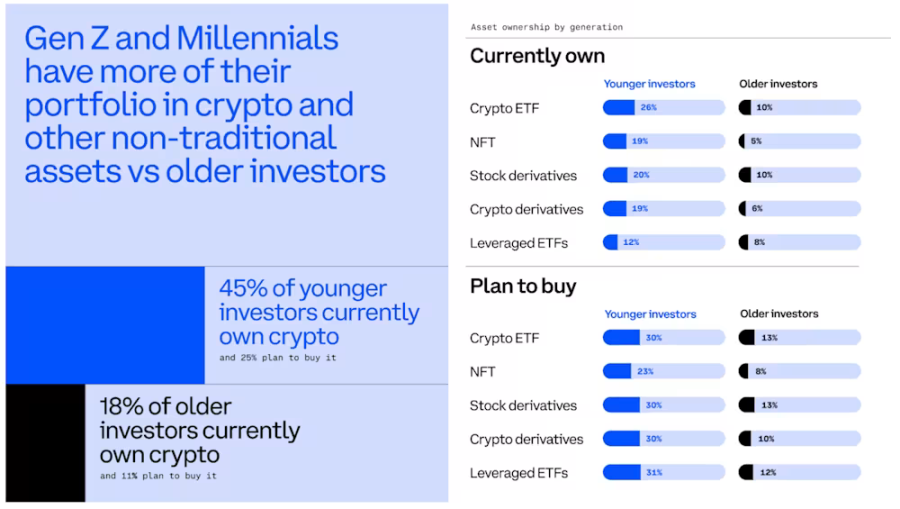
This anxiety is directly reflected in their asset allocation strategies. The survey reveals that younger investors allocate 25% of their investment portfolios to non-traditional asset classes such as cryptocurrencies, financial derivatives, non-fungible tokens (NFTs), and other emerging products. This proportion is three times higher than that of older investors, who allocate only 8% to non-traditional assets.

The proportion of stock holdings is roughly similar across generations, but the key difference lies in the diversification of younger investors' portfolios beyond stocks. They are more actively seeking opportunities for returns beyond traditional stock dividends and are more willing to experiment with new investment tools and emerging markets to narrow the wealth gap.

Cryptocurrency Is Not a Side Hustle but a Core Allocation

This generational shift in investment philosophy is most evident in the acceptance of cryptocurrency. The report shows that 45% of younger investors already hold cryptocurrencies, compared to only 18% of older investors. Additionally, nearly half (47%) of younger investors want to gain early access to new crypto assets before they become mainstream. In contrast, only 16% of older investors express this desire.

For the younger generation, cryptocurrency is not merely a speculative trade but a crucial tool to help them catch up in wealth accumulation. Eighty percent of young people believe that cryptocurrency provides their generation with more financial opportunities outside the traditional financial system. At the same time, another 80% are convinced that cryptocurrency will play a significantly larger role in the future financial system. Among older investors, only about 60% share this view.

The younger generation's enthusiasm for exploring emerging markets extends beyond spot cryptocurrencies; they are also eager to engage with more non-traditional assets. Data shows that 80% of young investors are willing to try new investment opportunities ahead of others, while less than half of older generations share this attitude. Younger investors consistently show strong interest in emerging non-traditional products such as cryptocurrency derivatives, prediction markets, 24/7 stock trading, early token offerings, altcoins, and decentralized finance (DeFi) lending.

Implications of This Trend for Future Markets

The younger generation of investors has already demonstrated distinct characteristics: they trade more frequently, are willing to take greater risks for higher returns, and are shifting a significant portion of their investment portfolios to non-traditional assets, with cryptocurrency at the core. At the same time, they are driving the entire financial industry toward a transformation that better meets the needs of the internet-native generation, creating platforms that operate around the clock and support diverse asset trading.


Twitter: https://twitter.com/BitpushNewsCN

BitPush Telegram Group: https://t.me/BitPushCommunity

BitPush Telegram Subscription: https://t.me/bitpush

Original Link: https://www.bitpush.news/articles/7596437

Preguntas relacionadas

QWhat is the main finding of the Coinbase and Ipsos research regarding younger investors?

AThe research found that younger investors, such as Gen Z and Millennials, are more likely to actively manage their investments, embrace non-traditional assets, and view cryptocurrency as a core component of their financial future.

QWhy do younger investors feel the traditional wealth-building path is not for them?

AThey believe it is harder to build wealth through traditional means due to rising housing costs, high student debt, and slow wage growth, making alternative paths like cryptocurrency more appealing.

QHow much of their portfolio do younger investors allocate to non-traditional assets compared to older investors?

AYounger investors allocate 25% of their portfolio to non-traditional assets, which is three times the 8% allocated by older investors.

QWhat percentage of younger investors hold cryptocurrency, and how does this compare to older investors?

A45% of younger investors hold cryptocurrency, compared to only 18% of older investors.

QWhat do younger investors believe about the role of cryptocurrency in the future financial system?

A80% of younger investors believe cryptocurrency provides financial opportunities outside the traditional system and that it will play a significantly larger role in the future financial system.

Lecturas Relacionadas

Marvell: Can't Compare to NVIDIA, Can't Meet Expectations, Overvaluation Gets Squeezed First?

Marvell Technology (MRVL.O) reported its Q2 FY2027 earnings (ending July 2026) after market close on August 27. Key points include: The company raised its full-year revenue outlook for FY2027 to $12 billion (from $11.5B) and for FY2028 to $18 billion (from $16.5B). However, these upward revisions were only slightly above market expectations and significantly trailed NVIDIA's recent explosive guidance. The Data Center segment, accounting for 79% of revenue, grew 19% quarter-over-quarter to $2.17 billion, primarily driven by connectivity products. For FY2028, management forecasts over 60% growth for this segment, again below NVIDIA's >70% outlook. A major disappointment for investors was the lack of an upward revision to the Custom ASIC business guidance, despite Marvell's recent partnership agreement with Google. The market had anticipated potential gains from Google's TPU orders, but the maintained guidance for "over 100% growth" in FY2028 (with no specific target for FY2027) led to concerns that the Google deal may be a less favorable "framework agreement" where Marvell holds a weaker negotiating position. Adjusted gross margin was flat at 58.3%. Q3 revenue guidance is $3.15 billion, slightly above consensus. Overall, the report was largely in line with expectations, but the subsequent stock decline is attributed to growth forecasts that failed to meet heightened market expectations (particularly versus NVIDIA) and lingering uncertainty around the tangible benefits of the Google ASIC partnership. High valuation faces near-term pressure, but expectations for >50% growth in the coming years and long-term ASIC opportunity may provide support.

marsbitHace 35 min(s)

Marvell: Can't Compare to NVIDIA, Can't Meet Expectations, Overvaluation Gets Squeezed First?

marsbitHace 35 min(s)

US Stock Market Trend (August 31st): Kashkari's Hawkish Remarks Weigh on Chip Stocks, US-Iran Weekend Strikes Boost Oil Prices

U.S. stock markets ended lower on Friday following hawkish remarks from Federal Reserve Chair Wash at the Jackson Hole symposium, which sharply increased the probability of a September rate hike from 35% to nearly 60%. Major indexes fell: the S&P 500 dropped 0.25%, the Nasdaq declined 0.52%, and the Dow was essentially flat. This shift in interest rate expectations pressured rate-sensitive assets, leading to significant declines in chip stocks. The Philadelphia Semiconductor Index fell 3.47%, with Nvidia dropping 4.57%, erasing about half its post-earnings gains. Geopolitical tensions also escalated over the weekend as the U.S. and Iran exchanged military strikes, raising concerns over the security of oil transit through the Strait of Hormuz. This pushed oil prices up over 2% in early Asian trading on Monday, reintroducing a geopolitical risk premium. In other energy news, former President Trump announced a landmark 25-year oil deal with Venezuela, aiming to significantly increase the country's oil production. However, this long-term supply boost was overshadowed in the short term by the Middle East conflict and the dominant market focus on interest rates. The core market narrative for the coming week revolves around the interplay between re-priced hawkish rate expectations and escalating geopolitical risks. Key areas to watch include the trajectory of Treasury yields, the evolution of U.S.-Iran tensions and its impact on oil prices, and whether the sell-off in high-valuation tech and semiconductor stocks stabilizes or continues under the pressure of higher rates.

marsbitHace 51 min(s)

US Stock Market Trend (August 31st): Kashkari's Hawkish Remarks Weigh on Chip Stocks, US-Iran Weekend Strikes Boost Oil Prices

marsbitHace 51 min(s)

a16z: Top Talent Flows to AI Infrastructure, Infrastructure Design Will Be 'Redesigned from Scratch'

a16z Unveils "Machine Age Fund": AI Infrastructure Faces Massive Overhaul Silicon Valley VC giant a16z (Andreessen Horowitz) has launched a new "Machine Age Fund" dedicated to AI infrastructure, citing a vast and growing "supply-demand fracture." Key takeaways: * **Unlimited Demand vs. Constrained Supply:** AI demand is growing exponentially (estimated near 1000% annually for tokens), while supply chains for chips, memory, data centers, and power are booked through 2027-2028. GPU prices are rising against historical trends. * **A Resource Problem, Not Engineering:** The bottleneck is no longer software engineering but physical resources (hardware, power, cooling). Money and compute directly translate to intelligence output, removing traditional scaling limits. * **Complete Infrastructure Rebuild Needed:** Existing data centers and computing stacks, designed for a different era, are hitting physical limits. Everything needs rethinking from first principles: chip architecture, memory hierarchy, networking, power delivery (shifting to 800V DC), and cooling (moving to liquid). * **Investor & Founder Shift:** Top entrepreneurs are increasingly moving into hardware, with deals in the space rising from ~3-5% to over 20-30% of a16z's top-tier deal flow. Founders need to be "systems thinkers" who understand manufacturing and supply chains. * **Massive Economic Scale:** Training a frontier model now costs $3-5B. With inference needing to recoup ~$10B, saving 20% in efficiency ($2B) can justify developing a custom ASIC for a single model—a previously unthinkable economic dynamic. * **Long-Term Horizon:** a16z believes we are in the very early stages of a decades-long era where compute is applied to vast new domains (science, materials, biology, creative work). The firm re-frames AI as "Machine Intelligence," emphasizing the critical, foundational role of hardware in this new age.

marsbitHace 1 hora(s)

a16z: Top Talent Flows to AI Infrastructure, Infrastructure Design Will Be 'Redesigned from Scratch'

marsbitHace 1 hora(s)

Trading

Spot
活动图片