Both Suffer Losses Exceeding $9 Billion, Which Is More at Risk: Strategy or Bitmine?

Odaily星球日报Publicado a 2026-06-04Actualizado a 2026-06-04

Resumen

As Bitcoin and Ethereum prices drop significantly, two major corporate treasury holders, Strategy and Bitmine, are facing massive unrealized losses—approximately $100 billion and $90 billion, respectively. The article compares their financial health and underlying risks. Bitmine, holding over 5.4 million ETH, relies primarily on equity financing (like ATM offerings) and has substantial cash reserves, alongside staking income from its ETH holdings. It plans a $300 million perpetual preferred stock offering. In contrast, Strategy, holding Bitcoin, is burdened by significant convertible debt and preferred stock dividends, with cash reserves covering only about six months of its annual dividend obligations. Strategy's leverage is higher, and it faces potential liquidity pressure if BTC prices fall further, possibly forcing asset sales. While both companies are under pressure, Bitmine’s financial structure appears more resilient, whereas Strategy’s high leverage makes it more vulnerable to continued market declines.

Original|Odaily Planet Daily(@OdailyChina)

Author|Wenser(@wenser2010)

Amid the ongoing market decline, Strategy and Bitmine, the "Twin Titans of DAT Treasuries," have both incurred massive floating losses.

This morning, BTC briefly fell below $62,000, currently hovering around $63,800; ETH dropped below $1,800, currently around $1,780. At current prices, Strategy's floating loss has reached a staggering $10 billion; Bitmine's floating loss is also around $9 billion. For now, Michael Saylor and Tom Lee are "fellow sufferers in the same predicament," with Strategy and Bitmine ranking as the top two "DAT companies with the largest losses."

However, compared to Strategy, which requires continuous dividend payments, Bitmine faces less financial pressure and retains flexibility such as raising funds through STRC preferred shares. It is reported that Bitmine plans to raise $300 million by issuing perpetual preferred shares with an annual dividend yield of 9.5%. It seems Bitmine's pace of acquiring ETH continues; meanwhile, the Sword of Damocles hanging over Strategy becomes: Where will the funds for subsequent STRC dividend payments come from? Between the two, who faces greater financial pressure? Odaily Planet Daily will analyze for readers.

Bitmine VS Strategy: The Divergent Paths of DAT Holdings

Following today's BTC plunge, community members used AI to mock Saylor's "promotion" of BTC: "A man in his sixties personally promotes, ancestral BTC price drops to $62,000 per coin."

Returning to Bitmine and Strategy, currently, Bitmine's financial structure appears safer; whereas Strategy's leverage pressure is greater.

Bitmine's Equity Issuance Game: The Debt-Free DAT Financing Play

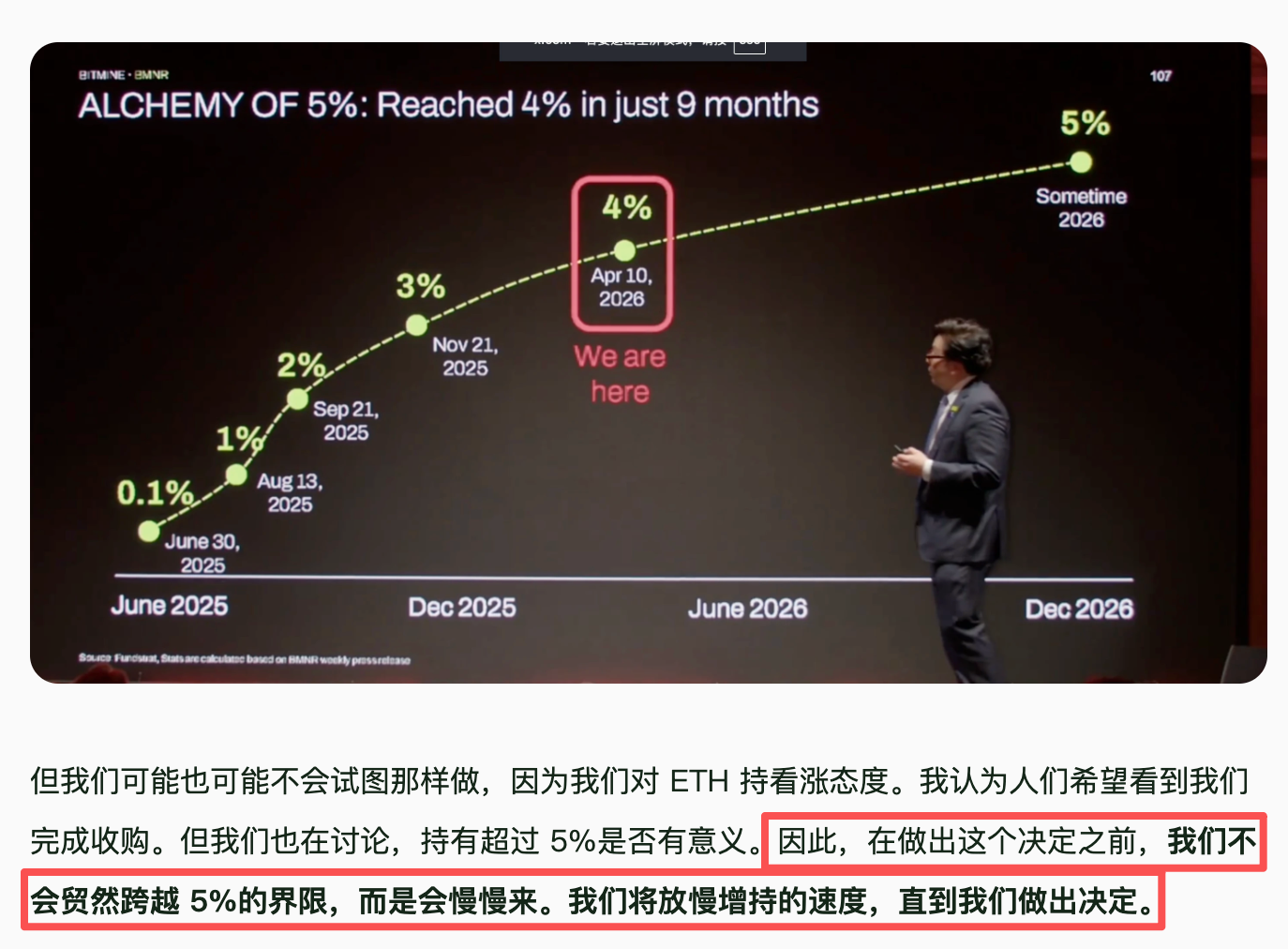
As of June 1, Bitmine holds 5,416,901 ETH; accounting for approximately 4.49% of ETH's total supply, nearing the '5% cap' repeatedly emphasized by Bitmine Chairman Tom Lee. Yesterday, Bitmine once again acquired 25,000 ETH via BitGo, valued at $48 million at the time. Currently, its holdings stand at 5,441,901 ETH.

The reason Bitmine has the confidence to continue accumulating during a market downturn is multifaceted. The primary reason is that Bitmine's funding source is equity issuance:

  • When initiating its ETH treasury and establishing the DAT company in June last year, Bitmine obtained initial seed capital through financing — $250 million, along with a small PIPE financing.
  • After July last year, Bitmine primarily relied on ATM equity issuance, gradually increasing this figure from $2 billion to $24.5 billion.

Sufficient funds give Tom Lee ample confidence, and Bitmine's book cash supports further acquisitions — in its June 1 public announcement, Bitmine also mentioned: The company's stake in Beast Industries is valued at $180 million; its stake in Eightco Holdings is valued at $93 million. The company's total cash amounts to $446 million.

Additionally, Tom Lee has previously boasted that Bitmine's Ethereum treasury generates daily staking rewards of $1 million. This refers to Bitmine staking approximately 87% (about 4.71 million ETH) of its ETH holdings through its MAVAN staking network, with estimated annualized returns of about 2.73%-3% (approximately $250-$300 million), which can also provide relatively stable cash flow.

In summary, Bitmine's financial condition is sound; and the latest preferred share financing with a 9.5% annualized dividend is expected to secure $300 million, further alleviating its financial pressure. For this company, the biggest risk points lie in equity dilution (issuing new shares) and further stock price declines due to book floating losses. If mNVA remains <1, it might trigger stock selling.

Strategy's Debt Leverage Game: Pressure from Convertible Bonds and Preferred Share Dividends

Compared to Bitmine's "using investors' money to buy ETH," Strategy faces greater financial pressure in acquiring BTC because it primarily "borrows money to increase BTC holdings."

According to information on Strategy's official website, currently, Strategy holds approximately $6.7 billion in convertible bond debt, plus about $9.9 billion in STRC preferred shares and market-value-varying amounts of STRD, STRK, STRF, requiring annual massive dividend and interest payments. At the end of May, after repurchasing $1.5 billion in convertible debt, Strategy's cash reserves fell to about $871 million, covering only about 6 months of its estimated $1.7 billion annual preferred dividend obligation.

Moreover, Strategy previously initiated a vote on "proposing to increase STRC dividend payments from monthly to twice monthly." The voting began on April 28 and will conclude on the meeting day of June 8. If approved, the first record date under the new schedule is June 30, and the first payment date is July 15. Eligible voting shareholders (holders of MSTR and STRC shares) must have held shares before April 17.
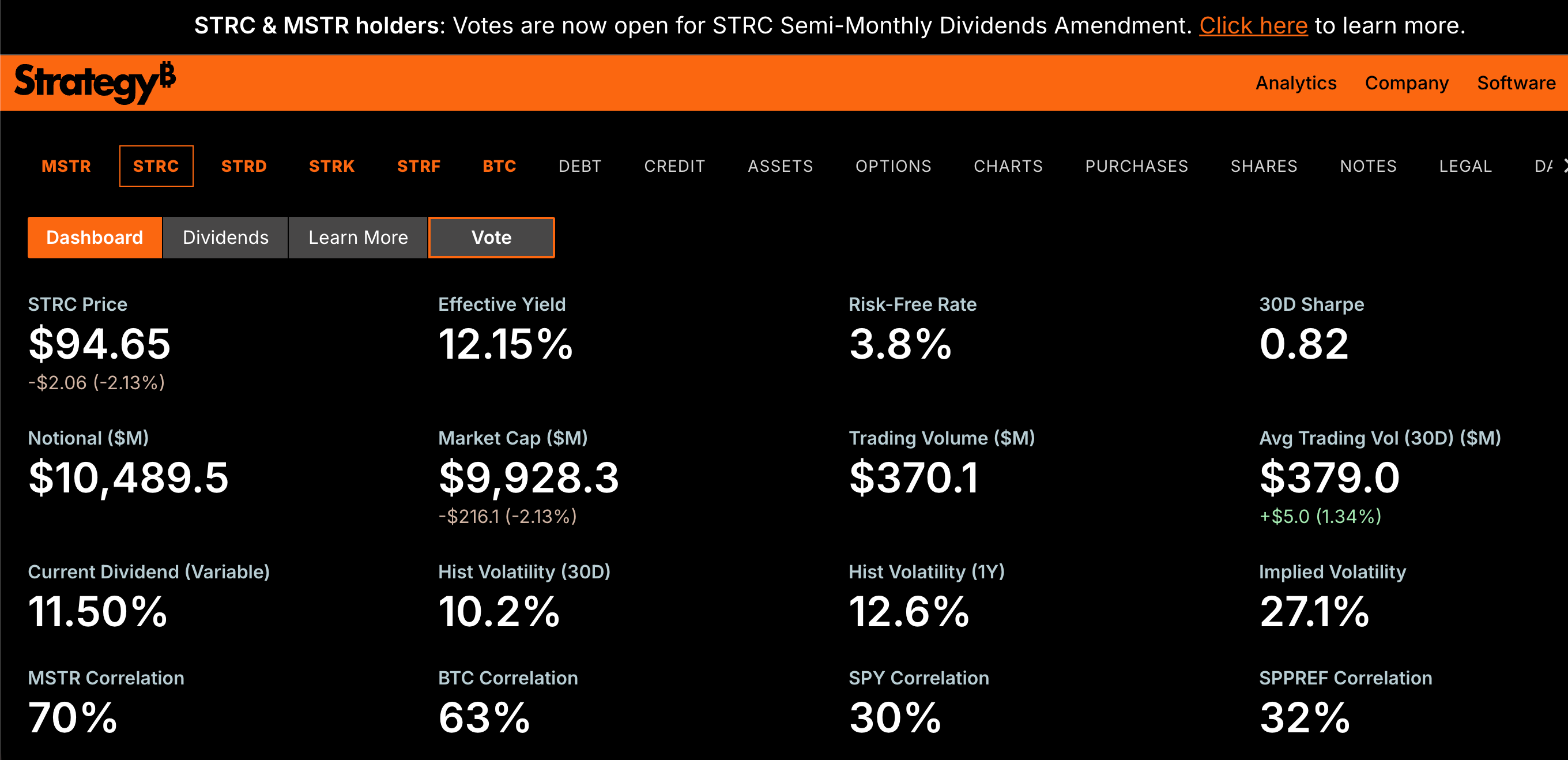
Also worth mentioning is that STRC's authorized issuance cap is approximately $28.3 billion. Possibly affected by BTC's continuous decline and shaken market confidence, STRC fell below $95 this morning, currently at $94.65, "de-pegging" over 5% from the $100 target price.

Compared to Bitmine, Strategy currently faces a significant gap between excessive preferred share financing amounts and dividend payments, exacerbated by BTC's continuous decline. Furthermore, unlike ETH which has a staking ecosystem for additional liquidity, BTC lacks such options.

Therefore, after Strategy sold 32 BTC last month, the market began to doubt the identity of "diamond-handed Strategy that only buys and never sells." Amid BTC's persistent decline, Strategy might face a series of liquidity crises, leading to an inability to repay debts and dividends, thereby selling more BTC and driving down prices. Essentially, Strategy is playing a "high-leverage bet that the BTC price won't fall below a certain level" debt leverage game.

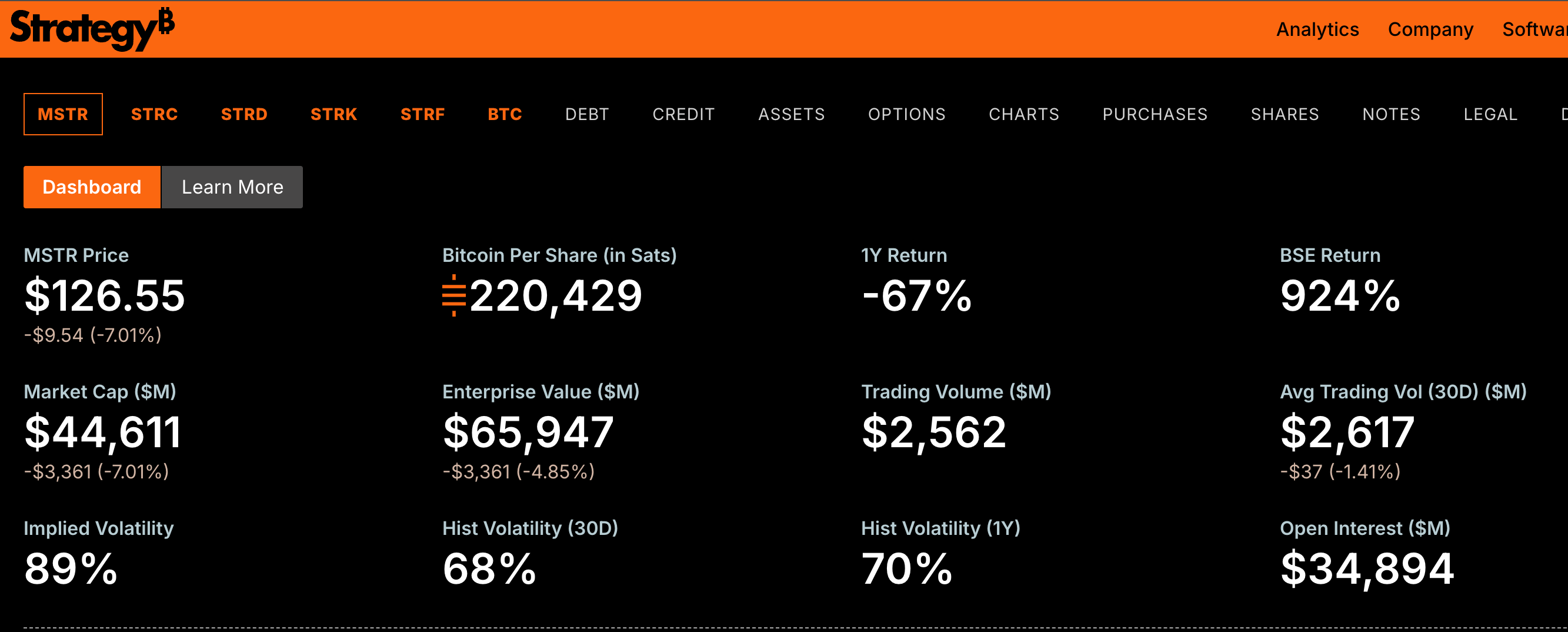
Thus, considering Strategy's current mNAV value of 0.83, the market remains highly skeptical of its future stock performance. Yesterday, its market capitalization already fell out of the top 200 US companies. Currently, Strategy (MSTR) stock is at $126, down 7% in 24 hours; market cap stands at $44.6 billion.
Of course, as a leader among DAT treasury companies, Bitmine Chairman Tom Lee remains quite optimistic about Strategy, previously stating: "Strategy selling Bitcoin and ETF outflows are typical bottoming behavior, not risk signals." At the recent "Proof of Talk 2026" conference at the Louvre in Paris, Tom Lee made bold claims: "With AI and tokenization driving major changes in financial infrastructure, ETH could ultimately reach $250,000." However, when discussing "Bitmine's actions after its ETH holdings reach 5% of the total supply," he also expressed caution about further ETH accumulation. (See "Tom Lee Recharges Faith: Crypto Spring Has Arrived, ETH Will Rise to $250,000")
Currently, Bitmine and Strategy find themselves in highly similar market situations, but Bitmine's financial condition is slightly better; Strategy faces the choice between "selling more BTC to obtain cash flow for dividend payments" and "sitting idle or continuing to borrow for acquisition as BTC keeps falling."


Preguntas relacionadas

QAccording to the article, what is the main difference in how Bitmine and Strategy finance their digital asset acquisitions?

ABitmine primarily funds its ETH acquisitions through equity issuance (ATM offerings and stock sales), which is a debt-free method. In contrast, Strategy primarily uses debt leverage, including convertible notes and preferred stock, to finance its BTC purchases, creating significant interest and dividend obligations.

QWhat specific financial pressure does Strategy face that the article highlights as its 'sword of Damocles'?

AStrategy faces significant pressure to cover its substantial annual dividend payments for its preferred stock (like STRC), estimated at $1.7 billion. With its cash reserves dwindling, the core question is where the funds for these ongoing dividend payments will come from.

QHow does Bitmine generate an additional income stream from its ETH holdings, as mentioned in the article?

ABitmine stakes approximately 87% of its ETH holdings (around 4.71 million ETH) through the MAVAN staking network. This generates daily staking rewards estimated at $1 million, providing a stable annualized cash flow of approximately $250-300 million.

QWhat are the key risk factors mentioned for Bitmine and Strategy's stock prices respectively?

AFor Bitmine, the main risk is equity dilution from issuing new shares and a declining stock price if its mNVA (market value to net asset value) falls below 1. For Strategy, the key risk is its high leverage and liquidity crisis if BTC prices fall further, potentially forcing asset sales and causing its mNAV to drop (currently 0.83), which could severely impact its stock price.

QWhat recent action by Strategy has caused market doubts about its 'diamond hands' reputation, and what potential consequence does the article suggest?

AStrategy recently sold 32 BTC. This action has led the market to doubt its long-held 'diamond hands' (never selling) policy. The article suggests that if BTC continues to fall, Strategy might face a liquidity crisis, forcing it to sell more BTC to meet its debt and dividend obligations, which could further depress the market.

Lecturas Relacionadas

Silicon Valley 'Startup Guru' Steve Hoffman: Web3 + AI Could Be a Trap

Silicon Valley investor and "Godfather of Startups" Steve Hoffman warns that combining Web3 with AI is likely a trap, not a promising venture. In an interview, Hoffman argues that while AI is a foundational technology touching all industries, Web3 adds complexity, friction, and regulatory risk without solving mainstream consumer or business needs. He advises founders to focus on deep, specialized applications where startups can out-iterate giants, rather than on generic features easily replicated by large tech companies. Hoffman observes that Silicon Valley will lead foundational AI research, while China excels at rapid, large-scale application and commercialization, particularly in robotics. He stresses that AI-driven autonomous agents capable of collaborative, multi-step tasks are 2-4 years away, which will cause significant job displacement. The solution is not to slow AI but to redesign business models around human-AI collaboration and reform social systems like education and retraining. For startups, Hoffman recommends focusing on vertical, expertise-heavy domains to build defensibility. He sees major opportunities in AI fraud detection and cybersecurity. Key founder mindsets include systemic thinking over feature-focus, relentless customer centricity, building adaptive teams, and deeply understanding AI's capabilities and limits. Hoffman is also leading a non-profit initiative to establish university centers aimed at training future leaders in responsible, human-value-aligned AI innovation.

marsbitHace 1 hora(s)

Silicon Valley 'Startup Guru' Steve Hoffman: Web3 + AI Could Be a Trap

marsbitHace 1 hora(s)

Token Inefficient, Economy Tokenless

The article "Tokens Aren't Economical, Economics Aren't Tokenized" analyzes a pivotal shift in the AI industry from a technology-driven narrative to one dominated by capital efficiency. It highlights two concurrent trends: a severe capital shortage due to the exorbitant and recurring costs of compute (e.g., OpenAI's high burn rate) and a wave of corporate spin-offs where major tech companies are separating their AI units (like Kuaishou's Kling and Baidu's Kunlunxin). The core argument is that AI's "anti-internet" business model, where user growth increases costs rather than profits, has created a disconnect between high valuations and actual cash flow. Spin-offs address this by allowing AI assets to be valued independently. Within a parent company, they are seen as cost centers, but as standalone entities, they are priced based on their growth potential and scarcity in the primary market, leading to massive valuation premiums (e.g., Kling's estimated value tripling post-spin-off). The industry is at an inflection point, moving from "model worship" to "value realization." The competition is evolving from a pure compute (GPU) race to a broader focus on systemic efficiency and full-stack engineering (involving CPUs and orchestration) to achieve viable commercialization. The year 2026 is framed as a critical moment where the industry must definitively answer how to economically translate AI capability into tangible business value, reshaping the sector's future power structure.

marsbitHace 1 hora(s)

Token Inefficient, Economy Tokenless

marsbitHace 1 hora(s)

Crossing the 'Memory Wall': The Wafer-Level Revolution and Computing Power Routes in the AI Inference Era

In 2026, a historic shift occurred in AI as major cloud providers' inference spending surpassed training spending for the first time, signaling a move from "building large models" to "using large models." This shifts the core challenge from computing power to the "memory wall"—the bottleneck of data movement (model weights, activations, KV Cache) between external DRAM and processors, where energy and latency from data transfer far exceed computation itself. Companies like Nvidia face GPU idle time due to bandwidth limits. In contrast, Cerebras Systems adopts a radical "wafer-scale" approach with its Wafer-Scale Engine (WSE). Instead of cutting a silicon wafer into many chips, Cerebras uses almost the entire wafer as one massive chip (WSE-3). This design provides 44GB of on-chip SRAM, delivering memory bandwidth thousands of times higher than traditional HBM (e.g., 21 PB/s vs. Nvidia B200). For LLM inference, weights are streamed layer-by-layer from external MemoryX storage to the chip, avoiding HBM bottlenecks. This results in token generation speeds 1.5–5 times faster than Nvidia's B200 in some models and significant advantages in first-token latency and long-context tasks. Additionally, Cerebras's architecture offers much lower interconnect power consumption (0.15 pJ/bit vs. GPU's ~10 pJ/bit). However, Cerebras faces challenges: SRAM scaling has slowed with advanced nodes, limiting future capacity gains; the chip requires specialized liquid cooling and custom software stacks; and its external I/O bandwidth (150 GB/s) is low compared to NVLink, hindering multi-system scaling for very large models. Competition is intensifying. Major players are pursuing three paths: 1) Developing proprietary inference ASICs (e.g., Google TPU, Microsoft Maia), 2) Leveraging advanced packaging (e.g., TSMC's SoW) to democratize wafer-scale-like integration, potentially eroding Cerebras's process advantage within a few years, and 3) Exploring optical interconnects for ultimate bandwidth. Commercially, Cerebras is transitioning from a hardware vendor to a service provider, facing the immense challenge of building high-power, specialized data centers to meet large contracts (e.g., 250MW/year from 2026–2028). In conclusion, the AI inference era presents a fundamental architectural trade-off. Cerebras opts for extreme physical optimization for low-latency, single-task performance, while Nvidia prioritizes versatility and massive cluster throughput. The path forward remains uncertain, with technology and business models still evolving in the race toward advanced AI.

marsbitHace 1 hora(s)

Crossing the 'Memory Wall': The Wafer-Level Revolution and Computing Power Routes in the AI Inference Era

marsbitHace 1 hora(s)

Has Bitcoin's 'Rebound Ended', Officially Entering the Late Bear Market Phase?

**Title: Has Bitcoin's Rebound Ended, Entering the Late Bear Market Phase?** **Summary:** Bitcoin's price has declined by 13% this week, signaling a potential return to late-stage bear market conditions. The price fell to around $67k, positioned between the Realized Price and Realized Cap Weighted Average. For the first time since early 2022, the Short-Term Holder cost basis has dropped below this key average, confirming a hallmark of late-cycle bear markets. Profitability metrics have collapsed sharply. The 7-day average of the Realized Profit/Loss ratio plummeted from a local high of 3.16 to 0.29, mirroring the February panic sell-off. Critically, the 90-day average never breached the threshold of 2, indicating the recent rally to $82k was a bear market bounce, not a structural shift. Realized losses surged to $1.35 billion daily, with $770 million coming from Long-Term Holders selling at a loss. This accelerating redistribution of supply from weak to strong hands is a necessary but ongoing process for a market bottom. The rally stalled almost precisely at the aggregate cost basis (~$83k) of US spot Bitcoin ETF investors, turning that level into strong resistance and leaving the average ETF holder underwater again. Spot market flows have turned decisively negative, showing sellers are dominating order books despite the price drop. While a significant futures long liquidation event cleared over $400 million in leverage, providing a potential reset, sustained spot demand is yet to materialize. Options markets continue to price in higher future volatility (Implied Volatility) than recent price action (Realized Volatility) has shown, with a persistent skew towards put options, indicating ongoing demand for downside protection. In conclusion, multiple metrics point to a fragile market structure. Resistance at the ETF cost basis, accelerating realized losses, dominant spot selling, and cautious options pricing all suggest the bear market trend persists. A sustainable recovery likely requires a resurgence of spot demand, ETF holders returning to profit, and a clear reduction in selling pressure.

marsbitHace 1 hora(s)

Has Bitcoin's 'Rebound Ended', Officially Entering the Late Bear Market Phase?

marsbitHace 1 hora(s)

Trading

Spot
Futuros
活动图片




