BlockFills Suspends Withdrawals: Is the First Domino About to Fall?

比推Publicado a 2026-02-12Actualizado a 2026-02-12

Resumen

BlockFills, a major institutional crypto lending platform backed by traditional finance giants like CME Ventures and Susquehanna International Group (SIG), has temporarily suspended withdrawals, citing "temporary liquidity adjustments" to protect client and company interests. The move echoes language used by Celsius before its collapse in 2022, raising concerns about a potential repeat of past crypto lending failures. Founded in Chicago in 2018, BlockFills serves over 2,000 institutional clients—including miners, hedge funds, and payment processors—and processed over $61.1 billion in trading volume in 2025. Its sudden pause on withdrawals has triggered market anxiety, especially amid Bitcoin’s sharp decline from $120,000 to around $60,000, which has pressured mining operations reliant on financing. While BlockFills emphasizes its institutional risk management and strong backing, analysts note that prolonged suspension could signal systemic risk in the crypto credit sector. If resolved quickly, it may demonstrate resilience of institutional infrastructure; if not, it could become the first major domino to fall in a new wave of crypto financial stress.

The day Celsius halted operations, it also used the phrase "temporary liquidity adjustment." Four years later, BlockFills has turned to the exact same page in the same playbook.

This lending platform, which claims to serve over 2,000 institutional clients and processed over $61.1 billion in trading volume in 2025, has initiated an internal circuit breaker. The official statement was measured in its wording: not a default, not bankruptcy, but a "temporary measure taken to protect the interests of clients and the company." Clients can still open and close positions, but funds cannot be withdrawn.
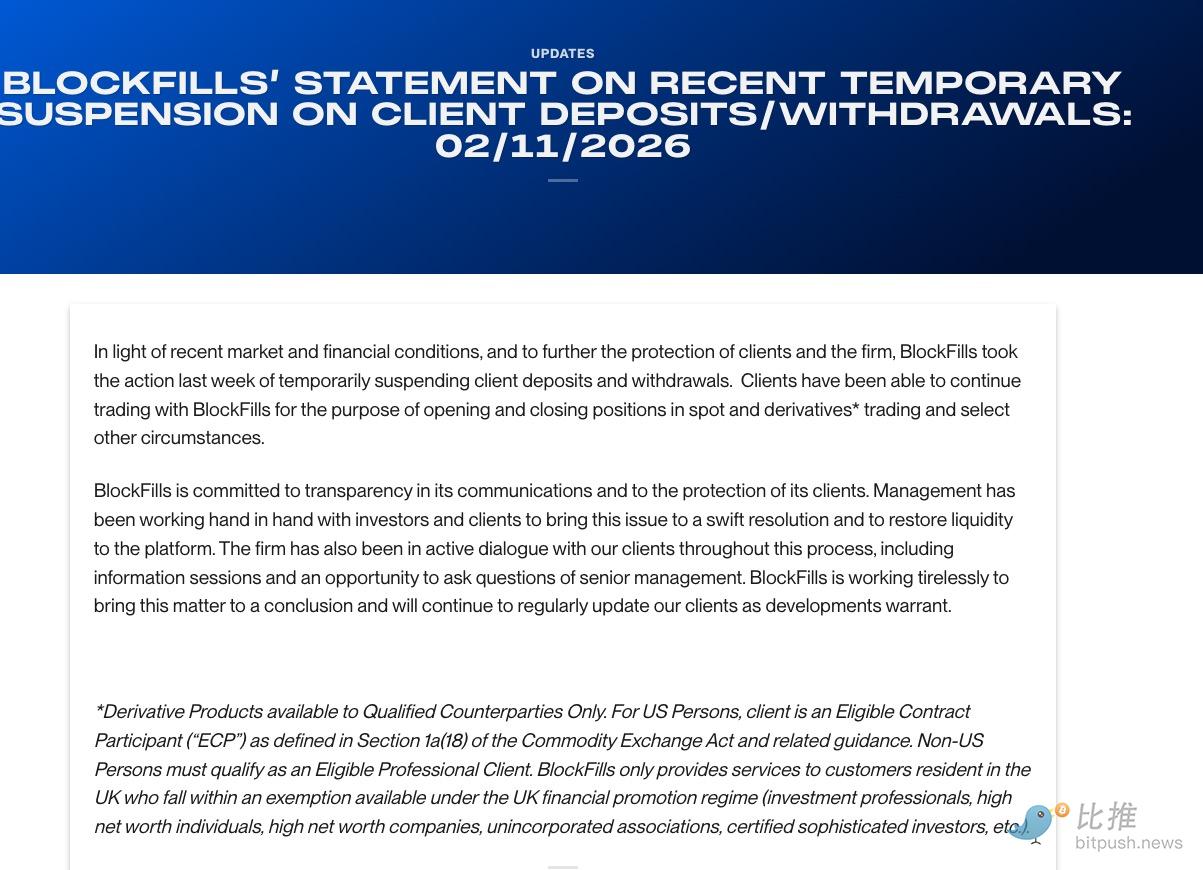
How familiar it smells. When Celsius collapsed in 2022, its opening line was also "temporary liquidity adjustment."

BlockFills' move immediately triggered collective market anxiety: Are we about to witness a repeat of the 2022 tragedies of Celsius and Genesis?

Who is BlockFills?

Founded in Chicago in 2018, this company is not a grassroots project, nor a Dubai-based exile exchange. It's based in Chicago—the Jerusalem of derivatives markets, home to the CME. Its core team comes from traditional finance market making and trading backends. Two names are written on its early investor list: CME Ventures and Susquehanna International Group (SIG).

What caliber of player is Susquehanna? A top-tier Wall Street market maker, accounting for over 30% of annual US options trading volume, and also an early investor in TikTok's parent company, ByteDance. It's not the kind of Crypto VC that chases hot trends and sprays money around; it's old money that stations actuaries upstairs at the exchange.

In 2021, BlockFills completed a $6 million seed round; on the eve of FTX's collapse in 2022, it counter-trend completed a $37 million Series A round. The lead investor was again Susquehanna Capital, with the follow-on list including CME Ventures, Simplex, C6 Ventures, and even Nexo.

Therefore, BlockFills is a "regular army" piece placed by traditional financial giants in the crypto lending arena. Its clients aren't the retail investors who rushed in during 2021, but miners, hedge funds, family offices, market makers, payment processors—over 2,000 institutions across 95 countries. Last year, the payment processor C14 alone processed billions of dollars in onboarding business through it.

Such a company initiating a "voluntary circuit breaker" is more worrying than the blow-up of any retail lending platform in 2022.

Who is BlockFills' largest client group?

Most likely, miners.

According to the official company disclosure, as of 2025, BlockFills provided approximately $150 million in financing and asset management solutions for global miners. As for which specific mining companies received this money, BlockFills did not say. As a platform serving 2,000 institutional clients, publicly disclosing a client list violates both commercial惯例 and privacy red lines. We can only find some clues from scattered public information: it has partnered with payment processor C14, integrated with Fireblocks and Zodia Custody, but those are ecosystem partners, not the borrowers.

The borrowers are silent, but their balance sheets don't lie.

Bitcoin fell from $120,000 to just over $60,000 in less than four months. In early February, "shutdown" warnings began circulating in mining circles. The breakeven line for Antminer S19 series models is around $70,000, and the coin price had been lying below that number for two weeks.

When an industry benchmark like MARA was monitored transferring over 1,300 BTC to an exchange—when the industry benchmark chooses to cut its losses and exit at the $60,000 mark—how many within BlockFills' miner client group were already in technical default?

Is it a "Protective Mechanism" or a "Precursor to Collapse"?

Fintech consultant Dr. Anya Sharma points out that such suspensions are essentially an extension of the "circuit breaker" mechanism in traditional finance. In the digital asset space, the lag of blockchain settlement and potential price flash crashes can lead to collateral valuation failures. Suspending services allows the system to recalibrate, preventing a complete meltdown caused by asset-liability mismatches.

Furthermore, compared to the retail platforms that failed in the 2022 bankruptcy wave, BlockFills has two significant "moats":

  1. Top-Tier "Blue-Blood" Background:

    BlockFills is backed by CME (Chicago Mercantile Exchange) and Susquehanna (SIG). These traditional financial giants not only provide credit endorsement but are also more likely to provide liquidity support (bailout) at critical moments.

  2. Institutionalized Risk Control:

    Celsius/BlockFi (Retail High-Yield Model): They attracted funds by promising high interest rates (10%-20% APY) to ordinary retail investors, then invested in high-risk projects (like Three Arrows Capital). This is a typical "high-cost liability" model, extremely fragile. BlockFills is more like a "cryptocurrency bank trading desk." Its funding sources are primarily institutional clients, and its business focus is providing hedging for miners and trading liquidity for hedge funds. BlockFills' business logic is closer to traditional finance, and its accounts are theoretically more transparent than the more Ponzi-esque model of Celsius.

Therefore, if BlockFills can resume services shortly (e.g., within 72 hours or a week) and transparently disclose its asset status, it will become a model of "risk management," proving that institutional-grade infrastructure is indeed more resilient than the previous generation of platforms. Conversely, if the suspension is prolonged, it will inevitably become the first giant domino to fall in this bear market, triggering a credit collapse in the institutional lending space.

Author: Little Bear Biscuit | Bitpush


Twitter:https://twitter.com/BitpushNewsCN

Bitpush TG Discussion:https://t.me/BitPushCommunity

Bitpush TG Subscription: https://t.me/bitpush

Original link:https://www.bitpush.news/articles/7611258

Preguntas relacionadas

QWhat is the main reason BlockFills has suspended withdrawals, according to its official statement?

AAccording to its official statement, BlockFills suspended withdrawals as a 'temporary measure to protect the interests and the company', not due to default or bankruptcy. It described the action as an internal circuit breaker.

QWhich major traditional financial institutions are key investors in BlockFills?

AThe key investors in BlockFills are CME Ventures and Susquehanna International Group (SIG), which are major players in traditional finance.

QWhat is the primary customer base that BlockFills serves, and why are they particularly vulnerable currently?

ABlockFills primarily serves institutional clients such as miners, hedge funds, and family offices. Miners are particularly vulnerable because the price of Bitcoin has fallen below the breakeven point for many mining rigs, potentially leading to defaults on loans.

QHow does BlockFills' business model differ from that of failed retail lending platforms like Celsius?

ABlockFills operates as a 'cryptocurrency bank trading desk' with institutional clients and focuses on hedging for miners and providing liquidity for hedge funds. In contrast, Celsius used a high-yield model targeting retail customers, which was more fragile and prone to collapse.

QWhat are the potential outcomes if BlockFills fails to resume services quickly, as suggested in the article?

AIf BlockFills fails to resume services quickly and transparently, it could become the first major domino to fall in this bear market, triggering a credit collapse in the institutional lending sector.

Lecturas Relacionadas

20 Billion Valuation, Alibaba and Tencent Competing to Invest, Whose Money Will Liang Wenfeng Take?

DeepSeek, an AI startup founded by Liang Wenfeng, is reportedly in talks with Alibaba and Tencent for an external funding round that could value the company at over $20 billion. This marks a significant shift, as DeepSeek had previously relied solely on funding from its parent company,幻方量化 (Huanfang Quantitative), and had resisted external investment. The potential valuation would place DeepSeek among the top-tier AI model companies in China, comparable to competitors like MoonDark (valued at ~$18 billion) and ahead of recently listed firms like MiniMax and Zhipu. The funding—which could range from $600 million (for a 3% stake) to $2 billion (for 10%)—is seen as a move to secure resources for model development, retain talent, and support infrastructure needs, particularly as competition in inference models and AI agents intensifies. Both Alibaba and Tencent are eager to invest, not only for financial returns but also to integrate DeepSeek into their broader AI ecosystems. However, DeepSeek’s leadership is cautious about maintaining independence and may prefer financial investors over strategic ones to avoid being locked into a specific tech ecosystem. Alternative options, such as state-backed funds, offer longer-term capital and policy support but may come with slower decision-making and potential constraints on global expansion. With competing AI firms accelerating their IPO plans, DeepSeek’s window for securing optimal terms may be narrowing. The final decision will reflect a trade-off between capital, resources, and strategic independence.

marsbitHace 31 min(s)

20 Billion Valuation, Alibaba and Tencent Competing to Invest, Whose Money Will Liang Wenfeng Take?

marsbitHace 31 min(s)

After Losing 97% of Its Market Value, iQiyi Attempts to Use AI to Forcefully Extend Its Lifespan

After losing 97% of its market value since its 2018 peak, iQiyi is aggressively pivoting to AI in a desperate attempt to survive. At its 2026 World Conference, CEO Gong Yu announced an "AI Artist Library" with over 100 virtual performers and a new AIGC platform, "NaDou Pro," promising faster production and lower costs. This shift comes as the company faces severe financial distress: its market cap sits near delisting thresholds at $1.36 billion, with significant losses, declining membership revenue, and depleted cash flow. The AI strategy has sparked controversy. Top actors have issued legal threats against unauthorized digital replicas, while in Hengdian, over 134,000 background actors are seeing their already scarce job opportunities vanish as AI replaces them for background roles. iQiyi's move represents a fundamental shift from being a high-cost content buyer to a landlord" to becoming a "platform capitalist" that transfers production risk to creators. This contrasts with competitors like Douyin (TikTok's Chinese counterpart), which is investing heavily in *real* actor-led short dramas, betting that authentic human connection retains users better than AI-generated content. The article draws a parallel to the 1920s transition to "talkies," which made cinema musicians obsolete but ultimately enriched the art form. In contrast, iQiyi's AI drive is framed not as an artistic evolution but as a cost-cutting measure that could degrade storytelling, replacing genuine human emotion with algorithmically calculated stimulation and potentially numbing audiences' capacity for empathy. The core question remains: can a company focused solely on financial survival preserve the art of storytelling?

marsbitHace 34 min(s)

After Losing 97% of Its Market Value, iQiyi Attempts to Use AI to Forcefully Extend Its Lifespan

marsbitHace 34 min(s)

Only a 50% Chance of Passing This Year, Can the CLARITY Bill Succeed Before the Midterm Elections?

The CLARITY Act, which passed the House in July 2025 with strong bipartisan support (294-134), faces a critical juncture in the Senate. The Senate Banking Committee is expected to hold a markup soon, but key issues remain unresolved, including stablecoin yield provisions, DeFi regulations, and securing full Republican committee support. Other contentious points involve the Blockchain Regulatory Certainty Act (BRCA), ethics amendments for government officials, and SEC-related matters. The legislative calendar is tight, with limited time before the midterm elections. If the committee markup is delayed beyond mid-May, the chances of passage in 2026 drop significantly. Senator Cynthia Lummis has warned that failure this year could delay comprehensive crypto market structure legislation until 2030 or later. Galaxy estimates the probability of the CLARITY Act becoming law in 2026 is only about 50%. The bill provides crucial regulatory clarity by defining jurisdictional boundaries between the SEC and CFTC, establishing a path for decentralization, and bringing digital commodity intermediaries under federal regulation. Its passage is seen as vital before potential power shifts in the next Congress, which could bring less favorable leadership to key committees. The timeline is compressed, and the bill must compete for floor time with other priorities like Iran authorization and DHS appropriations. Key hurdles include finalizing the stablecoin yield compromise text, addressing law enforcement concerns about BRCA, and navigating political dynamics around SEC nominations. The outcome of the Banking Committee markup and the level of bipartisan support will be critical indicators of its future success.

marsbitHace 1 hora(s)

Only a 50% Chance of Passing This Year, Can the CLARITY Bill Succeed Before the Midterm Elections?

marsbitHace 1 hora(s)

Trading

Spot
Futuros
活动图片