Blockchain Association says no to expanding stablecoin yield prohibition

cointelegraphPublicado a 2025-12-19Actualizado a 2025-12-19

Resumen

The Blockchain Association, along with over 125 crypto industry groups, has written to the US Senate Committee on Banking opposing a proposed expansion of the ban on offering yield rewards to stablecoin holders. The letter argues that extending the prohibition—originally targeting stablecoin issuers under the GENIUS Act to include third-party platforms—would stifle innovation, increase market concentration, and unfairly disadvantage crypto services compared to traditional financial providers like banks and credit card companies that offer similar rewards. The Association contends that stablecoin rewards help consumers offset inflation and are a standard feature of competitive markets. It also challenges banking industry claims that yield-bearing stablecoins threaten bank lending, stating there is no evidence to support such concerns. Additionally, the letter comes as the FDIC proposes rules allowing banks to issue stablecoins through subsidiaries, subject to reserve requirements and regulatory oversight.

The Blockchain Association, a non-profit crypto advocacy organization, wrote a letter to the US Senate Committee on Banking, signed by over 125 crypto industry groups and companies, opposing the ban on third-party service providers and platforms offering customer rewards to stablecoin holders.

Expanding the prohibition on stablecoin issuers sharing yield directly with customers, outlined in the GENIUS stablecoin regulatory framework, to include third-party service providers stifles innovation and leads to “greater market concentration,” the letter said.

The letter compared the rewards offered by crypto platforms to those offered by credit card companies, banks and other traditional payment providers.
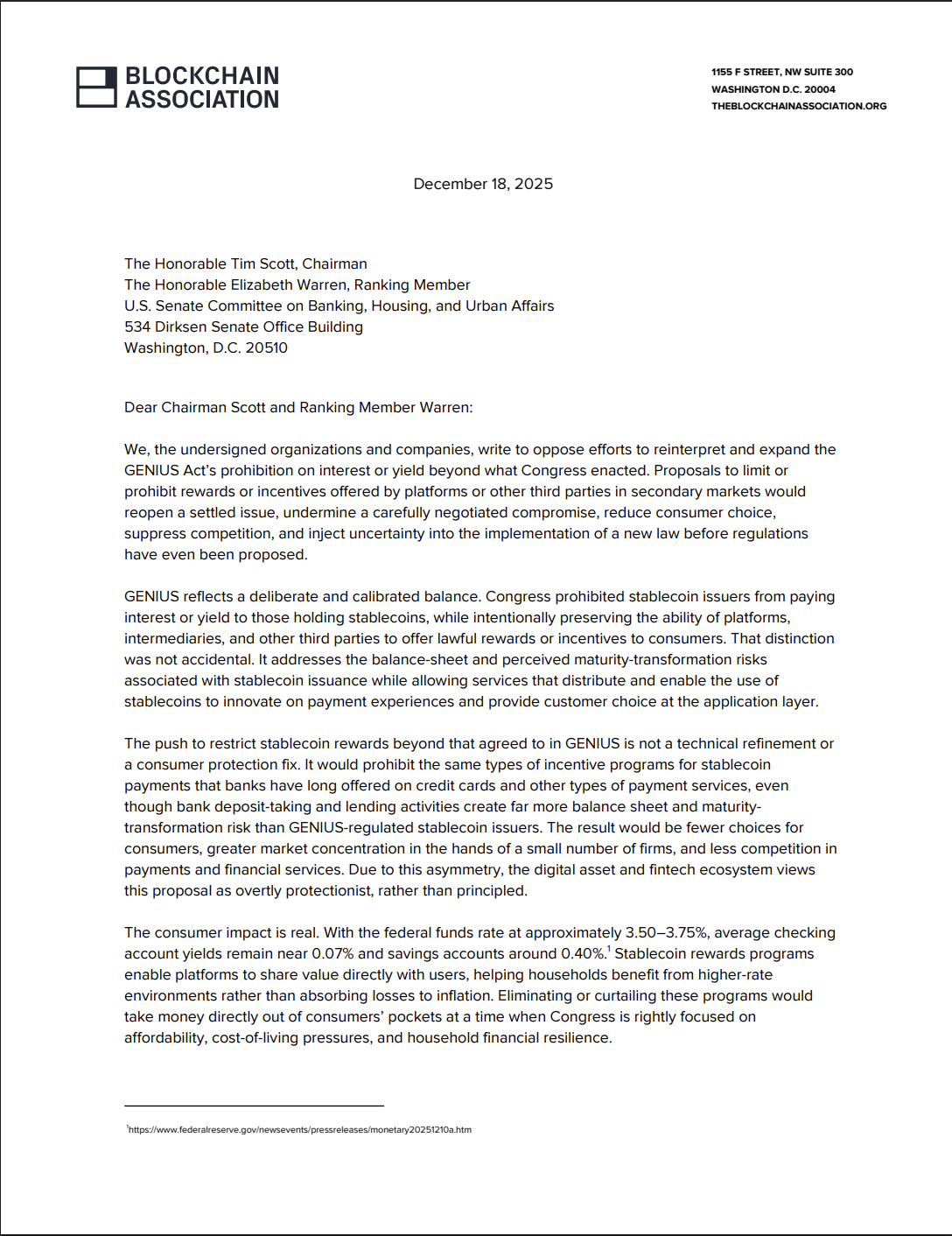
The letter opposes efforts to stop crypto platforms from sharing yield with customers. Source: The Blockchain Association

Prohibiting crypto platforms from offering similar rewards for stablecoins gives an unfair advantage to incumbent financial service providers, the Blockchain Association said.

“The potential benefits of payment stablecoins will not be realized if these types of payments cannot compete on a level playing field with other payment mechanisms. Rewards and incentives are a standard feature of competitive markets.”

The Blockchain Association has issued several statements and letters pushing back against efforts to prohibit crypto platforms from sharing yield-bearing opportunities with customers, arguing that these rewards help consumers offset inflation.

Related: Bank of Canada lays out criteria for ‘good money’ stablecoins

FDIC paves the way for banks to issue stablecoins, industry group says stables aren’t a threat

The Federal Deposit Insurance Corporation (FDIC), the US regulatory agency that oversees and insures the banking sector, published a proposal on Tuesday that would allow banks to issue stablecoins through subsidiaries.

Under the proposal, both the bank and its stablecoin subsidiary would be subject to FDIC rules and assessments for financial fitness, including reserve requirements.
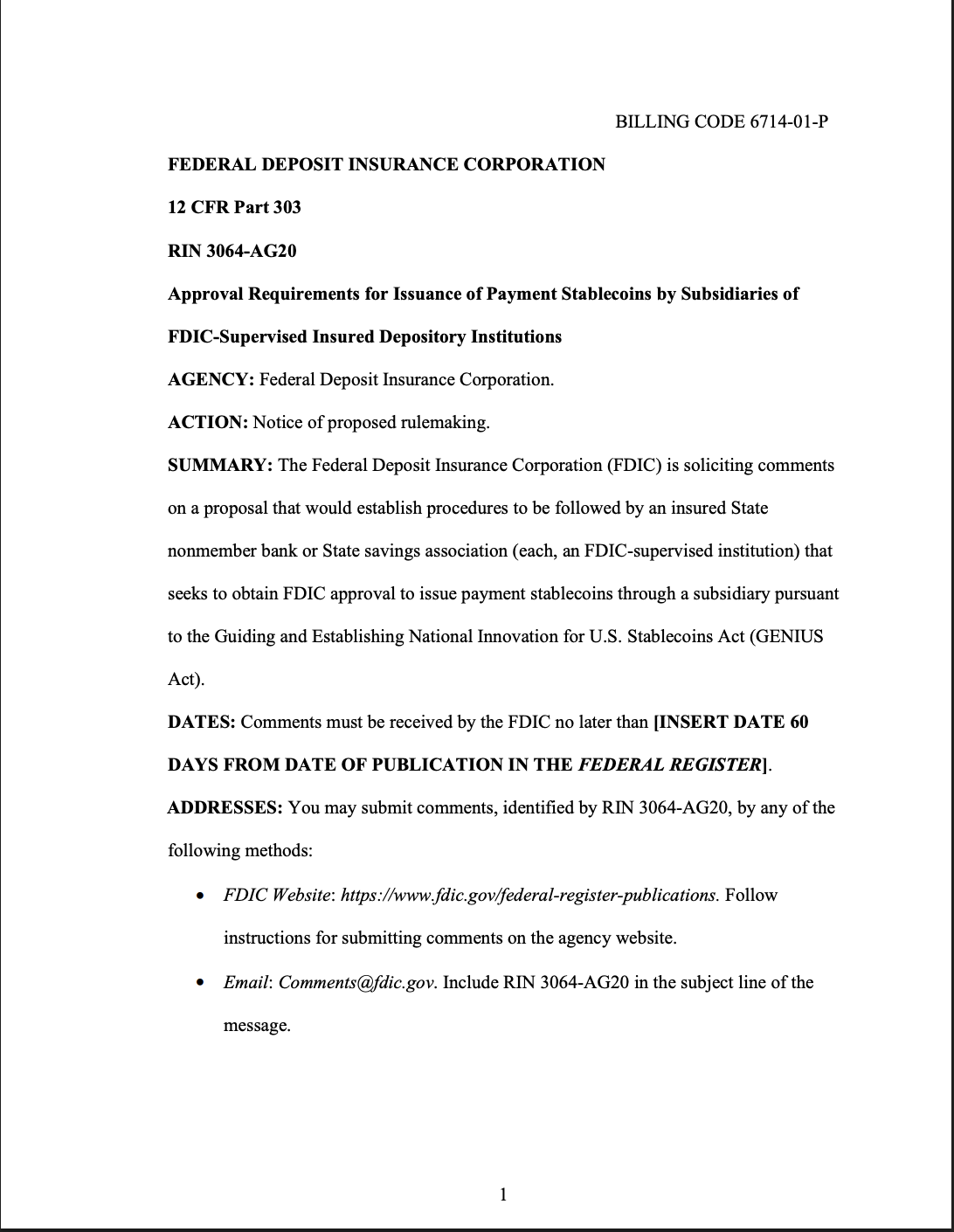
The FDIC proposal to allow banks to issue stablecoins. Source: FDIC

The Blockchain Association continues to push back on claims that yield-bearing stablecoins and sharing rewards with customers threaten the banking sector and bank lending.

“Evidence does not support claims that stablecoin rewards threaten community banks or lending capacity,” the Blockchain Association said, adding that it is difficult to make the case that bank lending is actually constrained by customer deposits.

Despite this, the banking industry has lobbied against yield-bearing stablecoins and crypto platforms sharing yield with clients over fears that interest offered on digital asset products will erode the market share of banks.

Magazine: Unstablecoins: Depegging, bank runs and other risks loom

Preguntas relacionadas

QWhat is the Blockchain Association's main argument against expanding the stablecoin yield prohibition to third-party service providers?

AThe Blockchain Association argues that expanding the prohibition to third-party service providers stifles innovation, leads to greater market concentration, and gives an unfair advantage to traditional financial service providers by preventing crypto platforms from competing on a level playing field.

QHow does the Blockchain Association compare the rewards offered by crypto platforms to those in traditional finance?

AThe letter compares the rewards offered by crypto platforms to the rewards offered by credit card companies, banks, and other traditional payment providers, stating that such incentives are a standard feature of competitive markets.

QWhat recent proposal did the FDIC make regarding banks and stablecoins?

AThe FDIC published a proposal that would allow banks to issue stablecoins through subsidiaries, with both the bank and its subsidiary being subject to FDIC rules, assessments for financial fitness, and reserve requirements.

QWhat is the banking industry's primary concern regarding yield-bearing stablecoins, according to the article?

AThe banking industry fears that the interest offered on digital asset products like yield-bearing stablecoins will erode their market share, leading them to lobby against these products and platforms sharing yield with clients.

QWhat reason does the Blockchain Association give for supporting the ability of platforms to share yield with stablecoin holders?

AThe Blockchain Association argues that these rewards help consumers offset inflation and are necessary for the potential benefits of payment stablecoins to be realized in a competitive market.

Lecturas Relacionadas

NEAR to Airdrop 330,000 Tokens, Betting on TVL Reaching $70 Million

On June 11th, NEAR Protocol launched the Near@3.33 Milestone Incentive Program, targeting users of its Confidential Intents privacy cross-chain execution feature. The program will distribute 333,333 milestone tokens when the Confidential Intents Total Value Locked (TVL) reaches $70 million. Users must have conducted Confidential transactions on near.com and maintain a Confidential balance above $100 in any asset to qualify, with a single wallet capped at 2% of the current airdrop pool. The milestone tokens will be locked upon receipt and cannot be sold or transferred. They can only be converted 1:1 to NEAR tokens once NEAR's Volume Weighted Average Price (VWAP) maintains $3.33 or higher for three consecutive trading days. As of the report, Confidential Intents TVL exceeds $20.69 million, needing roughly a 3x increase to trigger the airdrop. Confidential Intents, launched in February 2026, is NEAR's privacy execution layer designed to prevent MEV, front-running, and strategy leaks by building confidentiality directly into the execution environment. Its TVL has grown from zero to approximately $15 million in about three months. NEAR token price, which surged from around $1 in April to a peak of $3.08, currently trades near $2. The program aims to boost user activity for Confidential Intents, with future incentive rounds planned as community engagement increases.

Foresight NewsHace 30 min(s)

NEAR to Airdrop 330,000 Tokens, Betting on TVL Reaching $70 Million

Foresight NewsHace 30 min(s)

Crypto Market Makers Are Collectively Seeking Change as Money Becomes Harder to Earn

**Summary: Crypto Market Makers Adapt as Margins Shrink** Leading crypto market maker GSR exemplifies a broader industry shift, moving beyond traditional market-making to become a full-service "Web3 investment bank." Its recent strategic acquisitions—including an SEC-registered broker-dealer, rebranded as GSR Securities—and purchases of token advisory firms aim to create an integrated platform covering token design, fundraising, listing, liquidity provision, and asset management. This includes launching an ETF and investing in tokenization platforms like Libeara, backed by a strategic investment from Standard Chartered's SC Ventures. This transformation is not unique to GSR. Other major players like Keyrock, B2C2, Wintermute, and DWF Labs are also expanding geographically, pursuing regulatory licenses (especially under frameworks like MiCA in the EU), and diversifying into over-the-counter (OTC) trading, asset management, and real-world asset tokenization. The driving force behind this collective pivot is a rapidly changing market. Profits from traditional altcoin market-making are declining due to fewer viable projects, reduced client budgets, increased competition, and smarter, more demanding clients. Simultaneously, regulatory pressures are mounting, making compliance a baseline cost. Extreme market events further expose teams lacking robust risk controls. Consequently, the crypto market-making business model is evolving from one reliant on information asymmetry and volatility to a more institutionalized, regulated, and service-diverse industry. Survival now depends on building systemic capabilities beyond mere liquidity provision.

marsbitHace 35 min(s)

Crypto Market Makers Are Collectively Seeking Change as Money Becomes Harder to Earn

marsbitHace 35 min(s)

Market Adjusts Following Google's $84.7 Billion Fundraising, AI Valuations Now Focus on Payback Speed

After Alphabet's announcement of an $84.75 billion equity financing round, market focus for AI investment is shifting from pure growth narratives to capital efficiency and payback periods. The core argument is that AI is being re-priced from a software-like growth story into a heavy-asset infrastructure cycle, requiring massive capital expenditure (CapEx) on chips, data centers, and power grids. While Alphabet's financing itself is not a distress signal—part of it is for administrative purposes like tax obligations on stock compensation—it highlights the enormous capital demands of AI infrastructure. This demand extends beyond tech giants to pure-play AI model companies (like OpenAI, Anthropic), data center REITs, and utilities. Major tech firms are projected to spend heavily on AI data centers in 2026, signaling a broad-based capital cycle the market must absorb. Consequently, valuation logic is changing. Investors are moving away from questions about who has the strongest AI narrative and are now prioritizing clear visibility into orders, stable cash flows, and the cost of capital. This has led to recent pressure on high-multiple AI software and semiconductor stocks, while "picks-and-shovels" hardware, data center, and power assets with firmer near-term demand may see relative support. The key going forward will be monitoring whether rising CapEx guidance across companies is matched by a timely monetization of AI investments into revenue and cash flow. The market's tolerance for high spending depends on demonstrable returns. While the long-term AI thesis remains intact, the valuation framework has fundamentally shifted to emphasize capital discipline and payback speed.

marsbitHace 42 min(s)

Market Adjusts Following Google's $84.7 Billion Fundraising, AI Valuations Now Focus on Payback Speed

marsbitHace 42 min(s)

Trading

Spot
Futuros
活动图片





