Blockchain Association Rejects Proposal To Widen Stablecoin Yield Restrictions

bitcoinistPublicado a 2025-12-21Actualizado a 2025-12-21

Resumen

The Blockchain Association, along with over 125 crypto and fintech groups, is urging Senate Banking leaders to oppose efforts to expand a ban on stablecoin yields beyond what is explicitly stated in the GENIUS Act. The law prohibits stablecoin issuers from paying yields directly to holders but allows third-party platforms to offer rewards. The association argues that broadening the ban would harm competition and innovation, favoring larger financial firms. In contrast, banking groups, led by the American Bankers Association, are pushing for the ban to extend to partners and affiliates, warning that stablecoin rewards could circumvent the law and drain trillions from traditional bank deposits. The debate centers on consumer protection, financial stability, and the future competitive landscape of digital payments. Senate Banking staff are reviewing both sides as they consider potential legislative clarifications.

The Blockchain Association led a broad industry push this week, asking Senate Banking leaders to resist efforts that would widen a ban on stablecoin yields beyond what Congress wrote into law.

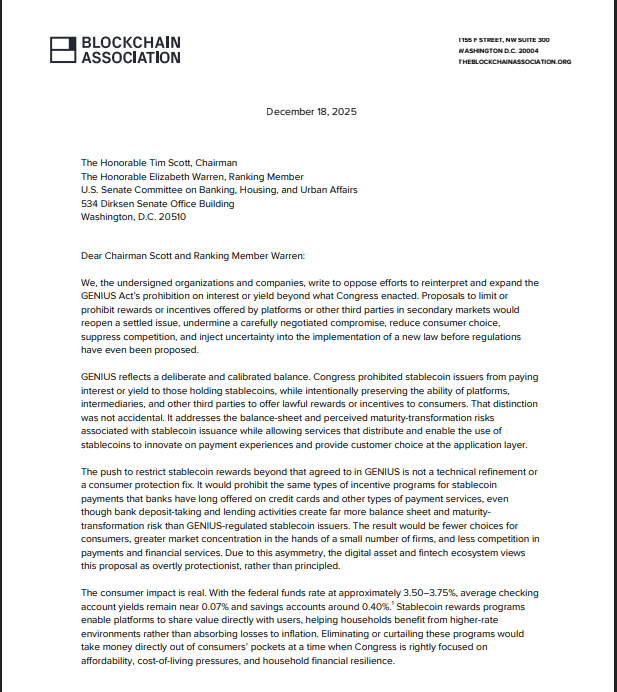
According to the association, the letter was signed by more than 125 crypto and fintech groups and companies and was sent to lawmakers to warn against reinterpreting the new rules in a way that would also bar exchanges and apps from offering rewards tied to stablecoin holdings.

Preserving Platforms’ Ability To Offer Rewards

The coalition’s argument rests on the text of the GENIUS Act, which was signed into law earlier this year by US President Donald Trump and explicitly bars permitted stablecoin issuers from paying interest or yield directly to holders.

Reports have disclosed that the statute nevertheless leaves room for third-party platforms to provide incentives, a distinction industry groups say is intentional and important for competition.

The letter pushes back against attempts to bar crypto platforms from offering yield to customers. Source: The Blockchain Association
Banks Call For Closing A Loophole

Banking groups have pushed back hard. A coalition led by the American Bankers Association and other banking trade groups asked Congress to clarify that the prohibition should extend to partners and affiliates, arguing that third-party rewards could circumvent the law and drain deposits from traditional banks.

According to recent coverage, Treasury analyses cited by bank advocates estimate that stablecoins could, in some scenarios, pull over $6 trillion from bank deposits — a figure that has become central to the banks’ case for tightening the rules.

What Industry Leaders Say

Industry spokespeople say expanding the ban would chill new services that rely on stablecoins and would tilt the market toward larger, incumbent financial firms that already control many payment rails.

BTCUSD currently trading at $88,063. Chart: TradingView

Based on reports, the Blockchain Association and partner groups contend that changing the law’s interpretation now would reopen negotiations the GENIUS Act resolved and would sow regulatory confusion before agencies finish writing implementing rules.

Competition And Consumer Choice At Stake

Supporters of stronger limits say the aim is consumer protection — to stop stablecoin arrangements from becoming de-facto interest accounts that could undermine the banking system and reduce loans to households and businesses.

Other observers point out the issue could also shape which firms win in payments going forward, since restrictions on rewards would affect the commercial incentives of exchanges and fintechs.

Next Steps In Washington

Senate Banking staff are weighing letters from both sides as they consider potential fixes or clarifying language during upcoming hearings.

Regulators who must implement the GENIUS Act have been urged to issue rules that prevent evasion of the ban, and lawmakers may face pressure to either leave the law as written or to craft narrow changes aimed at banks’ concerns.

Featured image from Unsplash, chart from TradingView

Preguntas relacionadas

QWhat is the main action taken by the Blockchain Association this week?

AThe Blockchain Association led a broad industry push by sending a letter to Senate Banking leaders, asking them to resist efforts to widen a ban on stablecoin yields beyond the text of the GENIUS Act.

QAccording to the coalition's argument, what does the GENIUS Act explicitly prohibit?

AThe GENIUS Act explicitly bars permitted stablecoin issuers from paying interest or yield directly to holders.

QWhy are banking groups, like the American Bankers Association, pushing for a broader interpretation of the ban?

ABanking groups argue that third-party rewards could circumvent the law and drain deposits from traditional banks, with estimates suggesting stablecoins could pull over $6 trillion from bank deposits in some scenarios.

QWhat is the potential market impact if the ban on stablecoin yields is expanded to third parties, according to industry spokespeople?

AIndustry spokespeople say expanding the ban would chill new services that rely on stablecoins and would tilt the market toward larger, incumbent financial firms that already control many payment rails.

QWhat are the next steps for Senate Banking staff regarding this issue?

ASenate Banking staff are weighing letters from both sides as they consider potential fixes or clarifying language during upcoming hearings.

Lecturas Relacionadas

In Jinjiang, Fujian, a Storage Super Unicorn Lies Quiet

In Fujian's Jinjiang, a city known for sportswear, lies a quiet semiconductor giant: Fujian Jinhua Integrated Circuit Co. (JHICC). Once a promising domestic DRAM manufacturer alongside Yangtze Memory and ChangXin Memory Technologies (CXMT), its journey was derailed in 2018 when the U.S. placed it on an Entity List and filed criminal charges for alleged trade secret theft. This halted production for years. A turning point came in February 2024 when a U.S. federal court found JHICC not guilty. However, it had lost crucial time. While CXMT soared to become a top-valued A-share company in 2024, JHICC, with an estimated valuation of 80 billion RMB, was just restarting. Its current output is primarily customized DDR4 chips, not the advanced DDR5/HBM demanded for AI, but it still benefits from the broader memory chip upcycle. JHICC's story is tied to Chen Zhengkun, a veteran engineer who left Micron to lead the venture. Founded in 2016 with state-backed funding, JHICC partnered with Taiwan's UMC to develop DRAM technology. Rapid progress was cut short by the U.S. actions, which Micron initiated, partly due to its heavy reliance on the Chinese market. Post-sanctions, Chen's team worked to rebuild the production line with reduced reliance on U.S. technology. According to its records, JHICC achieved small-scale production and revenue growth under immense pressure. It now focuses on the stable "niche" DRAM market (e.g., TVs, routers) with a monthly capacity of ~40,000 wafers, aiming for 60,000 by 2026. It holds over 1,000 patents but remains on the Entity List. For Jinjiang, investing in JHICC was a bold industrial leap. The local government provided unwavering financial and logistical support during the crisis, helping the company survive. JHICC has become the anchor for a growing local semiconductor cluster. Though its scale lags behind domestic peers, JHICC's persistence symbolizes a hard-won foothold in a global market long dominated by Samsung, SK Hynix, and Micron. Having missed one boom, it seeks a place in the new AI-driven memory supercycle.

marsbitHace 1 hora(s)

In Jinjiang, Fujian, a Storage Super Unicorn Lies Quiet

marsbitHace 1 hora(s)

Trading

Spot
活动图片





