Bitwise Reports Third Consecutive Crypto Market Decline as Tokenized Assets Reach Record Highs

TheNewsCryptoPublicado a 2026-07-10Actualizado a 2026-07-10

Resumen

Bitwise's Q2 2026 report details a third consecutive quarterly decline for the broader crypto market, with its Large Cap Crypto Index falling 15.4%. This downturn was marked by significant outflows from Spot Bitcoin ETFs, decreased trading activity, and heightened correlation with traditional stock markets. However, the report highlights a stark divergence from this negative price action, showcasing record growth in several blockchain sectors. Prediction markets saw trading volume surge to a historic $43.2 billion, while the total value of tokenized real-world assets grew over 50% year-to-date to nearly $32.89 billion. Key infrastructure also expanded, with stablecoin adoption and settlement volume outpacing major networks like Visa. Despite crypto asset prices underperforming, metrics such as Ethereum transaction activity and DeFi TVL have risen substantially from their 2022 lows, indicating robust and advancing underlying blockchain technology adoption.

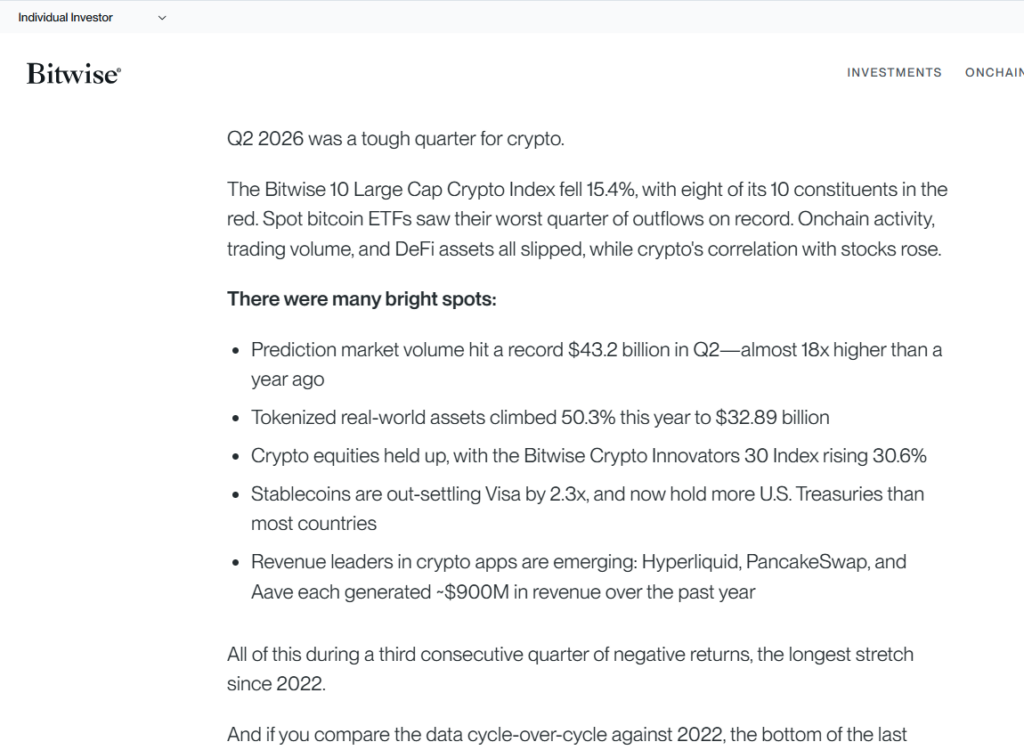
In its report on Q2 2026, Bitwise noted that it was another tough quarter for digital assets despite growth in a number of blockchain verticals. The Bitwise 10 Large Cap Crypto Index fell by 15.4% in Q2 2026, marking another quarter in a row of crypto declines. Out of the ten constituent assets that form the index, eight saw declines over the course of the quarter. According to Bitwise, it is crypto’s third consecutive quarter in negative territory since late 2025.

There were record outflows from Spot Bitcoin ETFs since the introduction of such financial instruments by the regulators. The Fear and Greed Index signaled increased wariness on behalf of investors amid the cryptocurrency markets. Activity within blockchain transactions, decentralized finance assets, and cryptocurrency trading volume also dropped compared to prior quarters. In addition, the report showed that there was greater correlation between cryptocurrency prices and the stock markets. The mixed results were also because, despite poor market performance, Bitwise emphasized continued growth across different blockchain sectors.
Prediction Markets and Tokenization Continue Expanding

Prediction markets were among the most rapidly expanding industries of blockchain in the second quarter. The trading volume grew to its historical high of $43.2 billion, marking almost eighteen-fold year-on-year growth. Tokenized assets saw their total value grow by 50.3% year-to-date and reached a total of about $32.89 billion.

According to Bitwise, the Bitwise Crypto Innovators 30 Index grew by 30.6%, surpassing the performance of the cryptocurrency market as a whole. Adoption of stablecoins was increasing, with the growth of settlement volume reaching 2.3 times more than Visa. The issuers of stablecoins were holding more U.S. Treasury securities than many nations.

At the same time, Hyperliquid, PancakeSwap, and Aave all managed to earn around $900 million in annual protocol revenue. In comparison to the 2022 market bottom, Bitwise stated that the activity of transactions on the Ethereum network is up thirteen times, DeFi TVL is up more than 60%, and the AUM of stablecoins doubled.

According to Bitwise’s quarterly report, there seems to be a widening gap between the performance of cryptocurrencies and blockchain technology usage. Despite the third quarter decline for digital assets, many sectors of blockchain experienced rapid growth. Prediction markets, tokenization of real-world assets, stablecoins, and decentralized finance saw growth even amidst negative sentiment. This reflects that blockchain technology is advancing even though cryptocurrency prices have been underperforming.

Highlighted Crypto News:
Sony Bank Advances US Dollar Stablecoin Plans With Conditional OCC Trust Approval


TagsBitwiseBlockchainCryptocurrencyexchangeMarket downprediction marketrealworldassets

Preguntas relacionadas

QAccording to the Bitwise report, what was the performance of the Bitwise 10 Large Cap Crypto Index in Q2 2026 and what does this represent for the overall market?

AThe Bitwise 10 Large Cap Crypto Index fell by 15.4% in Q2 2026, marking the third consecutive quarter of crypto market declines.

QDespite the general market decline, which two specific blockchain sectors showed significant growth in Q2 2026 according to the article?

APrediction markets and the tokenization of real-world assets showed significant growth. Prediction market trading volume hit a historical high, and the total value of tokenized assets increased by over 50% year-to-date.

QWhat evidence does the report provide to illustrate the growing adoption and scale of stablecoins?

AThe report states that stablecoin settlement volume grew to 2.3 times more than Visa's, and stablecoin issuers now hold more U.S. Treasury securities than many nations.

QHow does the performance of the Bitwise Crypto Innovators 30 Index compare to the broader cryptocurrency market in the reported quarter?

AThe Bitwise Crypto Innovators 30 Index grew by 30.6%, significantly outperforming the declining broader cryptocurrency market.

QWhat key divergence or gap does Bitwise's quarterly report highlight about the current state of the crypto and blockchain industry?

AThe report highlights a widening gap between the poor performance of cryptocurrency prices and the continued advancement and growth in blockchain technology usage across various sectors like DeFi, prediction markets, and tokenization.

Lecturas Relacionadas

IP Token Plunges 98%, Is DATA Rebranding the Last-Ditch Effort? Analyzing Story Protocol's Transformation

IP Token Plummets 98%, Is DATA Rebranding a Last Gamble? Analyzing Story Protocol's Pivot **Summary** Story Protocol, having seen its IP token fall approximately 98% from its all-time high, announced a major pivot on June 25, rebranding as the DATA Foundation. The project will shift its focus from IP to AI training data infrastructure, with a corresponding token change from IP to DATA. While the announcement triggered a brief price bounce, the token soon fell back near its lows. This analysis argues that such a fundamental rebrand is not typically a bullish signal, but rather an admission that the original strategy failed. Historically, rebrands fail when not backed by genuine improvements in product, user adoption, or liquidity, as seen in cases like MultiversX (Elrond) and Golem. Merely chasing a new narrative without execution is insufficient. Conversely, successful pivots are defined by on-chain evidence of growth. The transformation of ETHLend into Aave is the prime example, where a surge in Total Value Locked (TVL) and users preceded and drove long-term value. Projects like Polygon and Kaia, despite price declines, show underlying operational strength. Story’s pivot, announced just two weeks after its token hit a record low, risks being perceived as a last-ditch marketing effort. Leadership changes—with founder Seung Yoon Lee moving to an advisory role—further close the chapter on the original vision. For the DATA rebrand to succeed, it must demonstrably improve the token's relative strength against the market, boost on-chain liquidity/volume, and generate real user growth and settlement revenue from its new AI data narrative. Without such tangible results, Story will likely join the list of failed rebrands.

Foresight NewsHace 28 min(s)

IP Token Plunges 98%, Is DATA Rebranding the Last-Ditch Effort? Analyzing Story Protocol's Transformation

Foresight NewsHace 28 min(s)

USDT Market Cap Overtakes Ethereum, What Signal Does This Convey?

The article discusses the significance of USDT's market capitalization rivaling that of Ethereum. It clarifies that this does not indicate Ethereum provides economic security for USDT, as stablecoin security relies on the issuer, Tether, not the underlying blockchain. The trend also does not reflect a flaw in Ethereum's value, as ETH and USDT serve fundamentally different purposes—one as a yield-bearing asset for network fees, the other as a dollar-pegged medium of exchange. The core argument is that the dominant, enduring demand in crypto is for permissionless dollar transfers, a simple utility that doesn't require complex blockchain technology. USDT's growth, despite its issuer's controversial background, proves users prioritize widespread availability and ease of use over the technical merits or decentralization of the hosting chain. While stablecoin aggregate market cap continues to rise, the combined market cap of major smart contract platform native tokens (like Ethereum, Solana) has remained stagnant, showing a decoupling between the demand for simple dollar liquidity and the value assigned to the underlying settlement layers. The conclusion is that the market values the utility of permissionless dollars above all else, with users largely indifferent to the issuer's credibility or the hosting blockchain's governance, as long as the stablecoin is functional and accessible.

marsbitHace 1 hora(s)

USDT Market Cap Overtakes Ethereum, What Signal Does This Convey?

marsbitHace 1 hora(s)

Trading

Spot
活动图片