IP Token Plunges 98%, Is DATA Rebranding the Last-Ditch Effort? Analyzing Story Protocol's Transformation

Foresight NewsPublicado a 2026-07-10Actualizado a 2026-07-10

Resumen

IP Token Plummets 98%, Is DATA Rebranding a Last Gamble? Analyzing Story Protocol's Pivot **Summary** Story Protocol, having seen its IP token fall approximately 98% from its all-time high, announced a major pivot on June 25, rebranding as the DATA Foundation. The project will shift its focus from IP to AI training data infrastructure, with a corresponding token change from IP to DATA. While the announcement triggered a brief price bounce, the token soon fell back near its lows. This analysis argues that such a fundamental rebrand is not typically a bullish signal, but rather an admission that the original strategy failed. Historically, rebrands fail when not backed by genuine improvements in product, user adoption, or liquidity, as seen in cases like MultiversX (Elrond) and Golem. Merely chasing a new narrative without execution is insufficient. Conversely, successful pivots are defined by on-chain evidence of growth. The transformation of ETHLend into Aave is the prime example, where a surge in Total Value Locked (TVL) and users preceded and drove long-term value. Projects like Polygon and Kaia, despite price declines, show underlying operational strength. Story’s pivot, announced just two weeks after its token hit a record low, risks being perceived as a last-ditch marketing effort. Leadership changes—with founder Seung Yoon Lee moving to an advisory role—further close the chapter on the original vision. For the DATA rebrand to succeed, it must demonstrably improve th...


Author: Tiger Research

Compilation: AididiaoJP, Foresight News


Key Takeaways


Rebranding is usually not a signal of recovery, but more like an admission of the failure of the original strategy. Past cases show that if products, users, and liquidity don't truly return after a name change, it often ends in failure.


However, judging success or failure solely by price is prone to error. If on-chain execution evidence persists after the rebrand, one shouldn't jump to conclusions of failure too early.


The true test of success lies in the path of ETHLend's transformation into Aave: first comes growth in users and Total Value Locked, and then price follows.


Whether Story Protocol's shift from IP to DATA is a genuine business restructuring or a final marketing attempt will be answered by its future execution.


Market Reaction to Rebranding: Not Necessarily a Good Omen
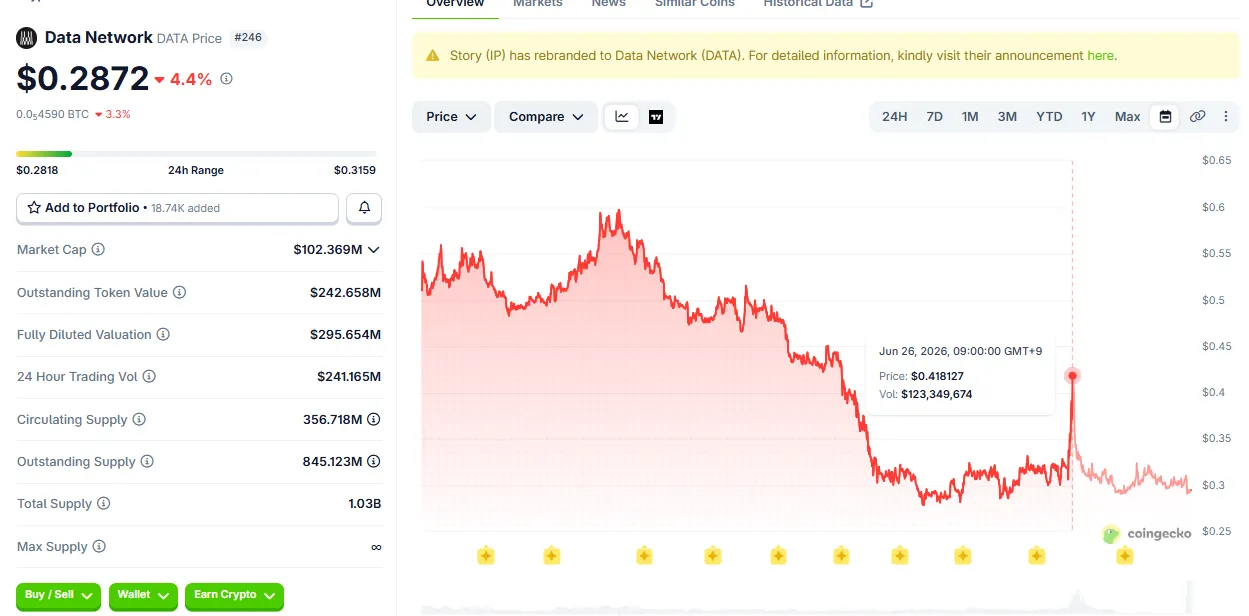


On June 25th, Story Protocol announced its transformation into the DATA Foundation and plans to switch its token from IP to DATA. Although the project had previously secured consecutive funding rounds led by a16z, the IP token struggled to sustain its value during the bear market, falling approximately 98% from its all-time high.


The token subsequently hit new lows. Following the rebranding announcement, the price saw a brief rebound but soon fell back near its lows.


In reality, it's difficult to view this rebranding as a long-term positive for the project. To some extent, it indirectly acknowledges that the project has reached a dead end.


A comprehensive rebrand incurs significant tangible and intangible costs. The time and funds previously invested in brand recognition become sunk costs. Changing the token symbol and project name also carries risks related to internal communication, external coordination, and on-chain asset migration. This means the decision itself carries weight; a rebrand is not superficial but involves a comprehensive adjustment of on-chain and off-chain infrastructure.


Before expecting short-term price rebounds from a token symbol change, a more pertinent question is: what fundamental problem forced the project to abandon the accumulated brand equity and decide to take this path?


Common Traits of Failed Rebranding Cases
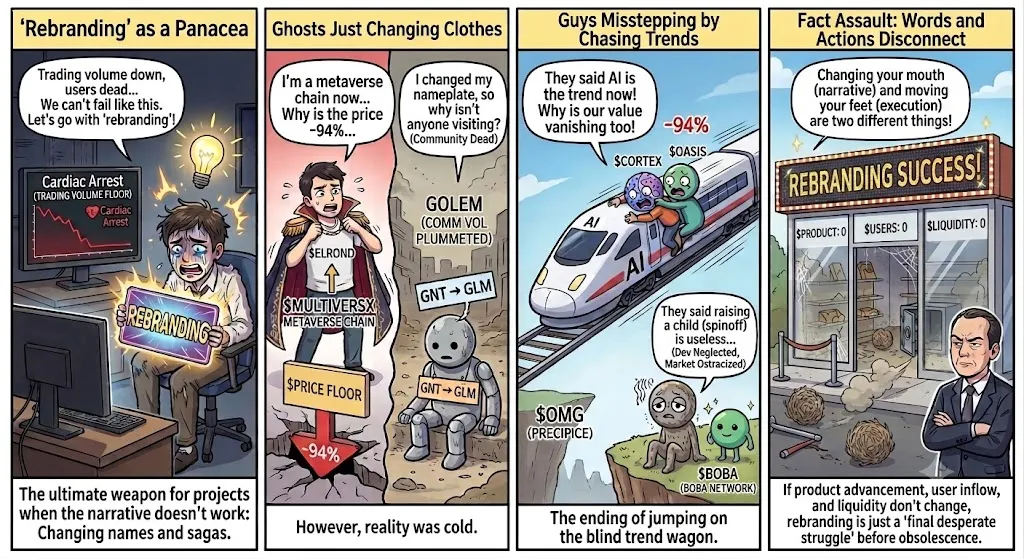


On the surface, rebranding seems like just changing the project name and token symbol, but in essence, it's a shift in product direction and core philosophy. Data from failed rebrands show that most projects that failed to demonstrate genuine improvement in real metrics were eventually eliminated by the market.


  • MultiversX (formerly Elrond): Kept the original EGLD token symbol, pivoted to a metaverse narrative, but the token value has fallen about 94% since the rebrand.
  • Golem (GNT to GLM): Completed token migration, but price is down 92.7% from its peak. Trading volume and development activity have significantly declined, and the project has largely lost relevance.
  • Cortex (CTXC) and Oasis (ROSE): As the AI blockchain narrative faded, Cortex's value nearly zeroed out. Oasis, after pivoting to AI privacy, has also fallen about 94% since its rebrand.
  • OMG Network: After spinning off Boba Network, core network development and ecosystem management were neglected, eventually being left behind by the market.


The common thread among these failed cases is the lack of substantive follow-through in product development, user acquisition, or liquidity provision after the rebrand. Adjusting the narrative and executing the business are two different things.


Judging by Token Price Alone is Far from Enough


Of course, judging a project's success or failure solely by price decline has its limitations, as post-rebrand performance is often intertwined with the overall bear market environment. To avoid mistakenly categorizing projects that still maintain robust on-chain execution data as failures, the following cases are worth referencing.


Ongoing Operational Cases


Kaia (KLAY & FNS merged into KAIA): Post-merger token price fell about 73%, but the project demonstrated strong underlying vitality through initiatives like partnering with South Korea's Kookmin Bank and Busan Bank to issue a Korean won stablecoin, and LINE's mini-program decentralized application. The mini-program attracted 35 million users in its first month, generating 7.3 million new wallets.


Polygon (MATIC to POL): Token fell about 81%, but underlying business continues to advance through the operation of multi-chain settlement infrastructure like AggLayer and the retention of a large ecosystem.


Render (RNDR to RENDER) and ASI: Although market performance has been weak, they possess clear real-world use cases—providing AI computing power and operating core AI products, and their technical execution is validated. Therefore, they are not categorized as failures.


The Benchmark for Successful Rebranding


The case of ETHLend transforming into Aave sets the standard for success.
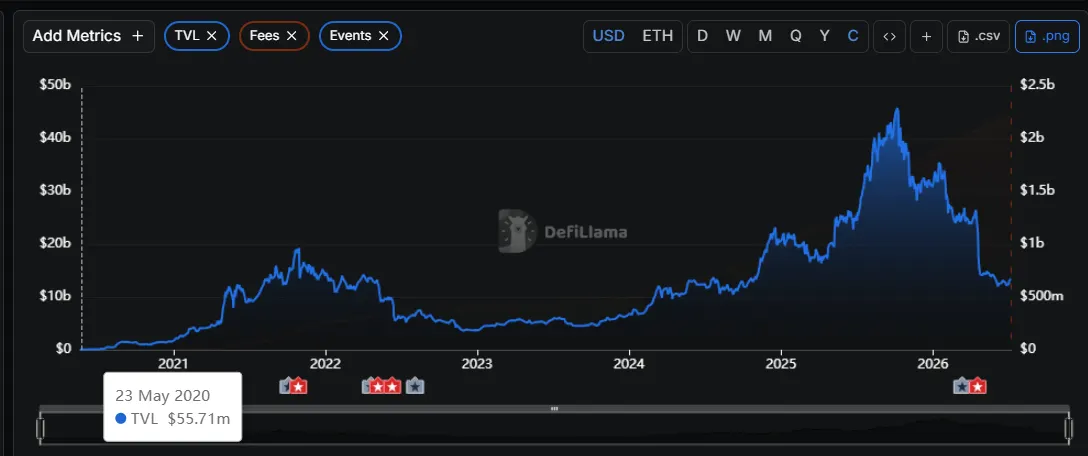


Since its name change in 2020, Aave's Total Value Locked has grown steadily. It has enriched its product line by expanding supported assets, and its user base has significantly expanded. Today, it has become synonymous with the lending protocol sector, a setter of on-chain benchmark interest rates, akin to the "central bank" of decentralized finance. This is a classic example of improving business metrics driving brand value appreciation.


The story of MakerDAO pivoting to Sky is similar: what matters is not the token's roughly 20% decline, but its performance relative to the broader market and its clear execution in running the USDS and sUSDS decentralized stablecoins.


These cases show that the key to judging the success of a rebrand is not short-term price volatility, but whether the project's stated rationale truly materializes and the subsequent tangible results. A rebrand without genuine growth in underlying metrics will eventually be abandoned by the market once the marketing effect wears off.


Story Protocol's Current Rebrand
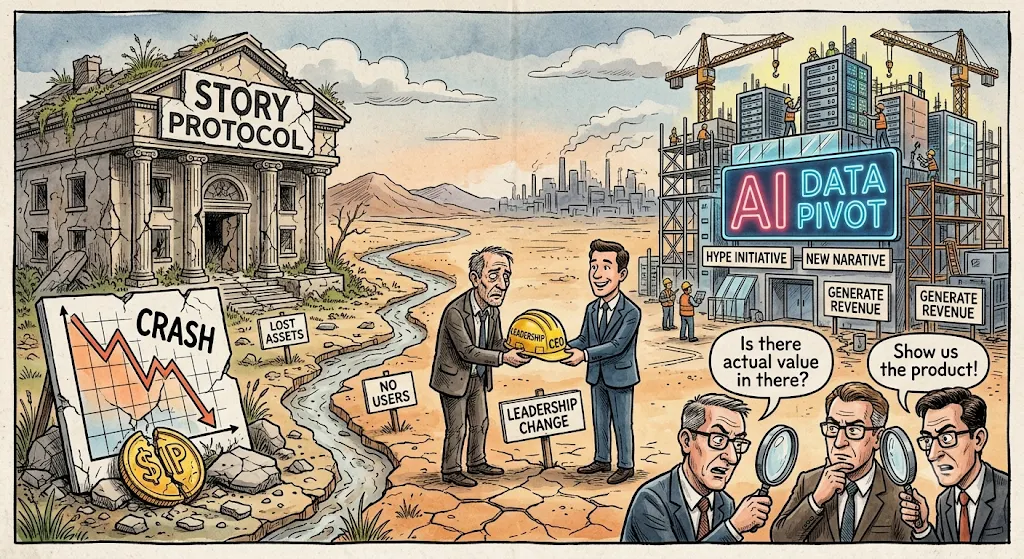


Story's IP token launched in February 2025, reaching its all-time high of around $14.78 in September of the same year, then entering a period of stagnation.


Notably, consider the timing: the token hit its all-time low of $0.275 on June 10, 2026. Just two weeks later, on June 25, the project announced its pivot to AI training data infrastructure.


Because the rebrand occurred near the all-time low, the market questions whether this is merely the final card played to boost the price.


For Story to justify this rebrand, three key metrics need to be tracked in the future:


  • Whether the token's relative strength compared to the broader market recovers;
  • The trend of on-chain liquidity and trading volume after the token switch;
  • Whether the new AI data narrative genuinely brings on-chain user growth and increased settlement revenue.


Changes in core leadership are also noteworthy. The original narrative leader, Seung Yoon Lee, has stepped back from the foundation's daily operations into an advisory role focusing on strategy. Former Chief Product Officer Andrea Muttoni has taken over as the new CEO of the DATA Foundation.


Seung Yoon Lee remains the CEO of the development company PIP Labs, but his reduced role in the foundation marks the end of a chapter for the original Story (IP) narrative centered around this Korean founder and the three consecutive a16z-led funding rounds.


Based on currently available data, this pivot to DATA looks more like a defensive adjustment than a long-term strategic overhaul. To change this perception, tangible results in liquidity, users, and settlement revenue must be delivered after the token switch. Otherwise, Story will become just another failed rebranding case, with its past brief glory fading into memory.


Criptos en tendencia

Preguntas relacionadas

QWhat is the main concern raised in the article about Story Protocol's rebranding to DATA Foundation?

AThe main concern is that the rebranding might not signal a genuine recovery but rather an admission that the original IP strategy has failed. The timing, occurring after the IP token hit a historical low, leads to skepticism about whether it's a final marketing attempt rather than a substantive business pivot.

QAccording to the article, what is the common factor among failed rebranding cases like MultiversX and Golem?

AThe common factor is that after the rebranding, there was no substantial follow-through in terms of product development, user acquisition, or liquidity provision. The narrative change was not backed by real improvements in fundamental business metrics.

QWhat key example does the article use to illustrate a successful rebranding, and why was it successful?

AThe article uses the example of ETHLend rebranding to Aave. It was successful because the rebranding was followed by significant growth in Total Value Locked (TVL), expansion of supported assets, and a substantial increase in user base, transforming it into a leading lending protocol.

QWhat three key metrics does the article suggest should be tracked to judge the success of Story Protocol's (DATA) rebranding?

AThe three key metrics are: 1) The relative strength of the DATA token compared to the broader market. 2) The trend of on-chain liquidity and trading volume after the token migration. 3) Whether the new AI data narrative actually brings growth in on-chain users and increases settlement revenue.

QWhat leadership change is highlighted in the article regarding Story Protocol's transition to DATA?

AThe article highlights that Seung Yoon Lee, the original narrative driver and founder, has stepped back from the foundation's daily operations to an advisory role focusing on strategy. Andrea Muttoni, the former Chief Product Officer, has taken over as the new CEO of the DATA Foundation.

Lecturas Relacionadas

RWA Weekly: EU Proposes Revision of MiCA to Cover Tokenization and Non-EU Stablecoins; Swift and 17 Banks to Pilot Tokenized Cross-Border Payments

RWA Weekly: EU Proposes MiCA Revision for Tokenization and Non-EU Stablecoins; Swift to Pilot Tokenized Cross-Border Payments with 17 Banks During the statistical period of July 3-10, 2026, the RWA sector showed signs of recovery. The total on-chain market capitalization of RWAs rebounded to $33.12 billion, ending a prolonged decline. The stablecoin market cap also returned above $300 billion, with active addresses and holders increasing, indicating restored market vitality. Key regulatory developments include China promoting the use of digital yuan in consumption vouchers, the EU considering revisions to its MiCA framework to cover tokenization and non-EU stablecoins, and Kazakhstan authorizing stablecoin use for cross-border corporate and government payments. In Hong Kong, HSBC issued its first "digitally native" structured product. Major project updates feature Swift announcing readiness of its blockchain ledger for a 24/7 tokenized cross-border payment pilot involving 17 global banks. Ondo launched a perpetuals platform allowing tokenized stocks as collateral. Sony received conditional U.S. OCC approval to launch a stablecoin-focused trust bank in 2027. Tether plans to natively issue USDT on Bitcoin via the RGB protocol. Significant funding rounds saw Securitize planning to deploy over $400 million for acquisitions to expand its institutional tokenization business, while Tether invested $20 million in Brazil's Mercado Bitcoin to support its growth in on-chain financial services. Analysis highlights that stablecoins are evolving into global financial infrastructure with regional specializations and that institutions should consider international expansion to gain practical experience in the RWA tokenization space amidst evolving regulations.

marsbitHace 19 min(s)

RWA Weekly: EU Proposes Revision of MiCA to Cover Tokenization and Non-EU Stablecoins; Swift and 17 Banks to Pilot Tokenized Cross-Border Payments

marsbitHace 19 min(s)

The first to catch the wave of the Robinhood Chain hype is Arbitrum, up nearly 20%

"ARB, the native token of Arbitrum, surged nearly 20% recently, emerging as a top-performing L2 token. This rally is attributed to the launch of 'Robinhood Chain,' a Real-World Asset (RWA) Layer 2 built using Arbitrum's technology. The launch has brought renewed attention to the 'Arbitrum Expansion Plan' (AEP), a year-and-a-half-old program. AEP allows external projects to build their own chains using Arbitrum's Orbit technology. In return, these 'tenant' chains that do not settle on Arbitrum's main networks must share 10% of their net protocol revenue with the Arbitrum ecosystem—8% to the DAO treasury and 2% to the developer guild. While smaller chains like Degen Chain previously triggered AEP, Robinhood Chain is the first major, high-profile tenant, making the revenue-sharing model economically significant for the first time. Initial data from Robinhood Chain is impressive, with over 35 million transactions, 350,000 addresses, $2.5 billion in TVL, and over $1 billion in DEX volume shortly after launch. However, its current protocol revenue, at roughly $146,000 net, translates to only a minimal payout to Arbitrum DAO. The ARB price surge thus reflects the market's anticipation of future revenue as Robinhood's vast $324 billion platform assets potentially migrate on-chain. This 'landlord' model mirrors Optimism's approach with its OP Stack and Superchain. However, Optimism's model faces pressure as its largest tenant, Base, announced plans to depart, causing a significant drop in OP's price. Similarly, analysts question Robinhood Chain's long-term dependence on Arbitrum, noting its daily sequencer revenue already nears three times that of Arbitrum itself. There is speculation that, like Base, it may eventually seek independence, with ETH potentially being its primary economic token rather than ARB."

Foresight NewsHace 47 min(s)

The first to catch the wave of the Robinhood Chain hype is Arbitrum, up nearly 20%

Foresight NewsHace 47 min(s)

The Ethereum Foundation is Dead, The Era of Ethereum's Pluralistic Organizations Has Dawned

The Ethereum Foundation (EF) has announced the dissolution of its Protocol Support Team, marking a significant organizational shift. This move, described as the largest layoff in EF's history with a 20% staff reduction, follows a major internal restructuring announced in late June. The restructuring, which EF framed as necessary to streamline for future challenges, has drawn criticism for its perceived cold execution. Concurrently, several new independent non-profit organizations have emerged, founded by former EF members. These include Ethlabs, a research and development lab, and Ethereum Institutional, which focuses on promoting institutional adoption of Ethereum. Their rise is seen as both filling roles vacated by EF's downsizing and signaling a fragmentation of the Ethereum ecosystem's leadership. Amidst these changes, EF is also integrating advanced AI tools into its security operations. The security team has begun using AI agents to conduct red-team testing, which has already uncovered vulnerabilities in Ethereum's code. While EF states that AI complements rather than replaces human researchers, this technological shift hints at potential future reductions in human-centric roles within the organization. The article posits that these developments—massive layoffs, the exodus of key personnel like former Executive Director Xiaowei Wang, the rise of rival organizations, and AI integration—collectively point to a decline in EF's central authority. Once the undisputed leader of the Ethereum ecosystem, EF now faces questions about its future role, with speculation that it may evolve into more of a symbolic "ecosystem mascot" rather than a driving force for growth and adoption. This organizational turmoil unfolds against a backdrop of ongoing market pressure and community debate over Ethereum's value proposition.

marsbitHace 52 min(s)

The Ethereum Foundation is Dead, The Era of Ethereum's Pluralistic Organizations Has Dawned

marsbitHace 52 min(s)

Trading

Spot

Artículos destacados

Qué es $S$

Entendiendo SPERO: Una Visión General Completa Introducción a SPERO A medida que el panorama de la innovación continúa evolucionando, la aparición de tecnologías web3 y proyectos de criptomonedas juega un papel fundamental en la configuración del futuro digital. Un proyecto que ha atraído la atención en este campo dinámico es SPERO, denotado como SPERO,$$s$. Este artículo tiene como objetivo reunir y presentar información detallada sobre SPERO, para ayudar a entusiastas e inversores a comprender sus fundamentos, objetivos e innovaciones dentro de los dominios web3 y cripto. ¿Qué es SPERO,$$s$? SPERO,$$s$ es un proyecto único dentro del espacio cripto que busca aprovechar los principios de descentralización y tecnología blockchain para crear un ecosistema que promueva la participación, la utilidad y la inclusión financiera. El proyecto está diseñado para facilitar interacciones de igual a igual de nuevas maneras, proporcionando a los usuarios soluciones y servicios financieros innovadores. En su esencia, SPERO,$$s$ tiene como objetivo empoderar a los individuos al proporcionar herramientas y plataformas que mejoren la experiencia del usuario en el espacio de las criptomonedas. Esto incluye habilitar métodos de transacción más flexibles, fomentar iniciativas impulsadas por la comunidad y crear caminos para oportunidades financieras a través de aplicaciones descentralizadas (dApps). La visión subyacente de SPERO,$$s$ gira en torno a la inclusividad, buscando cerrar brechas dentro de las finanzas tradicionales mientras aprovecha los beneficios de la tecnología blockchain. ¿Quién es el Creador de SPERO,$$s$? La identidad del creador de SPERO,$$s$ sigue siendo algo oscura, ya que hay recursos públicos limitados que proporcionan información de fondo detallada sobre su(s) fundador(es). Esta falta de transparencia puede derivarse del compromiso del proyecto con la descentralización, una ética que muchos proyectos web3 comparten, priorizando las contribuciones colectivas sobre el reconocimiento individual. Al centrar las discusiones en torno a la comunidad y sus objetivos colectivos, SPERO,$$s$ encarna la esencia del empoderamiento sin señalar a individuos específicos. Como tal, comprender la ética y la misión de SPERO sigue siendo más importante que identificar a un creador singular. ¿Quiénes son los Inversores de SPERO,$$s$? SPERO,$$s$ cuenta con el apoyo de una diversa gama de inversores que van desde capitalistas de riesgo hasta inversores ángeles dedicados a fomentar la innovación en el sector cripto. El enfoque de estos inversores generalmente se alinea con la misión de SPERO, priorizando proyectos que prometen avances tecnológicos sociales, inclusión financiera y gobernanza descentralizada. Estas fundaciones de inversores suelen estar interesadas en proyectos que no solo ofrecen productos innovadores, sino que también contribuyen positivamente a la comunidad blockchain y sus ecosistemas. El respaldo de estos inversores refuerza a SPERO,$$s$ como un contendiente notable en el dominio de proyectos cripto que evoluciona rápidamente. ¿Cómo Funciona SPERO,$$s$? SPERO,$$s$ emplea un marco multifacético que lo distingue de los proyectos de criptomonedas convencionales. Aquí hay algunas de las características clave que subrayan su singularidad e innovación: Gobernanza Descentralizada: SPERO,$$s$ integra modelos de gobernanza descentralizada, empoderando a los usuarios para participar activamente en los procesos de toma de decisiones sobre el futuro del proyecto. Este enfoque fomenta un sentido de propiedad y responsabilidad entre los miembros de la comunidad. Utilidad del Token: SPERO,$$s$ utiliza su propio token de criptomoneda, diseñado para servir diversas funciones dentro del ecosistema. Estos tokens permiten transacciones, recompensas y la facilitación de servicios ofrecidos en la plataforma, mejorando la participación y la utilidad general. Arquitectura en Capas: La arquitectura técnica de SPERO,$$s$ apoya la modularidad y escalabilidad, permitiendo la integración fluida de características y aplicaciones adicionales a medida que el proyecto evoluciona. Esta adaptabilidad es fundamental para mantener la relevancia en el cambiante paisaje cripto. Participación de la Comunidad: El proyecto enfatiza iniciativas impulsadas por la comunidad, empleando mecanismos que incentivan la colaboración y la retroalimentación. Al nutrir una comunidad sólida, SPERO,$$s$ puede abordar mejor las necesidades de los usuarios y adaptarse a las tendencias del mercado. Enfoque en la Inclusión: Al ofrecer tarifas de transacción bajas e interfaces amigables para el usuario, SPERO,$$s$ busca atraer a una base de usuarios diversa, incluyendo a individuos que anteriormente pueden no haber participado en el espacio cripto. Este compromiso con la inclusión se alinea con su misión general de empoderamiento a través de la accesibilidad. Cronología de SPERO,$$s$ Entender la historia de un proyecto proporciona información crucial sobre su trayectoria de desarrollo y hitos. A continuación se presenta una cronología sugerida que mapea eventos significativos en la evolución de SPERO,$$s$: Fase de Conceptualización e Ideación: Las ideas iniciales que forman la base de SPERO,$$s$ fueron concebidas, alineándose estrechamente con los principios de descentralización y enfoque comunitario dentro de la industria blockchain. Lanzamiento del Whitepaper del Proyecto: Tras la fase conceptual, se lanzó un whitepaper completo que detalla la visión, los objetivos y la infraestructura tecnológica de SPERO,$$s$ para generar interés y retroalimentación de la comunidad. Construcción de Comunidad y Primeras Interacciones: Se realizaron esfuerzos de divulgación activa para construir una comunidad de primeros adoptantes y posibles inversores, facilitando discusiones en torno a los objetivos del proyecto y obteniendo apoyo. Evento de Generación de Tokens: SPERO,$$s$ llevó a cabo un evento de generación de tokens (TGE) para distribuir sus tokens nativos a los primeros seguidores y establecer liquidez inicial dentro del ecosistema. Lanzamiento de la dApp Inicial: La primera aplicación descentralizada (dApp) asociada con SPERO,$$s$ se puso en marcha, permitiendo a los usuarios interactuar con las funcionalidades centrales de la plataforma. Desarrollo Continuo y Alianzas: Actualizaciones y mejoras continuas a las ofertas del proyecto, incluyendo alianzas estratégicas con otros actores en el espacio blockchain, han moldeado a SPERO,$$s$ en un jugador competitivo y en evolución en el mercado cripto. Conclusión SPERO,$$s$ se erige como un testimonio del potencial de web3 y las criptomonedas para revolucionar los sistemas financieros y empoderar a los individuos. Con un compromiso con la gobernanza descentralizada, la participación comunitaria y funcionalidades diseñadas de manera innovadora, allana el camino hacia un paisaje financiero más inclusivo. Como con cualquier inversión en el espacio cripto que evoluciona rápidamente, se anima a los posibles inversores y usuarios a investigar a fondo y participar de manera reflexiva con los desarrollos en curso dentro de SPERO,$$s$. El proyecto muestra el espíritu innovador de la industria cripto, invitando a una mayor exploración de sus innumerables posibilidades. Mientras el viaje de SPERO,$$s$ aún se desarrolla, sus principios fundamentales pueden, de hecho, influir en el futuro de cómo interactuamos con la tecnología, las finanzas y entre nosotros en ecosistemas digitales interconectados.

120 Vistas totalesPublicado en 2024.12.17Actualizado en 2024.12.17

Qué es $S$

Qué es AGENT S

Agent S: El Futuro de la Interacción Autónoma en Web3 Introducción En el paisaje en constante evolución de Web3 y las criptomonedas, las innovaciones están redefiniendo constantemente cómo los individuos interactúan con las plataformas digitales. Uno de estos proyectos pioneros, Agent S, promete revolucionar la interacción humano-computadora a través de su marco agente abierto. Al allanar el camino para interacciones autónomas, Agent S busca simplificar tareas complejas, ofreciendo aplicaciones transformadoras en inteligencia artificial (IA). Esta exploración detallada profundizará en las complejidades del proyecto, sus características únicas y las implicaciones para el dominio de las criptomonedas. ¿Qué es Agent S? Agent S se presenta como un marco agente abierto innovador, diseñado específicamente para abordar tres desafíos fundamentales en la automatización de tareas informáticas: Adquisición de Conocimiento Específico del Dominio: El marco aprende inteligentemente de diversas fuentes de conocimiento externas y experiencias internas. Este enfoque dual le permite construir un rico repositorio de conocimiento específico del dominio, mejorando su rendimiento en la ejecución de tareas. Planificación a Largo Plazo de Tareas: Agent S emplea planificación jerárquica aumentada por la experiencia, un enfoque estratégico que facilita la descomposición y ejecución eficiente de tareas complejas. Esta característica mejora significativamente su capacidad para gestionar múltiples subtareas de manera eficiente y efectiva. Manejo de Interfaces Dinámicas y No Uniformes: El proyecto introduce la Interfaz Agente-Computadora (ACI), una solución innovadora que mejora la interacción entre agentes y usuarios. Utilizando Modelos de Lenguaje Multimodal de Gran Escala (MLLMs), Agent S puede navegar y manipular diversas interfaces gráficas de usuario sin problemas. A través de estas características pioneras, Agent S proporciona un marco robusto que aborda las complejidades involucradas en la automatización de la interacción humana con las máquinas, preparando el terreno para una multitud de aplicaciones en IA y más allá. ¿Quién es el Creador de Agent S? Si bien el concepto de Agent S es fundamentalmente innovador, la información específica sobre su creador sigue siendo elusiva. El creador es actualmente desconocido, lo que resalta ya sea la etapa incipiente del proyecto o la elección estratégica de mantener a los miembros fundadores en el anonimato. Independientemente de la anonimidad, el enfoque sigue siendo en las capacidades y el potencial del marco. ¿Quiénes son los Inversores de Agent S? Dado que Agent S es relativamente nuevo en el ecosistema criptográfico, la información detallada sobre sus inversores y patrocinadores financieros no está documentada explícitamente. La falta de información disponible públicamente sobre las bases de inversión u organizaciones que apoyan el proyecto plantea preguntas sobre su estructura de financiamiento y hoja de ruta de desarrollo. Comprender el respaldo es crucial para evaluar la sostenibilidad del proyecto y su posible impacto en el mercado. ¿Cómo Funciona Agent S? En el núcleo de Agent S se encuentra una tecnología de vanguardia que le permite funcionar de manera efectiva en diversos entornos. Su modelo operativo se basa en varias características clave: Interacción Humano-Computadora Similar a la Humana: El marco ofrece planificación avanzada de IA, esforzándose por hacer que las interacciones con las computadoras sean más intuitivas. Al imitar el comportamiento humano en la ejecución de tareas, promete elevar las experiencias de los usuarios. Memoria Narrativa: Empleada para aprovechar experiencias de alto nivel, Agent S utiliza memoria narrativa para hacer un seguimiento de las historias de tareas, mejorando así sus procesos de toma de decisiones. Memoria Episódica: Esta característica proporciona a los usuarios una guía paso a paso, permitiendo que el marco ofrezca apoyo contextual a medida que se desarrollan las tareas. Soporte para OpenACI: Con la capacidad de ejecutarse localmente, Agent S permite a los usuarios mantener el control sobre sus interacciones y flujos de trabajo, alineándose con la ética descentralizada de Web3. Fácil Integración con APIs Externas: Su versatilidad y compatibilidad con varias plataformas de IA aseguran que Agent S pueda encajar sin problemas en ecosistemas tecnológicos existentes, convirtiéndolo en una opción atractiva para desarrolladores y organizaciones. Estas funcionalidades contribuyen colectivamente a la posición única de Agent S dentro del espacio cripto, ya que automatiza tareas complejas y de múltiples pasos con una intervención humana mínima. A medida que el proyecto evoluciona, sus posibles aplicaciones en Web3 podrían redefinir cómo se desarrollan las interacciones digitales. Cronología de Agent S El desarrollo y los hitos de Agent S pueden encapsularse en una cronología que resalta sus eventos significativos: 27 de septiembre de 2024: El concepto de Agent S fue lanzado en un documento de investigación integral titulado “Un Marco Agente Abierto que Usa Computadoras Como un Humano”, mostrando las bases del proyecto. 10 de octubre de 2024: El documento de investigación fue puesto a disposición del público en arXiv, ofreciendo una exploración profunda del marco y su evaluación de rendimiento basada en el benchmark OSWorld. 12 de octubre de 2024: Se lanzó una presentación en video, proporcionando una visión visual de las capacidades y características de Agent S, involucrando aún más a posibles usuarios e inversores. Estos marcadores en la cronología no solo ilustran el progreso de Agent S, sino que también indican su compromiso con la transparencia y la participación comunitaria. Puntos Clave Sobre Agent S A medida que el marco Agent S continúa evolucionando, varios atributos clave destacan, subrayando su naturaleza innovadora y potencial: Marco Innovador: Diseñado para proporcionar un uso intuitivo de las computadoras similar a la interacción humana, Agent S aporta un enfoque novedoso a la automatización de tareas. Interacción Autónoma: La capacidad de interactuar de manera autónoma con las computadoras a través de GUI significa un salto hacia soluciones informáticas más inteligentes y eficientes. Automatización de Tareas Complejas: Con su metodología robusta, puede automatizar tareas complejas y de múltiples pasos, haciendo que los procesos sean más rápidos y menos propensos a errores. Mejora Continua: Los mecanismos de aprendizaje permiten a Agent S mejorar a partir de experiencias pasadas, mejorando continuamente su rendimiento y eficacia. Versatilidad: Su adaptabilidad en diferentes entornos operativos como OSWorld y WindowsAgentArena asegura que pueda servir a una amplia gama de aplicaciones. A medida que Agent S se posiciona en el paisaje de Web3 y criptomonedas, su potencial para mejorar las capacidades de interacción y automatizar procesos significa un avance significativo en las tecnologías de IA. A través de su marco innovador, Agent S ejemplifica el futuro de las interacciones digitales, prometiendo una experiencia más fluida y eficiente para los usuarios en diversas industrias. Conclusión Agent S representa un audaz avance en la unión de la IA y Web3, con la capacidad de redefinir cómo interactuamos con la tecnología. Aunque aún se encuentra en sus primeras etapas, las posibilidades para su aplicación son vastas y atractivas. A través de su marco integral que aborda desafíos críticos, Agent S busca llevar las interacciones autónomas al primer plano de la experiencia digital. A medida que nos adentramos más en los reinos de las criptomonedas y la descentralización, proyectos como Agent S sin duda desempeñarán un papel crucial en la configuración del futuro de la tecnología y la colaboración humano-computadora.

524 Vistas totalesPublicado en 2025.01.14Actualizado en 2025.01.14

Qué es AGENT S

Cómo comprar S

¡Bienvenido a HTX.com! Hemos hecho que comprar Sonic (S) sea simple y conveniente. Sigue nuestra guía paso a paso para iniciar tu viaje de criptos.Paso 1: crea tu cuenta HTXUtiliza tu correo electrónico o número de teléfono para registrarte y obtener una cuenta gratuita en HTX. Experimenta un proceso de registro sin complicaciones y desbloquea todas las funciones.Obtener mi cuentaPaso 2: ve a Comprar cripto y elige tu método de pagoTarjeta de crédito/débito: usa tu Visa o Mastercard para comprar Sonic (S) al instante.Saldo: utiliza fondos del saldo de tu cuenta HTX para tradear sin problemas.Terceros: hemos agregado métodos de pago populares como Google Pay y Apple Pay para mejorar la comodidad.P2P: tradear directamente con otros usuarios en HTX.Over-the-Counter (OTC): ofrecemos servicios personalizados y tipos de cambio competitivos para los traders.Paso 3: guarda tu Sonic (S)Después de comprar tu Sonic (S), guárdalo en tu cuenta HTX. Alternativamente, puedes enviarlo a otro lugar mediante transferencia blockchain o utilizarlo para tradear otras criptomonedas.Paso 4: tradear Sonic (S)Tradear fácilmente con Sonic (S) en HTX's mercado spot. Simplemente accede a tu cuenta, selecciona tu par de trading, ejecuta tus trades y monitorea en tiempo real. Ofrecemos una experiencia fácil de usar tanto para principiantes como para traders experimentados.

1.1k Vistas totalesPublicado en 2025.01.15Actualizado en 2026.06.02

Cómo comprar S

Discusiones

Bienvenido a la comunidad de HTX. Aquí puedes mantenerte informado sobre los últimos desarrollos de la plataforma y acceder a análisis profesionales del mercado. A continuación se presentan las opiniones de los usuarios sobre el precio de S (S).

活动图片