Bittensor Goes Left, Virtuals Goes Right: Two Flywheel Paradigms of AI Crypto Projects

marsbitPublicado a 2026-03-26Actualizado a 2026-03-26

Resumen

The article compares two AI crypto project models: Bittensor's subnet ecosystem and Virtuals' agent-based system. Bittensor uses TAO emissions to incentivize subnets, which compete for daily TAO rewards. Subnets require significant capital to launch (e.g., 871 TAO for a subnet slot) and focus on infrastructure like decentralized computing and AI research. Its ecosystem has high entry barriers, complex onboarding, and targets technical users. Virtuals employs a pump.fun-like model where agent tokens gain value through trading volume, enabling rapid capital accumulation during speculative cycles. It has low entry costs for teams, supports quick iteration via a 60-day trial program, and excels at retail distribution due to its Base chain integration and consumer-friendly concepts. Both models share a liquidity flywheel: demand for subnet tokens boosts TAO, while demand for agent tokens boosts VIRTUAL. Bittensor is infrastructure-oriented with high funding potential, while Virtuals is application-focused, leveraging market momentum for consumer AI agents.

Original Author: 0xJeff

Original Compilation: AididiaoJP, Foresight News

This article aims to provide a brief comparison between Bittensor subnets and Virtuals agents to help understand their respective flywheel mechanisms, differences, and similarities.
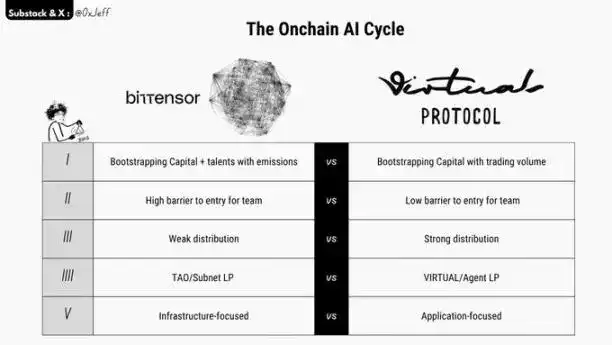
I. Guiding Capital and Talent Through Emissions Mechanism vs. Guiding Capital Through Trading Volume

Bittensor guides subnet development through its TAO emissions mechanism. Subnets are responsible for introducing the most innovative projects (or revenue-generating businesses) and compete for a share of the daily 3,600 TAO distribution.

Subnets also guide contributors (including miners performing tasks and validators verifying the miners' work) through their alpha token emissions mechanism. The emissions mechanism and the incentive coordination mechanism across stakeholders have been embedded since the project's inception.

Virtuals adopts a model similar to pump.fun, guiding development through trading volume. High trading activity translates into capital accumulation for the agent project. Agent teams can use their own emissions mechanisms to incentivize user participation.

In market cycles with high speculative token demand, this model has significant advantages—teams can quickly accumulate capital, gain product attention and market interest, thereby driving project launch and development.

II. High Entry Barrier vs. Low Entry Barrier (For Teams)

Launching a subnet on Bittensor requires substantial investment. Currently, acquiring a subnet slot requires 871 TAO (approximately $300,000), with the price fluctuating based on demand and the auction mechanism. This means subnet teams typically need mature ideas, clear plans, and solid execution capabilities.

To successfully operate a subnet, owners must ensure that the set tasks or objectives contribute to the R&D of their AI product/solution, prevent miner fraud, ensure validators effectively perform verification duties, generate revenue through business development and customer partnerships, and maintain investor confidence through buyback mechanisms.

The subnet token price needs to maintain an upward trend to attract more TAO inflow, increase the subnet's emission share, and thereby attract higher-level contributors to participate in mining.

In contrast, the barrier to launching an AI agent token on Virtuals is lower, requiring no initial cost, making it easier to test new ideas with less capital.

Virtuals also has a "60-day program" that allows founders to test new ideas and issue tokens during this period. If product-market fit is not found within 60 days, the relevant funds are reclaimed, and investors can retrieve a portion of their invested capital.

III. Weaker Distribution Capability vs. Stronger Distribution Capability

Bittensor operates independently on a blockchain built using the Polkadot Substrate framework. Cross-chain bridging is difficult, it lacks DeFi infrastructure components, and is not equipped with common infrastructure like the Ethereum Virtual Machine or Solana.

This results in a high entry barrier for the Bittensor ecosystem. Furthermore, relevant learning materials are filled with complex terminology, increasing the difficulty for new users to learn and understand. Consequently, its community members are mostly technical professionals willing to invest time in deep research, with relatively low retail participation.

In comparison, the understanding threshold for Virtuals is lower. Its team excels in marketing, branding, and distribution. Retail users can relatively intuitively understand concepts like AI agents, agent payments, and bots.

Since Virtuals is deployed on the Base chain, the process of purchasing AI agent tokens is convenient. The time from learning about a project, forming a bullish judgment, to making a purchase decision is short, which is a key reason for its rapid popularity from late 2024 to 2025 (earlier than Bittensor).

Currently, Bittensor is gradually entering the mainstream spotlight with pushes from Jason, Chamath, Barry Silbert (DCG & Yuma), and the community, leading to increased attention. However, the purchase process for subnet tokens remains relatively complex, and the issue has not been fundamentally resolved.

IV. TAO/Subnet Liquidity Pool vs. VIRTUAL/Agent Liquidity Pool

Bittensor and Virtuals share a key similarity in their liquidity pool flywheel mechanisms.

Investors wishing to purchase subnet alpha tokens need to hold TAO to do so. Therefore, rising demand for alpha tokens will drive up the price of TAO.

Similarly, within the Virtuals ecosystem, rising demand for AI agent tokens will drive up the price of VIRTUAL.

If the core tokens (TAO or VIRTUAL) can circulate within the ecosystem without outflow (e.g., through project teams trading goods and services to retain value), the advantages of this mechanism become more pronounced.

V. Infrastructure-Oriented vs. Application-Oriented

Bittensor subnets mostly focus on infrastructure or capital-intensive businesses, such as decentralized computing, inference, training, drug discovery, and quantum experiments.

Since Bittensor can provide over $10 million annually in funding for quality subnets and attract high-end talent, its model is suitable for driving ambitious, high-difficulty, high-investment ideas.

Virtuals agent teams, however, mostly focus on the application layer and consumer-facing agent products. Since agent tokens have a low initial price, if a team can launch a quality consumer product, it can leverage the token's market heat to quickly attract attention and drive project development.

Thanks to Virtuals' advantages in distribution, the flywheel effect of AI agent tokens demonstrated faster growth rates and higher price increases during periods of extreme market activity (such as late 2024 to early 2025).


Preguntas relacionadas

QWhat are the two main AI crypto projects compared in the article, and what are their core flywheel mechanisms?

AThe two main AI crypto projects compared are Bittensor and Virtuals. Bittensor's core flywheel mechanism is guided by TAO emissions to fund subnet development. Virtuals' core flywheel mechanism is guided by trading volume, similar to the pump.fun model, to accumulate capital for AI agent projects.

QHow does the entry barrier for launching a project differ between Bittensor and Virtuals?

ALaunching a subnet on Bittensor has a high entry barrier, currently requiring a significant investment (e.g., 871 TAO, ~$300k) to acquire a subnet slot. In contrast, launching an AI agent token on Virtuals has a low entry barrier, requiring no initial cost, allowing teams to test new ideas with minimal capital outlay.

QWhat is a key similarity in the liquidity pool flywheel mechanism between Bittensor and Virtuals?

AA key similarity is that demand for the ecosystem's project tokens drives the price of the core native token. In Bittensor, demand for subnet alpha tokens drives the price of TAO. In Virtuals, demand for AI agent tokens drives the price of VIRTUAL.

QAccording to the article, what is the primary focus of projects built on Bittensor versus those on Virtuals?

AProjects on Bittensor are primarily infrastructure-oriented, focusing on areas like decentralized computing, inference, training, drug discovery, and quantum experiments. Projects on Virtuals are primarily application-oriented, focusing on consumer-facing AI agent products.

QWhat advantage does Virtuals have over Bittensor in terms of distribution and user accessibility?

AVirtuals has a significant advantage in distribution and user accessibility. It has lower comprehension barriers, strong marketing, and is deployed on the Base chain, making the purchase process for AI agent tokens simple and intuitive for retail users. Bittensor has a higher learning curve, complex terminology, and a more difficult token purchase process, making it less accessible to the average retail participant.

Lecturas Relacionadas

In Conversation with Ray Dalio: We Are Currently in an AI Bubble, with 1% of My Portfolio in Bitcoin

Ray Dalio, founder of Bridgewater Associates, warns in an interview that the current AI boom shows classic bubble characteristics, which could lead to significant economic downturns as seen in past cycles like 1929 or 2000. He explains that speculative enthusiasm, fueled by debt and overvaluation, often precedes a crash when rising rates or taxation force asset sales, causing widespread losses and recession. Dalio also outlines his "Big Cycle" theory, describing an approximate 80-year pattern where widening wealth gaps, massive government deficits, and shifting geopolitical power (like China's rise) create internal conflict and global instability. He emphasizes that we are in a late-cycle, transitional phase where traditional powers like the US and UK face decline. For personal wealth protection, Dalio advises diversification beyond cash into assets like stocks, bonds, real estate, and particularly gold, which he prefers over Bitcoin. While he holds about 1% of his portfolio in Bitcoin as a non-printable hard asset, he views gold as more secure from technological or governmental threats. Regarding AI's impact, Dalio believes it will disproportionately benefit capital owners, worsening inequality by replacing both physical and cognitive labor. He suggests that human intuition and emotional intelligence, combined with AI, will be key for future workers. On taxation, Dalio argues that wealth taxes are impractical and risk triggering asset sell-offs, reducing productive investment. He points to the UK as a cautionary example of debt, low productivity, and political strife. Geopolitically, Dalio foresees a more regionalized world, with the US showing weakness in prolonged conflicts like with Iran, akin to past imperial declines. The ideal outcome, he suggests, is coexisting powerful blocs (e.g., Americas, China-Asia Pacific) without major war.

marsbitHace 1 hora(s)

In Conversation with Ray Dalio: We Are Currently in an AI Bubble, with 1% of My Portfolio in Bitcoin

marsbitHace 1 hora(s)

Daily 7.2 Trillion KRW: Foreign Capital's Record Net Buying on Friday! Wall Street Says Headwinds for Korean Stock Fund Flows Have Subsided

South Korean stock market sees a dramatic shift in fund flows. On July 31, foreign investors made a record net purchase of approximately KRW 7.2 trillion in KOSPI stocks, marking a fundamental reversal from the persistent large-scale net outflows seen in previous months. This contributed to a significant narrowing of foreign net selling in July to KRW 9.8 trillion, down sharply from KRW 48.4 trillion in June and KRW 44.5 trillion in May. Simultaneously, domestic institutional pressure eased. South Korean pension funds and asset managers turned to a net buying position in July, purchasing KRW 1.0 trillion worth of KOSPI shares, contrasting with net sales in May and June. Market volatility is expected to be dampened by new financial regulations. Effective July 31, the Financial Services Commission tightened access for retail investors to single-stock leveraged ETFs by raising the minimum cash deposit requirement. Trading volumes for these products subsequently dropped to about 50% of their monthly average. Citigroup Research maintains its year-end KOSPI target of 10,000 points. The firm cites several supportive factors: the substantial easing of headwinds from capital outflows, a robust fundamental outlook for the semiconductor sector, historically low market valuations, strong economic fundamentals, and the potential for policy support from financial authorities if needed.

marsbitHace 1 hora(s)

Daily 7.2 Trillion KRW: Foreign Capital's Record Net Buying on Friday! Wall Street Says Headwinds for Korean Stock Fund Flows Have Subsided

marsbitHace 1 hora(s)

Thanks to Dice Rolls, Bitcoin Keys Are Stored Offline, But Not Everyone Will Do It

The article discusses using dice rolls to generate secure Bitcoin wallet seeds, providing entropy independent of potentially flawed hardware random number generators. It explains that each fair dice roll offers about 2.585 bits of entropy, with around 50 rolls needed for a standard 12-word seed phrase and 99+ recommended for higher security. This method gained attention after a vulnerability was revealed in some Coldcard hardware wallets, where a faulty firmware RNG (dating back to 2021) compromised generated keys. The analysis notes that while a dice-generated main seed was safe from this specific flaw, other Coldcard functions (like creating paper wallets, backup keys, or passwords) could still be vulnerable if they used the defective RNG. The piece argues that while dice-based entropy is technically robust, the manual process is error-prone, tedious, and unrealistic for most new users, who might make mistakes in recording or inputting rolls. It concludes that while manual entropy generation should remain an option for advanced users, the long-term goal is to develop reliable, user-friendly hardware and software that securely generates randomness without requiring specialized knowledge. Coldcard users are advised to check their firmware version and replace any secondary secrets (like paper wallet keys) created with vulnerable devices, while also considering multi-signature setups with devices from different manufacturers for added security.

cryptonews.ruHace 6 hora(s)

Thanks to Dice Rolls, Bitcoin Keys Are Stored Offline, But Not Everyone Will Do It

cryptonews.ruHace 6 hora(s)

Trading

Spot
活动图片




