BitMine enters Ethereum staking race with new MAVAN platform – Details

ambcryptoPublicado a 2026-03-27Actualizado a 2026-03-27

Resumen

BitMine Immersion Technologies, the world's largest Ethereum treasury firm, has launched a new ETH staking platform called MAVAN (Made in America Validator Network) with the goal of becoming the leading staking provider. The company has already staked 3.14 million ETH worth over $6.8 billion and holds a total of 4.6 million ETH, representing 3.8% of the total supply. It aims to control 5% of the circulating supply and generate $300 million in annual yield. While staking all its ETH would make it the second-largest platform, surpassing Binance, it would still need an additional 5 million ETH to overtake current leader Lido, which holds nearly 9 million staked ETH. BitMine also plans to expand into other proof-of-stake networks and blockchain infrastructure in the future.

Bitmine Immersion Technologies, the world’s largest Ethereum treasury firm, now aims to replace Lido as the top ETH staking platform. On Wednesday, the firm unveiled its ETH staking platform dubbed MAVAN (an acronym for Made in America Validator Network).

The firm reported that it has already staked 3,142, 643 ETH as of Tuesday, 24 March, translating to over $6.8B worth of staked ETH based on current market prices. In the past week alone, BitMine staked 101.7K ETH, worth $219M.

At the time of writing, BitMine held a total of 4.6 million ETH or 3.8% of the total supply. It aims to control 5% of the circulating supply.

It also bought an additional 50K ETH earlier on Thursday, bringing its weekly buys to over 117K ETH. This meant the remaining unstaked ETH was over 1.5 million ETH. This too will be staked in the coming weeks, the firm said.

BitMine’s aggressive bet on ETH staking

The end goal is to become the top staking platform for institutions with the potential to generate $300M annually at the current 2.83% 7-day BMNR yield. Tom Lee, the chairman of the firm, added,

Because Bitmine is the largest owner of Ethereum in the world, shortly after launch, MAVAN will be the largest Ethereum staking platform in the world.

Highlighting MAVAN and Bitmine’s long-term staking strategy, Lee continued,

We plan to expand across additional proof-of-stake (PoS)networks and critical blockchain infrastructure over time, and through 2026, we’ll grow our efforts in areas such as on-chain vaults, post-quantum client development, and more.

In other words, other PoS chains like SOL, BNB, Tron [TRX], and others could fall in BitMine’s staking orbit.

However, the update could shake up the broader ETH staking ecosystem, which is currently facing stiff competition amid growing appetite for low-risk institutional staking.

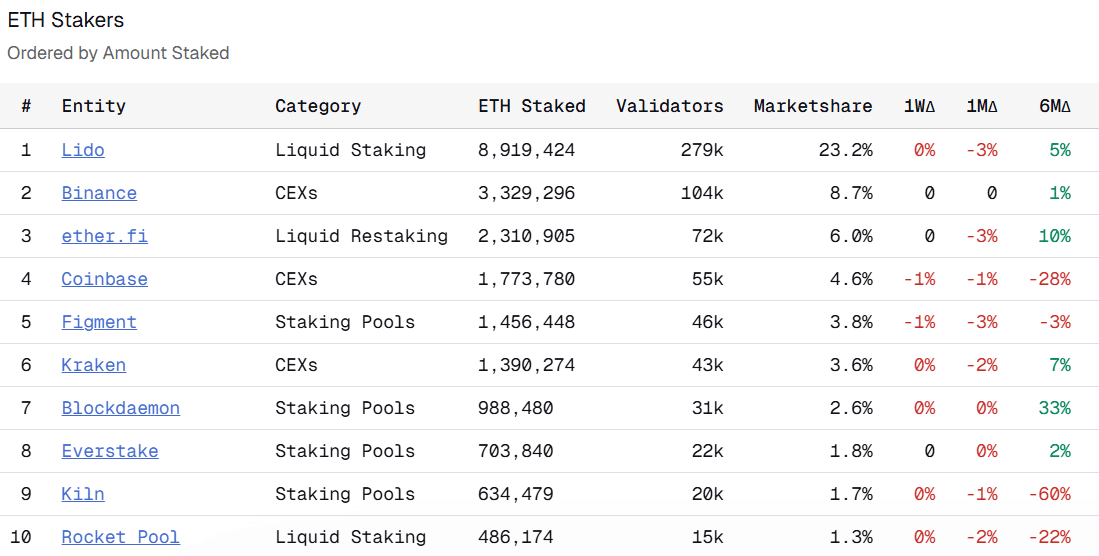
In fact, Lido, the top leader in the segment, confirmed that the ongoing structural shift was partly responsible for its 23% annual revenue fall in 2025. Although its market share also shrank, it was still leading in the segment with nearly 9 million staked ETH.

Alas, with BitMine now eyeing its position, will it defend its top spot? Well, that depends on whether Lido’s staking outflows continue in the next few months.

As it stands, even if BitMine stakes its entire 4.6 million ETH stash, that would make it the second-largest staking platform, surpassing Binance. However, it would still need an extra 5 million ETH to dislodge Lido from the top seat.
Source: Dune

Final Summary

  • BitMine unveiled the MAVAN staking platform and plans to stake the whole of its 4.6 million ETH stash to get $300M in annual yield revenue.
  • However, it will need over 5 million ETH to displace Lido as the top staking platform.

Preguntas relacionadas

QWhat is the name of the new ETH staking platform launched by BitMine and what does the acronym stand for?

AThe new ETH staking platform is called MAVAN, which stands for Made in America Validator Network.

QHow much Ethereum (ETH) has BitMine already staked as of March 24th, and what is its total ETH holding?

AAs of March 24th, BitMine has staked 3,142,643 ETH. The company's total ETH holding is 4.6 million.

QWhat is BitMine's stated end goal for its staking platform in terms of annual revenue and current yield?

ABitMine's end goal is to generate $300 million in annual revenue at the current 2.83% 7-day BMNR yield.

QWho is the current leader in the ETH staking segment and how much ETH do they have staked?

ALido is the current leader in the ETH staking segment with nearly 9 million staked ETH.

QBesides Ethereum, what other types of networks does BitMine plan to expand into, according to Chairman Tom Lee?

AAccording to Tom Lee, BitMine plans to expand across additional proof-of-stake (PoS) networks, such as SOL, BNB, and Tron [TRX], as well as critical blockchain infrastructure.

Lecturas Relacionadas

20 Billion Valuation, Alibaba and Tencent Competing to Invest, Whose Money Will Liang Wenfeng Take?

DeepSeek, an AI startup founded by Liang Wenfeng, is reportedly in talks with Alibaba and Tencent for an external funding round that could value the company at over $20 billion. This marks a significant shift, as DeepSeek had previously relied solely on funding from its parent company,幻方量化 (Huanfang Quantitative), and had resisted external investment. The potential valuation would place DeepSeek among the top-tier AI model companies in China, comparable to competitors like MoonDark (valued at ~$18 billion) and ahead of recently listed firms like MiniMax and Zhipu. The funding—which could range from $600 million (for a 3% stake) to $2 billion (for 10%)—is seen as a move to secure resources for model development, retain talent, and support infrastructure needs, particularly as competition in inference models and AI agents intensifies. Both Alibaba and Tencent are eager to invest, not only for financial returns but also to integrate DeepSeek into their broader AI ecosystems. However, DeepSeek’s leadership is cautious about maintaining independence and may prefer financial investors over strategic ones to avoid being locked into a specific tech ecosystem. Alternative options, such as state-backed funds, offer longer-term capital and policy support but may come with slower decision-making and potential constraints on global expansion. With competing AI firms accelerating their IPO plans, DeepSeek’s window for securing optimal terms may be narrowing. The final decision will reflect a trade-off between capital, resources, and strategic independence.

marsbitHace 58 min(s)

20 Billion Valuation, Alibaba and Tencent Competing to Invest, Whose Money Will Liang Wenfeng Take?

marsbitHace 58 min(s)

After Losing 97% of Its Market Value, iQiyi Attempts to Use AI to Forcefully Extend Its Lifespan

After losing 97% of its market value since its 2018 peak, iQiyi is aggressively pivoting to AI in a desperate attempt to survive. At its 2026 World Conference, CEO Gong Yu announced an "AI Artist Library" with over 100 virtual performers and a new AIGC platform, "NaDou Pro," promising faster production and lower costs. This shift comes as the company faces severe financial distress: its market cap sits near delisting thresholds at $1.36 billion, with significant losses, declining membership revenue, and depleted cash flow. The AI strategy has sparked controversy. Top actors have issued legal threats against unauthorized digital replicas, while in Hengdian, over 134,000 background actors are seeing their already scarce job opportunities vanish as AI replaces them for background roles. iQiyi's move represents a fundamental shift from being a high-cost content buyer to a landlord" to becoming a "platform capitalist" that transfers production risk to creators. This contrasts with competitors like Douyin (TikTok's Chinese counterpart), which is investing heavily in *real* actor-led short dramas, betting that authentic human connection retains users better than AI-generated content. The article draws a parallel to the 1920s transition to "talkies," which made cinema musicians obsolete but ultimately enriched the art form. In contrast, iQiyi's AI drive is framed not as an artistic evolution but as a cost-cutting measure that could degrade storytelling, replacing genuine human emotion with algorithmically calculated stimulation and potentially numbing audiences' capacity for empathy. The core question remains: can a company focused solely on financial survival preserve the art of storytelling?

marsbitHace 1 hora(s)

After Losing 97% of Its Market Value, iQiyi Attempts to Use AI to Forcefully Extend Its Lifespan

marsbitHace 1 hora(s)

Trading

Spot
Futuros
活动图片