BitMine enters Ethereum staking race with new MAVAN platform – Details

ambcryptoPublicado a 2026-03-27Actualizado a 2026-03-27

Resumen

BitMine Immersion Technologies, the world's largest Ethereum treasury firm, has launched a new ETH staking platform called MAVAN (Made in America Validator Network) with the goal of becoming the leading staking provider. The company has already staked 3.14 million ETH worth over $6.8 billion and holds a total of 4.6 million ETH, representing 3.8% of the total supply. It aims to control 5% of the circulating supply and generate $300 million in annual yield. While staking all its ETH would make it the second-largest platform, surpassing Binance, it would still need an additional 5 million ETH to overtake current leader Lido, which holds nearly 9 million staked ETH. BitMine also plans to expand into other proof-of-stake networks and blockchain infrastructure in the future.

Bitmine Immersion Technologies, the world’s largest Ethereum treasury firm, now aims to replace Lido as the top ETH staking platform. On Wednesday, the firm unveiled its ETH staking platform dubbed MAVAN (an acronym for Made in America Validator Network).

The firm reported that it has already staked 3,142, 643 ETH as of Tuesday, 24 March, translating to over $6.8B worth of staked ETH based on current market prices. In the past week alone, BitMine staked 101.7K ETH, worth $219M.

At the time of writing, BitMine held a total of 4.6 million ETH or 3.8% of the total supply. It aims to control 5% of the circulating supply.

It also bought an additional 50K ETH earlier on Thursday, bringing its weekly buys to over 117K ETH. This meant the remaining unstaked ETH was over 1.5 million ETH. This too will be staked in the coming weeks, the firm said.

BitMine’s aggressive bet on ETH staking

The end goal is to become the top staking platform for institutions with the potential to generate $300M annually at the current 2.83% 7-day BMNR yield. Tom Lee, the chairman of the firm, added,

Because Bitmine is the largest owner of Ethereum in the world, shortly after launch, MAVAN will be the largest Ethereum staking platform in the world.

Highlighting MAVAN and Bitmine’s long-term staking strategy, Lee continued,

We plan to expand across additional proof-of-stake (PoS)networks and critical blockchain infrastructure over time, and through 2026, we’ll grow our efforts in areas such as on-chain vaults, post-quantum client development, and more.

In other words, other PoS chains like SOL, BNB, Tron [TRX], and others could fall in BitMine’s staking orbit.

However, the update could shake up the broader ETH staking ecosystem, which is currently facing stiff competition amid growing appetite for low-risk institutional staking.

In fact, Lido, the top leader in the segment, confirmed that the ongoing structural shift was partly responsible for its 23% annual revenue fall in 2025. Although its market share also shrank, it was still leading in the segment with nearly 9 million staked ETH.

Alas, with BitMine now eyeing its position, will it defend its top spot? Well, that depends on whether Lido’s staking outflows continue in the next few months.

As it stands, even if BitMine stakes its entire 4.6 million ETH stash, that would make it the second-largest staking platform, surpassing Binance. However, it would still need an extra 5 million ETH to dislodge Lido from the top seat.
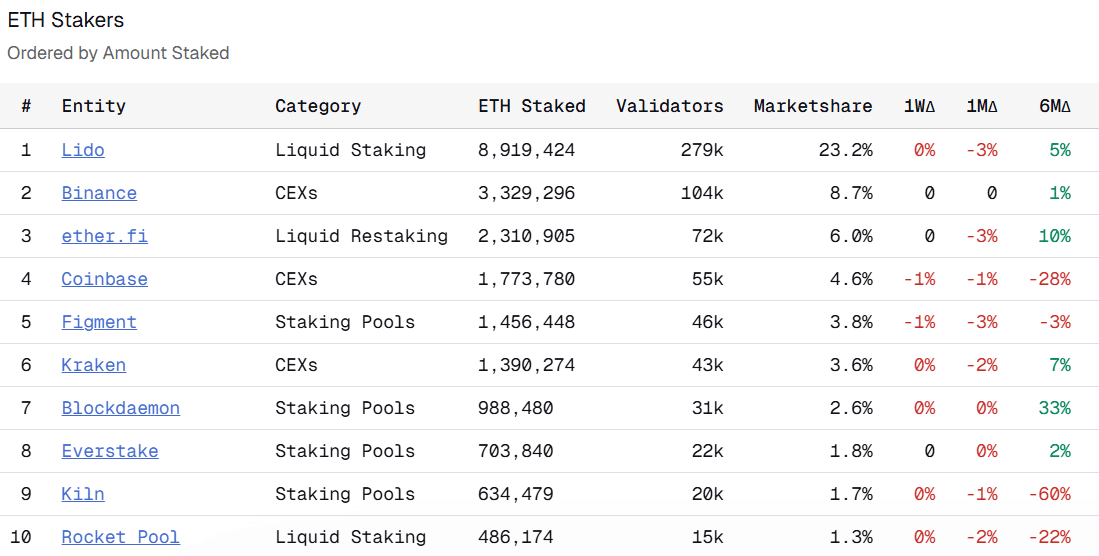
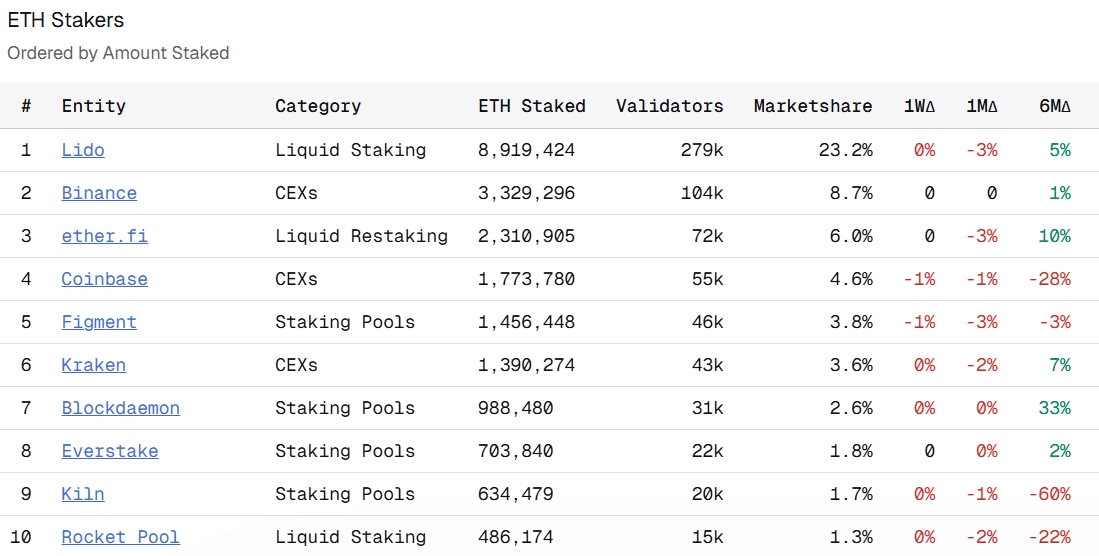
Source: Dune

Final Summary

  • BitMine unveiled the MAVAN staking platform and plans to stake the whole of its 4.6 million ETH stash to get $300M in annual yield revenue.
  • However, it will need over 5 million ETH to displace Lido as the top staking platform.

Preguntas relacionadas

QWhat is the name of the new ETH staking platform launched by BitMine and what does the acronym stand for?

AThe new ETH staking platform is called MAVAN, which stands for Made in America Validator Network.

QHow much Ethereum (ETH) has BitMine already staked as of March 24th, and what is its total ETH holding?

AAs of March 24th, BitMine has staked 3,142,643 ETH. The company's total ETH holding is 4.6 million.

QWhat is BitMine's stated end goal for its staking platform in terms of annual revenue and current yield?

ABitMine's end goal is to generate $300 million in annual revenue at the current 2.83% 7-day BMNR yield.

QWho is the current leader in the ETH staking segment and how much ETH do they have staked?

ALido is the current leader in the ETH staking segment with nearly 9 million staked ETH.

QBesides Ethereum, what other types of networks does BitMine plan to expand into, according to Chairman Tom Lee?

AAccording to Tom Lee, BitMine plans to expand across additional proof-of-stake (PoS) networks, such as SOL, BNB, and Tron [TRX], as well as critical blockchain infrastructure.

Lecturas Relacionadas

The Verdict in Choi Tae-won's Divorce Case: Revealing the Inheritance Undercurrent Behind SK Hynix's Trillion-Won Empire

SK Group Chairman Chey Tae-won's high-profile divorce case, involving a record 1.38 trillion won settlement, has drawn attention to the succession plans for Korea's second-largest conglomerate, especially its crown jewel, SK hynix. Unlike traditional chaebol scripts centered on the eldest son, Chey's three children from his marriage to former President Roh Tae-woo's daughter, Roh Soh-yeong, are carving distinct, non-traditional paths. Eldest daughter Chey Yun-jung (b. 1989) is seen as the most evident successor. With a scientific and consulting background, she holds executive roles at SK bioscience and SK Inc.'s growth support department, focusing on future strategy and biopharma. Her marriage is to an AI infrastructure entrepreneur, not a traditional business alliance. Second daughter Chey Min-jung (b. 1991) took a unique route, voluntarily serving as a South Korean naval officer, including an anti-piracy deployment. She later worked on policy and strategy for SK hynix in Washington D.C. before co-founding an AI-driven healthcare startup. She married a former U.S. Marine Corps officer, connecting her to U.S. defense and policy circles—networks crucial for a global semiconductor giant. The only son, Chey In-geun (b. 1995), who studied physics like his father, worked briefly at SK E&S before joining McKinsey. Despite fitting the traditional "heir" profile as the eldest son, he remains silent and holds no public position or shares in SK, suggesting the old succession playbook is obsolete. As SK hynix's valuation soars, becoming a geopolitical asset in the AI era, the heirs' legitimacy is no longer automatic. They must prove themselves in fields like AI biotech, global policy, and strategic consulting. Their marriages also reflect new elite networks in tech and defense, not old political alliances. Their inheritance is the complex challenge of navigating a globalized, tech-driven world, not just a corporate throne.

marsbitHace 11 hora(s)

The Verdict in Choi Tae-won's Divorce Case: Revealing the Inheritance Undercurrent Behind SK Hynix's Trillion-Won Empire

marsbitHace 11 hora(s)

From OpenSea to OpenRouter: Is Alex Atallah Repeating His 'Exit at the Peak' Playbook?

From OpenSea to OpenRouter: Is Alex Atallah Repeating His "Exit at the Peak" Playbook? According to the Wall Street Journal, payments giant Stripe is in talks to acquire the AI model aggregation platform OpenRouter in a potential deal valuing the company near $100 billion. This would mark founder Alex Atallah's second creation of a company reaching a $100 billion valuation, following his co-founding of NFT marketplace OpenSea. OpenRouter, founded just over three years ago, has grown rapidly by acting as a unified gateway for developers to access over 400 AI models. It currently has about 10 million users and processes over 200 trillion tokens monthly. While the platform's annualized revenue is around $50 million, its valuation has skyrocketed from $1.3 billion in March 2026. The potential acquisition by Stripe, a company OpenRouter's founder once likened it to, represents a major expansion into AI infrastructure for the payments leader. This move echoes Atallah's previous timing with OpenSea, where he departed before the NFT market's significant downturn. For OpenRouter, selling now may be strategic. Despite its scale, its business model—charging a 5-5.5% fee on AI inference calls—faces pressure from competition, open-source models, and potential price wars among model providers, limiting its profitability narrative for an IPO. A key asset for potential acquirers like Stripe is OpenRouter's vast repository of real-world AI usage data, which offers unique insights into model performance and developer preferences that are difficult to replicate. Whether this potential deal signifies a new valuation benchmark for AI infrastructure or another market peak signal remains to be seen.

链捕手Hace 11 hora(s)

From OpenSea to OpenRouter: Is Alex Atallah Repeating His 'Exit at the Peak' Playbook?

链捕手Hace 11 hora(s)

Trading

Spot
活动图片





