Bitcoin's 'Strict Headmaster' Arrives? If He Takes the Helm at the Fed, the Crypto Party Could End Abruptly

Odaily星球日报Publicado a 2025-12-22Actualizado a 2025-12-22

Resumen

The article discusses the potential implications of Kevin Warsh, a former Federal Reserve governor and Wall Street insider, becoming the next Fed Chair. Unlike other candidates like Kevin Hassett, who is seen as favoring lower interest rates and easier monetary policy, Warsh represents a more disciplined approach. Having worked at Morgan Stanley and experienced the 2008 financial crisis firsthand, Warsh is highly sensitive to systemic risks and liquidity issues. Warsh’s policy stance combines aggressive quantitative tightening (QT) with moderate interest rate cuts. He aims to control inflation by reducing the money supply and restoring the dollar’s credibility, while also easing corporate financing costs. This approach could challenge risk assets like cryptocurrencies, which have thrived in an era of abundant liquidity. If appointed, Warsh could bring stricter regulation to crypto, particularly stablecoins, potentially requiring full cash or short-term debt reserves. He opposes a retail central bank digital currency (CBDC) on privacy grounds but supports a wholesale CBDC for interbank settlements. While his policies may pressure crypto in the short term, they could also foster more institutional adoption and real-world asset (RWA) integration in the long run. However, the article notes that political pressures—especially from a Trump administration seeking lower rates and economic growth—could ultimately influence Warsh’s decisions, regardless of his personal beliefs.

Original | Odaily Planet Daily (@OdailyChina)

Author | Ethan(@ethanzhang_web3)
As the year draws to a close, the question of who will wield the scepter of the Federal Reserve Chair—the "master valve" of global liquidity—has become the most watched year-end suspense.

Months ago, when the benchmark rate ended its long pause and saw its first cut, the market was once convinced that Christopher Waller was the chosen one (Recommended reading: ‘The Academic Outsider: Small-Town Professor Waller Becomes Hottest Candidate for Fed Chair’). The winds shifted in October, with Kevin Hassett surging ahead, his odds once approaching 85%. He is seen as a "mouthpiece for the White House"; if he takes office, policy might completely follow Trump's will, even jokingly called a "human printing press."

However, today, we will not discuss the frontrunner with the highest probability, but focus on the wildcard "second in line"—Kevin Warsh.

If Hassett represents the market's "greed expectation" (lower rates, more liquidity), then Warsh represents the market's "fear and awe" (harder money, stricter rules). Why is the market re-examining this outsider once hailed as the "Wall Street Golden Boy"? If he truly takes the helm of the Fed, what fundamental changes could occur in the underlying logic of the crypto market? (Odaily Note: The core views of this article are extrapolated based on Warsh's recent speeches and interviews.)

Warsh's Evolution: From Wall Street Golden Boy to Fed Outsider

Kevin Warsh does not hold a Ph.D. in macroeconomics, and his career did not start in an ivory tower but in Morgan Stanley's M&A department. This experience gave him a mindset completely different from that of Bernanke or Yellen: in the eyes of academics, a crisis is just a data anomaly in a model; but in Warsh's eyes, a crisis is the second a counterparty defaults, the life-or-death moment when liquidity instantly vanishes from "available" to "unavailable."

In 2006, when the 35-year-old Warsh was appointed as a Federal Reserve Governor, many questioned his lack of seniority. But history is humorous; it was precisely this "Wall Street insider" practical experience that made him an indispensable player in the subsequent financial storm. During the darkest moments of 2008, Warsh's role had already surpassed that of a regulator; he became the sole "translator" between the Fed and Wall Street.
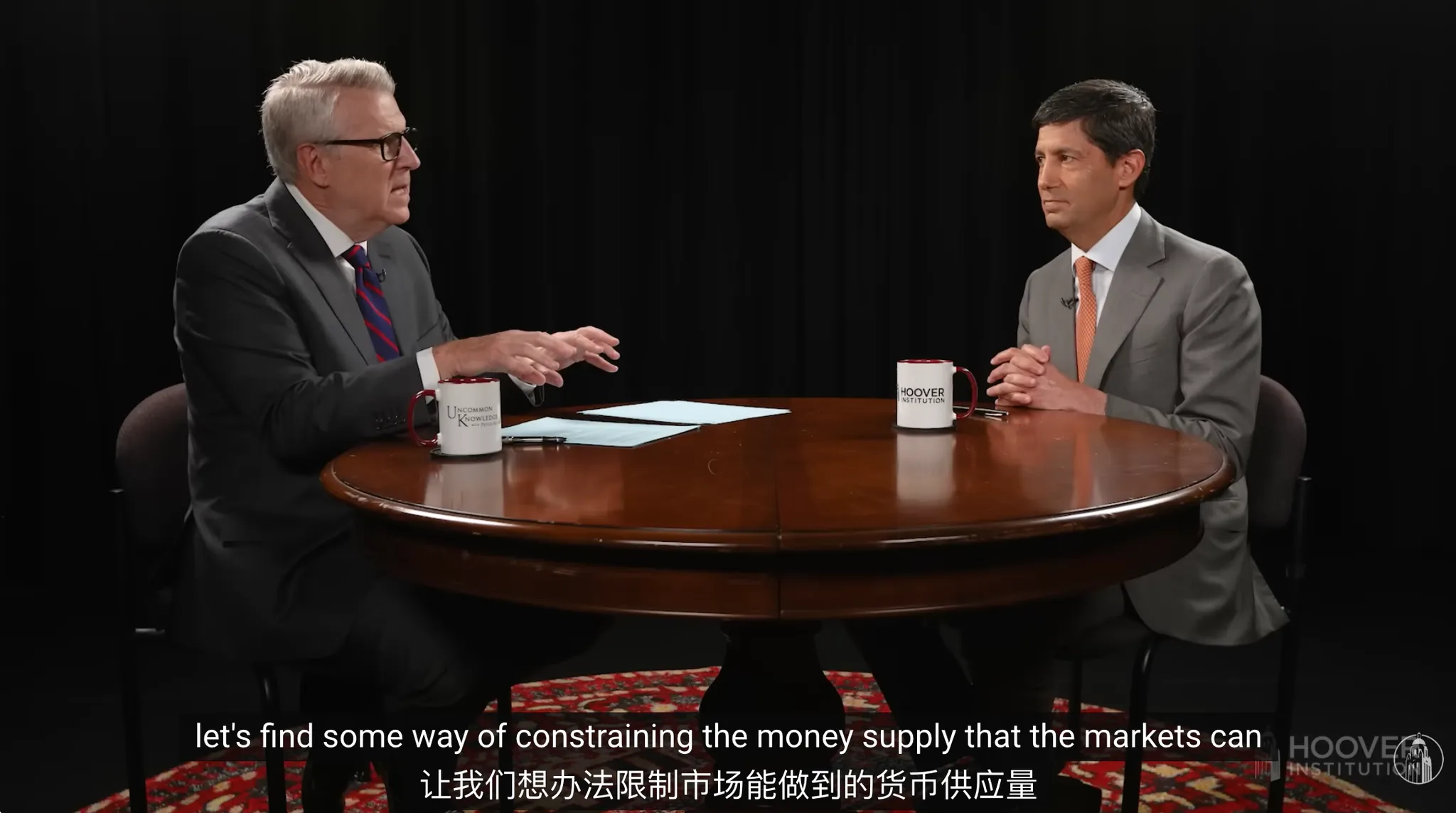
Excerpt from Warsh's interview at Stanford's Hoover Institution

On one hand, he had to translate Bear Stearns' toxic assets, which went to zero overnight, into language that academic officials could understand; on the other hand, he had to translate the Fed's obscure rescue intentions to the panicked market. He was involved in the frantic weekend negotiations before Lehman's collapse. This close-quarters combat gave him a physiological sensitivity to "liquidity." He saw through the essence of quantitative easing (QE): the central bank must indeed act as the "lender of last resort" during a crisis, but this is essentially a transaction that mortgages future credit to buy survival time in the present. He even pointedly noted that the long-term输血 (blood transfusion) after the crisis was actually "reverse Robin Hood," artificially inflating asset prices to rob the poor to feed the rich, which not only distorted market signals but also planted the seeds for a bigger crisis.

It was this keen sense of the system's fragility that became his core bargaining chip when Trump was selecting candidates for the new Fed Chair. On Trump's list, Warsh and another frontrunner, Kevin Hassett, formed a stark contrast, a contest dubbed the "Battle of the Kevins" by the media.
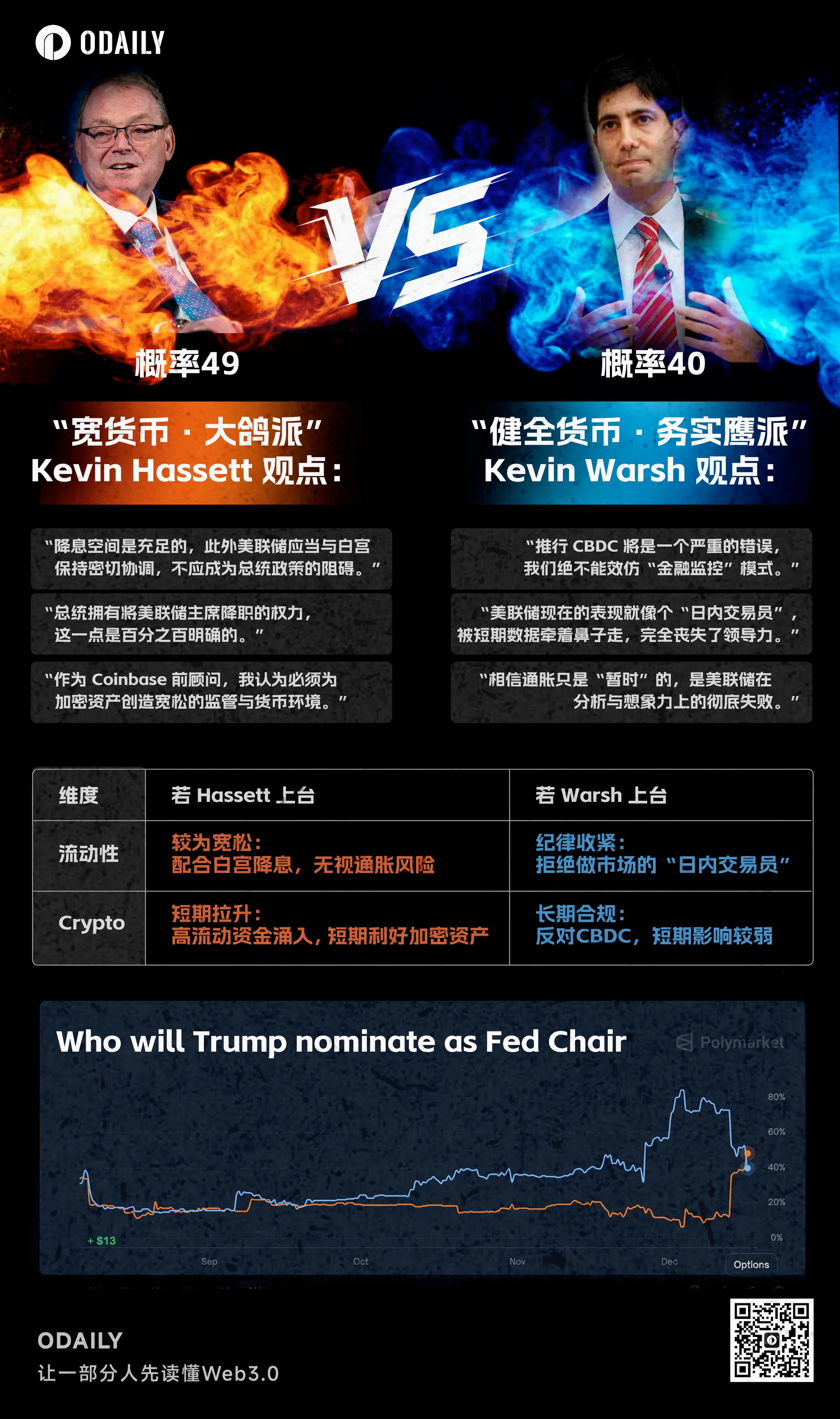
Fed Chair Candidates: Hassett VS Warsh, Source: Odaily Original

Hassett is a typical "growth-first" advocate. His logic is simple and direct: as long as the economy is growing, low rates are justified. The market generally believes that if Hassett takes office, he would likely cater to Trump's desire for low rates, even initiating rate cuts before inflation is fully under control. This also explains why long-term bond yields surged whenever Hassett's odds increased—the market feared runaway inflation.

In contrast, Warsh's logic is far more complex; it's difficult to simply label him as "hawkish" or "dovish." Although he also advocates for rate cuts, his reasoning is completely different. Warsh believes the current inflationary pressure isn't because people are buying too much, but due to supply constraints and the massive monetary oversupply of the past decade. The Fed's bloated balance sheet is actually "crowding out" private credit and distorting capital allocation.

Therefore, the prescription Warsh offers is an extremely experimental combination: aggressive quantitative tightening (QT) coupled with moderate rate cuts. His intention is clear: control inflation expectations by reducing the money supply, restoring the credibility of the dollar's purchasing power—essentially, draining some water out of the pool; while simultaneously loosening corporate financing costs by lowering nominal rates. This is a hardcore attempt to get the economy moving again without turning on the liquidity taps.

The Butterfly Effect on the Crypto Market: Liquidity, Regulation, and Hawkish Core

If Powell is like a "gentle stepfather" to the crypto market, treading carefully so as not to wake the children, then Warsh is more like a "strict headmaster of a boarding school" holding a ruler. The storm stirred by this butterfly's wings might be more violent than we anticipate.

This "strictness" is first reflected in his obsession with liquidity cleanliness. The crypto market, especially Bitcoin, has been, to some extent, a derivative of global dollar abundance over the past decade. Warsh's policy core is a "strategic reset," a return to the sound money principles of the Volcker era. His aforementioned "aggressive balance sheet reduction" is both short-term bad news and a long-term litmus test for Bitcoin.

Warsh has clearly stated: "If you want to lower interest rates, you must first stop the printing press." For risk assets accustomed to the "Fed put," this means the disappearance of the safety net. If he takes office and firmly implements his "strategic reset," guiding monetary policy back to more robust principles, a global liquidity tightening will be the first domino to fall. As a "frontier risk asset" highly sensitive to liquidity, the cryptocurrency market will undoubtedly face valuation reassessment pressure in the short term.
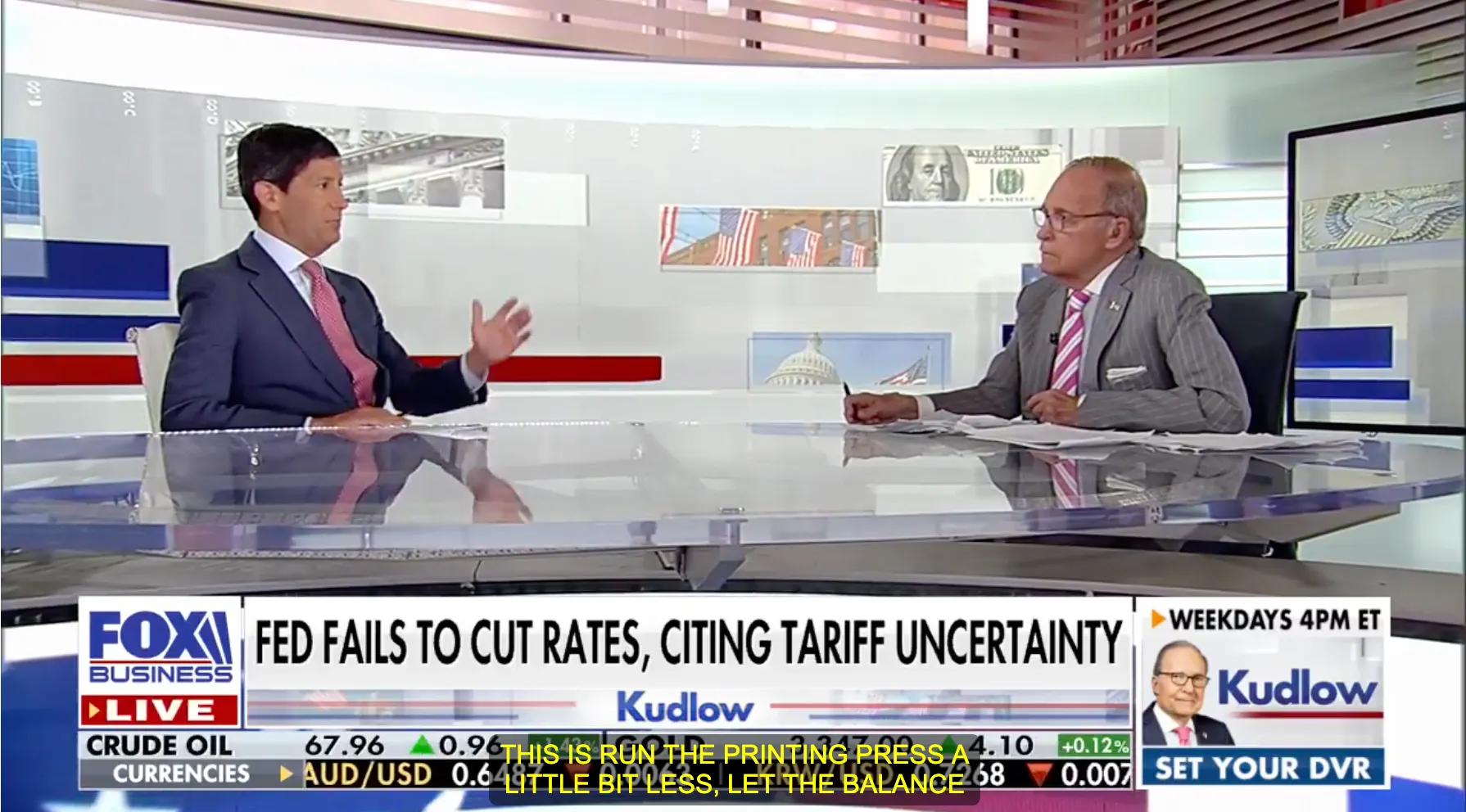
Kevin Warsh discusses Fed Chair Jerome Powell's利率 strategy on "Kudlow," source Fox Business

More importantly, if he actually achieves "inflation-free growth" through supply-side reforms, keeping real yields positive for the long term, then holding fiat currency and government bonds will become profitable. This is starkly different from the negative interest rate era of 2020, where "everything rallied, only cash was trash." Bitcoin's appeal as a "zero-yield asset" could be severely tested.

But there are two sides to every coin. Warsh is someone who is extremely superstitious about "market discipline"; he would never rush to rescue the market after a mere 10% stock market drop like Powell did. This "no bottom" market environment might反而 give Bitcoin a chance to prove its worth: when the traditional financial system develops credit cracks due to deleveraging (like the Silicon Valley Bank crisis), can Bitcoin break free from the gravitational pull of US stocks and truly become a Noah's Ark for safe-haven funds? This is the ultimate test Warsh poses to the crypto market.

Hidden behind this test is Warsh's unique definition of cryptocurrency. He left a famous quote in The Wall Street Journal: "Cryptocurrency is a misnomer. It is not mysterious. It is not money. It is software."
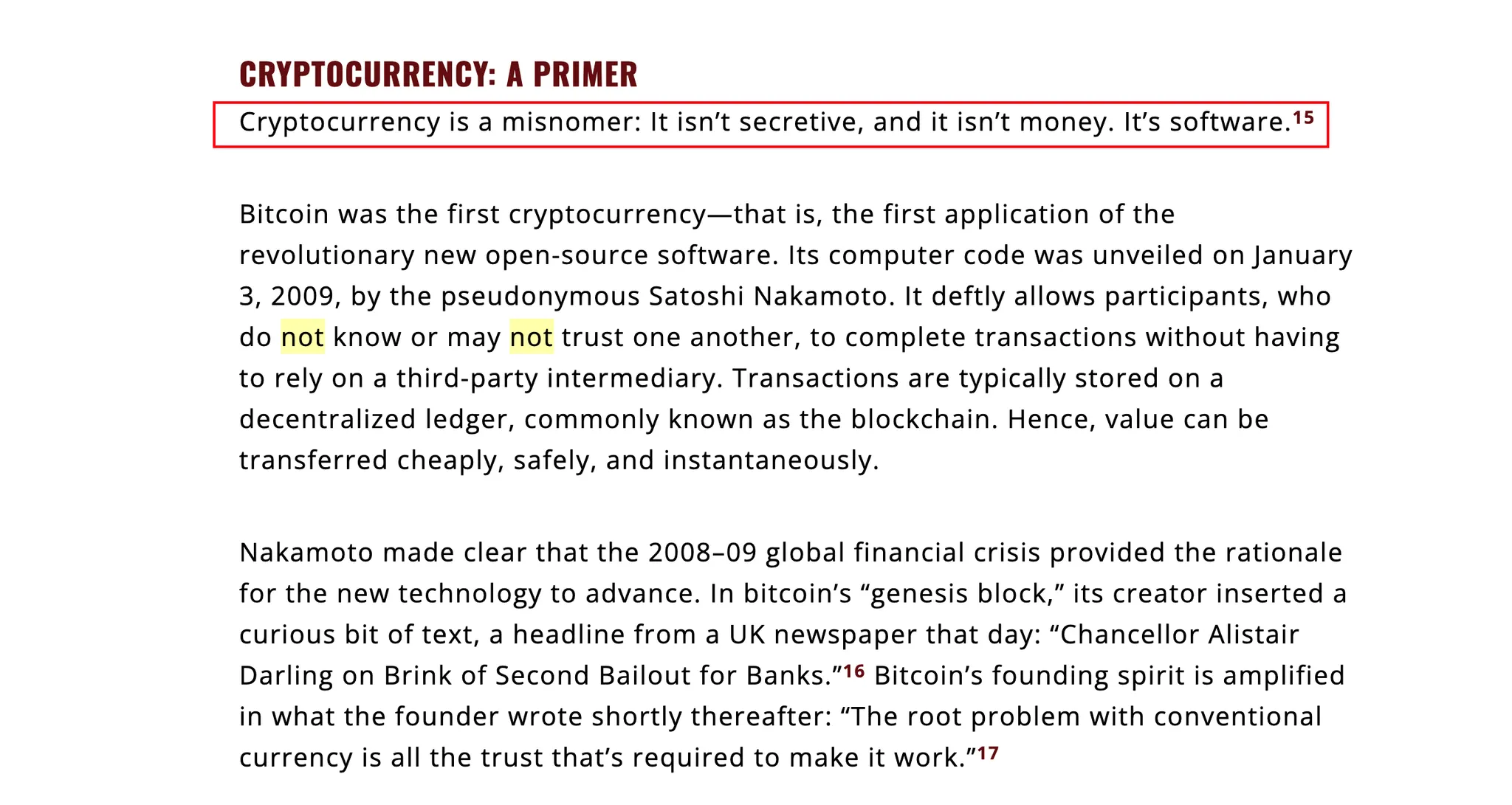
Excerpt from Kevin Warsh's column ‘Money Matters: The Dollar, Cryptocurrency, and the National Interest’

This sounds harsh, but if you look at his resume, you'll find he is not a blind opponent but an insider who understands the technical mechanisms deeply. He is not only an advisor to the crypto index fund Bitwise but also an early angel investor in the algorithmic stablecoin project Basis. Basis attempted to mimic central bank open market operations with algorithms. Although the project ultimately died due to regulation, this experience made Warsh understand better than any bureaucrat how code generates "money."

Precisely because he understands, he is more severe. Warsh is a typical "institutionalist." He recognizes crypto assets as investment vehicles like commodities or tech stocks, but he has very low tolerance for "private coinage" that challenges dollar sovereignty.

This binary attitude will directly determine the fate of stablecoins. Warsh is highly likely to push for bringing stablecoin issuers under a "narrow bank" regulatory framework: requiring 100% cash or short-term debt reserves, prohibiting fractional reserve lending like banks. This is a double-edged sword for Tether or Circle. They would gain a legitimate status similar to banks, with extremely deep moats; but they would also lose the flexibility of "shadow banking," and their profit model would be彻底 locked into government bond interest. As for those small and medium-sized stablecoins trying to engage in "credit creation," they would likely be eliminated under such high pressure. (Recommended reading: ‘Farewell to the ‘Correspondent Bank’ Era? Five Crypto Institutions Get the Key to the Fed's Payment System’)

The same logic extends to CBDCs. Unlike many Republicans who oppose them outright, Warsh offers a more refined "American solution." He firmly opposes a "retail CBDC" issued directly by the Fed to individuals, seeing it as an invasion of privacy and an overreach of power—a view surprisingly aligned with the crypto community's values. But he is a proponent of "wholesale CBDCs," advocating for the use of blockchain technology to reform the interbank clearing system to address geopolitical challenges.

Under this architecture, the future might see a奇妙 fusion: the underlying settlement layer controlled by the Fed's wholesale chain, while the upper application layer is left to regulated public chains and Web3 institutions. For DeFi, that would be the end of the "Wild West" era, but perhaps also the true beginning of spring for RWA. After all, in Warsh's logic, as long as you don't try to replace the dollar, technological efficiency gains will always be welcome.

Conclusion

Kevin Warsh is not just an alternative on Trump's list; he is the embodiment of the old Wall Street order trying to redeem itself in the digital age. Perhaps under his leadership, RWA and DeFi, built on real utility and institutional compliance, might just be entering their true golden age.

However, just as the market overinterprets Warsh's resume, BitMEX founder Arthur Hayes poured a bucket of very sobering cold water. In Hayes' view, we might all be making a directional error. The key is not what that person "believes in" before becoming Chair, but whether he understands, after taking that seat, who he actually "works for."

Looking back at the Fed's century-long history, the博弈 (game) between the President and the Chair has never stopped. Back then, President Lyndon B. Johnson reportedly even physically intimidated then-Chair William McChesney Martin on a Texas ranch to force a rate cut. Compared to that, Trump's Twitter attacks are child's play. Hayes' logic is cruel but真实 (real): The US President will ultimately always get the monetary policy he wants. And what Trump wants is always lower rates, a hotter market, and more abundant money supply. No matter who sits in that chair, they will eventually have to use the tools to get the job done.

This is the ultimate suspense facing the crypto market:

Warsh is indeed someone who wants to put his hand on the printing press's switch and try to turn it off. But when political gravity strikes, when the growth demand of "Make America Great Again" collides with his "hard money" ideals, will he tame inflation, or will the power game tame him?

In this博弈 (game), Warsh might be a respectable "hawkish" opponent. But in the eyes of seasoned traders like Hayes, who becomes Chair doesn't really matter, because no matter how曲折 (tortuous) the process, as long as the political machine is still running, the liquidity valve will ultimately be turned back on.

Recommended Reading:

‘Inflation Is a Choice: Kevin Warsh on Fixing the Fed | Extraordinary Insights’

‘Farewell to the ‘Correspondent Bank’ Era? Five Crypto Institutions Get the Key to the Fed's Payment System’)

‘Money Matters: The Dollar, Cryptocurrency, and the National Interest’

Preguntas relacionadas

QWho is Kevin Warsh and why is he considered a potential 'strict headmaster' for the cryptocurrency market if he becomes Fed Chair?

AKevin Warsh is a former Federal Reserve Governor and Wall Street insider known for his hardline monetary views. He is seen as a 'strict headmaster' because his proposed policy mix of aggressive quantitative tightening (QT) and moderate rate cuts aims to restore monetary discipline, which could sharply reduce the liquidity that has fueled crypto market rallies.

QHow does Kevin Warsh's proposed monetary policy differ from that of another top candidate, Kevin Hassett?

AKevin Hassett represents a 'growth-first' approach, likely favoring lower rates to stimulate the economy, even if inflation isn't fully controlled. In contrast, Kevin Warsh advocates for aggressive balance sheet reduction (QT) combined with moderate rate cuts to control inflation by tightening money supply while easing corporate borrowing costs, prioritizing monetary stability over stimulus.

QWhat impact could Kevin Warsh's potential leadership have on stablecoins and their regulatory framework?

AWarsh would likely push to regulate stablecoin issuers as 'narrow banks,' requiring 100% cash or short-term debt reserves and banning fractional reserve lending. This would grant them legitimacy but eliminate flexibility, locking their profitability to treasury yields and potentially forcing out stablecoins attempting 'credit creation.'

QHow does Kevin Warsh view central bank digital currencies (CBDCs), and what distinction does he make in their implementation?

AWarsh opposes a retail CBDC issued directly by the Fed to individuals, seeing it as a privacy violation and overreach of power. However, he supports a wholesale CBDC for interbank settlement systems, aiming to use blockchain technology to improve efficiency in financial infrastructure without challenging dollar sovereignty.

QAccording to the article, why might the choice of Fed Chair ultimately matter less than political pressures, as highlighted by BitMEX founder Arthur Hayes?

AHayes argues that historical precedent shows U.S. Presidents ultimately get the monetary policy they demand, regardless of the Fed Chair's personal beliefs. If Trump prioritizes lower rates, economic growth, and ample liquidity, political pressure would likely force any Chair, including a hardliner like Warsh, to accommodate those demands, thus sustaining liquidity flows.

Lecturas Relacionadas

Can a Hair Dryer Earn $34,000? Deciphering the Reflexivity Paradox in Prediction Markets

An individual manipulated a weather sensor at Paris Charles de Gaulle Airport with a portable heat source, causing a Polymarket weather market to settle at 22°C and earning $34,000. This incident highlights a fundamental issue in prediction markets: when a market aims to reflect reality, it also incentivizes participants to influence that reality. Prediction markets operate on two layers: platform rules (what outcome counts as a win) and data sources (what actually happened). While most focus on rules, the real vulnerability lies in the data source. If reality is recorded through a specific source, influencing that source directly affects market settlement. The article categorizes markets by their vulnerability: 1. **Single-point physical data sources** (e.g., weather stations): Easily manipulated through physical interference. 2. **Insider information markets** (e.g., MrBeast video details): Insiders like team members use non-public information to trade. Kalshi fined a剪辑师 $20,000 for insider trading. 3. **Actor-manipulated markets** (e.g., Andrew Tate’s tweet counts): The subject of the market can control the outcome. Evidence suggests Tate’sociated accounts coordinated to profit. 4. **Individual-action markets** (e.g., WNBA disruptions): A single person can execute an event to profit from their pre-placed bets. Kalshi and Polymarket handle these issues differently. Kalshi enforces strict KYC, publicly penalizes insider trading, and reports to regulators. Polymarket, with its anonymous wallet-based system, has historically been more permissive, arguing that insider information improves market accuracy. However, it cooperated with authorities in the "Van Dyke case," where a user traded on classified government information. The core paradox is reflexivity: prediction markets are designed to discover truth, but their financial incentives can distort reality. The more valuable a prediction becomes, the more likely participants are to influence the event itself. The market ceases to be a mirror of reality and instead shapes it.

marsbitHace 34 min(s)

Can a Hair Dryer Earn $34,000? Deciphering the Reflexivity Paradox in Prediction Markets

marsbitHace 34 min(s)

First Day Review of "Musk's WeChat" XChat: Even Worse Than Expected

Elon Musk's much-anticipated "WeChat-like" app, XChat, has officially launched after multiple delays. The initial review reveals a product that falls short of expectations, offering an experience largely similar to X Platform's (formerly Twitter) direct messages, despite being marketed as an encrypted communication tool. Key observations from the first-day test include: 1. The app's promoted "end-to-end encryption" and its claimed relation to Bitcoin's architecture were criticized by experts as a superficial attempt to capitalize on crypto buzz, with no real technical connection. 2. Musk's vision of an ad-free "secure communication system" is technically met, but only because the app is currently extremely basic, featuring only a single chat interface. 3. A promised anti-screenshot feature appears inconsistent; it works in X Platform group chats but fails within the XChat app itself, where screenshots still capture avatars. 4. The app supports 45 languages and has a 16+ age rating, indicating a broader tolerance for content compared to WeChat's 13+ rating. 5. A puzzling login process requires users to verify the email associated with their X account. 6. The touted encryption" feels minimal in practice, with its presence only indicated by a simple "Encrypted - Yes" label on messages. 7. Disappearing message timers for groups can be set from 5 minutes to 4 weeks, with the timer starting upon being read by a user. 8. Group invite links are shared with X Platform groups. 9. Group size limits are planned to be increased, aiming for 1000 members, a move that has drawn user criticism. 10. The app offers 8 different colored icons, and its chat bubbles are notably similar to WeChat's. Message deletion options mimic Telegram's. Crucially, many pre-announced features like importing X contacts, integrating Grok AI, X Money payments, and Cashtags are not yet available. The initial release is seen as a bare-bones and underwhelming first step.

Odaily星球日报Hace 1 hora(s)

First Day Review of "Musk's WeChat" XChat: Even Worse Than Expected

Odaily星球日报Hace 1 hora(s)

Trading

Spot
Futuros

Artículos destacados

Qué es $S$

Entendiendo SPERO: Una Visión General Completa Introducción a SPERO A medida que el panorama de la innovación continúa evolucionando, la aparición de tecnologías web3 y proyectos de criptomonedas juega un papel fundamental en la configuración del futuro digital. Un proyecto que ha atraído la atención en este campo dinámico es SPERO, denotado como SPERO,$$s$. Este artículo tiene como objetivo reunir y presentar información detallada sobre SPERO, para ayudar a entusiastas e inversores a comprender sus fundamentos, objetivos e innovaciones dentro de los dominios web3 y cripto. ¿Qué es SPERO,$$s$? SPERO,$$s$ es un proyecto único dentro del espacio cripto que busca aprovechar los principios de descentralización y tecnología blockchain para crear un ecosistema que promueva la participación, la utilidad y la inclusión financiera. El proyecto está diseñado para facilitar interacciones de igual a igual de nuevas maneras, proporcionando a los usuarios soluciones y servicios financieros innovadores. En su esencia, SPERO,$$s$ tiene como objetivo empoderar a los individuos al proporcionar herramientas y plataformas que mejoren la experiencia del usuario en el espacio de las criptomonedas. Esto incluye habilitar métodos de transacción más flexibles, fomentar iniciativas impulsadas por la comunidad y crear caminos para oportunidades financieras a través de aplicaciones descentralizadas (dApps). La visión subyacente de SPERO,$$s$ gira en torno a la inclusividad, buscando cerrar brechas dentro de las finanzas tradicionales mientras aprovecha los beneficios de la tecnología blockchain. ¿Quién es el Creador de SPERO,$$s$? La identidad del creador de SPERO,$$s$ sigue siendo algo oscura, ya que hay recursos públicos limitados que proporcionan información de fondo detallada sobre su(s) fundador(es). Esta falta de transparencia puede derivarse del compromiso del proyecto con la descentralización, una ética que muchos proyectos web3 comparten, priorizando las contribuciones colectivas sobre el reconocimiento individual. Al centrar las discusiones en torno a la comunidad y sus objetivos colectivos, SPERO,$$s$ encarna la esencia del empoderamiento sin señalar a individuos específicos. Como tal, comprender la ética y la misión de SPERO sigue siendo más importante que identificar a un creador singular. ¿Quiénes son los Inversores de SPERO,$$s$? SPERO,$$s$ cuenta con el apoyo de una diversa gama de inversores que van desde capitalistas de riesgo hasta inversores ángeles dedicados a fomentar la innovación en el sector cripto. El enfoque de estos inversores generalmente se alinea con la misión de SPERO, priorizando proyectos que prometen avances tecnológicos sociales, inclusión financiera y gobernanza descentralizada. Estas fundaciones de inversores suelen estar interesadas en proyectos que no solo ofrecen productos innovadores, sino que también contribuyen positivamente a la comunidad blockchain y sus ecosistemas. El respaldo de estos inversores refuerza a SPERO,$$s$ como un contendiente notable en el dominio de proyectos cripto que evoluciona rápidamente. ¿Cómo Funciona SPERO,$$s$? SPERO,$$s$ emplea un marco multifacético que lo distingue de los proyectos de criptomonedas convencionales. Aquí hay algunas de las características clave que subrayan su singularidad e innovación: Gobernanza Descentralizada: SPERO,$$s$ integra modelos de gobernanza descentralizada, empoderando a los usuarios para participar activamente en los procesos de toma de decisiones sobre el futuro del proyecto. Este enfoque fomenta un sentido de propiedad y responsabilidad entre los miembros de la comunidad. Utilidad del Token: SPERO,$$s$ utiliza su propio token de criptomoneda, diseñado para servir diversas funciones dentro del ecosistema. Estos tokens permiten transacciones, recompensas y la facilitación de servicios ofrecidos en la plataforma, mejorando la participación y la utilidad general. Arquitectura en Capas: La arquitectura técnica de SPERO,$$s$ apoya la modularidad y escalabilidad, permitiendo la integración fluida de características y aplicaciones adicionales a medida que el proyecto evoluciona. Esta adaptabilidad es fundamental para mantener la relevancia en el cambiante paisaje cripto. Participación de la Comunidad: El proyecto enfatiza iniciativas impulsadas por la comunidad, empleando mecanismos que incentivan la colaboración y la retroalimentación. Al nutrir una comunidad sólida, SPERO,$$s$ puede abordar mejor las necesidades de los usuarios y adaptarse a las tendencias del mercado. Enfoque en la Inclusión: Al ofrecer tarifas de transacción bajas e interfaces amigables para el usuario, SPERO,$$s$ busca atraer a una base de usuarios diversa, incluyendo a individuos que anteriormente pueden no haber participado en el espacio cripto. Este compromiso con la inclusión se alinea con su misión general de empoderamiento a través de la accesibilidad. Cronología de SPERO,$$s$ Entender la historia de un proyecto proporciona información crucial sobre su trayectoria de desarrollo y hitos. A continuación se presenta una cronología sugerida que mapea eventos significativos en la evolución de SPERO,$$s$: Fase de Conceptualización e Ideación: Las ideas iniciales que forman la base de SPERO,$$s$ fueron concebidas, alineándose estrechamente con los principios de descentralización y enfoque comunitario dentro de la industria blockchain. Lanzamiento del Whitepaper del Proyecto: Tras la fase conceptual, se lanzó un whitepaper completo que detalla la visión, los objetivos y la infraestructura tecnológica de SPERO,$$s$ para generar interés y retroalimentación de la comunidad. Construcción de Comunidad y Primeras Interacciones: Se realizaron esfuerzos de divulgación activa para construir una comunidad de primeros adoptantes y posibles inversores, facilitando discusiones en torno a los objetivos del proyecto y obteniendo apoyo. Evento de Generación de Tokens: SPERO,$$s$ llevó a cabo un evento de generación de tokens (TGE) para distribuir sus tokens nativos a los primeros seguidores y establecer liquidez inicial dentro del ecosistema. Lanzamiento de la dApp Inicial: La primera aplicación descentralizada (dApp) asociada con SPERO,$$s$ se puso en marcha, permitiendo a los usuarios interactuar con las funcionalidades centrales de la plataforma. Desarrollo Continuo y Alianzas: Actualizaciones y mejoras continuas a las ofertas del proyecto, incluyendo alianzas estratégicas con otros actores en el espacio blockchain, han moldeado a SPERO,$$s$ en un jugador competitivo y en evolución en el mercado cripto. Conclusión SPERO,$$s$ se erige como un testimonio del potencial de web3 y las criptomonedas para revolucionar los sistemas financieros y empoderar a los individuos. Con un compromiso con la gobernanza descentralizada, la participación comunitaria y funcionalidades diseñadas de manera innovadora, allana el camino hacia un paisaje financiero más inclusivo. Como con cualquier inversión en el espacio cripto que evoluciona rápidamente, se anima a los posibles inversores y usuarios a investigar a fondo y participar de manera reflexiva con los desarrollos en curso dentro de SPERO,$$s$. El proyecto muestra el espíritu innovador de la industria cripto, invitando a una mayor exploración de sus innumerables posibilidades. Mientras el viaje de SPERO,$$s$ aún se desarrolla, sus principios fundamentales pueden, de hecho, influir en el futuro de cómo interactuamos con la tecnología, las finanzas y entre nosotros en ecosistemas digitales interconectados.

72 Vistas totalesPublicado en 2024.12.17Actualizado en 2024.12.17

Qué es $S$

Qué es AGENT S

Agent S: El Futuro de la Interacción Autónoma en Web3 Introducción En el paisaje en constante evolución de Web3 y las criptomonedas, las innovaciones están redefiniendo constantemente cómo los individuos interactúan con las plataformas digitales. Uno de estos proyectos pioneros, Agent S, promete revolucionar la interacción humano-computadora a través de su marco agente abierto. Al allanar el camino para interacciones autónomas, Agent S busca simplificar tareas complejas, ofreciendo aplicaciones transformadoras en inteligencia artificial (IA). Esta exploración detallada profundizará en las complejidades del proyecto, sus características únicas y las implicaciones para el dominio de las criptomonedas. ¿Qué es Agent S? Agent S se presenta como un marco agente abierto innovador, diseñado específicamente para abordar tres desafíos fundamentales en la automatización de tareas informáticas: Adquisición de Conocimiento Específico del Dominio: El marco aprende inteligentemente de diversas fuentes de conocimiento externas y experiencias internas. Este enfoque dual le permite construir un rico repositorio de conocimiento específico del dominio, mejorando su rendimiento en la ejecución de tareas. Planificación a Largo Plazo de Tareas: Agent S emplea planificación jerárquica aumentada por la experiencia, un enfoque estratégico que facilita la descomposición y ejecución eficiente de tareas complejas. Esta característica mejora significativamente su capacidad para gestionar múltiples subtareas de manera eficiente y efectiva. Manejo de Interfaces Dinámicas y No Uniformes: El proyecto introduce la Interfaz Agente-Computadora (ACI), una solución innovadora que mejora la interacción entre agentes y usuarios. Utilizando Modelos de Lenguaje Multimodal de Gran Escala (MLLMs), Agent S puede navegar y manipular diversas interfaces gráficas de usuario sin problemas. A través de estas características pioneras, Agent S proporciona un marco robusto que aborda las complejidades involucradas en la automatización de la interacción humana con las máquinas, preparando el terreno para una multitud de aplicaciones en IA y más allá. ¿Quién es el Creador de Agent S? Si bien el concepto de Agent S es fundamentalmente innovador, la información específica sobre su creador sigue siendo elusiva. El creador es actualmente desconocido, lo que resalta ya sea la etapa incipiente del proyecto o la elección estratégica de mantener a los miembros fundadores en el anonimato. Independientemente de la anonimidad, el enfoque sigue siendo en las capacidades y el potencial del marco. ¿Quiénes son los Inversores de Agent S? Dado que Agent S es relativamente nuevo en el ecosistema criptográfico, la información detallada sobre sus inversores y patrocinadores financieros no está documentada explícitamente. La falta de información disponible públicamente sobre las bases de inversión u organizaciones que apoyan el proyecto plantea preguntas sobre su estructura de financiamiento y hoja de ruta de desarrollo. Comprender el respaldo es crucial para evaluar la sostenibilidad del proyecto y su posible impacto en el mercado. ¿Cómo Funciona Agent S? En el núcleo de Agent S se encuentra una tecnología de vanguardia que le permite funcionar de manera efectiva en diversos entornos. Su modelo operativo se basa en varias características clave: Interacción Humano-Computadora Similar a la Humana: El marco ofrece planificación avanzada de IA, esforzándose por hacer que las interacciones con las computadoras sean más intuitivas. Al imitar el comportamiento humano en la ejecución de tareas, promete elevar las experiencias de los usuarios. Memoria Narrativa: Empleada para aprovechar experiencias de alto nivel, Agent S utiliza memoria narrativa para hacer un seguimiento de las historias de tareas, mejorando así sus procesos de toma de decisiones. Memoria Episódica: Esta característica proporciona a los usuarios una guía paso a paso, permitiendo que el marco ofrezca apoyo contextual a medida que se desarrollan las tareas. Soporte para OpenACI: Con la capacidad de ejecutarse localmente, Agent S permite a los usuarios mantener el control sobre sus interacciones y flujos de trabajo, alineándose con la ética descentralizada de Web3. Fácil Integración con APIs Externas: Su versatilidad y compatibilidad con varias plataformas de IA aseguran que Agent S pueda encajar sin problemas en ecosistemas tecnológicos existentes, convirtiéndolo en una opción atractiva para desarrolladores y organizaciones. Estas funcionalidades contribuyen colectivamente a la posición única de Agent S dentro del espacio cripto, ya que automatiza tareas complejas y de múltiples pasos con una intervención humana mínima. A medida que el proyecto evoluciona, sus posibles aplicaciones en Web3 podrían redefinir cómo se desarrollan las interacciones digitales. Cronología de Agent S El desarrollo y los hitos de Agent S pueden encapsularse en una cronología que resalta sus eventos significativos: 27 de septiembre de 2024: El concepto de Agent S fue lanzado en un documento de investigación integral titulado “Un Marco Agente Abierto que Usa Computadoras Como un Humano”, mostrando las bases del proyecto. 10 de octubre de 2024: El documento de investigación fue puesto a disposición del público en arXiv, ofreciendo una exploración profunda del marco y su evaluación de rendimiento basada en el benchmark OSWorld. 12 de octubre de 2024: Se lanzó una presentación en video, proporcionando una visión visual de las capacidades y características de Agent S, involucrando aún más a posibles usuarios e inversores. Estos marcadores en la cronología no solo ilustran el progreso de Agent S, sino que también indican su compromiso con la transparencia y la participación comunitaria. Puntos Clave Sobre Agent S A medida que el marco Agent S continúa evolucionando, varios atributos clave destacan, subrayando su naturaleza innovadora y potencial: Marco Innovador: Diseñado para proporcionar un uso intuitivo de las computadoras similar a la interacción humana, Agent S aporta un enfoque novedoso a la automatización de tareas. Interacción Autónoma: La capacidad de interactuar de manera autónoma con las computadoras a través de GUI significa un salto hacia soluciones informáticas más inteligentes y eficientes. Automatización de Tareas Complejas: Con su metodología robusta, puede automatizar tareas complejas y de múltiples pasos, haciendo que los procesos sean más rápidos y menos propensos a errores. Mejora Continua: Los mecanismos de aprendizaje permiten a Agent S mejorar a partir de experiencias pasadas, mejorando continuamente su rendimiento y eficacia. Versatilidad: Su adaptabilidad en diferentes entornos operativos como OSWorld y WindowsAgentArena asegura que pueda servir a una amplia gama de aplicaciones. A medida que Agent S se posiciona en el paisaje de Web3 y criptomonedas, su potencial para mejorar las capacidades de interacción y automatizar procesos significa un avance significativo en las tecnologías de IA. A través de su marco innovador, Agent S ejemplifica el futuro de las interacciones digitales, prometiendo una experiencia más fluida y eficiente para los usuarios en diversas industrias. Conclusión Agent S representa un audaz avance en la unión de la IA y Web3, con la capacidad de redefinir cómo interactuamos con la tecnología. Aunque aún se encuentra en sus primeras etapas, las posibilidades para su aplicación son vastas y atractivas. A través de su marco integral que aborda desafíos críticos, Agent S busca llevar las interacciones autónomas al primer plano de la experiencia digital. A medida que nos adentramos más en los reinos de las criptomonedas y la descentralización, proyectos como Agent S sin duda desempeñarán un papel crucial en la configuración del futuro de la tecnología y la colaboración humano-computadora.

346 Vistas totalesPublicado en 2025.01.14Actualizado en 2025.01.14

Qué es AGENT S

Cómo comprar S

¡Bienvenido a HTX.com! Hemos hecho que comprar Sonic (S) sea simple y conveniente. Sigue nuestra guía paso a paso para iniciar tu viaje de criptos.Paso 1: crea tu cuenta HTXUtiliza tu correo electrónico o número de teléfono para registrarte y obtener una cuenta gratuita en HTX. Experimenta un proceso de registro sin complicaciones y desbloquea todas las funciones.Obtener mi cuentaPaso 2: ve a Comprar cripto y elige tu método de pagoTarjeta de crédito/débito: usa tu Visa o Mastercard para comprar Sonic (S) al instante.Saldo: utiliza fondos del saldo de tu cuenta HTX para tradear sin problemas.Terceros: hemos agregado métodos de pago populares como Google Pay y Apple Pay para mejorar la comodidad.P2P: tradear directamente con otros usuarios en HTX.Over-the-Counter (OTC): ofrecemos servicios personalizados y tipos de cambio competitivos para los traders.Paso 3: guarda tu Sonic (S)Después de comprar tu Sonic (S), guárdalo en tu cuenta HTX. Alternativamente, puedes enviarlo a otro lugar mediante transferencia blockchain o utilizarlo para tradear otras criptomonedas.Paso 4: tradear Sonic (S)Tradear fácilmente con Sonic (S) en HTX's mercado spot. Simplemente accede a tu cuenta, selecciona tu par de trading, ejecuta tus trades y monitorea en tiempo real. Ofrecemos una experiencia fácil de usar tanto para principiantes como para traders experimentados.

715 Vistas totalesPublicado en 2025.01.15Actualizado en 2025.03.21

Cómo comprar S

Discusiones

Bienvenido a la comunidad de HTX. Aquí puedes mantenerte informado sobre los últimos desarrollos de la plataforma y acceder a análisis profesionales del mercado. A continuación se presentan las opiniones de los usuarios sobre el precio de S (S).

活动图片