Bitcoin Transactions Hit Highest Since 2024—But Fees Remain Low

bitcoinistPublicado a 2026-04-08Actualizado a 2026-04-08

Resumen

Bitcoin network activity has surged to its highest level since November 2024, with daily transactions reaching 615,000, according to on-chain data from CryptoQuant. The Network Activity Index, which tracks metrics like active addresses and transactions, has sharply rebounded above its 365-day moving average after a prolonged decline. Despite the increase in transactions, network fees remain low, suggesting the activity may not be driven entirely by organic user demand. Instead, it could be due to exchanges, custodians, and large holders conducting operational moves like UTXO management amid low fee conditions. Meanwhile, Bitcoin’s price briefly recovered above $70,000 before retracing to around $69,000.

On-chain data shows the Bitcoin network activity has seen a sudden rebound after months of staying down, with transactions hitting 615,000.

Bitcoin Transaction Count Has Reached The Highest Level Since November 2024

In a new thread on X, on-chain analytics firm CryptoQuant has discussed the revival that the Bitcoin network activity has witnessed recently. CryptoQuant has cited its “Network Activity Index” to showcase the rebound. This index combines the data related to different metrics like active addresses and transactions to provide an overview of the blockchain.
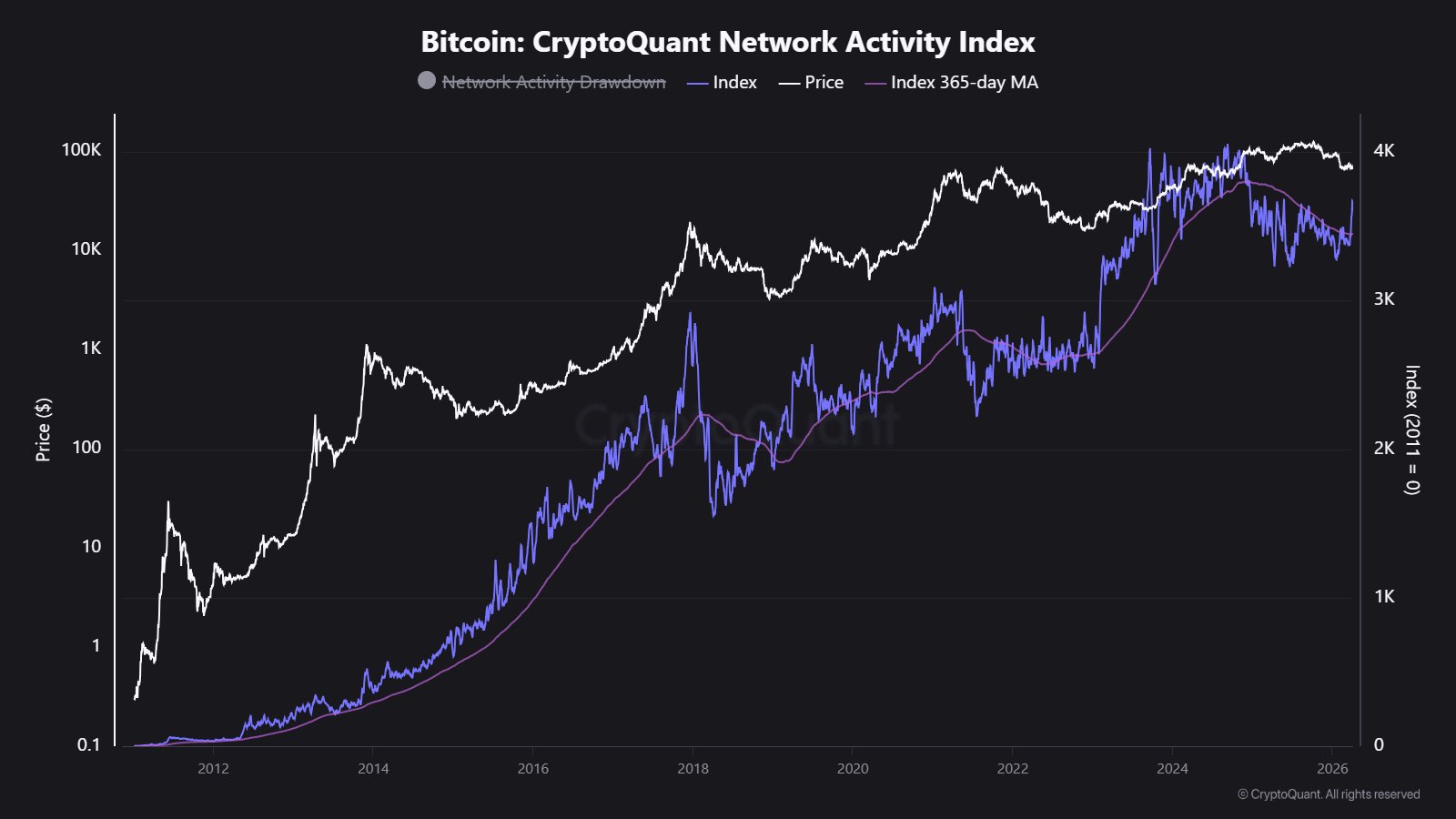
The index appears to have broken past its 365-day MA in recent days | Source: CryptoQuant on X

From the above chart, it’s visible that the Bitcoin Network Activity Index plunged below its 365-day moving average (MA) back in late 2024 and remained in a downtrend during 2025. The trajectory continued into the first quarter of 2026, but since the onset of the second quarter, fates appear to have flipped for the indicator.

Not only has the Network Activity Index managed to break past its 365-day MA, it has done so in a sharp manner, with its value shooting up. The reversal in the indicator has come alongside a sharp surge in the total number of transactions occurring on the Bitcoin network.
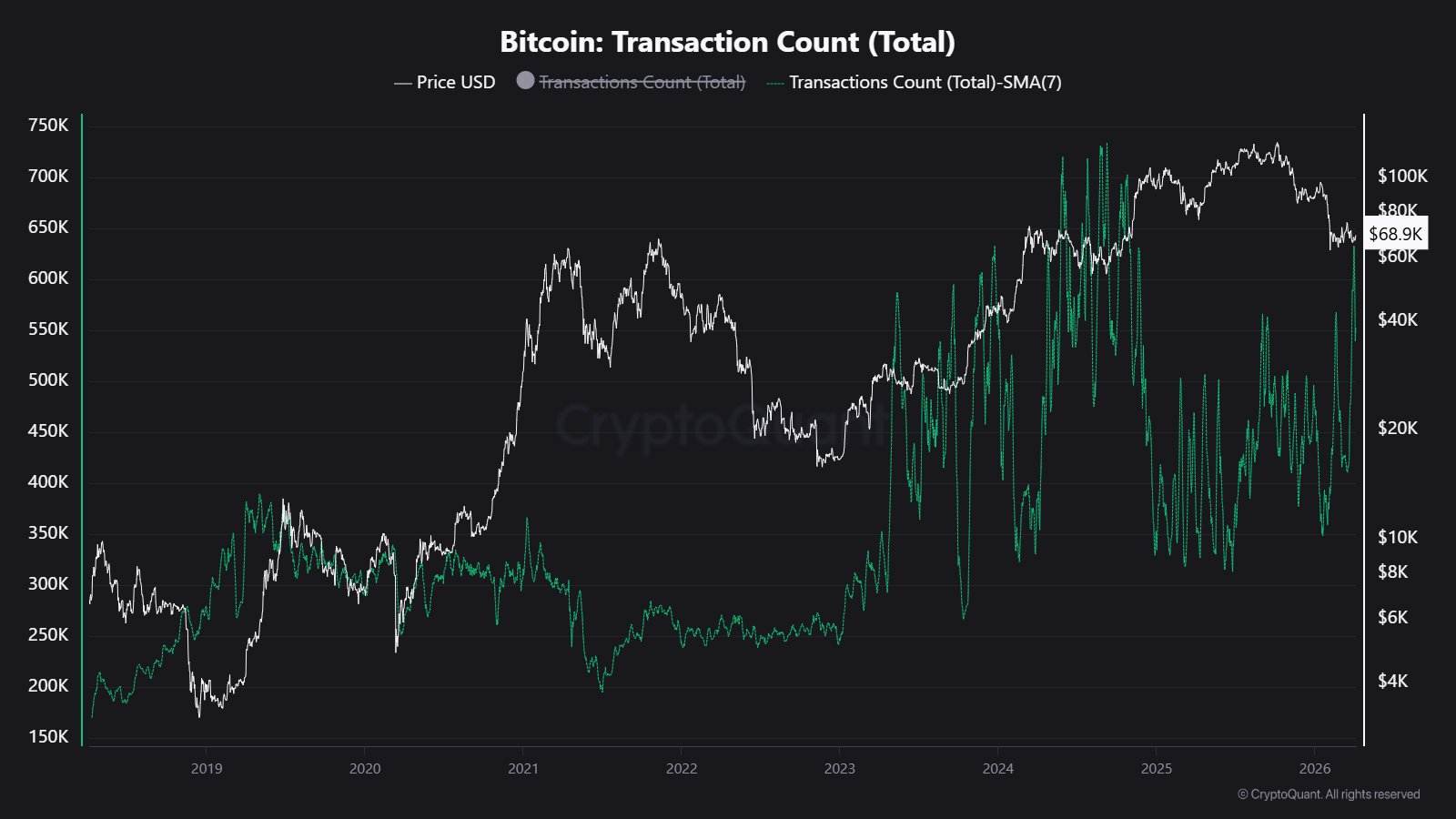
How the total number of transactions on the BTC network has changed over the last several years | Source: CryptoQuant on X

As displayed in the graph, the 7-day simple moving average (SMA) of the Bitcoin transaction count was muted earlier, but a recent sharp revival has meant that its value has reached a high of 615,000. This is the most amount of transfers on the BTC blockchain since November 2024, when the activity decline began.

Interestingly, while transactions have shot up, the total fees that Bitcoin miners are earning on the network have stayed at low levels.
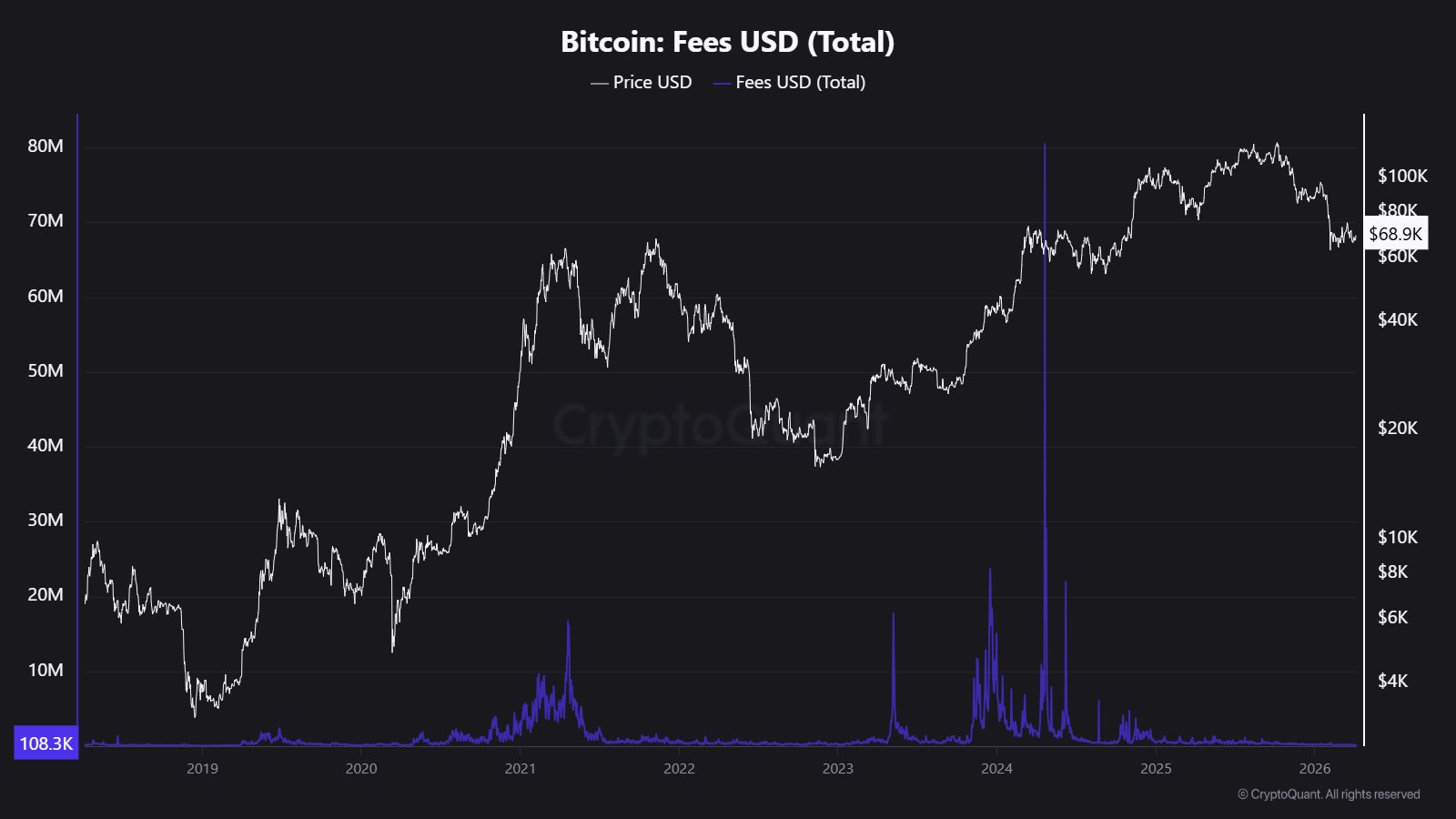
The total fees on the BTC network has been low since the end of 2024 | Source: CryptoQuant on X

The transaction fees can correlate with the demand for using the network that exists among users. The BTC blockchain only has a limited capacity to handle transfers, so in periods of network congestion, the average fees can blow up as senders compete against each other to get transfers through first. In contrast, when there isn’t much demand for getting moves through quickly, the fees can stay at low levels.

The Network Activity Index suggests that the Bitcoin network has observed a spike in usage, but the fees staying low could imply that the source may not entirely be organic demand, but rather a result of exchanges, custodians, and large holders taking advantage of the current low fee competition environment to make operational moves like UTXO management and wallet reshuffling.

BTC Price

Bitcoin recovered above $70,000 on Monday, but the coin has since retraced back to $69,000.

The trend in the price of the coin over the last five days | Source: BTCUSDT on TradingView


Preguntas relacionadas

QWhat is the current number of Bitcoin transactions and how does it compare to recent history?

AThe Bitcoin network has reached 615,000 transactions, which is the highest level since November 2024.

QWhat does the 'Network Activity Index' measure and what recent trend has it shown?

AThe 'Network Activity Index' combines data from metrics like active addresses and transactions to provide an overview of the blockchain. It recently broke past its 365-day moving average in a sharp upward reversal.

QDespite the surge in transactions, what has happened to Bitcoin's transaction fees?

ADespite the surge in transactions, the total fees that Bitcoin miners are earning have remained at low levels.

QAccording to the article, what is a possible reason for the low fees despite high network activity?

AThe low fees could imply that the source of the activity may not be entirely organic demand, but rather a result of exchanges, custodians, and large holders taking advantage of the low fee environment for operational moves like UTXO management and wallet reshuffling.

QWhat was the price of Bitcoin at the time of the article's writing?

ABitcoin had retraced to $69,000 after briefly recovering above $70,000.

Lecturas Relacionadas

a16z Partner: Being in the Flow of Capital Is the True Moat

A16z Partner: Standing in the Cash Flow is the True Moat Historically, many of the strongest companies built their moats by positioning themselves within "cash flows"—facilitating value creation and transfer in a network and taking a cut. The more value flows, the larger they grow. Crypto is the first modern technology natively built for this. With open ledgers, programmable settlement, and stablecoins enabling internet-speed global value transfer, it allows startups to inherit network effects from day one. Well-designed tokens align users, developers, and the protocol towards network growth, distributing value to contributors. This model isn't new (e.g., railroads, Visa, Google, AWS) but Crypto democratizes it. It lets entrepreneurs target areas with high inefficiency and profit extraction—like traditional finance's payments, custody, FX, and settlement—to compress costs, increase speed, and redistribute value by standing in the new flow. The opportunity extends beyond finance to emerging markets like GPU/compute, AI training data, energy, and space, where new, programmable infrastructure can be built without legacy constraints. Key questions for founders: Are you already in the cash flow? Does your revenue scale 10x with network activity? Where is profit extraction highest relative to value created in your market? The strategy is clear: compress the old cost structure, position yourself in the new value stream, and let the network compound.

marsbitHace 21 min(s)

a16z Partner: Being in the Flow of Capital Is the True Moat

marsbitHace 21 min(s)

Capturing 15 Top-Tier Zero-Day Vulnerabilities: A Consensus Protocol Debug Agent Framework Built by 0G Lab in Collaboration with Teams from NUS, PKU, and BUPT

"Agents Capture 15 Critical Zero-Day Bugs: 0G Lab's Multi-Agent Framework Automates Debugging in Consensus Protocols" Distributed consensus protocols are notoriously difficult to debug due to complex, intertwined states. A novel framework, Agora, developed by 0G Labs with researchers from NUS, Peking University, and Beijing University of Posts and Telecommunications, tackles this by fusing deep domain expertise with a collaborative multi-agent LLM architecture. Agora moves beyond the limitations of single LLMs and traditional testing like fuzzing. It employs three specialized agents: an Orchestrator for global state, a Strategy agent for generating attack scenarios using distributed systems knowledge, and a TestGen agent that creates executable tests. A core innovation is its efficient "Succinct Memory & Communication" mechanism and a dynamic test harness. This allows the system to translate abstract hypotheses into concrete tests across languages like Go and Rust, run them, capture failures, and refine the approach in a closed loop—all with minimal token overhead. In rigorous evaluations on production-level protocols including Raft, EPaxos, and components from etcd and Sui, Agora discovered 15 previously unknown deep logic bugs (e.g., execution divergence, liveness violations). In stark contrast, powerful standalone LLMs like GPT-5.2 and Claude 4.5 found zero such bugs. Agora achieved this with a high precision of 73.9% and at an average cost of only about $40 per bug found. The framework demonstrates high generalizability. Its decoupled design allows the "Multi-Agent + Hypothesis-Driven Testing" paradigm to be applied to other complex domains like database concurrency control, OS kernels, and Web3 smart contract auditing. By enabling efficient, automated detection of deep logic flaws, Agora points the way for AI-powered security in critical infrastructure, aligning with the growing trends of agentic systems and automated quality control.

marsbitHace 24 min(s)

Capturing 15 Top-Tier Zero-Day Vulnerabilities: A Consensus Protocol Debug Agent Framework Built by 0G Lab in Collaboration with Teams from NUS, PKU, and BUPT

marsbitHace 24 min(s)

a16z crypto Partner: Cash Flow Is the True Moat

Title: a16z Crypto Partner: Capital Flow is the True Moat In business history, enduringly successful enterprises often share a core logic: capturing value by facilitating its creation and transfer within an ecosystem, taking a share of the proceeds. The scale of value flowing through the ecosystem directly correlates with the company's growth. Cryptography is the first modern technology natively suited to this commercial logic. Startups that don't leverage this framework in product design and business model construction miss significant opportunities. Stablecoins enable internet-speed, 24/7 global settlement of value with end-to-end programmability. With open underlying channels for capital flow and transparent unit economics, every circulating dollar globally represents potential flow in this arena. Blockchain is inherently a network business model. All transactions are recorded on a shared ledger, and each new participant strengthens this foundational system for future developers. More users and applications increase the network's value for all. Crypto entrepreneurs start with built-in network effects, unlike traditional businesses that spend years building them on legacy infrastructure. Network tokens amplify this advantage. A well-designed token system aligns users, developers, service providers, and validators around a common goal—network growth—while distributing rewards based on contribution. All proceeds flow back to ecosystem participants, creating a virtuous cycle of value circulation. This is not a new logic; the crypto industry simply makes it easier for startups to implement and scale. Historic giants like railroads, Standard Oil, AT&T, and modern leaders like Google and AWS succeeded by positioning themselves at critical junctures of value flow. In finance, Visa processed $15.7 trillion in payments (net revenue: $35.9B), and top market makers like Jane Street thrive by being in the path of order flow, benefiting from volume. Combining capital flow with network effects creates one of business's most robust models. As Jeff Bezos noted, "Your margin is my opportunity." This is acutely true in traditional finance, where sectors like payments, custody, and settlements extract significant fees (e.g., 2-3% for card networks, 6-9% for cross-border transfers). These profits represent opportunities for disruption by reducing costs and increasing efficiency, as proven by Stripe and Square in payments. Crypto founders can build the next-generation infrastructure: programmable, instant, global, and inherently embedded in capital flow paths. Opportunities extend beyond finance to markets like compute/GPU trading, AI training data, energy, robotics, and critical minerals—areas poised for massive global value movement that existing channels cannot handle. These are blue oceans for new, programmable infrastructure centered on capital flow, free from entrenched platforms and intermediaries. Founders should ask: Is your business at the heart of a value flow? Does your revenue scale 10x with ecosystem transaction growth? Where are the highest margins relative to value created in your target market? The answers point to the opportunity: cut existing costs, enter new value flow arenas, and grow through network effects.

Foresight NewsHace 25 min(s)

a16z crypto Partner: Cash Flow Is the True Moat

Foresight NewsHace 25 min(s)

Unveiling the 'White-haired Stock God' Serenity: A Spiritual Remedy for Anxious Retail Investors

The article details the rise of Serenity, dubbed the "White-Haired Stock God," whose social media posts have recently caused significant volatility in China's A-share market. Previously gaining fame in international retail investor communities, Serenity is known for his "Chokepoint Investment" strategy targeting small monopolies in the AI supply chain, reportedly achieving returns over 3612% this year. His influence stems from his background as a former AI research scientist, detailed analysis, and a massive following on X, where his subscriber count has surpassed Elon Musk's. In early June, Serenity's Chinese-language posts mentioning A-shares like LeaderDrive (Lide Xiebo), Easun, and Innolight triggered immediate 20% surges in their stock prices. He later clarified that some recommendations were crowdsourced from followers and claimed he did not hold positions in these stocks, stating his actions were "just for fun" to offer a foreign perspective on Chinese markets. This activity drew scrutiny from Chinese financial media, which warned of potential "pump-and-dump" schemes and legal risks. While anonymous, clues suggest Serenity is likely a Chinese-speaking individual living in Japan. He maintains his anonymity due to past harassment but enjoys substantial monthly income from his paid subscriptions. The article posits that Serenity embodies the market's current appetite for a charismatic, successful figure during the AI bull run, serving as an "outward projection" of bullish sentiment. It concludes by noting the cyclical nature of such market icons, warning that the same crowds that elevate them often seek scapegoats when trends reverse.

Odaily星球日报Hace 30 min(s)

Unveiling the 'White-haired Stock God' Serenity: A Spiritual Remedy for Anxious Retail Investors

Odaily星球日报Hace 30 min(s)

Unveiling the 'White-Haired Stock God' Serenity: The Mental Elixir for Anxious Retail Investors

The anonymous stock influencer known as "White-Haired Stock God" Serenity has ignited a frenzy in the A-share market. From June 5-9, Serenity's posts on platform X mentioning A-shares like LeaderDrive, Easun, and Innolight triggered sharp price surges, with some stocks hitting 20% daily limits. Serenity, who claims a 3612% personal return this year, gained fame internationally using a "chokepoint investment" strategy focused on small, monopolistic AI supply chain companies. With over 810k X followers, his influence rivals top analysts. His recent foray into Chinese stocks, which he claims is "for fun" to offer a "foreign perspective," has drawn scrutiny. While Serenity denies holding positions in these A-shares and states his posts are not recommendations, his actions have caused significant market volatility. He monetizes through a $1/month subscription, earning an estimated $54k monthly. Facing accusations of market manipulation, he maintains he promotes "information democracy." Community analysis suggests Serenity is likely an English-speaking Chinese national living in Japan, based on his posting patterns and shared personal details. He maintains anonymity due to past harassment. Ultimately, Serenity is seen by many as a manifestation of the current AI bull market's euphoria—a mysterious, seemingly successful figure who fulfills the market's desire for a "stock god," though such personas often face intense scrutiny when market sentiment shifts.

marsbitHace 31 min(s)

Unveiling the 'White-Haired Stock God' Serenity: The Mental Elixir for Anxious Retail Investors

marsbitHace 31 min(s)

Trading

Spot
Futuros

Artículos destacados

Qué es BITCOIN

Entendiendo HarryPotterObamaSonic10Inu (ERC-20) y Su Posición en el Espacio Cripto En los últimos años, el mercado de criptomonedas ha sido testigo de un aumento en la popularidad de las monedas meme, capturando el interés no solo de los comerciantes, sino también de aquellos que buscan compromiso comunitario y valor de entretenimiento. Entre estos tokens únicos se encuentra HarryPotterObamaSonic10Inu (ERC-20), un proyecto intrigante que mezcla referencias culturales en el tejido de las criptomonedas. Este artículo profundiza en los aspectos clave de HarryPotterObamaSonic10Inu, explorando sus mecanismos, ethos impulsado por la comunidad y su relación con el paisaje cripto más amplio. ¿Qué es HarryPotterObamaSonic10Inu (ERC-20)? Como su nombre sugiere, HarryPotterObamaSonic10Inu es una moneda meme construida sobre la blockchain de Ethereum, clasificada bajo el estándar ERC-20. A diferencia de las criptomonedas tradicionales que pueden enfatizar la utilidad práctica o el potencial de inversión, este token prospera en el valor de entretenimiento y la fuerza de su comunidad. El proyecto tiene como objetivo fomentar un entorno donde los usuarios comprometidos puedan reunirse, compartir ideas y participar en actividades inspiradas por diversos fenómenos culturales. Una característica notable de HarryPotterObamaSonic10Inu es su cero impuestos en las transacciones. Este atractivo elemento tiene como objetivo incentivar el comercio y la participación comunitaria, sin cargos adicionales que puedan disuadir a los comerciantes de pequeña escala. El suministro total de la moneda está establecido en mil millones de tokens, una cifra que marca su intención de mantener una circulación sustancial dentro de la comunidad. Creador de HarryPotterObamaSonic10Inu (ERC-20) Los orígenes de HarryPotterObamaSonic10Inu están algo envueltos en misterio; los detalles sobre el creador siguen siendo desconocidos. El desarrollo de este token carece de un equipo identificable o de un plan explícito, lo cual no es inusual dentro del sector de monedas meme. En cambio, el proyecto ha surgido de manera orgánica, con su progreso muy dependiente del entusiasmo y la participación de su comunidad. Inversores de HarryPotterObamaSonic10Inu (ERC-20) En cuanto a inversiones externas y respaldo, HarryPotterObamaSonic10Inu también sigue siendo ambiguo. El token no lista ninguna fundación de inversión conocida o apoyo organizacional significativo. En cambio, la savia del proyecto es su comunidad de base, que informa su crecimiento y sostenibilidad a través de la acción colectiva y el compromiso en el espacio cripto. ¿Cómo Funciona HarryPotterObamaSonic10Inu (ERC-20)? Como una moneda meme, HarryPotterObamaSonic10Inu opera principalmente fuera de los marcos tradicionales que a menudo rigen el valor de los activos. Hay varios aspectos distintivos que definen cómo funciona el proyecto: Transacciones Sin Impuestos: Sin tarifas impositivas en las transacciones, los usuarios pueden comprar y vender el token libremente sin preocuparse por costos ocultos. Compromiso Comunitario: El proyecto prospera en la interacción comunitaria, aprovechando plataformas de redes sociales para crear entusiasmo y facilitar la participación. Las discusiones, el intercambio de contenido y el compromiso son elementos cruciales que ayudan a expandir su alcance y fomentar la lealtad entre los seguidores. Sin Utilidad Práctica: Cabe señalar que HarryPotterObamaSonic10Inu no ofrece utilidad concreta dentro del ecosistema financiero. Más bien, se clasifica como un token principalmente para actividades de entretenimiento y comunitarias. Referencia Cultural: El token incorpora astutamente elementos de la cultura popular para atraer interés, conectando con entusiastas de los memes y seguidores de las criptomonedas por igual. HarryPotterObamaSonic10Inu ejemplifica cómo las monedas meme operan de manera diferente a los proyectos de criptomonedas más tradicionales, ingresando al mercado como construcciones sociales innovadoras en lugar de activos utilitarios. Cronología de HarryPotterObamaSonic10Inu (ERC-20) La historia de HarryPotterObamaSonic10Inu está marcada por varios hitos notables: Creación: El token surgió de un meme viral, capturando la imaginación de muchos entusiastas de las criptomonedas. Las fechas específicas de creación no están disponibles, subrayando su ascenso orgánico. Listado en Exchanges: HarryPotterObamaSonic10Inu ha llegado a varios exchanges, permitiendo un acceso y comercio más fácil por parte de la comunidad. Iniciativas de Compromiso Comunitario: Actividades continuas destinadas a mejorar la interacción comunitaria, incluyendo concursos, campañas en redes sociales y generación de contenido por parte de fanáticos y defensores. Planes de Expansión Futuros: La hoja de ruta del proyecto incluye el lanzamiento de una colección de NFT, mercancía y un sitio de comercio electrónico relacionado con sus temas culturales, involucrando aún más a la comunidad e intentando añadir más dimensiones a su ecosistema. Puntos Clave Sobre HarryPotterObamaSonic10Inu (ERC-20) Naturaleza Impulsada por la Comunidad: El proyecto prioriza la participación colectiva y la creatividad, asegurando que la involucración de los usuarios esté a la vanguardia de su desarrollo. Clasificación como Moneda Meme: Representa la epítome de las criptomonedas basadas en el entretenimiento, diferenciándose de los vehículos de inversión tradicionales. Sin Afiliación Directa con Bitcoin: A pesar de la similitud en el nombre del ticker, HarryPotterObamaSonic10Inu es distinto y no tiene relación con Bitcoin u otras criptomonedas establecidas. Enfoque en la Colaboración: HarryPotterObamaSonic10Inu está diseñado para crear un espacio para la colaboración y el intercambio de historias entre sus poseedores, proporcionando una vía para la creatividad y el vínculo comunitario. Perspectivas Futuras: La ambición de expandirse más allá de su premisa inicial hacia NFTs y mercancías describe un camino para que el proyecto potencialmente ingrese a avenidas más tradicionales dentro de la cultura digital. A medida que las monedas meme continúan capturando la imaginación de la comunidad de criptomonedas, HarryPotterObamaSonic10Inu (ERC-20) se destaca debido a sus lazos culturales y su enfoque centrado en la comunidad. Si bien puede no encajar en el molde típico de un token impulsado por la utilidad, su esencia radica en la alegría y la camaradería fomentadas entre sus seguidores, destacando la naturaleza en evolución de las criptomonedas en una era cada vez más digital. A medida que el proyecto continúa desarrollándose, será importante observar cómo las dinámicas comunitarias influyen en su trayectoria en el cambiante paisaje de la tecnología blockchain.

1.7k Vistas totalesPublicado en 2024.04.01Actualizado en 2024.12.03

Qué es BITCOIN

Cómo comprar BTC

¡Bienvenido a HTX.com! Hemos hecho que comprar Bitcoin (BTC) sea simple y conveniente. Sigue nuestra guía paso a paso para iniciar tu viaje de criptos.Paso 1: crea tu cuenta HTXUtiliza tu correo electrónico o número de teléfono para registrarte y obtener una cuenta gratuita en HTX. Experimenta un proceso de registro sin complicaciones y desbloquea todas las funciones.Obtener mi cuentaPaso 2: ve a Comprar cripto y elige tu método de pagoTarjeta de crédito/débito: usa tu Visa o Mastercard para comprar Bitcoin (BTC) al instante.Saldo: utiliza fondos del saldo de tu cuenta HTX para tradear sin problemas.Terceros: hemos agregado métodos de pago populares como Google Pay y Apple Pay para mejorar la comodidad.P2P: tradear directamente con otros usuarios en HTX.Over-the-Counter (OTC): ofrecemos servicios personalizados y tipos de cambio competitivos para los traders.Paso 3: guarda tu Bitcoin (BTC)Después de comprar tu Bitcoin (BTC), guárdalo en tu cuenta HTX. Alternativamente, puedes enviarlo a otro lugar mediante transferencia blockchain o utilizarlo para tradear otras criptomonedas.Paso 4: tradear Bitcoin (BTC)Tradear fácilmente con Bitcoin (BTC) en HTX's mercado spot. Simplemente accede a tu cuenta, selecciona tu par de trading, ejecuta tus trades y monitorea en tiempo real. Ofrecemos una experiencia fácil de usar tanto para principiantes como para traders experimentados.

5.1k Vistas totalesPublicado en 2024.12.12Actualizado en 2026.06.02

Cómo comprar BTC

Qué es $BITCOIN

ORO DIGITAL ($BITCOIN): Un Análisis Integral Introducción al ORO DIGITAL ($BITCOIN) ORO DIGITAL ($BITCOIN) es un proyecto basado en blockchain que opera en la red Solana, cuyo objetivo es combinar las características de los metales preciosos tradicionales con la innovación de las tecnologías descentralizadas. Aunque comparte un nombre con Bitcoin, a menudo referido como “oro digital” debido a su percepción como un refugio de valor, ORO DIGITAL es un token separado diseñado para crear un ecosistema único dentro del paisaje Web3. Su meta es posicionarse como un activo digital alternativo viable, aunque los detalles sobre sus aplicaciones y funcionalidades aún están en desarrollo. ¿Qué es ORO DIGITAL ($BITCOIN)? ORO DIGITAL ($BITCOIN) es un token de criptomoneda diseñado explícitamente para su uso en la blockchain de Solana. A diferencia de Bitcoin, que proporciona un papel de almacenamiento de valor ampliamente reconocido, este token parece centrarse en aplicaciones y características más amplias. Aspectos notables incluyen: Infraestructura Blockchain: El token está construido sobre la blockchain de Solana, conocida por su capacidad para manejar transacciones de alta velocidad y bajo costo. Dinámicas de Suministro: ORO DIGITAL tiene un suministro máximo limitado a 100 cuatrillones de tokens (100P $BITCOIN), aunque los detalles sobre su suministro circulante no se han divulgado actualmente. Utilidad: Si bien las funcionalidades precisas no están delineadas explícitamente, hay indicios de que el token podría ser utilizado para diversas aplicaciones, potencialmente involucrando aplicaciones descentralizadas (dApps) o estrategias de tokenización de activos. ¿Quién es el Creador de ORO DIGITAL ($BITCOIN)? En la actualidad, la identidad de los creadores y el equipo de desarrollo detrás de ORO DIGITAL ($BITCOIN) sigue siendo desconocida. Esta situación es típica entre muchos proyectos innovadores dentro del espacio blockchain, particularmente aquellos alineados con las finanzas descentralizadas y fenómenos de monedas meme. Si bien tal anonimato puede fomentar una cultura impulsada por la comunidad, intensifica las preocupaciones sobre la gobernanza y la responsabilidad. ¿Quiénes son los Inversores de ORO DIGITAL ($BITCOIN)? La información disponible indica que ORO DIGITAL ($BITCOIN) no tiene patrocinadores institucionales conocidos ni inversiones destacadas de capital de riesgo. El proyecto parece operar en un modelo de peer-to-peer centrado en el apoyo y la adopción de la comunidad en lugar de rutas de financiamiento tradicionales. Su actividad y liquidez se sitúan principalmente en intercambios descentralizados (DEX), como PumpSwap, en lugar de plataformas de trading centralizadas establecidas, lo que resalta aún más su enfoque de base. Cómo Funciona ORO DIGITAL ($BITCOIN) Los mecanismos operativos de ORO DIGITAL ($BITCOIN) pueden elaborarse en función de su diseño blockchain y atributos de red: Mecanismo de Consenso: Al aprovechar el único proof-of-history (PoH) de Solana combinado con un modelo de proof-of-stake (PoS), el proyecto asegura una validación de transacciones eficiente que contribuye al alto rendimiento de la red. Tokenómica: Si bien los mecanismos deflacionarios específicos no se han detallado extensamente, el vasto suministro máximo de tokens implica que podría atender microtransacciones o casos de uso nicho que aún están por definirse. Interoperabilidad: Existe el potencial de integración con el ecosistema más amplio de Solana, incluyendo varias plataformas de finanzas descentralizadas (DeFi). Sin embargo, los detalles sobre integraciones específicas permanecen no especificados. Cronología de Eventos Clave Aquí hay una cronología que destaca hitos significativos relacionados con ORO DIGITAL ($BITCOIN): 2023: El despliegue inicial del token ocurre en la blockchain de Solana, marcado por su dirección de contrato. 2024: ORO DIGITAL gana visibilidad al estar disponible para trading en intercambios descentralizados como PumpSwap, permitiendo a los usuarios comerciar contra SOL. 2025: El proyecto presencia actividad de trading esporádica y potencial interés en compromisos liderados por la comunidad, aunque no se han documentado asociaciones notables o avances técnicos hasta el momento. Análisis Crítico Fortalezas Escalabilidad: La infraestructura subyacente de Solana soporta altos volúmenes de transacciones, lo que podría mejorar la utilidad de $BITCOIN en varios escenarios de transacción. Accesibilidad: El potencial bajo precio de trading por token podría atraer a inversores minoristas, facilitando una participación más amplia debido a oportunidades de propiedad fraccionada. Riesgos Falta de Transparencia: La ausencia de patrocinadores, desarrolladores o un proceso de auditoría conocidos públicamente puede generar escepticismo sobre la sostenibilidad y confiabilidad del proyecto. Volatilidad del Mercado: La actividad de trading depende en gran medida del comportamiento especulativo, lo que puede resultar en una volatilidad de precios significativa y en incertidumbre para los inversores. Conclusión ORO DIGITAL ($BITCOIN) surge como un proyecto intrigante pero ambiguo dentro del ecosistema de Solana en rápida evolución. Si bien intenta aprovechar la narrativa del “oro digital”, su alejamiento del papel establecido de Bitcoin como refugio de valor subraya la necesidad de una diferenciación más clara de su utilidad y estructura de gobernanza previstas. La aceptación y adopción futura dependerán probablemente de abordar la actual opacidad y de definir sus estrategias operativas y económicas de manera más explícita. Nota: Este informe abarca información sintetizada disponible hasta octubre de 2023, y pueden haber ocurrido desarrollos más allá del período de investigación.

83 Vistas totalesPublicado en 2025.05.13Actualizado en 2025.05.13

Qué es $BITCOIN

Discusiones

Bienvenido a la comunidad de HTX. Aquí puedes mantenerte informado sobre los últimos desarrollos de la plataforma y acceder a análisis profesionales del mercado. A continuación se presentan las opiniones de los usuarios sobre el precio de BTC (BTC).

活动图片













