Bitcoin Short-Term Bullish Structure Validated, HYPE Low-Entry Window Opens | Guest Analysis

Odaily星球日报Publicado a 2026-06-15Actualizado a 2026-06-15

Resumen

**Market Analysis Summary (Week of June 2026)** **Overall Market Context:** The market environment is exceptionally complex, with the unexpected US-Iran agreement and the reopening of the Strait of Hormuz triggering a global asset repricing and significant volatility. This heightened noise underscores the importance of a structured analytical framework. **Bitcoin (BTC) Analysis & Strategy:** * **Current Status:** The price has climbed above $65,000, currently in a rebound phase (segment 38-39) following a complex 12-segment correction from the May high of $82,850. * **Key Levels:** * **Primary Resistance:** $69,500–$70,500. A successful breakout above $65,000 targets this zone. * **Primary Support:** $65,000 (immediate), followed by $59,000–$60,000 and $55,000. * **Weekly Outlook & Strategy:** The focus is on the confirmation of the $65,000 level. * **Bullish Scenario (Hold $65K):** A move toward the $69.5K–$70.5K resistance zone is anticipated, which is a potential area for initiating medium-term short positions. * **Bearish Scenario (Break below $65K):** A retest of the $60,000–$62,000 support range is likely. * **Medium-Term Strategy:** Currently neutral. Plan to establish short positions (up to 60% allocation) either in the $69.5K–$70.5K resistance zone upon signs of rejection, or on a confirmed breakdown below $65,000 and further below $59K–$60K. * **Short-Term Strategy:** Utilize 30% capital for scalping opportunities based on...

This week's market environment is exceptionally complex—the unexpected conclusion of the US-Iran agreement and the reopening of the Strait of Hormuz have triggered a massive global asset repricing. Moments of intense market sentiment volatility are precisely when structural analysis proves most valuable. The greater the noise, the more critical the framework.

This week, we focus on two main narratives: How will Bitcoin's subsequent direction be determined following its pullback after breaching $65,000? And, will HYPE's test of the $62.5~$64.57 resistance zone, after completing a four-stage correction, present new short-term opportunities?

For the complete structural analysis, market forecasts, and operational strategies, please refer to the main text.

Summary of This Week's Core Trading Views:

• BTC hourly chart structural analysis. (Details in Part 1)

• BTC weekly market forecast and mid- to short-term operational strategies. (Details in Part 2)

• HYPE hourly chart structural analysis. (Details in Part 3)

• HYPE weekly market forecast and short-term operational strategy. (Details in Part 4)

Last Week's Trading Strategy and Core View Market Validation:

• HYPE Short-Term Trade Performance: Completed one short-term long position trade (1x leverage) last week, achieving a gain of approximately 11.88%. (Details in Table 1)

• BTC Market Forecast Validation: In last week's article, we pointed out: After briefly dipping below the $60,000 threshold, the price found support and would initiate a short-term rebound to confirm the validity of the break below that key level. The current market movement validates our previous forecast.

• HYPE Market Forecast Validation: In last week's article, we pointed out: When HYPE price retested the key support zone of $55-57 showing signs of stabilizing, coupled with bottom signals triggered by our two models, a light long position could be considered. Current market movements are highly consistent with our forecast.

Part 1: In-Depth Analysis of Bitcoin's Hourly Chart Structure

Bitcoin _ 4-Hour K-Line Chart
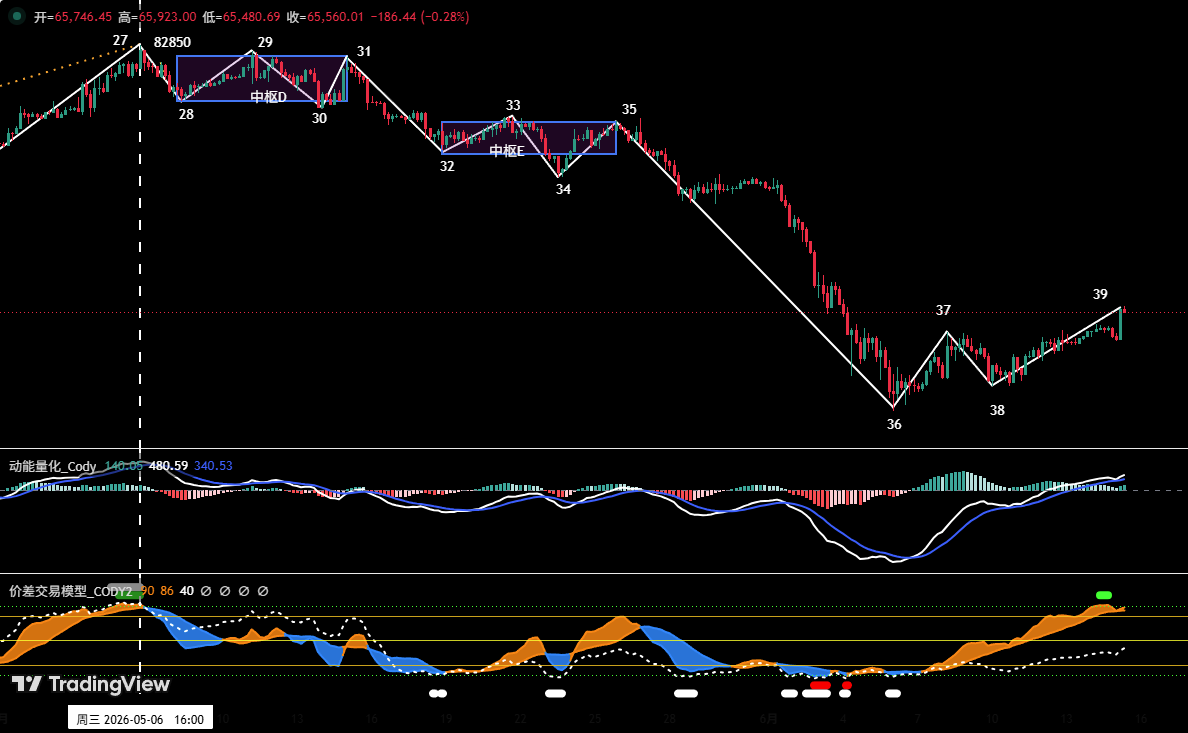
Figure 1

1. As shown in (Figure 1), since the correction began from the high of $82,850 on May 6th, a detailed 12-stage correction structure can be identified on the 4-hour chart. It includes two descending price consolidation zones: Zone D and Zone E. The overall structure is clear, presenting a typical complex correction pattern.

2. From the 4-hour structural perspective, the market is currently in the 38-39 stage rebound. The price has now surpassed $65,000. If a subsequent effective breakout is confirmed, the next significant resistance for the rebound lies in the $69,500~$70,500 region.

Part 2: Bitcoin Weekly Market Forecast and Operational Strategy

1. BTC Weekly Market Movement Forecast:

This week's core view: Focus on the result of the pullback confirmation after the price broke above $65,000.

• If the pullback fails and the level is lost, the market may test the $60,000~$62,000 core support zone again.

• If it holds firmly above, it will challenge the $69,500~$70,500 core resistance zone. This area will be a key region for us to plan mid-term short position entries.

2. Core Resistance Levels:

• First Resistance Zone: $69,500~$70,500 region (previous high-volume trading zone)

• Second Resistance Zone: $72,500~$74,500 region (previous high-volume trading zone)

3. Core Support Levels:

• First Support Level: Around $65,000

• Second Support Level: $59,000~$60,000 region (previous important support)

• Third Support Level: Around $55,000 (previous important support)

4. This Week's Operational Strategy (Excluding Impact of Unexpected News)

1. Mid-Term Strategy:

Bitcoin _ Daily K-Line Chart: (Position Monitoring Model)
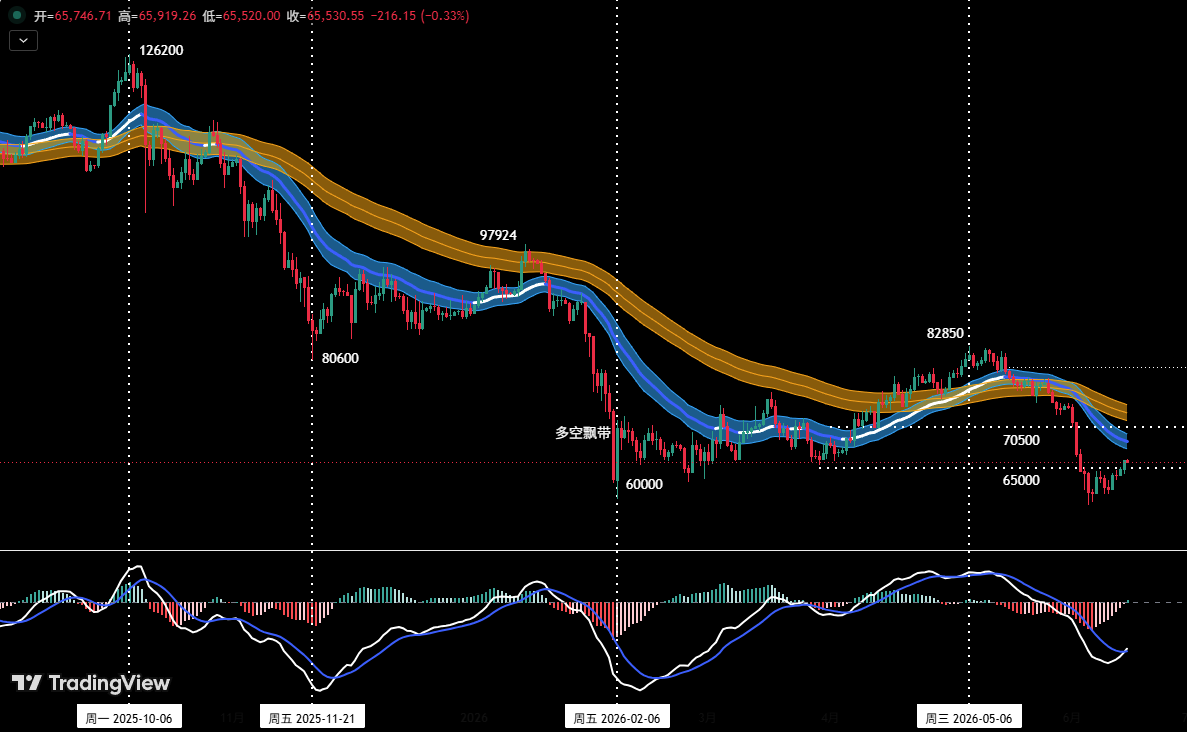
Figure 2

Position Monitoring Model: As shown in (Figure 2), the current price has effectively broken below the "Bull-Bear Channel," with the technical pattern shifting to a bear-dominated structure. Last week's market did not meet our pre-set conditions for initiating a (short) position, so the mid-term position remains empty for now.

This week, based on the outcome of the battle for $65,000 between bulls and bears, mid-term short positions can be gradually built according to the following three-tiered strategy:

Add Position at Strong Resistance: If the price successfully holds above the $65,000 region and subsequently rebounds to the $69,500~$70,500 zone showing clear resistance signs, consider establishing a mid-term (short) position, with total exposure controlled below 60%.

• Short on Support Break (Follow-through): If the price loses the $65,000 support and shows signals of a confirmed breakdown, you can initially establish a 30% mid-term short position.

Short on Further Break (Momentum): If the price loses the $65,000 support and effectively breaks below the $59,000~$60,000 support zone, you can add to the short position, with total exposure controlled below 60%.

2. Short-Term Strategy: Utilize 30% of capital, set stop-loss points, and seek "spread" opportunities based on support and resistance levels. (Use 30-minute/60-minute as the operational timeframe).

3. For short-term operations, to dynamically adapt to complex market developments, we have prepared A/B two specific operational plans in advance.

Plan A: Enter Position at Strong Resistance.

• Entry: If the price successfully holds above the $65,000 region and subsequently rebounds to around $69,500~$70,500 showing signs of stalling, combined with top signals from the quantitative model, you can initiate a short position below 30%.

• Risk Control: Set initial stop-loss.

• Exit: Gradually close the position to take profits when the price adjusts near important support levels, combined with model signals.

Plan B: Short on Effective Support Break (Follow-through).

• Entry: If the price loses the $65,000 support and shows signals of a confirmed breakdown, you can initiate a short position below 30%.

• Risk Control: Set initial stop-loss.

• Exit: Gradually close the position to take profits when the price falls to important support levels, combined with model signals.

Part 3: HYPE Hourly Chart Structural Analysis

HYPE_4-Hour K-Line Chart
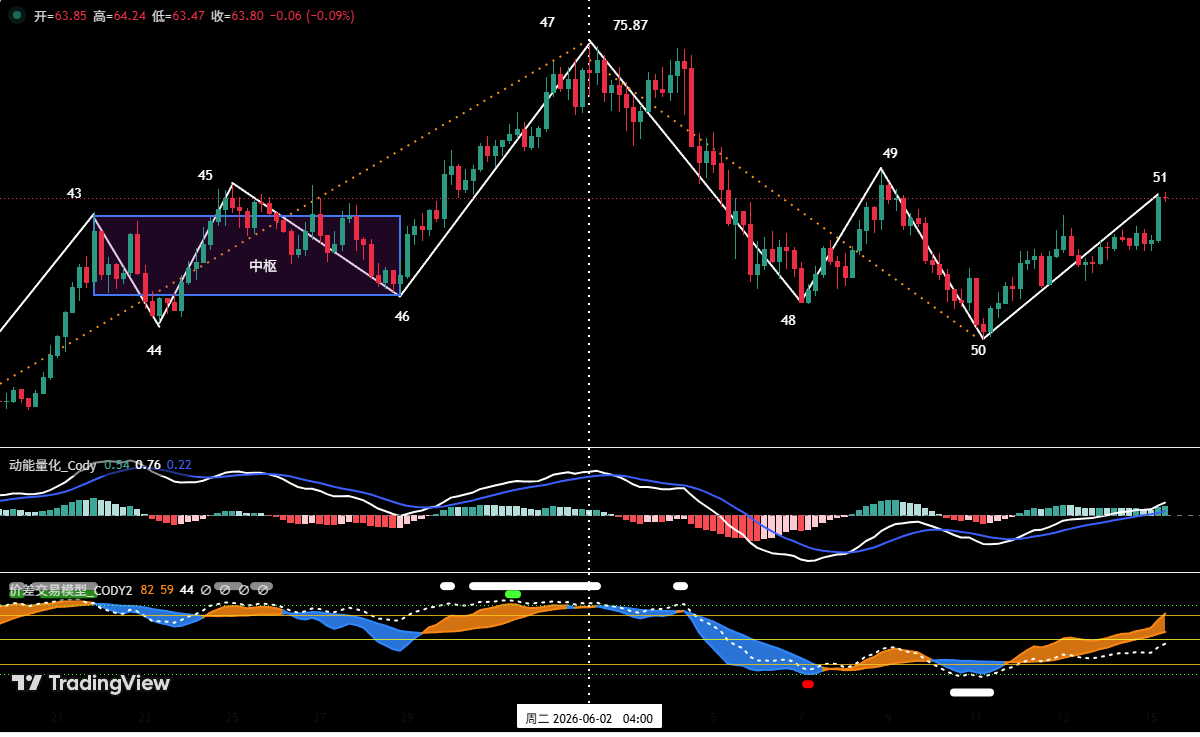
Figure 3

1. As shown in (Figure 3), on the 4-hour timeframe, HYPE's correction since the June 2nd high of $75.87 can be subdivided into a four-stage structure: (47-48), (48-49), (49-50), (50-51).

2. Currently, HYPE price has stabilized and rebounded from the support area around $52 and is in the (50-51 segment) rebound process. The overhead resistance lies in the $62.5 to $64.57 region. If (endpoint 51) forms a high point in this area (there is a high probability the overall trend will construct a "descending consolidation zone" here), the price will likely continue downward to seek stronger support.

Part 4: HYPE Weekly Market Forecast and Short-Term Operational Strategy

1. HYPE Weekly Market Movement Forecast:

1. Core Resistance Levels:

• First Resistance Level: $62.5-64.57 region;

• Second Resistance Level: $68-70 region;

2. Core Support Levels:

• First Support Level: $52-55.5 region;

• Second Support Level: $47-49 region;

This Week's Core View on HYPE:

• Observe the resistance effect in the $62.5-64.57 region and the position where "endpoint 51" forms its price high.

2. HYPE Short-Term Operational Strategy This Week: (Buy on Support)

This week's HYPE short-term trading should adhere to the strategy of "buying on dips, avoiding chasing rallies."

Short-Term Strategy: Test Long on Support Zone Stabilization

When HYPE price retests the key support zones of $52-54.5 or the deeper $47-49 and shows signs of stabilizing, combined with bottom signals triggered by our two models, consider testing a light long position. Position size must be controlled below 30%, and strict stop-loss discipline must be maintained.

Part 5: HYPE Operation Review

1. Short-Term Operation Review: (See Table 1)

We strictly followed the operational plan and, based on trading signals from our self-built "Spread Trading Model" and "Momentum Quantitative Model," completed one short-term (long) operation last week, achieving a trading profit of 11.88%.

2. HYPE Short-Term Trade Details Summary: (Leverage*1x)
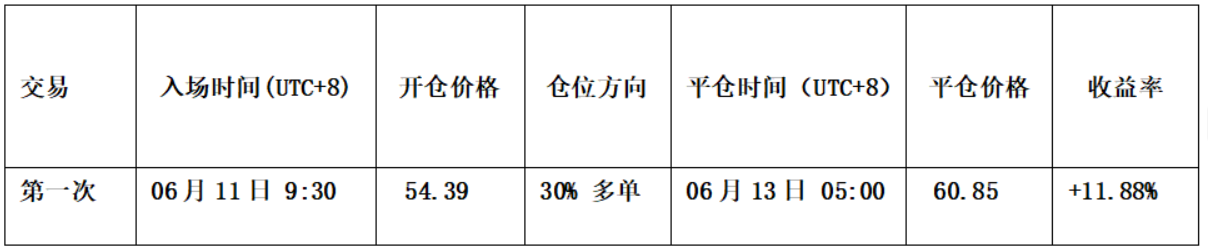
3. Short-Term Trade Review: (See Figure 4)

1. Entry Strategy:

• A relatively complete downward correction structure had been completed beforehand;

• Our self-built "Spread Trading Model" had already issued strong bottom warning signals in advance (red and white points in the chart);

• Our self-built "Momentum Quantitative Model" had issued a momentum bottom divergence signal;

Based on the above three points, we entered a 30% long position around $54.39.

2. Exit Strategy:

• When the price rose to around $62.5, it showed signs of encountering resistance;

• Our self-built "Spread Trading Model" had already issued a top warning signal in advance (white point in the chart);

• Our self-built "Momentum Quantitative Model" had issued a momentum top divergence signal;

Therefore, we closed the entire position around $60.85.

3. Summary: This trade successfully achieved a profit of approximately 11.88%.

HYPE_30-Minute K-Line Chart: (Momentum Quantitative Model + Spread Trading Model)
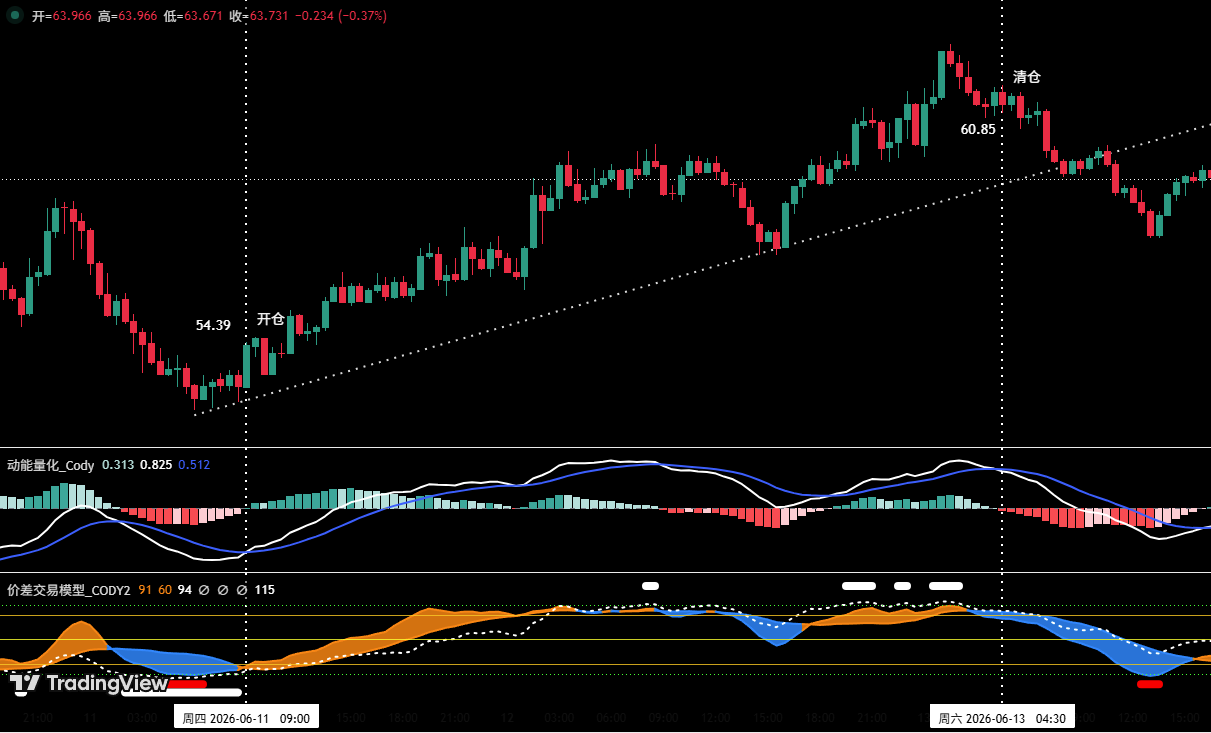
Figure 4 (Short-Term Trade Illustration)

Part 6: Special Notes:​​

1. Upon Entry: Immediately set an initial stop-loss.

2. When Profit Reaches 1%: Move the stop-loss to the entry price (break-even point) to ensure capital safety.

3. When Profit Reaches 2%​​: Move the stop-loss to the 1% profit level.

4. Continuous Tracking: Thereafter, for every additional 1% profit, move the stop-loss up by 1% accordingly, dynamically protecting and locking in gains.

Financial markets change rapidly. All market analysis and trading strategies require dynamic adjustment. All views, analytical models, and operational strategies mentioned in this article are derived from personal technical analysis, intended solely for personal trading log purposes. They do not constitute any investment advice or operational basis. Markets involve risks, investment requires caution. Please do not make decisions based on this content.


Preguntas relacionadas

QWhat are the key conditions for initiating a medium-term short position on BTC according to the article's strategy?

AThe key conditions are: 1) If the price successfully holds above the $65,000 area and subsequently rebounds to the $69,500~$70,500 resistance area showing clear signs of pressure, a medium-term short position can be considered. 2) If the price loses support at $65,000 and shows effective breakdown signals, a preliminary medium-term short position can be established. 3) If the price breaks down the $59,000~$60,000 support interval after losing $65,000, additional short positions can be added.

QWhat is the core short-term trading strategy for HYPE this week, and what are the key support levels to watch for entry?

AThe core short-term strategy for HYPE is 'buying on dips and avoiding chasing rallies.' Specifically, when the price retests the key support zones of $52-54.5 or the deeper $47-49 and shows signs of stopping declines and stabilizing, combined with bottom signals from the two proprietary models, one can consider a light long position. Positions must be controlled below 30% with strict stop-loss discipline.

QWhat was the result of the previous week's HYPE short-term trade mentioned in the article, and what models were used for the decision?

AThe previous week's HYPE short-term long position (with 1x leverage) achieved a profit of approximately 11.88%. The decision was based on signals from two proprietary models: the 'Price Difference Trading Model' which issued a strong bottom warning signal, and the 'Dynamic Quantitative Model' which issued a momentum bottom divergence signal.

QAccording to the Bitcoin 4-hour chart analysis, what is the next important resistance level if the breakout above $65,000 is confirmed effective?

AIf the breakout above $65,000 is confirmed effective, the next important resistance level is located in the $69,500~$70,500 region.

QWhat is the article's overall market outlook for Bitcoin this week, and what is the pivotal level for determining the short-term direction?

AThe article's core view for Bitcoin this week is to focus on the result of the price's pullback confirmation after breaking above $65,000. This level is pivotal. If the pullback holds, the price may challenge the $69,500~$70,500 core resistance area. If it fails and the support is lost, the market may test the core support interval of $60,000~$62,000 again.

Lecturas Relacionadas

SemiAnalysis Dissects Huawei's Kirin 9030: Process Technology Halted, So They Folded the Chip

SemiAnalysis has published a detailed teardown report on the HiSilicon Kirin 9030 Pro chipset found in Huawei's Mate 80 Pro. Fabricated using SMIC's most advanced N+3 node without EUV lithography, the analysis reveals significant technical achievements and strategic shifts. The report indicates SMIC's N+3 has achieved transistor density comparable to TSMC's N6 (113.4 vs 107.7 MTr/mm²), primarily through aggressive use of Self-Aligned Quadruple Patterning (SAQP) for its metal layers. This results in a notably small 32.5nm M0 metal pitch. However, SemiAnalysis notes this achievement comes with significantly higher process complexity, cost, and potential yield challenges compared to competitors using more advanced tools. The Kirin 9030 design maximizes this constrained density. While its GPU performance has improved ~70% and matches Qualcomm's 2022 flagship level, the CPU core's IPC lags behind current top-tier designs from Apple and Qualcomm, a gap attributed to the underlying manufacturing technology rather than design capability. Facing long-term restrictions on advanced tools, Huawei is charting a new path. The report highlights the company's "LogicFolding" roadmap, a 3D stacking technique aimed at shortening signal paths to boost performance and efficiency. The goal is to reach 5GHz frequency and a projected density of 295 MTr/mm² by 2031. SemiAnalysis concludes that export controls have not halted China's chip progress but have fundamentally altered its trajectory, making it more expensive and complex. This has spurred innovation in alternative areas like 3D stacking and domestic EDA tool development, with Huawei's supply chain also beginning to integrate Chinese memory from CXMT.

marsbitHace 31 min(s)

SemiAnalysis Dissects Huawei's Kirin 9030: Process Technology Halted, So They Folded the Chip

marsbitHace 31 min(s)

How Will the Price Move Before SpaceX's Next Share Unlock?

TL;DR Investors buying SPCX after SpaceX's IPO are not simply investing in a typical tech stock. It’s a high-valuation asset driven by Musk's narrative, Starlink, and space transport potential, but with a key twist: a very small initial float of ~4% has led to significant post-listing price appreciation. The current price action reflects a timing gap. Before the first lock-up expiration (estimated around August, subject to official confirmation), scarcity and high demand could continue to push prices up. Short-term bulls focus on low float, FOMO, and potential index inclusion. However, bears point to the supply dynamics that will change post-lockup. Existing shareholders still hold over 95% of shares, which will be released in stages starting from the first unlock window. This introduces future selling pressure from low-cost holders. The upcoming Q2 earnings report is a critical catalyst before the unlock. It will test whether the company's fundamentals can justify the current ~$2.1T valuation. Strong results could support the pre-unlock momentum, while weak figures could amplify concerns about future supply. The trading thesis is shifting from immediate scarcity ("can't buy enough") to evaluating future absorption capacity ("who will buy when more supply hits"). The path ahead hinges on the specifics of the unlock schedule, Q2 earnings performance, and whether anticipated passive index buying materializes.

marsbitHace 52 min(s)

How Will the Price Move Before SpaceX's Next Share Unlock?

marsbitHace 52 min(s)

Bitcoin Short-Term Bullish Structure Validated, HYPE Accumulation Window Opens | Guest Analysis

**Bitcoin and HYPE Market Analysis: Short-Term Outlook and Trading Strategies** This market analysis examines Bitcoin (BTC) and HYPE amid volatile conditions, providing short-term outlooks and specific trading strategies. **Key Outlooks:** * **Bitcoin (BTC):** Focus is on whether BTC's recent move above $65,000 holds. A successful breakout could lead to a test of the $69,500-$70,500 resistance zone, where medium-term short positions are considered. A failure, breaking below $65,000, may trigger a decline towards the $59,000-$60,000 support area. * **HYPE:** The token completed a four-wave correction and is now rebounding. The key resistance zone is $62.5-$64.57. The trading strategy is "buy on dips," looking for entry opportunities near the $52-$54.5 or deeper $47-$49 support zones, pending confirmation from proprietary models. **BTC Trading Strategy:** * **Medium-term:** Primarily looking to establish short positions (up to 60% allocated capital) if price rallies to the $69,500-$70,500 resistance area and shows signs of reversal. Alternative plans involve initiating shorts on a breakdown below $65,000. * **Short-term:** Allocate up to 30% capital for intraday "spread" trades based on support/resistance levels on 30/60-minute charts. **HYPE Trading Strategy:** * **Short-term:** Adopt a dip-buying approach. Consider light long positions (under 30% capital) when price tests key support levels ($52-$54.5 or $47-$49) and shows stabilization, confirmed by proprietary "Price Spread" and "Momentum Quant" models. **Trade Recap:** The analysis reviews a successful HYPE long trade from the previous week, executed at ~$54.39 and closed at ~$60.85 for an ~11.88% gain, based on signals from the aforementioned models. **Risk Management Emphasis:** The article stresses strict capital allocation (under 30-60%), immediate initial stop-loss placement, and a trailing stop-loss protocol to lock in profits as trades move favorably. ***Disclaimer:** All analysis, models, and strategies are for educational purposes based on technical analysis, not investment advice. Markets are volatile; trade with caution.*

marsbitHace 59 min(s)

Bitcoin Short-Term Bullish Structure Validated, HYPE Accumulation Window Opens | Guest Analysis

marsbitHace 59 min(s)

Trading

Spot
Futuros

Artículos destacados

Qué es BITCOIN

Entendiendo HarryPotterObamaSonic10Inu (ERC-20) y Su Posición en el Espacio Cripto En los últimos años, el mercado de criptomonedas ha sido testigo de un aumento en la popularidad de las monedas meme, capturando el interés no solo de los comerciantes, sino también de aquellos que buscan compromiso comunitario y valor de entretenimiento. Entre estos tokens únicos se encuentra HarryPotterObamaSonic10Inu (ERC-20), un proyecto intrigante que mezcla referencias culturales en el tejido de las criptomonedas. Este artículo profundiza en los aspectos clave de HarryPotterObamaSonic10Inu, explorando sus mecanismos, ethos impulsado por la comunidad y su relación con el paisaje cripto más amplio. ¿Qué es HarryPotterObamaSonic10Inu (ERC-20)? Como su nombre sugiere, HarryPotterObamaSonic10Inu es una moneda meme construida sobre la blockchain de Ethereum, clasificada bajo el estándar ERC-20. A diferencia de las criptomonedas tradicionales que pueden enfatizar la utilidad práctica o el potencial de inversión, este token prospera en el valor de entretenimiento y la fuerza de su comunidad. El proyecto tiene como objetivo fomentar un entorno donde los usuarios comprometidos puedan reunirse, compartir ideas y participar en actividades inspiradas por diversos fenómenos culturales. Una característica notable de HarryPotterObamaSonic10Inu es su cero impuestos en las transacciones. Este atractivo elemento tiene como objetivo incentivar el comercio y la participación comunitaria, sin cargos adicionales que puedan disuadir a los comerciantes de pequeña escala. El suministro total de la moneda está establecido en mil millones de tokens, una cifra que marca su intención de mantener una circulación sustancial dentro de la comunidad. Creador de HarryPotterObamaSonic10Inu (ERC-20) Los orígenes de HarryPotterObamaSonic10Inu están algo envueltos en misterio; los detalles sobre el creador siguen siendo desconocidos. El desarrollo de este token carece de un equipo identificable o de un plan explícito, lo cual no es inusual dentro del sector de monedas meme. En cambio, el proyecto ha surgido de manera orgánica, con su progreso muy dependiente del entusiasmo y la participación de su comunidad. Inversores de HarryPotterObamaSonic10Inu (ERC-20) En cuanto a inversiones externas y respaldo, HarryPotterObamaSonic10Inu también sigue siendo ambiguo. El token no lista ninguna fundación de inversión conocida o apoyo organizacional significativo. En cambio, la savia del proyecto es su comunidad de base, que informa su crecimiento y sostenibilidad a través de la acción colectiva y el compromiso en el espacio cripto. ¿Cómo Funciona HarryPotterObamaSonic10Inu (ERC-20)? Como una moneda meme, HarryPotterObamaSonic10Inu opera principalmente fuera de los marcos tradicionales que a menudo rigen el valor de los activos. Hay varios aspectos distintivos que definen cómo funciona el proyecto: Transacciones Sin Impuestos: Sin tarifas impositivas en las transacciones, los usuarios pueden comprar y vender el token libremente sin preocuparse por costos ocultos. Compromiso Comunitario: El proyecto prospera en la interacción comunitaria, aprovechando plataformas de redes sociales para crear entusiasmo y facilitar la participación. Las discusiones, el intercambio de contenido y el compromiso son elementos cruciales que ayudan a expandir su alcance y fomentar la lealtad entre los seguidores. Sin Utilidad Práctica: Cabe señalar que HarryPotterObamaSonic10Inu no ofrece utilidad concreta dentro del ecosistema financiero. Más bien, se clasifica como un token principalmente para actividades de entretenimiento y comunitarias. Referencia Cultural: El token incorpora astutamente elementos de la cultura popular para atraer interés, conectando con entusiastas de los memes y seguidores de las criptomonedas por igual. HarryPotterObamaSonic10Inu ejemplifica cómo las monedas meme operan de manera diferente a los proyectos de criptomonedas más tradicionales, ingresando al mercado como construcciones sociales innovadoras en lugar de activos utilitarios. Cronología de HarryPotterObamaSonic10Inu (ERC-20) La historia de HarryPotterObamaSonic10Inu está marcada por varios hitos notables: Creación: El token surgió de un meme viral, capturando la imaginación de muchos entusiastas de las criptomonedas. Las fechas específicas de creación no están disponibles, subrayando su ascenso orgánico. Listado en Exchanges: HarryPotterObamaSonic10Inu ha llegado a varios exchanges, permitiendo un acceso y comercio más fácil por parte de la comunidad. Iniciativas de Compromiso Comunitario: Actividades continuas destinadas a mejorar la interacción comunitaria, incluyendo concursos, campañas en redes sociales y generación de contenido por parte de fanáticos y defensores. Planes de Expansión Futuros: La hoja de ruta del proyecto incluye el lanzamiento de una colección de NFT, mercancía y un sitio de comercio electrónico relacionado con sus temas culturales, involucrando aún más a la comunidad e intentando añadir más dimensiones a su ecosistema. Puntos Clave Sobre HarryPotterObamaSonic10Inu (ERC-20) Naturaleza Impulsada por la Comunidad: El proyecto prioriza la participación colectiva y la creatividad, asegurando que la involucración de los usuarios esté a la vanguardia de su desarrollo. Clasificación como Moneda Meme: Representa la epítome de las criptomonedas basadas en el entretenimiento, diferenciándose de los vehículos de inversión tradicionales. Sin Afiliación Directa con Bitcoin: A pesar de la similitud en el nombre del ticker, HarryPotterObamaSonic10Inu es distinto y no tiene relación con Bitcoin u otras criptomonedas establecidas. Enfoque en la Colaboración: HarryPotterObamaSonic10Inu está diseñado para crear un espacio para la colaboración y el intercambio de historias entre sus poseedores, proporcionando una vía para la creatividad y el vínculo comunitario. Perspectivas Futuras: La ambición de expandirse más allá de su premisa inicial hacia NFTs y mercancías describe un camino para que el proyecto potencialmente ingrese a avenidas más tradicionales dentro de la cultura digital. A medida que las monedas meme continúan capturando la imaginación de la comunidad de criptomonedas, HarryPotterObamaSonic10Inu (ERC-20) se destaca debido a sus lazos culturales y su enfoque centrado en la comunidad. Si bien puede no encajar en el molde típico de un token impulsado por la utilidad, su esencia radica en la alegría y la camaradería fomentadas entre sus seguidores, destacando la naturaleza en evolución de las criptomonedas en una era cada vez más digital. A medida que el proyecto continúa desarrollándose, será importante observar cómo las dinámicas comunitarias influyen en su trayectoria en el cambiante paisaje de la tecnología blockchain.

1.8k Vistas totalesPublicado en 2024.04.01Actualizado en 2024.12.03

Qué es BITCOIN

Cómo comprar BTC

¡Bienvenido a HTX.com! Hemos hecho que comprar Bitcoin (BTC) sea simple y conveniente. Sigue nuestra guía paso a paso para iniciar tu viaje de criptos.Paso 1: crea tu cuenta HTXUtiliza tu correo electrónico o número de teléfono para registrarte y obtener una cuenta gratuita en HTX. Experimenta un proceso de registro sin complicaciones y desbloquea todas las funciones.Obtener mi cuentaPaso 2: ve a Comprar cripto y elige tu método de pagoTarjeta de crédito/débito: usa tu Visa o Mastercard para comprar Bitcoin (BTC) al instante.Saldo: utiliza fondos del saldo de tu cuenta HTX para tradear sin problemas.Terceros: hemos agregado métodos de pago populares como Google Pay y Apple Pay para mejorar la comodidad.P2P: tradear directamente con otros usuarios en HTX.Over-the-Counter (OTC): ofrecemos servicios personalizados y tipos de cambio competitivos para los traders.Paso 3: guarda tu Bitcoin (BTC)Después de comprar tu Bitcoin (BTC), guárdalo en tu cuenta HTX. Alternativamente, puedes enviarlo a otro lugar mediante transferencia blockchain o utilizarlo para tradear otras criptomonedas.Paso 4: tradear Bitcoin (BTC)Tradear fácilmente con Bitcoin (BTC) en HTX's mercado spot. Simplemente accede a tu cuenta, selecciona tu par de trading, ejecuta tus trades y monitorea en tiempo real. Ofrecemos una experiencia fácil de usar tanto para principiantes como para traders experimentados.

5.2k Vistas totalesPublicado en 2024.12.12Actualizado en 2026.06.02

Cómo comprar BTC

Qué es $BITCOIN

ORO DIGITAL ($BITCOIN): Un Análisis Integral Introducción al ORO DIGITAL ($BITCOIN) ORO DIGITAL ($BITCOIN) es un proyecto basado en blockchain que opera en la red Solana, cuyo objetivo es combinar las características de los metales preciosos tradicionales con la innovación de las tecnologías descentralizadas. Aunque comparte un nombre con Bitcoin, a menudo referido como “oro digital” debido a su percepción como un refugio de valor, ORO DIGITAL es un token separado diseñado para crear un ecosistema único dentro del paisaje Web3. Su meta es posicionarse como un activo digital alternativo viable, aunque los detalles sobre sus aplicaciones y funcionalidades aún están en desarrollo. ¿Qué es ORO DIGITAL ($BITCOIN)? ORO DIGITAL ($BITCOIN) es un token de criptomoneda diseñado explícitamente para su uso en la blockchain de Solana. A diferencia de Bitcoin, que proporciona un papel de almacenamiento de valor ampliamente reconocido, este token parece centrarse en aplicaciones y características más amplias. Aspectos notables incluyen: Infraestructura Blockchain: El token está construido sobre la blockchain de Solana, conocida por su capacidad para manejar transacciones de alta velocidad y bajo costo. Dinámicas de Suministro: ORO DIGITAL tiene un suministro máximo limitado a 100 cuatrillones de tokens (100P $BITCOIN), aunque los detalles sobre su suministro circulante no se han divulgado actualmente. Utilidad: Si bien las funcionalidades precisas no están delineadas explícitamente, hay indicios de que el token podría ser utilizado para diversas aplicaciones, potencialmente involucrando aplicaciones descentralizadas (dApps) o estrategias de tokenización de activos. ¿Quién es el Creador de ORO DIGITAL ($BITCOIN)? En la actualidad, la identidad de los creadores y el equipo de desarrollo detrás de ORO DIGITAL ($BITCOIN) sigue siendo desconocida. Esta situación es típica entre muchos proyectos innovadores dentro del espacio blockchain, particularmente aquellos alineados con las finanzas descentralizadas y fenómenos de monedas meme. Si bien tal anonimato puede fomentar una cultura impulsada por la comunidad, intensifica las preocupaciones sobre la gobernanza y la responsabilidad. ¿Quiénes son los Inversores de ORO DIGITAL ($BITCOIN)? La información disponible indica que ORO DIGITAL ($BITCOIN) no tiene patrocinadores institucionales conocidos ni inversiones destacadas de capital de riesgo. El proyecto parece operar en un modelo de peer-to-peer centrado en el apoyo y la adopción de la comunidad en lugar de rutas de financiamiento tradicionales. Su actividad y liquidez se sitúan principalmente en intercambios descentralizados (DEX), como PumpSwap, en lugar de plataformas de trading centralizadas establecidas, lo que resalta aún más su enfoque de base. Cómo Funciona ORO DIGITAL ($BITCOIN) Los mecanismos operativos de ORO DIGITAL ($BITCOIN) pueden elaborarse en función de su diseño blockchain y atributos de red: Mecanismo de Consenso: Al aprovechar el único proof-of-history (PoH) de Solana combinado con un modelo de proof-of-stake (PoS), el proyecto asegura una validación de transacciones eficiente que contribuye al alto rendimiento de la red. Tokenómica: Si bien los mecanismos deflacionarios específicos no se han detallado extensamente, el vasto suministro máximo de tokens implica que podría atender microtransacciones o casos de uso nicho que aún están por definirse. Interoperabilidad: Existe el potencial de integración con el ecosistema más amplio de Solana, incluyendo varias plataformas de finanzas descentralizadas (DeFi). Sin embargo, los detalles sobre integraciones específicas permanecen no especificados. Cronología de Eventos Clave Aquí hay una cronología que destaca hitos significativos relacionados con ORO DIGITAL ($BITCOIN): 2023: El despliegue inicial del token ocurre en la blockchain de Solana, marcado por su dirección de contrato. 2024: ORO DIGITAL gana visibilidad al estar disponible para trading en intercambios descentralizados como PumpSwap, permitiendo a los usuarios comerciar contra SOL. 2025: El proyecto presencia actividad de trading esporádica y potencial interés en compromisos liderados por la comunidad, aunque no se han documentado asociaciones notables o avances técnicos hasta el momento. Análisis Crítico Fortalezas Escalabilidad: La infraestructura subyacente de Solana soporta altos volúmenes de transacciones, lo que podría mejorar la utilidad de $BITCOIN en varios escenarios de transacción. Accesibilidad: El potencial bajo precio de trading por token podría atraer a inversores minoristas, facilitando una participación más amplia debido a oportunidades de propiedad fraccionada. Riesgos Falta de Transparencia: La ausencia de patrocinadores, desarrolladores o un proceso de auditoría conocidos públicamente puede generar escepticismo sobre la sostenibilidad y confiabilidad del proyecto. Volatilidad del Mercado: La actividad de trading depende en gran medida del comportamiento especulativo, lo que puede resultar en una volatilidad de precios significativa y en incertidumbre para los inversores. Conclusión ORO DIGITAL ($BITCOIN) surge como un proyecto intrigante pero ambiguo dentro del ecosistema de Solana en rápida evolución. Si bien intenta aprovechar la narrativa del “oro digital”, su alejamiento del papel establecido de Bitcoin como refugio de valor subraya la necesidad de una diferenciación más clara de su utilidad y estructura de gobernanza previstas. La aceptación y adopción futura dependerán probablemente de abordar la actual opacidad y de definir sus estrategias operativas y económicas de manera más explícita. Nota: Este informe abarca información sintetizada disponible hasta octubre de 2023, y pueden haber ocurrido desarrollos más allá del período de investigación.

83 Vistas totalesPublicado en 2025.05.13Actualizado en 2025.05.13

Qué es $BITCOIN

Discusiones

Bienvenido a la comunidad de HTX. Aquí puedes mantenerte informado sobre los últimos desarrollos de la plataforma y acceder a análisis profesionales del mercado. A continuación se presentan las opiniones de los usuarios sobre el precio de BTC (BTC).

活动图片