Bitcoin's price could receive strong support in the coming decade if large investors begin to perceive it as a full-fledged financial asset, according to Bitwise Chief Investment Officer Matt Hougan.

According to Hougan's estimate, institutional capital could bring trillions of dollars to Bitcoin. This is not a brief market spike but a long process: more and more major players are gradually including cryptocurrency in the range of assets that can be used to preserve capital.
- Financial advisors
- Family offices
- Pension plans
- Sovereign wealth funds
- Bitwise expects that within the next 10 years, institutional investors could direct trillions of dollars into Bitcoin.
- Hougan links the long-term target of $1.3 million per coin by 2035 to Bitcoin's potential share of the growing store-of-value market.
- In his view, the primary demand will shift over time from corporate buyers like Strategy to pension funds, insurance companies, endowments, sovereign wealth funds, and other major capital holders.
Why Institutional Money is Becoming the Main Factor
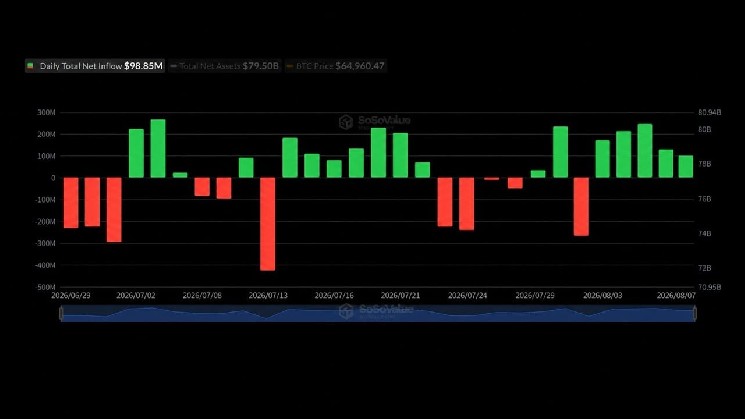
According to Hougan, financial advisors and family offices will be the first to act more actively. He sees signs of this shift in disclosures of positions in spot Bitcoin ETFs, as well as in the steps of major financial groups, including Morgan Stanley and Wells Fargo, which are making it easier for clients to access this asset class.
Even larger sources of capital could enter the game:
- Funds
- Endowments
- Pension plans
- Insurance companies
- Sovereign wealth funds
- Central banks
Hougan emphasizes that this is not a one-time reversal but a process spanning more than 10 years.
This will take more than 10 years.
The scale of the potential inflow explains Bitwise's optimism. According to Hougan, such institutions manage assets worth $100 to $200 trillion worldwide. Even if they allocate just 1% of their portfolios to Bitcoin, that could be enough to support a long-term growth scenario.
How Hougan Assesses the Long-Term Target
The forecast of $1.3 million per Bitcoin by 2035 is based on the idea that the asset can capture 25% of the expanding store-of-value market. Hougan reminded that gold's market capitalization grew from about $2 trillion at the launch of gold ETFs in 2004 to about $30 trillion today.
If this market continues to grow at historical rates of about 13% per year for another decade, a quarter of its volume could push Bitcoin to the indicated price target. The US dollar in these calculations serves as the base measure of value, not a separate driver of the forecast.
When people evaluate Bitcoin, they often compare it to gold as a store-of-value asset. The logic is simple: if gold is worth $30 trillion, and Bitcoin takes half of that market, one coin could be worth $715,000.
Hougan believes retail investors have already done enormous work for the market: cryptocurrency has grown from zero to a valuation of about $2 trillion largely thanks to them. But the move from $2 trillion to $20 trillion, he says, will require a completely different scale of capital.
Institutions hold the majority of the world's money. Cryptocurrency grew due to retail, which lifted it from 0 to $2 trillion. But the move from $2 trillion to $20 trillion will be driven by institutional capital.
Why Strategy's Role May Diminish
Strategy has remained one of the most prominent buyers of Bitcoin over the years and became the largest corporate holder of the asset, accumulating 842,138 coins even considering recent moderate sales. However, Hougan does not expect this company to remain the main source of demand in the future.
He explains Strategy's past success by two features of capital markets. Initially, investors viewed its shares as one of the few public ways to gain exposure to cryptocurrencies. This allowed the company to trade at a premium to the value of its Bitcoin reserves. Then, Strategy used convertible debt and preferred shares to raise money for new purchases.
Now, both advantages have weakened. Spot ETFs have given investors a direct and clearer way to buy exposure to Bitcoin. And Strategy's debt-raising capabilities, in Hougan's view, have largely been utilized within the limits of what the market is willing to support relative to the company's existing capital.
The easy paths to accumulation have already been taken.
Hougan does not believe that Strategy will stop buying Bitcoin. Rather, the pace may become slower, and the purchases themselves may depend more on the market cycle.
Bitcoin as a Financial Asset, Not Just Technology
In this logic, mining itself or the technical side of the blockchain is not the central point, although it is the blockchain that underlies the network created by Satoshi Nakamoto. For large investors, the key question sounds different: can Bitcoin take a place in a portfolio alongside traditional stores of value.
Bitcoin is viewed as a potential store of value, and long-term demand, according to Hougan's logic, should come from major capital holders.
The payment system for daily transactions, a banking transaction, or a transfer through infrastructure like Coinbase—is not the center of Hougan's thesis. He is speaking primarily about long-term demand from capital that needs clear access, storage, authentication, and regulated instruments. Against this backdrop, Bitcoin differs from other digital assets, including Ethereum, precisely in its role as a potential store of value.
For long-term investors, Hougan believes, the main question is not where Bitcoin has found a local bottom. Sharp price movements largely depend on the market cycle and how demand from major buyers changes. It is much more important to understand whether the peak of the current cycle has already been formed—or whether the market still has a larger institutional phase ahead.
end-content