Bitcoin Price Bottom Not In Yet, Crypto Founder Calls ‘One Final Dump’

bitcoinistPublicado a 2026-04-12Actualizado a 2026-04-12

Resumen

Bitcoin's recent price surge above $73,000 has sparked debate on whether the market has bottomed. However, crypto founder Joao Wedson suggests a "final dump" may still occur. His analysis, based on on-chain data, indicates that the Investor Price has fallen below the Long-Term Holder Realized Price—a signal that historically precedes a cycle bottom. This pattern suggests weaker investors are exiting while stronger hands accumulate, but the process is slow, leading to sideways or downward pressure. Market rallies are likely to fade due to selling pressure from investors seeking to break even. Wedson concludes the current structure resembles a mid-cycle reset rather than a final bottom, favoring gradual accumulation over rapid price expansion.

The Bitcoin price and the general cryptocurrency market received a major boost over the past week, as the geopolitical tensions in the Middle East seemingly reached a temporary halt. The premier cryptocurrency has maintained relatively strong momentum since breaking the psychological $70,000 resistance on Tuesday, April 7.

Now, this sudden resurgence has sparked conversations among the crypto crowd on whether the Bitcoin price has formed a structural bottom yet. According to a prominent crypto founder, the world’s largest cryptocurrency might still experience “one final dump” before the end of this bear phase.

On-Chain Signal Points To One More BTC Drop

In an April 10 post on the X platform, the Alphractal founder and CEO, Joao Wedson, highlighted an emerging signal that suggests that the Bitcoin price still likely has one more trip to the downside. This projection is based on an on-chain insight that suggests that BTC’s price tends to move toward a cycle bottom when the Investor Price falls below the Long-Term Holder (LTH) Realized Price.

Wedson explained the relevance of this on-chain insight and why it emerges before a major price and an ensuing coin accumulation. According to the on-chain data expert, the Investor Price is a metric that measures the average cost of economically active coins, and, when it falls below the LTH Realized Price, suggests fresher capital has flowed in at lower prices than long-term investors paid.

Wedson wrote on X:

This usually happens after distribution phases, when demand weakens, and marginal buyers step back. Long-term holders historically sell less when the price approaches or dips below their cost basis.
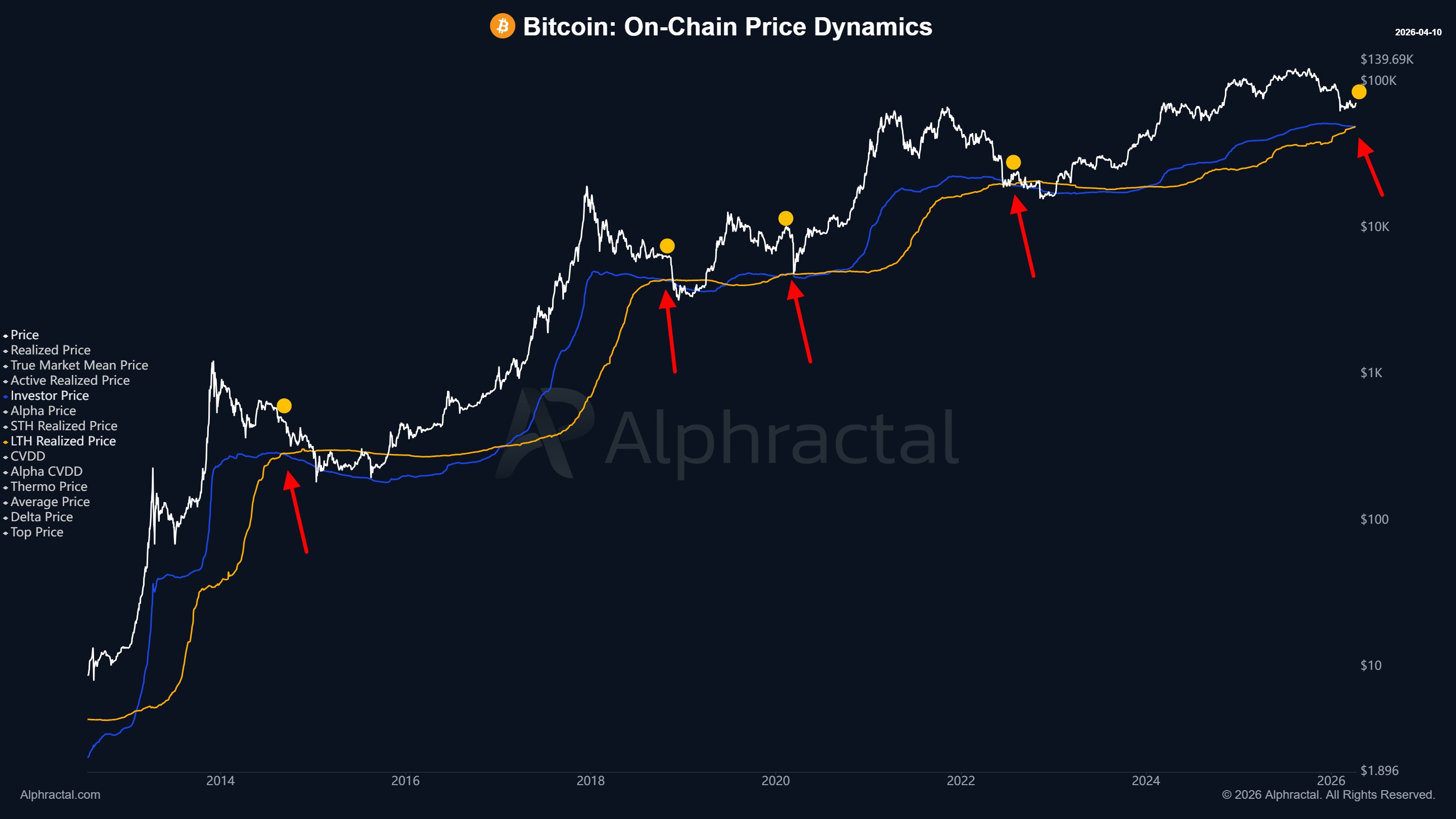
Source: @joao_wedson on X

As shown in the chart above, the LTH Realized Price appears to be breaking above the Investor Price, indicating a transition phase in which weaker hands exit while stronger hands gradually absorb supply. However, it is worth noting that this absorption is slower than expected, which explains why the Bitcoin price often falls into an intermediate accumulation range.

Moreover, with Investor Price below LTH Realized Price, market surges tend to quickly wane as they meet supply (selling pressure) from investors looking to exit at their breakeven prices. This phenomenon caps the current upside potential of the premier cryptocurrency, reinforcing possible sideways to downward price movements until a new demand impulse appears.

Finally, Wedson noted that the current Bitcoin price structure historically aligns with mid-cycle resets rather than final bottoms, mirroring a market “digesting” prior excesses, rebalancing cost bases, and moving coins to the more patient investors. “The environment favors time-based accumulation over momentum-driven expansion,” the Alphractal founder wrote.

Bitcoin Price At A Glance

As of this writing, the price of BTC sits just above the $73,100 mark, reflecting a nearly 2% jump in the past day.

The price of BTC on the daily timeframe | Source: BTCUSDT chart on TradingView


Preguntas relacionadas

QAccording to Joao Wedson, what on-chain signal suggests that the Bitcoin price might experience one more trip to the downside?

AThe signal is when the Investor Price falls below the Long-Term Holder (LTH) Realized Price, indicating that fresher capital has entered at lower prices and suggesting a potential move towards a cycle bottom.

QWhat does the Investor Price metric measure, and what does it imply when it is below the LTH Realized Price?

AThe Investor Price measures the average cost of economically active coins. When it falls below the LTH Realized Price, it implies that newer investors have bought in at lower prices than long-term holders, often occurring after distribution phase when demand weakens.

QWhy do market surges tend to wane quickly when the Investor Price is below the LTH Realized Price?

AMarket surges quickly wane because they meet selling pressure from investors looking to exit at their breakeven prices, which caps the upside potential and reinforces sideways or downward price movements.

QWhat did the Alphractal founder say about the current Bitcoin price structure in historical terms?

AHe stated that the current price structure historically aligns with mid-cycle resets rather than final bottoms, indicating the market is digesting prior excesses and rebalancing cost bases, favoring time-based accumulation over momentum-driven expansion.

QWhat was the Bitcoin price at the time of writing, and how much had it increased in the past day?

AAt the time of writing, the Bitcoin price was just above $73,100, reflecting a nearly 2% jump in the past day.

Lecturas Relacionadas

Dialogue with a Macro Analyst: AI Drains All Liquidity from U.S. Stocks, $40K Bitcoin is the True Bottom

In a recent discussion, macro strategist Luke Groman, founder of FFT LC, presented a sobering analysis of current markets. He argues that while the S&P 500 hits new highs, this is largely driven by just seven AI stocks, which are "sucking all the oxygen and liquidity out of the room." Bitcoin, which he calls the "last working smoke alarm for liquidity," is signaling trouble, having entered a difficult period. Groman explains that the AI boom is fueled by accounting practices that front-load revenue, creating an illusion of high profits while cash is being depleted. He warns this cycle could reverse sharply when construction slows. His base case is that stocks will rise in dollar terms but fall significantly when measured in gold or Bitcoin, highlighting that long-term US Treasury futures have already lost 90% of their value against gold over the past decade. He points to major structural risks, including China's dominance in rare earths—a small commodity market underpinning trillions in tech stock value—and the prolonged closure of the Strait of Hormuz, which he calls a "Suez Moment" for the US. This, combined with a shift towards a "no ticky, no washy" proof-of-work system for settling trade (using gold, not trust), signals deeper systemic distrust. Regarding US debt, Groman notes that historically, all 58 countries that reached a 130% debt-to-GDP ratio defaulted, primarily through inflation. The US crossed this threshold in 2020. He also highlights a contradiction in the AI narrative: if it's as transformative as claimed, it must destroy white-collar jobs, threatening half of US tax revenue—a reality at odds with the "no job loss" messaging from tech leaders. On Bitcoin, Groman sold most of his position near the top and hasn't fully re-entered. Citing technical analysis from Northstar Bad Charts, he suggests a potential bottom around $40,000 could materialize in Q3 or Q4. He concludes that while he may be labeled a doomsayer, his view is simply realistic, grounded in historical precedents and current macro pressures.

marsbitHace 56 min(s)

Dialogue with a Macro Analyst: AI Drains All Liquidity from U.S. Stocks, $40K Bitcoin is the True Bottom

marsbitHace 56 min(s)

Apple's Desired On-Device AI Sees a Dark Horse Emerge: The First Cognitive Model is Born, 4B Matches GPT-5.4

A Chinese company, Tomorrow's Journey (Nextie), has introduced what it is calling the industry's first "cognitive model" for edge devices. Named New Journey Alpha, this 4-billion-parameter model reportedly matches the performance of trillion-parameter giants like GPT-5.4 in group intelligence tasks such as debate and collective decision-making. The development follows Andrej Karpathy's vision of stripping vast factual knowledge from large language models to retain only a smaller "cognitive core" capable of reasoning, planning, and knowing its own limits. This approach directly addresses the soaring computational costs and token expenses hindering AI's widespread deployment, as highlighted by incidents like Amazon shutting down an internal AI tool due to prohibitive costs. Trained via reinforcement learning on a corpus of academic papers from 1800-2020 to enhance generalization, the model enables three key advancements: 1) Improved decision quality in multi-agent systems, 2) Drastically reduced compute costs, allowing for cost-effective cloud or on-device (e.g., MacBook) deployment, and 3) The feasibility of "proactive" AI agents that act autonomously without user prompts, unlocking new commercial possibilities beyond today's reactive models. Built by the former Microsoft Xiaoice team—known for creating a 3.6B model that outperformed a 65B Llama model—the company is now focusing on the multi-agent systems sector, a field gaining significant investor interest. The model's economic impact is profound; by achieving high-level performance with minimal parameters, it fundamentally alters the cost structure of AI services, challenging the prevailing model of ever-larger parameter counts.

marsbitHace 3 hora(s)

Apple's Desired On-Device AI Sees a Dark Horse Emerge: The First Cognitive Model is Born, 4B Matches GPT-5.4

marsbitHace 3 hora(s)

Trading

Spot
Futuros

Artículos destacados

Cómo comprar ONE

¡Bienvenido a HTX.com! Hemos hecho que comprar Harmony (ONE) sea simple y conveniente. Sigue nuestra guía paso a paso para iniciar tu viaje de criptos.Paso 1: crea tu cuenta HTXUtiliza tu correo electrónico o número de teléfono para registrarte y obtener una cuenta gratuita en HTX. Experimenta un proceso de registro sin complicaciones y desbloquea todas las funciones.Obtener mi cuentaPaso 2: ve a Comprar cripto y elige tu método de pagoTarjeta de crédito/débito: usa tu Visa o Mastercard para comprar Harmony (ONE) al instante.Saldo: utiliza fondos del saldo de tu cuenta HTX para tradear sin problemas.Terceros: hemos agregado métodos de pago populares como Google Pay y Apple Pay para mejorar la comodidad.P2P: tradear directamente con otros usuarios en HTX.Over-the-Counter (OTC): ofrecemos servicios personalizados y tipos de cambio competitivos para los traders.Paso 3: guarda tu Harmony (ONE)Después de comprar tu Harmony (ONE), guárdalo en tu cuenta HTX. Alternativamente, puedes enviarlo a otro lugar mediante transferencia blockchain o utilizarlo para tradear otras criptomonedas.Paso 4: tradear Harmony (ONE)Tradear fácilmente con Harmony (ONE) en HTX's mercado spot. Simplemente accede a tu cuenta, selecciona tu par de trading, ejecuta tus trades y monitorea en tiempo real. Ofrecemos una experiencia fácil de usar tanto para principiantes como para traders experimentados.

282 Vistas totalesPublicado en 2024.12.12Actualizado en 2026.06.02

Cómo comprar ONE

Discusiones

Bienvenido a la comunidad de HTX. Aquí puedes mantenerte informado sobre los últimos desarrollos de la plataforma y acceder a análisis profesionales del mercado. A continuación se presentan las opiniones de los usuarios sobre el precio de ONE (ONE).

活动图片












