Bitcoin News: ETFs Under Pressure – Record Losses for Investors

bitcoinistPublicado a 2026-02-05Actualizado a 2026-02-05

Resumen

Bitcoin ETFs are facing significant pressure as the cryptocurrency market experiences one of its toughest tests since the launch of US spot ETFs. Bitcoin's price has fallen sharply to around $76,140, well below the average net cost basis of $82,405 for ETF investors. This has resulted in aggregate unrealized losses of approximately $7.31 billion—the largest since the ETFs began trading in January 2024. The decline marks a dramatic shift from mid-2025 when investors held over $80 billion in paper profits. Analysts are watching whether the $82,400 level will act as strong resistance during any recovery, as many may try to exit breakeven. Meanwhile, attention is shifting to Bitcoin Layer-2 solutions like Bitcoin Hyper, which aims to enhance network utility and scalability while offering staking yields up to 38% APY, positioning itself as a potential catalyst for the next market cycle.

The cryptocurrency market is experiencing one of its toughest tests of resilience this week since the launch of the US spot ETFs. After Bitcoin reached new all-time highs for much of the past year, a massive price drop has triggered a chain reaction that is hitting institutional products particularly hard. What was considered an unstoppable price driver for months is now turning into a burden for the entire market structure. As capital flows out of the funds, many market participants are asking the fundamental question of how resilient the cryptocurrency's new investor base really is.

Current data now reveals for the first time the precise extent of the financial imbalance in which many ETF investors currently find themselves.

Bitcoin ETFs: Price Drop Below Cost Basis Forces Rethink

Market dynamics have deteriorated drastically, with US Bitcoin ETFs at the center of the storm. A key indicator of the current panic is the so-called "Cost Basis," i.e., the average purchase price of the ETF shares. Current chart data from Bloomberg Intelligence shows that the Bitcoin price, at around $76,140, has fallen significantly below the Net Cost Basis of $82,405. The discrepancy is even clearer with the Gross Cost Basis, which only considers purchases and is currently at $83,655. This means the leading cryptocurrency is trading significantly below the level at which the bulk of institutional money flowed into the market.

This circumstance is immediately reflected in investor profitability. According to the available data from Bloomberg Intelligence, aggregate Bitcoin ETF holders are in the deepest loss zone since the products launched in January 2024. The average unrealized loss currently amounts to approximately $7.31 billion. This marks a dramatic turning point compared to the summer of 2025, when investors were sitting on paper profits of over $80 billion at times.

Bloomberg analyst James Seyffart emphasizes in this context that Bitcoin ETF holders are collectively facing the biggest losses since the launch, which massively increases the psychological pressure on the market.

The current correction is being interpreted more as a stress test for the long-term conviction of ETF buyers. While the Bitcoin price reached peak values of over $120,000 in October 2025, the recent downward movement has sustainably dampened the euphoria. Nevertheless, the data shows that, despite the billions in losses, there has been no uncontrolled mass capitulation so far. Analysts are now closely watching whether the net cost basis of around $82,400 will act as a massive resistance level in a recovery, as many investors might try to close their positions there without a loss.

Bitcoin L2: New Narratives for 2026?

The current market situation illustrates that the dependence on institutional ETF inflows has brought a new form of volatility into the ecosystem, posing challenges for many investors. As the dust settles around the record outflows, many market participants are already looking towards technological innovations that could create intrinsic value for the network independent of exchange-traded products. In particular, the segment of Bitcoin Layer-2 solutions is coming into focus as a potential catalyst for the next market cycle, as it directly expands the fundamental utility of the leading cryptocurrency.

In this dynamic environment, the project Bitcoin Hyper is currently generating significant attention as it addresses a technological gap that has remained unfulfilled by Bitcoin's pure store-of-value function. The project aims to massively increase the efficiency and scalability of the network through a specialized Layer-2 structure to make Bitcoin usable for a broader range of applications in the decentralized finance (DeFi) space.

Go Directly to the Bitcoin Hyper Presale
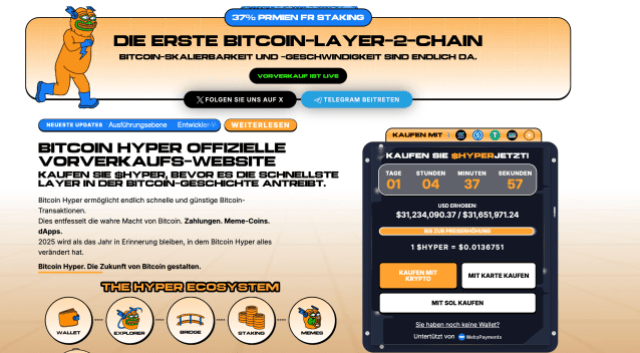
The narrative behind Bitcoin Hyper is closely linked to the community's desire to underpin Bitcoin's dominance with real utility, rather than relying solely on spot market price dynamics. The project is currently showing significant momentum, reflected in an above-average demand during its ongoing funding phase. A key driver for the growing interest is the integrated staking model, which currently promises an annual percentage yield (APY) of 38 percent.

Compared to the broad market average, this figure signals a strong attraction for investors seeking productive yield opportunities within the Bitcoin ecosystem. By combining technical scaling with economic incentives, Bitcoin Hyper distinguishes itself from purely speculative approaches and attempts to establish a sustainable infrastructure for the future Bitcoin network. Interested observers currently have the opportunity to benefit from planned price increases within the presale structure through early participation, which could lead to paper gains.

Go Directly to the Bitcoin Hyper Presale

Criptos en tendencia

Preguntas relacionadas

QWhat is the main reason for the current pressure on Bitcoin ETF investors according to the article?

AThe main reason is that Bitcoin's price has fallen significantly below the net cost basis of $82,405 and the gross cost basis of $83,655, meaning most institutional money entered the market at a higher price, putting investors in a loss position.

QWhat is the current aggregate unrealized loss for Bitcoin ETF holders as reported by Bloomberg Intelligence?

AThe current aggregate unrealized loss for Bitcoin ETF holders is approximately $7.31 billion.

QWhat potential role does the net cost basis of $82,400 play in a market recovery, as mentioned in the article?

AAnalysts are watching to see if the net cost basis of $82,400 will act as a major resistance level during a recovery, as many investors might try to close their positions at break-even to avoid losses.

QWhat new technological area is gaining focus as a potential catalyst for the next market cycle, independent of ETFs?

AThe segment of Bitcoin Layer-2 solutions is gaining focus as a potential catalyst, as they aim to expand the fundamental utility of Bitcoin, for example in decentralized finance (DeFi).

QWhat specific feature of the 'Bitcoin Hyper' project is highlighted as a major driver for investor interest?

AA major driver for interest in the 'Bitcoin Hyper' project is its integrated staking model, which currently offers a prospective annual yield (APY) of 38%.

Lecturas Relacionadas

In Jinjiang, Fujian, a Storage Super Unicorn Lies Quiet

In Fujian's Jinjiang, a city known for sportswear, lies a quiet semiconductor giant: Fujian Jinhua Integrated Circuit Co. (JHICC). Once a promising domestic DRAM manufacturer alongside Yangtze Memory and ChangXin Memory Technologies (CXMT), its journey was derailed in 2018 when the U.S. placed it on an Entity List and filed criminal charges for alleged trade secret theft. This halted production for years. A turning point came in February 2024 when a U.S. federal court found JHICC not guilty. However, it had lost crucial time. While CXMT soared to become a top-valued A-share company in 2024, JHICC, with an estimated valuation of 80 billion RMB, was just restarting. Its current output is primarily customized DDR4 chips, not the advanced DDR5/HBM demanded for AI, but it still benefits from the broader memory chip upcycle. JHICC's story is tied to Chen Zhengkun, a veteran engineer who left Micron to lead the venture. Founded in 2016 with state-backed funding, JHICC partnered with Taiwan's UMC to develop DRAM technology. Rapid progress was cut short by the U.S. actions, which Micron initiated, partly due to its heavy reliance on the Chinese market. Post-sanctions, Chen's team worked to rebuild the production line with reduced reliance on U.S. technology. According to its records, JHICC achieved small-scale production and revenue growth under immense pressure. It now focuses on the stable "niche" DRAM market (e.g., TVs, routers) with a monthly capacity of ~40,000 wafers, aiming for 60,000 by 2026. It holds over 1,000 patents but remains on the Entity List. For Jinjiang, investing in JHICC was a bold industrial leap. The local government provided unwavering financial and logistical support during the crisis, helping the company survive. JHICC has become the anchor for a growing local semiconductor cluster. Though its scale lags behind domestic peers, JHICC's persistence symbolizes a hard-won foothold in a global market long dominated by Samsung, SK Hynix, and Micron. Having missed one boom, it seeks a place in the new AI-driven memory supercycle.

marsbitHace 25 min(s)

In Jinjiang, Fujian, a Storage Super Unicorn Lies Quiet

marsbitHace 25 min(s)

Must-Watch Events Next Week|CLARITY Act Could Face Senate Vote; SpaceX, Circle to Report Earnings (8.3-8.9)

**Summary: Key Events and Developments to Watch (August 3-9)** The upcoming week is marked by significant financial disclosures, key legislative deadlines, and notable product updates. **Major Financial Events:** Several companies are scheduled to release their Q2 2026 earnings. American Bitcoin (ABTC) will report on August 3, followed by SpaceX and Hut 8 Mining Corp. on August 4, and Circle on August 5. Notably, a significant portion of SpaceX shares (up to 12% of total shares) will be unlocked on August 6 following their earnings release. **Key Legislative Deadline:** The U.S. Senate faces an August 7 deadline to secure 60 votes for the CLARITY Act, a bipartisan bill aiming to establish a federal regulatory framework for cryptocurrencies. The Senate may hold a full vote on the bill during the week. **Economic Data:** The U.S. July Non-Farm Payrolls report will be released on August 7, providing crucial labor market data. **Technology & Product Updates:** * **Shutdowns:** DeFi portfolio tracker Zapper and wallet app Ctrl Wallet will cease operations on August 3. * **Upgrades:** LayerZero will deprecate its v1 relayers on August 3. XRP Ledger's new version 3.3.0, featuring five new functions, is expected next week. * **AI:** Elon Musk announced that the advanced Grok 4.6 AI model is set for release around August 7. * **Bitcoin:** The BIP-110 forced signaling for a potential Bitcoin network change is scheduled to begin around August 8. **Other Notable Events:** Chinese robotics firm Unitree Tech has set its preliminary price inquiry for its IPO for August 5. South Korean exchange Upbit will delist AQT and AERGO tokens on August 3.

marsbitHace 2 hora(s)

Must-Watch Events Next Week|CLARITY Act Could Face Senate Vote; SpaceX, Circle to Report Earnings (8.3-8.9)

marsbitHace 2 hora(s)

Trading

Spot

Artículos destacados

Cómo comprar ONE

¡Bienvenido a HTX.com! Hemos hecho que comprar Harmony (ONE) sea simple y conveniente. Sigue nuestra guía paso a paso para iniciar tu viaje de criptos.Paso 1: crea tu cuenta HTXUtiliza tu correo electrónico o número de teléfono para registrarte y obtener una cuenta gratuita en HTX. Experimenta un proceso de registro sin complicaciones y desbloquea todas las funciones.Obtener mi cuentaPaso 2: ve a Comprar cripto y elige tu método de pagoTarjeta de crédito/débito: usa tu Visa o Mastercard para comprar Harmony (ONE) al instante.Saldo: utiliza fondos del saldo de tu cuenta HTX para tradear sin problemas.Terceros: hemos agregado métodos de pago populares como Google Pay y Apple Pay para mejorar la comodidad.P2P: tradear directamente con otros usuarios en HTX.Over-the-Counter (OTC): ofrecemos servicios personalizados y tipos de cambio competitivos para los traders.Paso 3: guarda tu Harmony (ONE)Después de comprar tu Harmony (ONE), guárdalo en tu cuenta HTX. Alternativamente, puedes enviarlo a otro lugar mediante transferencia blockchain o utilizarlo para tradear otras criptomonedas.Paso 4: tradear Harmony (ONE)Tradear fácilmente con Harmony (ONE) en HTX's mercado spot. Simplemente accede a tu cuenta, selecciona tu par de trading, ejecuta tus trades y monitorea en tiempo real. Ofrecemos una experiencia fácil de usar tanto para principiantes como para traders experimentados.

377 Vistas totalesPublicado en 2024.12.12Actualizado en 2026.06.02

Cómo comprar ONE

Discusiones

Bienvenido a la comunidad de HTX. Aquí puedes mantenerte informado sobre los últimos desarrollos de la plataforma y acceder a análisis profesionales del mercado. A continuación se presentan las opiniones de los usuarios sobre el precio de ONE (ONE).

活动图片













