Bitcoin Bull Turn Hinges On US Debt Wall, Real Vision Says

bitcoinistPublicado a 2026-06-09Actualizado a 2026-06-09

Resumen

Real Vision crypto analyst Jamie Coutts says Bitcoin's long-term technical setup is approaching attractive, accumulation-zone levels, suggesting a potential cycle bottom in Q2/Q3. However, he cautions that a major macroeconomic obstacle could delay a sustained bullish reversal: a looming US Treasury refinancing wall. In 2027, $3.67 trillion of government debt matures and must be refinanced at significantly higher interest rates. Coutts argues current market liquidity is insufficient to absorb this issuance smoothly, especially as capital continues rotating out of crypto and into AI-related equities and commodities since late 2025. This liquidity constraint, combined with a potential contraction of the Federal Reserve's balance sheet, poses a risk to all risk assets, including Bitcoin. While Bitcoin may be the first to detect a future shift toward increased Fed liquidity, Coutts believes such a shift may only come after stress emerges in the Treasury market. Therefore, despite a positive technical structure, Bitcoin's next durable bull phase may hinge on navigating this significant macro refinancing challenge.

Real Vision Chief Crypto Analyst Jamie Coutts says Bitcoin is moving into a more attractive long-term setup, but a major US Treasury refinancing wall may still stand between the market and a durable bullish reversal.

In a post on X, Coutts said Bitcoin’s long-term technical backdrop is beginning to resemble the kind of structure that can precede a cycle bottom. “I’ll be the first to turn bullish on Bitcoin when the long-term technicals hit exhaustion and the trend turns,” he wrote. “I’ve argued Q2/Q3 would mark the bottom based on historical bear-market structures. Its playing out that way. The relative setup is approaching very attractive levels. The asset is in the long-term accumulation zone, imo.”

US Debt Refinancing Wall May Pressure Bitcoin

The issue, in Coutts’ view, is not simply Bitcoin’s chart. It is the macro plumbing around it.

He pointed to 2027, when the US faces $3.67 trillion in coupon maturities, a figure he said is 36% above the 2020–2025 average. The refinancing burden reflects the repricing of Covid-era debt issued when rates were near zero into a market where rates are now in the 4% to 5% range.
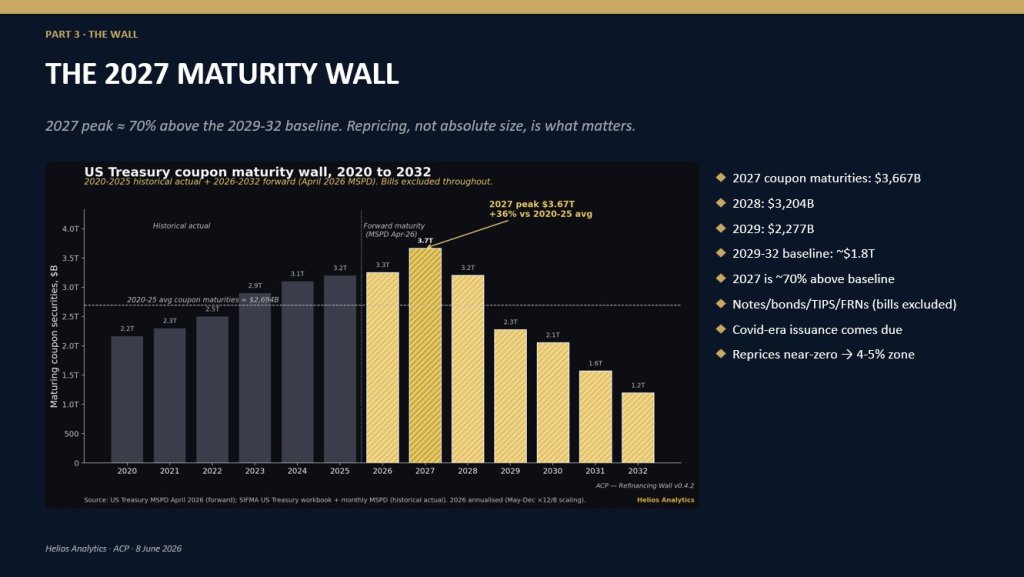
Source: X @Jamie1Coutts

For Bitcoin and other risk assets, the concern is whether current liquidity conditions can absorb that level of issuance without stress in the Treasury market. Coutts argued that liquidity remains a constraint, particularly as capital has continued to rotate away from crypto since late 2025.

“Retail and insto flows have been rotating out of Bitcoin and crypto since Q4 2025,” he said. “Every marginal unit of liquidity has flowed into AI buildout assets. That makes sense. Capital flows to where it’s treated best. Right now, the capital allocation argument sits with AI equities and commodities. On-chain activity is back at multi-year lows.”

That rotation matters because Bitcoin’s bull phases have historically depended not only on internal crypto positioning, but also on broader liquidity expansion and risk appetite. Coutts’ point is that Bitcoin may be entering a structurally attractive zone at the same time liquidity remains scarce and competing asset classes are absorbing the available capital.

He also pushed back against the market’s focus on IPO issuance, arguing that the larger issue is the government refinancing burden and the ability of the financial system to intermediate it. “While the market fixates on IPO issuance,” he wrote, “what concerns me about all risk assets is that markets ex-crypto don’t seem bothered by the fact that current liquidity levels can’t easily absorb this refi supply.”

The complication is the Fed’s balance sheet. Coutts noted that Kevin Warsh wants a smaller balance sheet, adding another potential constraint if policymakers try to roll a large maturity wall through a system with reduced central bank liquidity.

“Yes, they will continue to stuff the short end and monetise through the banks,” Coutts said, adding that stablecoins are likely to play an “increasingly important role.” But he warned that rolling $3.67 trillion of maturities through a contracting Fed balance sheet “without a bond market accident would be among the most impressive acts of fiscal/monetary policy management in a generation.”

The implication for Bitcoin is nuanced. Coutts is not dismissing the bottoming case. He is arguing that the market may still need a macro trigger before the next sustained advance can take hold. In his framework, Bitcoin is likely to sense a shift in Fed-side liquidity before other assets, but that shift may not arrive until stress appears in Treasuries.

“I don’t see how they do it without far more Fed-side liquidity,” he wrote. “Bitcoin will detect it first. But there’s still an uncomfortable distance to travel. Treasuries will need to start misbehaving before the policy needle moves. That’s the tricky part.”

At press time, BTC traded at $63,196.
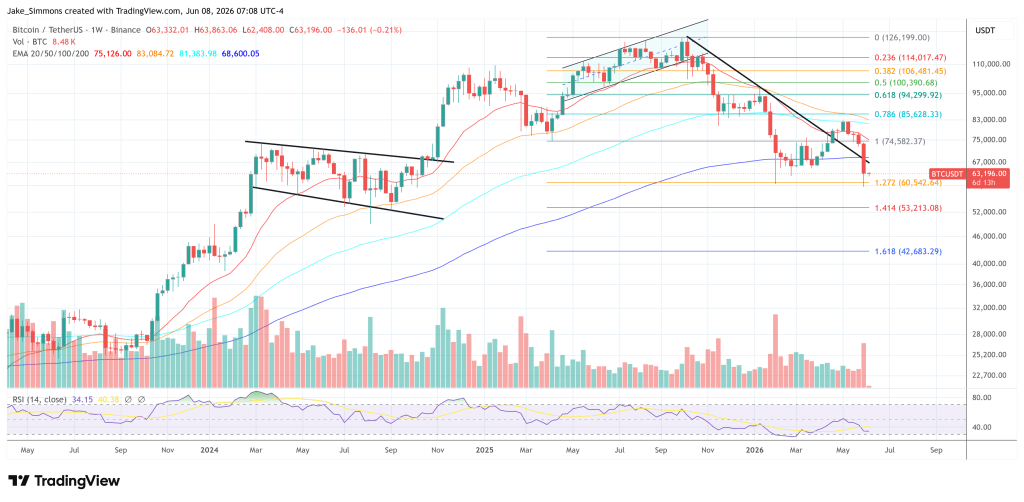
Bitcoin trades below the 200-week EMA, 1-week chart | Source: BTCUSDT on TradingView.com

Preguntas relacionadas

QAccording to Jamie Coutts, what is the key macroeconomic event that could prevent a sustained Bitcoin bull run?

AThe key macroeconomic event is the US Treasury's massive refinancing wall in 2027, involving $3.67 trillion in coupon maturities. The concern is whether current liquidity can absorb this issuance without stress in the Treasury market, potentially constraining capital flow to risk assets like Bitcoin.

QWhat does Jamie Coutts mean when he says Bitcoin is in a 'long-term accumulation zone'?

AHe means that Bitcoin's long-term technical setup is approaching very attractive levels, resembling structures that have historically preceded a cycle bottom. This suggests the asset is at a price level where long-term investors might consider accumulating positions.

QWhere has capital been rotating since Q4 2025, according to the article?

ACapital has been rotating away from Bitcoin and crypto and flowing into AI buildout assets (AI equities and commodities), as capital flows to where it is 'treated best' based on the current capital allocation argument.

QWhy does Jamie Coutts believe Bitcoin might sense a macro shift before other assets?

AHe believes Bitcoin is likely to detect a shift in Fed-side liquidity (potentially increased liquidity in response to Treasury market stress) before other assets, given its sensitivity to such monetary and liquidity conditions.

QWhat potential role does Coutts see for stablecoins in the context of the US debt refinancing challenge?

AHe suggests that stablecoins are likely to play an 'increasingly important role' as the financial system intermediates the large refinancing burden, potentially as part of the mechanisms to manage liquidity.

Lecturas Relacionadas

How to Conduct Deep Research Using Claude's Dynamic Workflows

The article "How to Use Claude's Dynamic Workflows for Deep Research" discusses overcoming the pitfalls of technical research, where both humans and AI can get overwhelmed by information, leading to vague conclusions. It introduces Claude Code's new "Dynamic Workflows" feature, which automatically designs and executes task-specific workflows before starting a task, unlike simpler "planning modes." This approach incorporates validation, result convergence, and adversarial verification from the outset. The core of Dynamic Workflows is six predefined scheduling patterns that address how to decompose tasks and synthesize results: 1. **Classify-and-Act (Routing):** An agent classifies the task and routes it to the most suitable specialist agent for execution. It's precise and efficient but struggles with ambiguous tasks. 2. **Fan-out & Merge:** The task is split into parallel, independent subtasks whose results are later merged. It's fast and isolates contexts but is more expensive and challenging to synthesize. 3. **Adversarial Verification:** Multiple "challenger" agents critique a worker agent's conclusion, requiring majority approval. This counters confirmation bias and self-assessment errors but relies on verifiable facts. 4. **Generate & Filter:** Multiple agents generate many candidate solutions, which are then filtered against a rubric to output only the best. It fosters diversity but depends heavily on the filter's quality. 5. **Tournament:** Multiple agents compete on the same task, with pairwise comparisons eliminating contestants over rounds to select the best. This offers stable relative judgment but is complex. 6. **Loop:** An agent iteratively attempts a task, learning from errors and adjusting until a stop condition is met. It handles tasks with unknown scope but risks infinite loops without proper design. The author compares their own custom deep-research system, which involved multi-agent analysis and deduplication but lacked goal-oriented convergence, to Claude's built-in workflow. The official workflow adds critical layers: initial problem decomposition, credibility assessment of sources, cross-agent voting to delete weak conclusions (not just averaging), and output tightly focused on the user's original goals and actionable recommendations. This structurally addresses common AI issues like goal drift, premature stopping, context pollution, and output bias. In summary, Dynamic Workflows represent a shift from smarter single conversations to a structured research process, compressing what used to require many dialogues into 3-4 interactions, albeit at higher token cost. The author notes remaining challenges for their specific domain (blockchain research): the need for fact-based verification over official documentation, depth in truly novel interdisciplinary thinking, the practical validation of proposed solutions, and tailoring information density to the audience.

marsbitJusto ahora

How to Conduct Deep Research Using Claude's Dynamic Workflows

marsbitJusto ahora

When LPs Teach Me Investment with Doubao: A Self-Narrative of a Private Equity GP Switching Careers

When LPs Use Doubao to Teach Investing: A Transition Story of a Private Equity GP AI is making life increasingly difficult for small private equity fund managers, as a former GP of an offshore dollar fund reveals. The fund, managing tens of millions in US stocks, outperformed the Nasdaq but struggled with fundraising. Its traditional Cayman SPC/BVI structure failed to attract major Asian LPs, who now prefer Hong Kong LPF or Singapore VCC frameworks. The rise of AI-powered quantitative strategies has further squeezed the space for funds like his, which relied on subjective, discretionary investing. AI tools have leveled the information playing field, empowering LPs—often high-net-worth individuals, entrepreneurs, or family offices—to analyze investments themselves using chatbots like Doubao. This has eroded trust in GPs' expertise, leading to more frequent challenges over investment decisions and even withdrawals, especially during market rallies when retail investors sometimes outperform funds. Friction arises not necessarily from AI's capabilities but from how LPs use it. Many rely on conversational AI for validation rather than rigorous analysis, sometimes receiving misleading or hallucinated advice. While AI democratizes research, effective investing still requires discerning real insight from plausible-sounding output. Ultimately, AI is unlikely to fully replace GPs. Asset management remains a trust-based service. However, the industry must adapt. The future may see "human私募" (private equity) learning from AI and focusing more on providing value beyond pure analysis—perhaps by mastering the emotional intelligence and trust-building that machines cannot replicate.

Odaily星球日报Hace 28 min(s)

When LPs Teach Me Investment with Doubao: A Self-Narrative of a Private Equity GP Switching Careers

Odaily星球日报Hace 28 min(s)

Wang Chuan: After Investing in Storage Stocks and Seeing a Thirty-Fold Return, How to Remain Unanxious (Part 7) - A Quarter-Century Cycle

Wang Chuan: Reflections on Investment Anxiety and Market Cycles After Observing a 30x Gain in a Storage Stock (Part 7) – A Quarter-Century Cycle This article examines the cyclical nature and inherent risks in technology hardware investments, using the storage and semiconductor sectors as examples. It criticizes the misleading practice of "annualized" Net Dollar Retention (NDR) rates, where short-term growth is extrapolated unrealistically. A key concept explored is "reflexivity" – demand driven by panic, exploration, and liquidity during market booms, which can vanish just as quickly when conditions reverse. This reflexivity exists both in product demand and among speculative stock buyers, creating powerful feedback loops that inflate prices during upturns and exacerbate crashes during downturns. The author highlights a major risk for hardware sectors: unlike assets with defined cycles (e.g., Bitcoin's halving), there's no guarantee of a swift recovery post-crash. Companies like Micron, Intel, and Cisco took roughly a quarter-century to surpass their 2000 highs, enduring drawdowns exceeding 80%. This is attributed to the "bullwhip effect" in supply chains, where demand collapses instantly but过剩产能 persists, and a migration of narrative-driven capital. High-valuation stories吸引 speculative funds during growth phases, but these funds quickly depart for the next hot narrative once growth slows, leaving behind stronger companies with much lower valuations. The piece warns of dangerous mental models formed during bull markets: 1) equating current strong demand with perpetual high growth, and 2) believing that making fast, large profits is easy. Citing巴菲特, the author notes that easy money undermines rationality, likening speculators to Cinderella at a ball with a clock that has no hands. The current phase presents an asymmetric risk-reward scenario: potential for further gains exists, but the downside risk is an 80%+ drawdown and a multi-decade wait for breakeven, which reflexive speculators cannot tolerate. The hypothetical investor "老王" (Lao Wang), who achieved a 30x return, is used to illustrate potential pitfalls. Leverage could lead to a wipeout during a sharp correction. Even without leverage, ingrained beliefs in easy money would likely lead him to double down after losses, expecting a quick rebound. Instead, he might face a protracted decline, depleting his resources through frantic trading as the high-growth narrative fades. The conclusion references Schopenhauer, comparing those who have seen multiple market cycles to an audience seeing the same magic trick repeatedly—once the illusion is understood, its power is gone.

marsbitHace 51 min(s)

Wang Chuan: After Investing in Storage Stocks and Seeing a Thirty-Fold Return, How to Remain Unanxious (Part 7) - A Quarter-Century Cycle

marsbitHace 51 min(s)

US Stocks Too Expensive? This Top CIO Scoured the Globe and Found 5 Stocks More Attractive Than NVIDIA

Summary: Main Street Research CIO James Demmert maintains his bullish 8,100 target for the S&P 500 but argues that greater opportunities now lie overseas. He identifies five international stocks with superior valuations poised to benefit from the AI revolution, suggesting international markets will outperform the US for years. Key Recommendations: 1. **ASML (Netherlands):** A foundational chip manufacturing technology provider, offering crucial AI exposure and geographic diversification. Demmert's top long-term pick. 2. **HSBC (UK/Asia):** A global bank with a 9x P/E ratio, better growth prospects than US peers like JPMorgan, and strong Asian presence. 3. **Siemens Energy (Germany):** A direct play on global power grid expansion driven by AI, crypto, and EV electricity demand. 4. **BHP Group (Australia):** A "hidden AI play" and "second derivative" of the trend due to massive copper demand for data centers. Trades at a 16x P/E. 5. **AstraZeneca (UK):** An undervalued healthcare stock with a strong pipeline (18x P/E, >20% growth), expected to benefit from AI's impact on medicine. Core Thesis: International outperformance is driven by both attractive valuations and a major policy shift. While the US tightens fiscal policy, Europe and Japan are launching unprecedented stimulus, reigniting growth. Demmert recommends allocating 45% of a portfolio internationally, citing excessive US investor conservatism as a key mistake.

marsbitHace 56 min(s)

US Stocks Too Expensive? This Top CIO Scoured the Globe and Found 5 Stocks More Attractive Than NVIDIA

marsbitHace 56 min(s)

Trading

Spot
Futuros

Artículos destacados

Qué es BITCOIN

Entendiendo HarryPotterObamaSonic10Inu (ERC-20) y Su Posición en el Espacio Cripto En los últimos años, el mercado de criptomonedas ha sido testigo de un aumento en la popularidad de las monedas meme, capturando el interés no solo de los comerciantes, sino también de aquellos que buscan compromiso comunitario y valor de entretenimiento. Entre estos tokens únicos se encuentra HarryPotterObamaSonic10Inu (ERC-20), un proyecto intrigante que mezcla referencias culturales en el tejido de las criptomonedas. Este artículo profundiza en los aspectos clave de HarryPotterObamaSonic10Inu, explorando sus mecanismos, ethos impulsado por la comunidad y su relación con el paisaje cripto más amplio. ¿Qué es HarryPotterObamaSonic10Inu (ERC-20)? Como su nombre sugiere, HarryPotterObamaSonic10Inu es una moneda meme construida sobre la blockchain de Ethereum, clasificada bajo el estándar ERC-20. A diferencia de las criptomonedas tradicionales que pueden enfatizar la utilidad práctica o el potencial de inversión, este token prospera en el valor de entretenimiento y la fuerza de su comunidad. El proyecto tiene como objetivo fomentar un entorno donde los usuarios comprometidos puedan reunirse, compartir ideas y participar en actividades inspiradas por diversos fenómenos culturales. Una característica notable de HarryPotterObamaSonic10Inu es su cero impuestos en las transacciones. Este atractivo elemento tiene como objetivo incentivar el comercio y la participación comunitaria, sin cargos adicionales que puedan disuadir a los comerciantes de pequeña escala. El suministro total de la moneda está establecido en mil millones de tokens, una cifra que marca su intención de mantener una circulación sustancial dentro de la comunidad. Creador de HarryPotterObamaSonic10Inu (ERC-20) Los orígenes de HarryPotterObamaSonic10Inu están algo envueltos en misterio; los detalles sobre el creador siguen siendo desconocidos. El desarrollo de este token carece de un equipo identificable o de un plan explícito, lo cual no es inusual dentro del sector de monedas meme. En cambio, el proyecto ha surgido de manera orgánica, con su progreso muy dependiente del entusiasmo y la participación de su comunidad. Inversores de HarryPotterObamaSonic10Inu (ERC-20) En cuanto a inversiones externas y respaldo, HarryPotterObamaSonic10Inu también sigue siendo ambiguo. El token no lista ninguna fundación de inversión conocida o apoyo organizacional significativo. En cambio, la savia del proyecto es su comunidad de base, que informa su crecimiento y sostenibilidad a través de la acción colectiva y el compromiso en el espacio cripto. ¿Cómo Funciona HarryPotterObamaSonic10Inu (ERC-20)? Como una moneda meme, HarryPotterObamaSonic10Inu opera principalmente fuera de los marcos tradicionales que a menudo rigen el valor de los activos. Hay varios aspectos distintivos que definen cómo funciona el proyecto: Transacciones Sin Impuestos: Sin tarifas impositivas en las transacciones, los usuarios pueden comprar y vender el token libremente sin preocuparse por costos ocultos. Compromiso Comunitario: El proyecto prospera en la interacción comunitaria, aprovechando plataformas de redes sociales para crear entusiasmo y facilitar la participación. Las discusiones, el intercambio de contenido y el compromiso son elementos cruciales que ayudan a expandir su alcance y fomentar la lealtad entre los seguidores. Sin Utilidad Práctica: Cabe señalar que HarryPotterObamaSonic10Inu no ofrece utilidad concreta dentro del ecosistema financiero. Más bien, se clasifica como un token principalmente para actividades de entretenimiento y comunitarias. Referencia Cultural: El token incorpora astutamente elementos de la cultura popular para atraer interés, conectando con entusiastas de los memes y seguidores de las criptomonedas por igual. HarryPotterObamaSonic10Inu ejemplifica cómo las monedas meme operan de manera diferente a los proyectos de criptomonedas más tradicionales, ingresando al mercado como construcciones sociales innovadoras en lugar de activos utilitarios. Cronología de HarryPotterObamaSonic10Inu (ERC-20) La historia de HarryPotterObamaSonic10Inu está marcada por varios hitos notables: Creación: El token surgió de un meme viral, capturando la imaginación de muchos entusiastas de las criptomonedas. Las fechas específicas de creación no están disponibles, subrayando su ascenso orgánico. Listado en Exchanges: HarryPotterObamaSonic10Inu ha llegado a varios exchanges, permitiendo un acceso y comercio más fácil por parte de la comunidad. Iniciativas de Compromiso Comunitario: Actividades continuas destinadas a mejorar la interacción comunitaria, incluyendo concursos, campañas en redes sociales y generación de contenido por parte de fanáticos y defensores. Planes de Expansión Futuros: La hoja de ruta del proyecto incluye el lanzamiento de una colección de NFT, mercancía y un sitio de comercio electrónico relacionado con sus temas culturales, involucrando aún más a la comunidad e intentando añadir más dimensiones a su ecosistema. Puntos Clave Sobre HarryPotterObamaSonic10Inu (ERC-20) Naturaleza Impulsada por la Comunidad: El proyecto prioriza la participación colectiva y la creatividad, asegurando que la involucración de los usuarios esté a la vanguardia de su desarrollo. Clasificación como Moneda Meme: Representa la epítome de las criptomonedas basadas en el entretenimiento, diferenciándose de los vehículos de inversión tradicionales. Sin Afiliación Directa con Bitcoin: A pesar de la similitud en el nombre del ticker, HarryPotterObamaSonic10Inu es distinto y no tiene relación con Bitcoin u otras criptomonedas establecidas. Enfoque en la Colaboración: HarryPotterObamaSonic10Inu está diseñado para crear un espacio para la colaboración y el intercambio de historias entre sus poseedores, proporcionando una vía para la creatividad y el vínculo comunitario. Perspectivas Futuras: La ambición de expandirse más allá de su premisa inicial hacia NFTs y mercancías describe un camino para que el proyecto potencialmente ingrese a avenidas más tradicionales dentro de la cultura digital. A medida que las monedas meme continúan capturando la imaginación de la comunidad de criptomonedas, HarryPotterObamaSonic10Inu (ERC-20) se destaca debido a sus lazos culturales y su enfoque centrado en la comunidad. Si bien puede no encajar en el molde típico de un token impulsado por la utilidad, su esencia radica en la alegría y la camaradería fomentadas entre sus seguidores, destacando la naturaleza en evolución de las criptomonedas en una era cada vez más digital. A medida que el proyecto continúa desarrollándose, será importante observar cómo las dinámicas comunitarias influyen en su trayectoria en el cambiante paisaje de la tecnología blockchain.

1.7k Vistas totalesPublicado en 2024.04.01Actualizado en 2024.12.03

Qué es BITCOIN

Cómo comprar BTC

¡Bienvenido a HTX.com! Hemos hecho que comprar Bitcoin (BTC) sea simple y conveniente. Sigue nuestra guía paso a paso para iniciar tu viaje de criptos.Paso 1: crea tu cuenta HTXUtiliza tu correo electrónico o número de teléfono para registrarte y obtener una cuenta gratuita en HTX. Experimenta un proceso de registro sin complicaciones y desbloquea todas las funciones.Obtener mi cuentaPaso 2: ve a Comprar cripto y elige tu método de pagoTarjeta de crédito/débito: usa tu Visa o Mastercard para comprar Bitcoin (BTC) al instante.Saldo: utiliza fondos del saldo de tu cuenta HTX para tradear sin problemas.Terceros: hemos agregado métodos de pago populares como Google Pay y Apple Pay para mejorar la comodidad.P2P: tradear directamente con otros usuarios en HTX.Over-the-Counter (OTC): ofrecemos servicios personalizados y tipos de cambio competitivos para los traders.Paso 3: guarda tu Bitcoin (BTC)Después de comprar tu Bitcoin (BTC), guárdalo en tu cuenta HTX. Alternativamente, puedes enviarlo a otro lugar mediante transferencia blockchain o utilizarlo para tradear otras criptomonedas.Paso 4: tradear Bitcoin (BTC)Tradear fácilmente con Bitcoin (BTC) en HTX's mercado spot. Simplemente accede a tu cuenta, selecciona tu par de trading, ejecuta tus trades y monitorea en tiempo real. Ofrecemos una experiencia fácil de usar tanto para principiantes como para traders experimentados.

5.1k Vistas totalesPublicado en 2024.12.12Actualizado en 2026.06.02

Cómo comprar BTC

Qué es $BITCOIN

ORO DIGITAL ($BITCOIN): Un Análisis Integral Introducción al ORO DIGITAL ($BITCOIN) ORO DIGITAL ($BITCOIN) es un proyecto basado en blockchain que opera en la red Solana, cuyo objetivo es combinar las características de los metales preciosos tradicionales con la innovación de las tecnologías descentralizadas. Aunque comparte un nombre con Bitcoin, a menudo referido como “oro digital” debido a su percepción como un refugio de valor, ORO DIGITAL es un token separado diseñado para crear un ecosistema único dentro del paisaje Web3. Su meta es posicionarse como un activo digital alternativo viable, aunque los detalles sobre sus aplicaciones y funcionalidades aún están en desarrollo. ¿Qué es ORO DIGITAL ($BITCOIN)? ORO DIGITAL ($BITCOIN) es un token de criptomoneda diseñado explícitamente para su uso en la blockchain de Solana. A diferencia de Bitcoin, que proporciona un papel de almacenamiento de valor ampliamente reconocido, este token parece centrarse en aplicaciones y características más amplias. Aspectos notables incluyen: Infraestructura Blockchain: El token está construido sobre la blockchain de Solana, conocida por su capacidad para manejar transacciones de alta velocidad y bajo costo. Dinámicas de Suministro: ORO DIGITAL tiene un suministro máximo limitado a 100 cuatrillones de tokens (100P $BITCOIN), aunque los detalles sobre su suministro circulante no se han divulgado actualmente. Utilidad: Si bien las funcionalidades precisas no están delineadas explícitamente, hay indicios de que el token podría ser utilizado para diversas aplicaciones, potencialmente involucrando aplicaciones descentralizadas (dApps) o estrategias de tokenización de activos. ¿Quién es el Creador de ORO DIGITAL ($BITCOIN)? En la actualidad, la identidad de los creadores y el equipo de desarrollo detrás de ORO DIGITAL ($BITCOIN) sigue siendo desconocida. Esta situación es típica entre muchos proyectos innovadores dentro del espacio blockchain, particularmente aquellos alineados con las finanzas descentralizadas y fenómenos de monedas meme. Si bien tal anonimato puede fomentar una cultura impulsada por la comunidad, intensifica las preocupaciones sobre la gobernanza y la responsabilidad. ¿Quiénes son los Inversores de ORO DIGITAL ($BITCOIN)? La información disponible indica que ORO DIGITAL ($BITCOIN) no tiene patrocinadores institucionales conocidos ni inversiones destacadas de capital de riesgo. El proyecto parece operar en un modelo de peer-to-peer centrado en el apoyo y la adopción de la comunidad en lugar de rutas de financiamiento tradicionales. Su actividad y liquidez se sitúan principalmente en intercambios descentralizados (DEX), como PumpSwap, en lugar de plataformas de trading centralizadas establecidas, lo que resalta aún más su enfoque de base. Cómo Funciona ORO DIGITAL ($BITCOIN) Los mecanismos operativos de ORO DIGITAL ($BITCOIN) pueden elaborarse en función de su diseño blockchain y atributos de red: Mecanismo de Consenso: Al aprovechar el único proof-of-history (PoH) de Solana combinado con un modelo de proof-of-stake (PoS), el proyecto asegura una validación de transacciones eficiente que contribuye al alto rendimiento de la red. Tokenómica: Si bien los mecanismos deflacionarios específicos no se han detallado extensamente, el vasto suministro máximo de tokens implica que podría atender microtransacciones o casos de uso nicho que aún están por definirse. Interoperabilidad: Existe el potencial de integración con el ecosistema más amplio de Solana, incluyendo varias plataformas de finanzas descentralizadas (DeFi). Sin embargo, los detalles sobre integraciones específicas permanecen no especificados. Cronología de Eventos Clave Aquí hay una cronología que destaca hitos significativos relacionados con ORO DIGITAL ($BITCOIN): 2023: El despliegue inicial del token ocurre en la blockchain de Solana, marcado por su dirección de contrato. 2024: ORO DIGITAL gana visibilidad al estar disponible para trading en intercambios descentralizados como PumpSwap, permitiendo a los usuarios comerciar contra SOL. 2025: El proyecto presencia actividad de trading esporádica y potencial interés en compromisos liderados por la comunidad, aunque no se han documentado asociaciones notables o avances técnicos hasta el momento. Análisis Crítico Fortalezas Escalabilidad: La infraestructura subyacente de Solana soporta altos volúmenes de transacciones, lo que podría mejorar la utilidad de $BITCOIN en varios escenarios de transacción. Accesibilidad: El potencial bajo precio de trading por token podría atraer a inversores minoristas, facilitando una participación más amplia debido a oportunidades de propiedad fraccionada. Riesgos Falta de Transparencia: La ausencia de patrocinadores, desarrolladores o un proceso de auditoría conocidos públicamente puede generar escepticismo sobre la sostenibilidad y confiabilidad del proyecto. Volatilidad del Mercado: La actividad de trading depende en gran medida del comportamiento especulativo, lo que puede resultar en una volatilidad de precios significativa y en incertidumbre para los inversores. Conclusión ORO DIGITAL ($BITCOIN) surge como un proyecto intrigante pero ambiguo dentro del ecosistema de Solana en rápida evolución. Si bien intenta aprovechar la narrativa del “oro digital”, su alejamiento del papel establecido de Bitcoin como refugio de valor subraya la necesidad de una diferenciación más clara de su utilidad y estructura de gobernanza previstas. La aceptación y adopción futura dependerán probablemente de abordar la actual opacidad y de definir sus estrategias operativas y económicas de manera más explícita. Nota: Este informe abarca información sintetizada disponible hasta octubre de 2023, y pueden haber ocurrido desarrollos más allá del período de investigación.

83 Vistas totalesPublicado en 2025.05.13Actualizado en 2025.05.13

Qué es $BITCOIN

Discusiones

Bienvenido a la comunidad de HTX. Aquí puedes mantenerte informado sobre los últimos desarrollos de la plataforma y acceder a análisis profesionales del mercado. A continuación se presentan las opiniones de los usuarios sobre el precio de BTC (BTC).

活动图片














