Binance mulls new US strategy, CZ potentially reducing stake: Report

cointelegraphPublicado a 2025-12-17Actualizado a 2025-12-17

Resumen

Binance, the world's largest cryptocurrency exchange, is reportedly considering a strategic reshuffle to strengthen its US presence, which may involve reducing co-founder Changpeng "CZ" Zhao's majority stake. His controlling ownership has been a major hurdle for expansion into key US states. The company is exploring partnerships with US-based firms like BlackRock and World Liberty Financial. This follows CZ's pardon by former President Donald Trump in October, which sparked criticism from some US lawmakers who called it "corruption" and "pay-to-play." Binance.US currently operates as a separate, compliant entity for US users. The US is a critical market, ranked second in global crypto adoption, and gaining access would open significant liquidity for Binance.

Binance, the world’s largest cryptocurrency exchange by trading volume, is considering a strategic reshuffling to strengthen its presence in the US market, a move that could see Binance co-founder Changpeng “CZ” Zhao’s majority stake in the company reduced.

Zhao’s controlling stake in Binance has been a “major hurdle” to the company expanding to strategically critical US states, according to Bloomberg, citing people familiar with the matter. Although no concrete plans have been announced, the conversation surrounding any potential action remains reportedly “fluid.”

The company is also considering partnerships with US-based companies, including asset manager BlackRock and decentralized finance (DeFi) platform World Liberty Financial (WLFI), which is linked to US President Donald Trump, to strengthen its footprint in the country.

Rumors of Binance’s return to the US began to circulate in October after Trump pardoned Zhao, fueled by speculation from crypto industry executives and comments that Zhao made on social media.

“Will do everything we can to help make America the capital of crypto and advance Web3 worldwide,” Zhao said in October after the pardon.
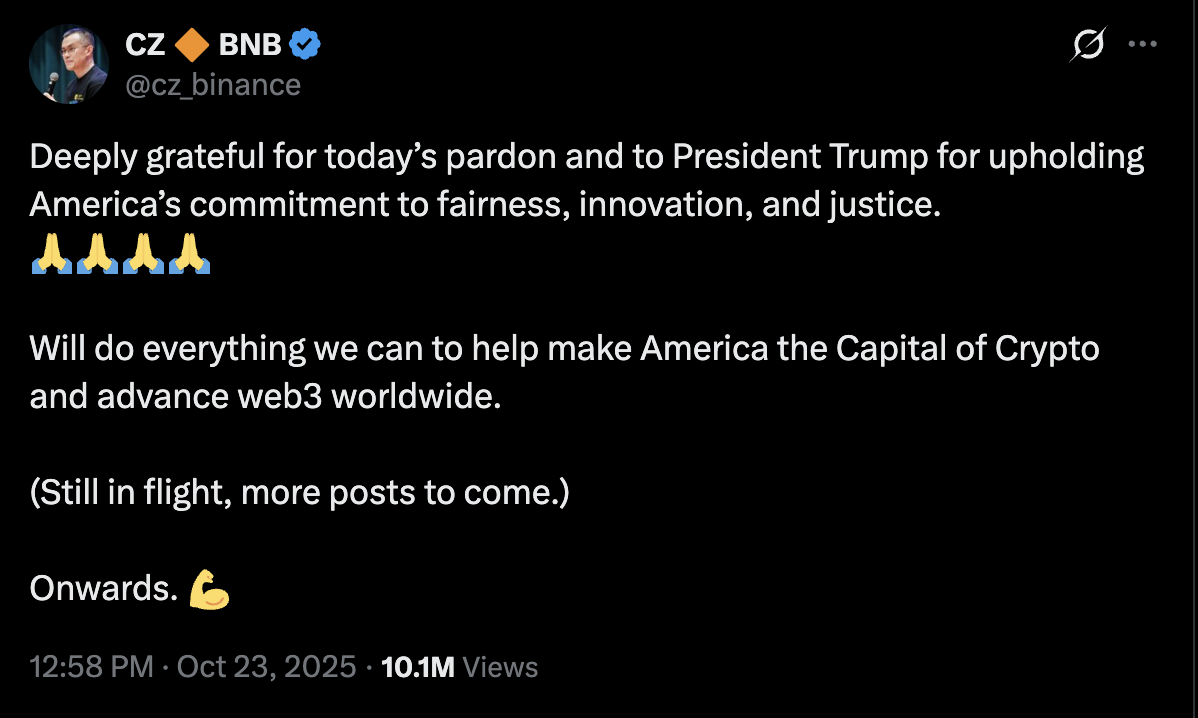
Source: CZ

In June 2019, Binance announced that it would stop serving US customers, and a separate company, called Binance.US and operated by BAM Trading Services, was formed to provide regulatory-compliant services to US users.

In 2023, the US Securities and Exchange Commission alleged that Binance Holdings Ltd. operated both Binance.com and BAM Trading Services.

Binance.US does not feature crypto derivatives or access to the global Binance exchange’s liquidity and operates as a completely separate crypto exchange.

Cointelegraph reached out to Binance and Binance.US but did not receive a response by the time of publication.

The US is considered a key market for crypto exchanges and is ranked as the number two for global crypto adoption, according to Chainalysis’ 2025 Global Crypto Adoption Index. Expanding to the US would open up US liquidity to the world’s largest crypto exchange.
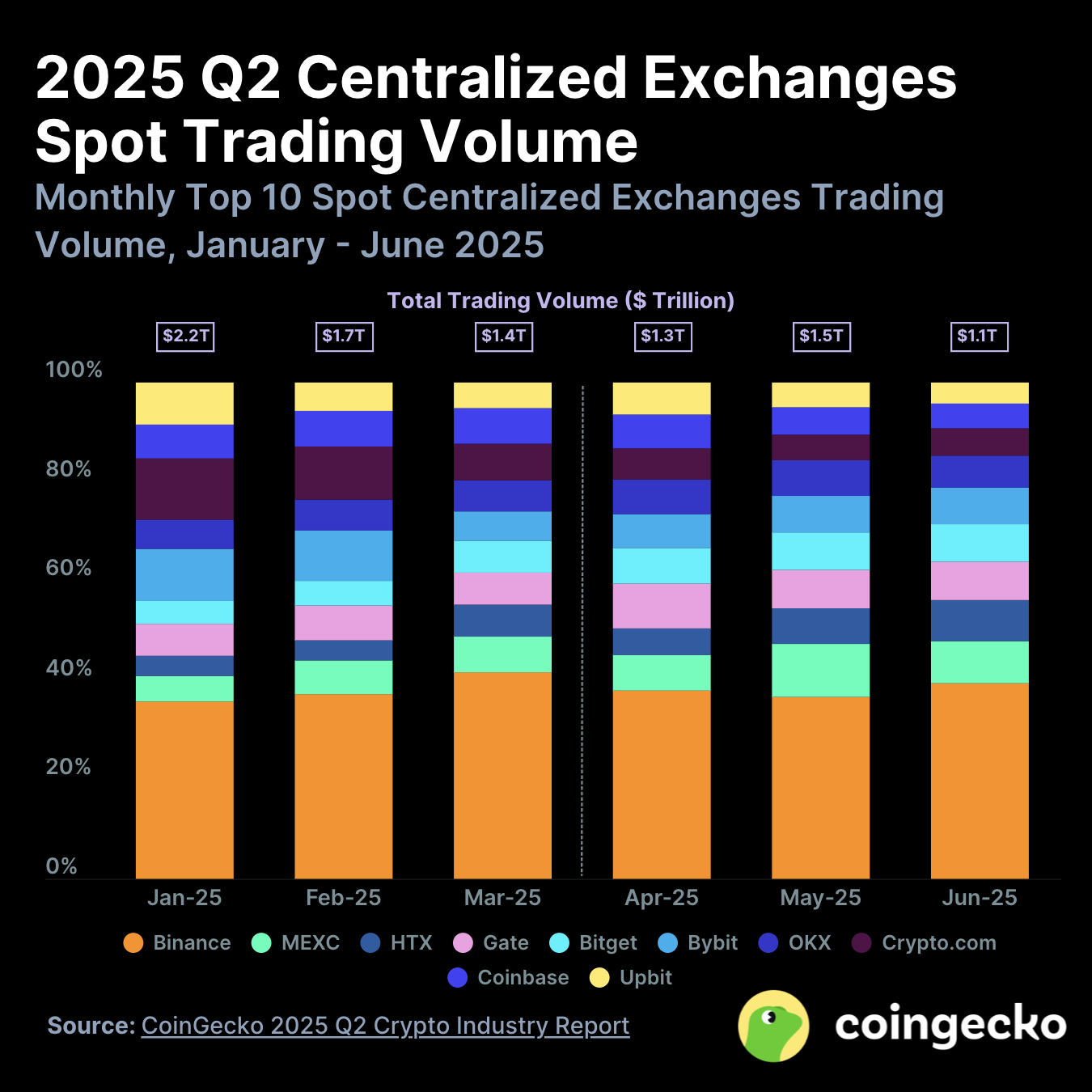
Binance claims the top spot among centralized crypto exchanges in terms of trading volume. Source: CoinGecko

Related: Binance names co-founder Yi He co-CEO alongside Richard Teng

Several US lawmakers voice opposition to the CZ pardon and the crypto industry

Trump’s pardon of Zhao in October drew backlash from several Democratic Party lawmakers in the US, including Massachusetts Senator Elizabeth Warren and California Congresswoman Maxine Waters.

Waters said the pardon was a form of pay-to-play and accused Trump of doing political favors for the crypto industry that “helped line his pockets.”

Warren, who is one of the most vocal critics of the crypto industry, also criticized the pardon, characterizing it as “corruption.”

The comments reflect pockets of resistance among some Democratic lawmakers to the crypto industry’s continued expansion in the US and could signal potential opposition to Binance returning to the US.

Magazine: Unstablecoins: Depegging, bank runs and other risks loom

Lecturas Relacionadas

UBS: The Crowdedness of A-Share Tech Stocks Is Far From Reaching Historical Peaks

UBS: A-share tech stocks still far from peak crowding levels A-shares' technology sector has seen a strong rebound, with trading activity hitting record highs, raising concerns about market crowding. However, UBS Securities argues that a key indicator of institutional positioning suggests the current crowding level remains well below historical peaks. While the large-cap tech sector's share of total A-share trading volume and market capitalization have reached historical highs, the overweight ratio of domestic mutual funds in this sector stood at 9.9% in Q1 2026. This is down from 11.6% in Q3 2025 and significantly lower than the historical peak of 14.1% in Q4 2015. It also pales in comparison to the historical peak overweight of 18.7% for the consumer sector. UBS notes that typical cycles from a low to a peak in fund overweighting last about three years, and the current outperformance of the tech/growth style has lasted less than two years since the policy pivot in September 2024. UBS expects A-share earnings recovery to accelerate, providing fundamental support. It forecasts 2026 A-share profit growth to rise to 11% from 3.9% in 2025. Non-financial A-share profits grew 11.8% YoY in Q1 2026, with gross and net profit margins at their highest since 2023. Persistent fund inflows, the expansion of thematic ETFs, and a recovery in private fund issuance are supporting market liquidity. In tactical allocation, UBS favors growth and cyclical styles under its "slow bull" base case, with overweight ratings on six sectors: Electronics (benefiting from semiconductor inventory recovery and AI innovation), Communications (driven by AI computing demand), Machinery (aided by domestic capex recovery), Non-ferrous Metals (due to rising copper/aluminum prices), Chemicals (supported by anti-involution policies), and Electrical Equipment (driven by policy support and AI data center power demand).

marsbitHace 5 min(s)

UBS: The Crowdedness of A-Share Tech Stocks Is Far From Reaching Historical Peaks

marsbitHace 5 min(s)

Should You Buy SpaceX Stock at $1.7 Trillion? Here's What the Market Is Worried About

SpaceX is preparing for a massive IPO aiming to raise around $75 billion at a valuation of approximately $1.75 trillion. While its achievements in reusable rockets and the profitable Starlink satellite internet service are clear, the market is concerned about the aggressive valuation. Key issues include: the current $1.75 trillion valuation, which is about 94 times 2025 revenue, seems to price in not just existing businesses but also unproven future ventures like AI infrastructure and orbital data centers. Financially, while Starlink is profitable, the AI division, bolstered by the acquisition of xAI, is incurring massive losses and consuming the majority of capital expenditures. This acquisition also introduced complex related-party financing arrangements and debt onto SpaceX's balance sheet. Furthermore, corporate governance poses a challenge. SpaceX's dual-class share structure ensures founder Elon Musk retains absolute control, limiting ordinary shareholders' influence over high-risk, long-term strategic decisions. The future success of ambitious projects like the Starship rocket—critical for lowering costs and enabling new services—remains a significant variable for the valuation. In summary, the market's apprehension (FUD) centers not on doubting SpaceX's past technological triumphs but on questioning how much premium public investors should pay for a future that combines proven profits with highly speculative and capital-intensive new ventures, all under a governance structure that offers limited shareholder oversight.

marsbitHace 1 hora(s)

Should You Buy SpaceX Stock at $1.7 Trillion? Here's What the Market Is Worried About

marsbitHace 1 hora(s)

Breaking the DeFi Cascading Liquidation Curse: Vitalik Proposes a New Solution

Vitalik Buterin has proposed a new DeFi design to eliminate the automatic liquidation mechanism that causes market instability during sharp downturns. The current system, used by protocols like Aave, triggers forced sales when collateral value falls below a threshold, often exacerbating price drops and creating systemic selling pressure. Buterin's alternative model is based on splitting an asset like ETH into two synthetic option-like tokens, P and N, pegged to a price index. Their combined value always equals one ETH. Instead of sudden liquidation, a position's value gradually drifts from its target peg if the market moves. Users must proactively rebalance their holdings to maintain their desired exposure, transferring the management burden from the protocol to the user or automated tools. A key advantage is the reduced reliance on real-time oracles. Pricing decisions are deferred until contract expiry, allowing for more robust, fault-tolerant oracle designs. This removes a clear liquidation threshold that speculators can target for manipulation or MEV extraction. However, significant challenges remain. Frequent rebalancing could incur high slippage and transaction costs, necessitating new liquidity provider models. The design is better suited for hedging instruments than for stablecoins requiring a rigid 1:1 peg. While not an immediate replacement for existing systems, the proposal challenges the foundational assumption that instantaneous forced liquidation is an unavoidable necessity in DeFi, opening the door for fundamentally different risk management architectures.

marsbitHace 1 hora(s)

Breaking the DeFi Cascading Liquidation Curse: Vitalik Proposes a New Solution

marsbitHace 1 hora(s)

Trading

Spot
Futuros

Artículos destacados

Cómo comprar US

¡Bienvenido a HTX.com! Hemos hecho que comprar Talus Network (US) sea simple y conveniente. Sigue nuestra guía paso a paso para iniciar tu viaje de criptos.Paso 1: crea tu cuenta HTXUtiliza tu correo electrónico o número de teléfono para registrarte y obtener una cuenta gratuita en HTX. Experimenta un proceso de registro sin complicaciones y desbloquea todas las funciones.Obtener mi cuentaPaso 2: ve a Comprar cripto y elige tu método de pagoTarjeta de crédito/débito: usa tu Visa o Mastercard para comprar Talus Network (US) al instante.Saldo: utiliza fondos del saldo de tu cuenta HTX para tradear sin problemas.Terceros: hemos agregado métodos de pago populares como Google Pay y Apple Pay para mejorar la comodidad.P2P: tradear directamente con otros usuarios en HTX.Over-the-Counter (OTC): ofrecemos servicios personalizados y tipos de cambio competitivos para los traders.Paso 3: guarda tu Talus Network (US)Después de comprar tu Talus Network (US), guárdalo en tu cuenta HTX. Alternativamente, puedes enviarlo a otro lugar mediante transferencia blockchain o utilizarlo para tradear otras criptomonedas.Paso 4: tradear Talus Network (US)Tradear fácilmente con Talus Network (US) en HTX's mercado spot. Simplemente accede a tu cuenta, selecciona tu par de trading, ejecuta tus trades y monitorea en tiempo real. Ofrecemos una experiencia fácil de usar tanto para principiantes como para traders experimentados.

550 Vistas totalesPublicado en 2025.12.11Actualizado en 2026.06.02

Cómo comprar US

Discusiones

Bienvenido a la comunidad de HTX. Aquí puedes mantenerte informado sobre los últimos desarrollos de la plataforma y acceder a análisis profesionales del mercado. A continuación se presentan las opiniones de los usuarios sobre el precio de US (US).

活动图片