Binance hints at stock perps push to join global tokenized equities race

cointelegraphPublicado a 2025-12-12Actualizado a 2025-12-12

Resumen

Crypto exchange Binance is preparing to introduce stock trading capabilities, as indicated by recent API updates that include endpoints for signing “TradFi-Perps” agreements and checking trading session schedules. This suggests Binance may soon offer perpetual futures for stocks, operating in traditional market hours rather than 24/7. The move follows Binance’s short-lived 2021 attempt at tokenized stocks, which was halted due to regulatory scrutiny. This development aligns with a broader industry trend toward tokenized equities, with players like Coinbase also entering the space. However, the growth of tokenized stock trading—both on centralized and DeFi platforms—has drawn mixed reactions. Some traditional finance entities, like Citadel Securities and the World Federation of Exchanges, have called for stricter regulation, while others, including Nasdaq and the SEC, appear more supportive, viewing tokenization as a positive innovation for markets.

Crypto exchange Binance has added new features to its application programming interface (API), indicating that the platform is preparing to introduce stock trading capabilities.

Binance’s changelog notes that on Dec. 11, the exchange introduced three new API endpoints, one of which — with a URL including stock/contract — allows users to “sign [a] TradFi-Perps agreement contract.” The two other endpoints introduced on the same day allow users to query “trading session schedules for a one-week period” or “current trading session information.”

Together, this information suggests that Binance is introducing perpetual futures trading on its platform. The existing trading schedule endpoints also suggest trading will likely occur in sessions, as in traditional finance, rather than following crypto’s 24/7 nature.

This follows Binance’s launch of tokenized stocks in 2021, in a relatively short-lived initiative. Following their announcement in late April, Binance halted tokenized stock sales just months later in mid-July 2021 after immediately attracting the attention of regulators.

Binance acknowledged Cointelegraph’s request for comment, but had not responded by publication.
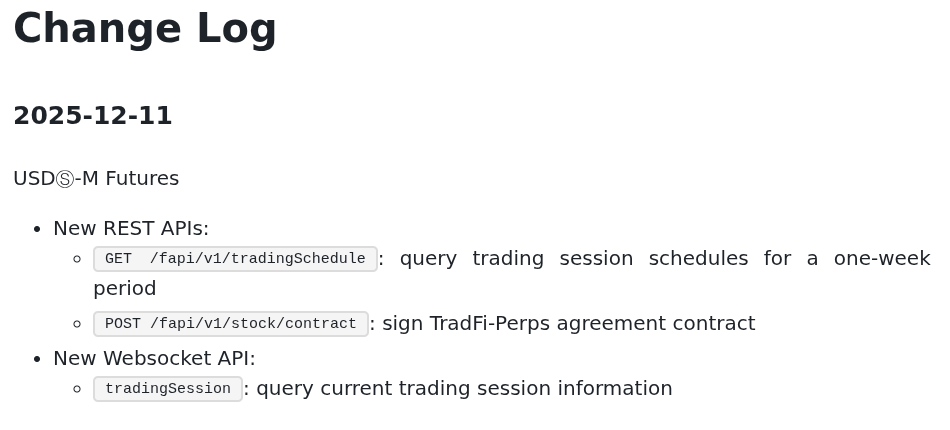
Binance API change log. Source: Binance

Related: Ondo wins Liechtenstein approval to offer tokenized stocks in Europe

Tokenized stocks are all the rage

Binance’s initiative follows a series of similar efforts by players in both traditional and crypto finance, taking stock tokenization out of the fringes of finance. Friday reports indicate that top US-based crypto exchange Coinbase is days away from unveiling its push into tokenized stocks and prediction markets.

However, not everyone is enthusiastic about how stock tokenization is being rolled out. Market maker Citadel Securities caused uproar earlier this month when it recommended that the US Securities and Exchange Commission tighten regulations on tokenized stock trading on decentralized finance (DeFi) platforms.

According to the market maker, DeFi developers, smart-contract coders, and self-custody wallet providers should not be given “broad exemptive relief” for offering trading of tokenized US equities. Citadel argued that DeFi platforms likely fall under the definitions of an “exchange” or “broker-dealer” and should be regulated under securities law.

It also claimed that allowing those platforms to operate free from regulations “would create two separate regulatory regimes for the trading of the same security.” The World Federation of Exchanges (WFE) also argued in late November that the SEC shouldn’t grant broad regulatory relief to companies launching tokenized stock offerings.

The WFE said tokenization “is likely a natural evolution in capital markets” and that it was “pro-innovation.”Still, the organization argued that it “must be done in a responsible way that does not put investors or market integrity at risk.”

The comments follow tokenized stocks making their way not only to centralized crypto exchanges, but also to the DeFi ecosystem. At the end of June, more than 60 tokenized stocks launched on Solana-based DeFi platforms as well as crypto exchanges Kraken and Bybit.

Related: Robinhood tokenizes nearly 500 US stocks, ETFs on Arbitrum for EU users

Not all of traditional finance sees an issue

Other traditional finance players appeared to follow the “if you can’t beat them, join them” approach to the issue.

Last month, Nasdaq’s head of digital assets strategy, Matt Savarese, said the stock exchange is making SEC approval of its proposal to offer tokenized versions of stocks listed on the exchange a top priority.

The race intensified after the SEC was reported to be developing a plan to allow blockchain-registered versions of stocks to trade on cryptocurrency exchanges by the end of September.

SEC Chair Paul Atkins recently described tokenization as an “innovation” the agency should seek to advance, not restrict. The SEC issued a “no-action” letter Thursday to a subsidiary of the Depository Trust and Clearing Corporation that specializes in tokenizing securities, indicating that the regulator intends to allow the company to offer a new securities market tokenization service.

Lecturas Relacionadas

Day 6 of the rsETH Incident: DeFi United Secures Approximately $100 Million in Intentional Commitments, but a $50 Million Gap Remains

On April 18, Kelp DAO’s rsETH LayerZero bridge was exploited, resulting in the unauthorized minting of 116.5k rsETH (approx. $292M). The attacker borrowed around $190M on Aave V3. The Arbitrum Security Council froze 30,766 ETH linked to the incident. DeFi United, a cross-protocol rescue initiative led by Awe, was formed to cover a total shortfall of 112.2k rsETH ($258M). As of April 24, several protocols have pledged around $100M in support, though most commitments are still under DAO voting or discussion. Key pledges include: - Golem: 1,000 ETH ($2.3M) - Aave founder Stani Kulechov: 5,000 ETH ($11.5M) - EtherFi: up to 5,000 ETH ($11.5M) - Lido: up to 2,500 stETH ($5.75M), contingent on full coverage - Mantle: proposed a $69M loan to Aave DAO under specific terms The remaining shortfall is estimated at $50M. Aave’s treasury and safety module (~$236M combined) can cover the worst-case bad debt scenario ($230M). Three potential loss distribution paths were outlined by DefiLlama’s 0xngmi: 1. Uniform 18.5% haircut for all rsETH holders: Aave bad debt ~$216M 2. Only protect Mainnet, abandon L2: bad debt up to $341M 3. Repay only pre-attack holders: technically difficult, ~$91M net loss KelpDAO has not yet announced a specific plan. The success of DeFi United depends heavily on KelpDAO’s final decision on loss allocation.

marsbitHace 25 min(s)

Day 6 of the rsETH Incident: DeFi United Secures Approximately $100 Million in Intentional Commitments, but a $50 Million Gap Remains

marsbitHace 25 min(s)

Kicked Out of PayPal, Musk Aims for a Comeback in the Crypto Market

Elon Musk's X (formerly Twitter) has launched its "Smart Cashtags" feature, generating approximately $1 billion in trading volume within days of its April 2026 pilot launch. The feature allows users to click on stock or crypto tickers (or even full Solana token contract addresses) in posts to view real-time price charts and discussions without leaving the app. Initially available to iPhone users in the US and Canada, with a partnership in Canada enabling direct trading via the Wealthsimple app. This move is part of Musk's broader "Everything App" vision, spearheaded by the upcoming X Money platform. Analysts, such as Mizuho's Dan Dolev, see this as a potential disruptor to the US payments market, even prompting a downgrade of PayPal's stock. X Money's beta offers services like 6% APY on deposits, cashback, and P2P transfers, with speculation it may later incorporate crypto trading and stablecoin settlements for faster transactions. However, the ambitious plan faces significant regulatory scrutiny. Senator Elizabeth Warren has questioned the sustainability of the high 6% yield and raised concerns over X's banking partner, Cross River Bank, which has a history of regulatory violations. Additional risks involve the "GENIUS Act," which may create loopholes for stablecoin issuance without full FDIC insurance coverage, potentially leaving users unprotected. The integration of social trading on a platform with over 500 million users could inject new liquidity and retail interest into the crypto market. Yet, it also amplifies risks like herd mentality and the blurring of lines between entertainment and financial speculation. Musk's return to finance, after his ouster from PayPal, hinges on balancing innovation with regulatory compliance.

marsbitHace 2 hora(s)

Kicked Out of PayPal, Musk Aims for a Comeback in the Crypto Market

marsbitHace 2 hora(s)

Trading

Spot
Futuros

Artículos destacados

Cómo comprar PUSH

¡Bienvenido a HTX.com! Hemos hecho que comprar Push Protocol (PUSH) sea simple y conveniente. Sigue nuestra guía paso a paso para iniciar tu viaje de criptos.Paso 1: crea tu cuenta HTXUtiliza tu correo electrónico o número de teléfono para registrarte y obtener una cuenta gratuita en HTX. Experimenta un proceso de registro sin complicaciones y desbloquea todas las funciones.Obtener mi cuentaPaso 2: ve a Comprar cripto y elige tu método de pagoTarjeta de crédito/débito: usa tu Visa o Mastercard para comprar Push Protocol (PUSH) al instante.Saldo: utiliza fondos del saldo de tu cuenta HTX para tradear sin problemas.Terceros: hemos agregado métodos de pago populares como Google Pay y Apple Pay para mejorar la comodidad.P2P: tradear directamente con otros usuarios en HTX.Over-the-Counter (OTC): ofrecemos servicios personalizados y tipos de cambio competitivos para los traders.Paso 3: guarda tu Push Protocol (PUSH)Después de comprar tu Push Protocol (PUSH), guárdalo en tu cuenta HTX. Alternativamente, puedes enviarlo a otro lugar mediante transferencia blockchain o utilizarlo para tradear otras criptomonedas.Paso 4: tradear Push Protocol (PUSH)Tradear fácilmente con Push Protocol (PUSH) en HTX's mercado spot. Simplemente accede a tu cuenta, selecciona tu par de trading, ejecuta tus trades y monitorea en tiempo real. Ofrecemos una experiencia fácil de usar tanto para principiantes como para traders experimentados.

192 Vistas totalesPublicado en 2024.12.13Actualizado en 2025.03.21

Cómo comprar PUSH

Discusiones

Bienvenido a la comunidad de HTX. Aquí puedes mantenerte informado sobre los últimos desarrollos de la plataforma y acceder a análisis profesionales del mercado. A continuación se presentan las opiniones de los usuarios sobre el precio de PUSH (PUSH).

活动图片