Big Banks Go Stablecoins: Capital One Buys Brex For $5.15 Billion

bitcoinistPublicado a 2026-01-23Actualizado a 2026-01-23

Resumen

Capital One is acquiring fintech company Brex for $5.15 billion in a cash and stock deal, pending regulatory approval with an expected close by mid-2026. Brex, known for corporate cards and expense software, has expanded into stablecoin payments, enabling automatic conversion of dollar-pegged tokens. This acquisition provides Capital One with faster settlement technology and access to Brex's business clients. The deal reflects a reset in venture valuations from previous peaks. The stablecoin market has grown significantly, reaching $315 billion following recent regulation. Brex's CEO will remain to lead the unit, and market reaction has been tempered by strong earnings from Capital One.

Reports say Capital One will buy stablecoin fintech Brex for $5.15 billion in a deal that mixes cash and stock. According to the bank’s release, roughly half of the price will be paid in cash and the other half in Capital One stock.

Regulators must still sign off. The two companies expect the transaction to finish by mid-2026, though that timing could shift if approvals take longer.

Brex Brings Cards, Software — And Stablecoin Plans

Brex began as a corporate card and expense tool for startups and has added services for larger firms.

Reports note the company moved quickly into payment tech last year when it announced plans to offer native stablecoin payments, letting customers send and accept dollar-pegged tokens with automatic conversion back into USD balances.

That bit of tech is a major part of why the deal matters to a bank that wants faster settlement options.

A Mix Of Old And New

This is not just about software. It is also a play for customers. Brex runs business accounts, serves big names in tech, and has built a set of tools that many businesses use daily.

Some of those clients moved business deposits to Brex after the 2023 banking turmoil, and those relationships are part of the package Capital One is buying.

The price tag looks smaller than Brex’s peak private valuation years ago, which shows how venture valuations have reset across the sector.

BTCUSD trading at $89,184 on the 24-hour chart: TradingView

Why This Matters For Payments

Banks have been testing token-based rails and faster settlement for a while. By folding Brex into its operations, Capital One gains a ready platform that already experiments with stablecoin rails.

Real-time settlement for businesses can lower friction and could cut the waiting time for funds to clear. At the same time, regulators in the US and abroad are paying closer attention to token projects, so the new setup will run under tighter scrutiny.
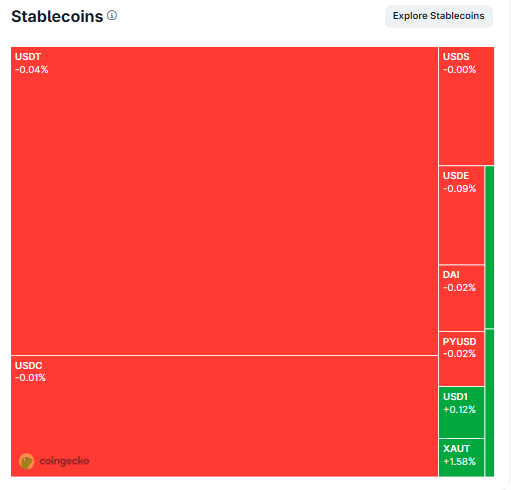
Source: Coingecko

The Growing Stablecoin Market

Stablecoins have drawn growing attention across traditional finance after Congress approved major rules for the tokens last year.

Based on data from Coingecko, the total value of stablecoins has climbed over 18% to an all-time high of $315 billion since the GENIUS Act was passed in July 2025. USDT takes the lion share of the overall stablecoin market.

Leadership And Market Reaction

Reports note that Pedro Franceschi, Brex’s CEO, will continue to lead the unit after the sale, now inside Capital One.

Investors reacted calmly overall; Capital One’s shares dipped early but were supported by robust quarterly results announced at the same time. That earnings strength helped soften any sharp market moves.

Featured image from YouHodler, chart from TradingView

Preguntas relacionadas

QWhat is the total acquisition price of Brex by Capital One and how is it structured?

AThe total acquisition price is $5.15 billion, with roughly half paid in cash and the other half in Capital One stock.

QWhat key technology did Brex develop that made it an attractive acquisition target for a bank like Capital One?

ABrex developed native stablecoin payment technology, allowing customers to send and accept dollar-pegged tokens with automatic conversion back to USD, which offers faster settlement options.

QWhat was a significant factor that led some clients to move their business deposits to Brex, as mentioned in the article?

ASome clients moved their business deposits to Brex following the banking turmoil in 2023.

QHow has the total value of the stablecoin market changed since the passage of the GENIUS Act, and what is its current all-time high?

ASince the GENIUS Act was passed in July 2025, the total value of the stablecoin market has climbed over 18% to an all-time high of $315 billion.

QWho will lead the Brex unit after the acquisition is completed, and what was the overall market reaction to the deal?

APedro Franceschi, Brex's CEO, will continue to lead the unit. The market reaction was calm overall; Capital One's shares dipped early but were supported by strong quarterly earnings.

Lecturas Relacionadas

The Value Distribution of Stablecoins

**Summary: The Value Distribution of Stablecoins** The article argues that stablecoins are evolving from mere trading tools into broader channels for dollar access. It divides the stablecoin ecosystem into four layers to analyze how value is distributed: 1. **Issuance Layer:** Mints stablecoins, holds reserve assets, and captures the spread between reserve yield and user costs (e.g., Tether, Circle). This layer currently earns the largest profit margin. 2. **Infrastructure Layer:** Connects stablecoins to the traditional financial system, handling fiat on/off-ramps, banking integration, compliance (KYC/AML), and asset management (e.g., Bridge, BVNK). This is the "unglamorous" but critical work, building the essential bridges between crypto and real-world finance. 3. **Acquiring/Distribution Layer:** Integrates stablecoins into merchant systems, manages payment flows, and provides enterprise financial software (e.g., Stripe, Coinbase). They act as the access point for businesses. 4. **Application Layer:** The end-users and businesses that ultimately use stablecoins for payments, settlements, or as a store of value. They benefit from convenience but have little pricing power. The core thesis is that while the issuance layer currently dominates profits, the often-overlooked **infrastructure layer holds significant long-term potential**. The real challenge and barrier to mass adoption is not the on-chain transfer of stablecoins (which is simple), but the complex "last mile" integration into existing business workflows, banking systems, and regulatory frameworks across different countries. Companies in this layer are currently in a "land grab" phase, investing heavily to build networks, secure bank partnerships, and establish compliance pathways. While their position is currently pressured by the profitable issuers above and distribution platforms below, the article suggests that if stablecoins become a default financial rail for businesses, the infrastructure providers who have done the hard work of integration will ultimately gain strong pricing power and become entrenched, essential players.

marsbitHace 3 hora(s)

The Value Distribution of Stablecoins

marsbitHace 3 hora(s)

The Value Distribution of Stablecoins

The Value Distribution of Stablecoins The article argues that stablecoins are evolving from a mere trading tool into a broad "dollar channel." It analyzes the industry's value chain through four layers: 1. **Issuance Layer (e.g., Tether, Circle):** The top layer that mints stablecoins, holds reserve assets, and captures the thickest interest rate spread. 2. **Infrastructure Layer (e.g., Bridge, BVNK):** Connects stablecoins to the traditional financial system, handling critical but complex "dirty work" like fiat on/off-ramps, banking integration, compliance (KYC/AML), and cross-border settlement. 3. **Acquiring/Distribution Layer (e.g., Stripe, Coinbase):** Embeds stablecoins into merchant systems, manages payment flows, and integrates with enterprise software. 4. **Application Layer:** End-users and businesses that ultimately use stablecoins for payments, settlement, or storing value. The author posits that while the issuance layer currently captures the most profit, the most overlooked and potentially critical layer is infrastructure. The core challenge for stablecoin adoption isn't the on-chain transfer (which is simple), but bridging the gap between blockchain and the real-world financial system. This involves solving practical problems for businesses: fiat conversion, reconciliation, tax handling, and user onboarding. Infrastructure companies are currently in a difficult "land-grab" phase—building networks, securing banking relationships, and achieving compliance country-by-country. They face pressure from both the profitable issuance layer above and distribution platforms below. However, the author suggests this layer is building a crucial moat. Once stablecoins become a default business rail, the infrastructure players who have done the hard work of integration may gain significant, durable value and pricing power.

链捕手Hace 3 hora(s)

The Value Distribution of Stablecoins

链捕手Hace 3 hora(s)

How to Do Research Well: Deliberately Practice the Real Skills That Matter

No one truly teaches you how to do research. You're often given a desk, a pre-selected problem, and vague instructions to "create something new." Consequently, many people reverse-engineer the job based on visible outputs—papers, posts, announcements—learning only how to *appear* like a researcher rather than how to *become* one. True research capability is built from stacking small, trainable skills, nearly all of which can be developed through deliberate practice. **Pick Your Own Problem:** Most researchers absorb problems from advisors or trends, lacking the underlying reasoning. Choosing a problem you genuinely care about, as John Schulman advises, leads to original work. Develop "taste" like a muscle: predict experiment outcomes, guess paper results from methods, and track which findings remain important over time. **Upgrade Your Inputs:** Relying on shared reading lists (arXiv hot lists, filtered group chats) leads to unoriginal conclusions. Undervalued old literature often holds crucial insights (e.g., MoE, LSTM, backpropagation). Richard Sutton's "The Bitter Lesson" or Claude Shannon's 1952 talk on creative thinking are more predictive than lengthy modern surveys. Breadth matters as much as depth: draw from neuroscience, mechanism design, hardware knowledge, and honest statistics. Read papers directly, especially appendices and limitations sections. **Write Everything Down:** As Paul Graham noted, writing exposes flaws in seemingly mature ideas. Writing is the cheapest defense against self-deception. Following Feynman's principle, Darwin programmatically wrote down facts contradicting his theory to combat memory bias. Maintain a detailed log of hypotheses, setups, predictions, results, and updated understandings. Reviewing past logs fosters essential humility.

marsbitHace 6 hora(s)

How to Do Research Well: Deliberately Practice the Real Skills That Matter

marsbitHace 6 hora(s)

Trading

Spot
Futuros

Artículos destacados

Cómo comprar ONE

¡Bienvenido a HTX.com! Hemos hecho que comprar Harmony (ONE) sea simple y conveniente. Sigue nuestra guía paso a paso para iniciar tu viaje de criptos.Paso 1: crea tu cuenta HTXUtiliza tu correo electrónico o número de teléfono para registrarte y obtener una cuenta gratuita en HTX. Experimenta un proceso de registro sin complicaciones y desbloquea todas las funciones.Obtener mi cuentaPaso 2: ve a Comprar cripto y elige tu método de pagoTarjeta de crédito/débito: usa tu Visa o Mastercard para comprar Harmony (ONE) al instante.Saldo: utiliza fondos del saldo de tu cuenta HTX para tradear sin problemas.Terceros: hemos agregado métodos de pago populares como Google Pay y Apple Pay para mejorar la comodidad.P2P: tradear directamente con otros usuarios en HTX.Over-the-Counter (OTC): ofrecemos servicios personalizados y tipos de cambio competitivos para los traders.Paso 3: guarda tu Harmony (ONE)Después de comprar tu Harmony (ONE), guárdalo en tu cuenta HTX. Alternativamente, puedes enviarlo a otro lugar mediante transferencia blockchain o utilizarlo para tradear otras criptomonedas.Paso 4: tradear Harmony (ONE)Tradear fácilmente con Harmony (ONE) en HTX's mercado spot. Simplemente accede a tu cuenta, selecciona tu par de trading, ejecuta tus trades y monitorea en tiempo real. Ofrecemos una experiencia fácil de usar tanto para principiantes como para traders experimentados.

290 Vistas totalesPublicado en 2024.12.12Actualizado en 2026.06.02

Cómo comprar ONE

Discusiones

Bienvenido a la comunidad de HTX. Aquí puedes mantenerte informado sobre los últimos desarrollos de la plataforma y acceder a análisis profesionales del mercado. A continuación se presentan las opiniones de los usuarios sobre el precio de ONE (ONE).

活动图片













