Before Buying the Dip, Understand the Two Types of Market Drawdowns

比推Publicado a 2026-02-13Actualizado a 2026-02-13

Resumen

The article distinguishes between two types of stock drawdowns: systemic (market-driven) and idiosyncratic (company-specific). Systemic drawdowns, like the 2008 financial crisis, affect the entire market and can be navigated with behavioral advantages such as patience, as markets tend to recover. Idiosyncratic drawdowns, such as the recent AI-driven sell-off in software stocks, require analytical advantages—investors must accurately assess whether a company’s long-term prospects remain intact despite market pessimism. Using FactSet as an example, the author emphasizes that investors must differentiate between temporary panic and fundamental erosion of a company’s competitive moat. Relying solely on behavioral strategies for idiosyncratic risks is inadequate; deep analysis is essential to avoid mistaking arrogance for conviction.

Author: Todd Wenning

Compiled by: Deep Tide TechFlow

Original title: Before Buying the Dip, Understand the Two Types of Market Drawdowns


Deep Tide Introduction: Academic financial theory categorizes risk into systemic risk and idiosyncratic risk. Similarly, stock drawdowns can also be divided into two types: market-driven systemic drawdowns (such as the 2008 financial crisis) and company-specific idiosyncratic drawdowns (such as the current AI-induced software stock crash).

Todd Wenning uses FactSet as an example to point out: during systemic drawdowns, you can leverage behavioral advantages (patiently waiting for the market to recover); but during idiosyncratic drawdowns, you need analytical advantages—having a more accurate vision of the company's future a decade from now than the market does.

Amid the current AI impact on software stocks, investors must distinguish: is this a temporary market panic, or is the moat truly collapsing?

Do not use a blunt behavioral solution to solve a problem that requires nuanced analysis.

Full text below:

Academic financial theory posits two types of risk: systemic and idiosyncratic.

  • Systemic risk is unavoidable market risk. It cannot be eliminated through diversification, and it is the only type of risk for which you are compensated.

  • On the other hand, idiosyncratic risk is company-specific risk. Because you can cheaply purchase a diversified portfolio of uncorrelated businesses, you are not compensated for taking on this risk.

We can discuss Modern Portfolio Theory another day, but the systemic-idiosyncratic framework is very helpful for understanding different types of drawdowns (the percentage decline from peak to trough of an investment) and how we as investors should evaluate opportunities.

From the moment we picked up our first value investing book, we were taught to take advantage of a despondent Mr. Market when stocks are being sold off. If we remain calm while he loses his senses, we will prove ourselves to be stoic value investors.

But not all drawdowns are the same. Some are market-driven (systemic), while others are company-specific (idiosyncratic). Before you make a move, you need to know which type you are looking at.
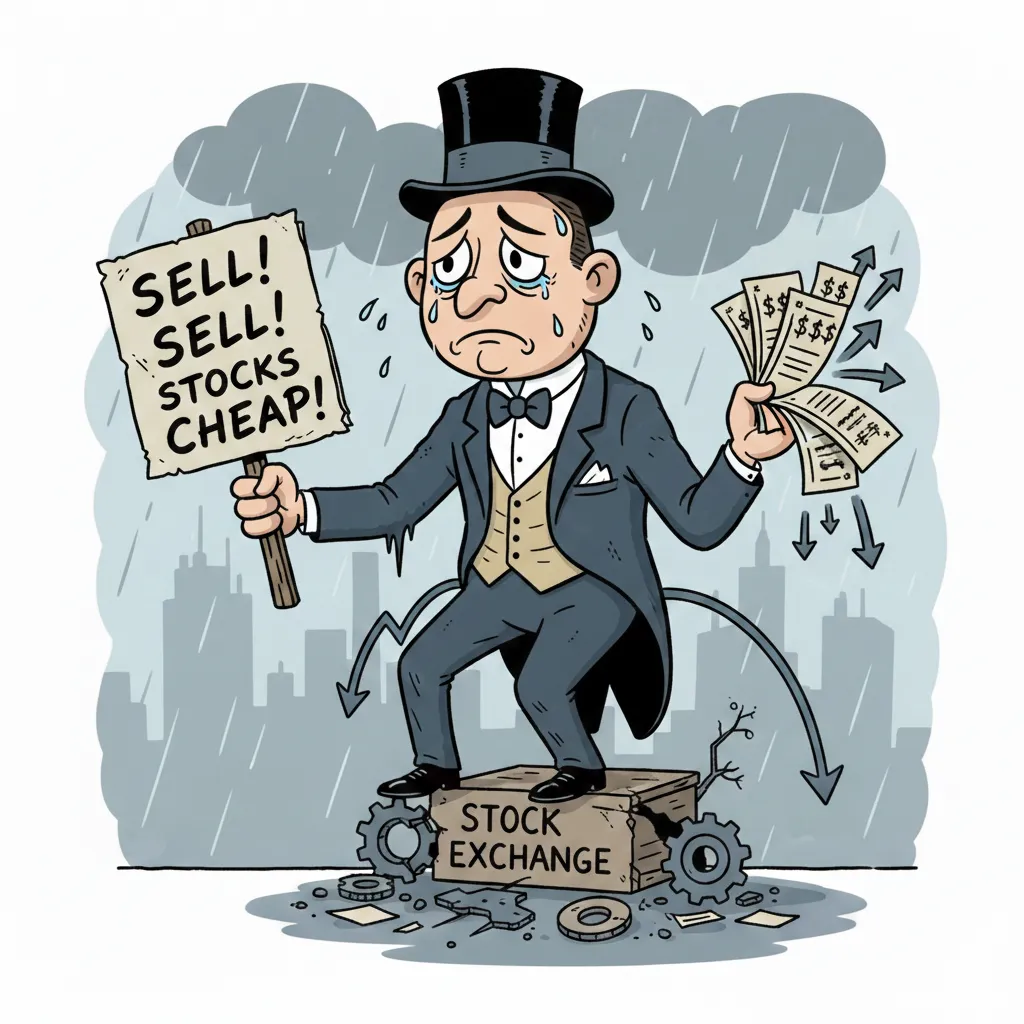
Generated by Gemini

The recent sell-off in software stocks due to AI concerns illustrates this point. Let's look at the 20-year drawdown history between FactSet (FDS, blue) and the S&P 500 (measured via the SPY ETF, orange).
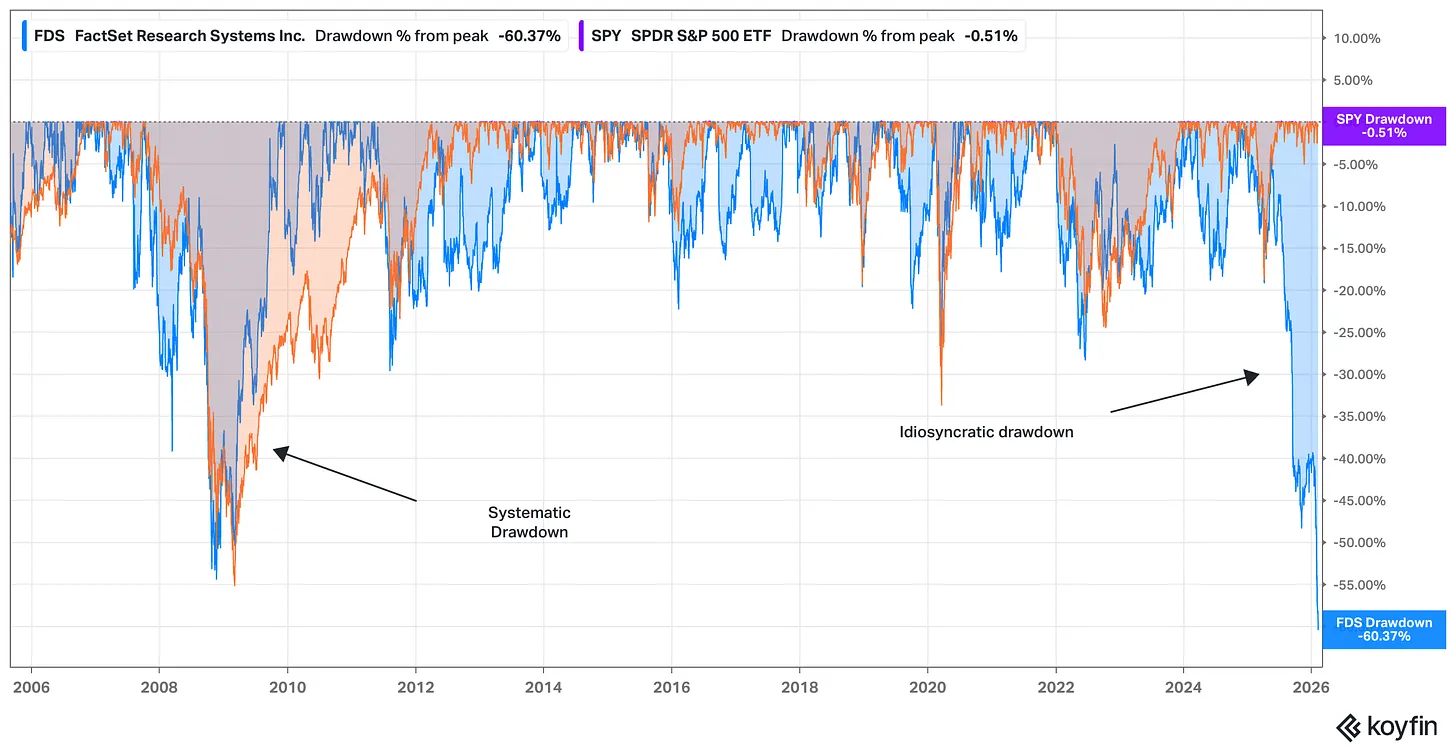
Source: Koyfin, as of February 12, 2026

FactSet's drawdown during the financial crisis was primarily systemic. In 2008/09, the entire market was worried about the durability of the financial system, and FactSet could not be immune to these concerns, especially since it sells products to financial professionals.

At that time, the stock's drawdown had less to do with FactSet's economic moat and more to do with whether that moat would matter if the financial system collapsed.

The 2025/26 FactSet drawdown is the opposite case. Here, the concerns are almost entirely focused on FactSet's moat and growth potential, along with widespread worries about accelerating AI capabilities disrupting pricing power in the software industry.

In systemic drawdowns, you can more reasonably make time arbitrage bets. History shows that markets tend to rebound, and companies with strong moats may emerge even stronger than before. So, if you are willing and able to remain patient while others panic, you can leverage a strong appetite to exploit behavioral advantages.

Photo by Walker Fenton on Unsplash

However, in idiosyncratic drawdowns, the market is telling you that something is wrong with the business itself. Specifically, it suggests increasing uncertainty about the business's terminal value.

Therefore, if you hope to take advantage of an idiosyncratic drawdown, you need analytical advantages in addition to behavioral ones.

To succeed, you need to have a more accurate vision of what the company will look like a decade from now than what the current market price implies.

Even if you know a company well, this is not easy to do. Stocks don't typically fall 50% relative to the market for no reason. Many once-stable holders—even some investors you respect for their deep research—had to capitulate for this to happen.

If you are going to step in as a buyer during an idiosyncratic drawdown, you need to have an answer for why these otherwise well-informed and thoughtful investors who sold were wrong, and why your vision is correct.

There is a fine line between conviction and arrogance.

Whether you are holding a stock in a drawdown or looking to initiate a new position in one, it's important that you understand what type of bet you are making.

Idiosyncratic drawdowns can tempt value investors to start looking for opportunities. Before you venture in, make sure you are not using a blunt behavioral solution to solve a problem that requires nuanced analysis.

Stay patient, stay focused.

Todd


Twitter:https://twitter.com/BitpushNewsCN

BitPush TG Discussion Group:https://t.me/BitPushCommunity

BitPush TG Subscription: https://t.me/bitpush

Original article link:https://www.bitpush.news/articles/7611840

Preguntas relacionadas

QWhat are the two types of risk identified in academic financial theory, and how do they differ?

AThe two types of risk are systemic risk and idiosyncratic risk. Systemic risk is unavoidable market risk that cannot be eliminated through diversification and is the only type of risk for which investors are compensated. Idiosyncratic risk is company-specific risk that can be mitigated through a diversified portfolio of uncorrelated businesses, and investors are not compensated for taking on this risk.

QHow should an investor approach a systemic drawdown versus an idiosyncratic drawdown?

AIn a systemic drawdown, an investor can leverage a behavioral advantage by being patient and waiting for the market to recover, as history shows markets tend to rebound. In an idiosyncratic drawdown, an investor needs an analytical advantage—a more accurate vision of what the company will look like in ten years than what the market currently implies—because the issue is specific to the company's fundamentals.

QWhat example does Todd Wenning use to illustrate the difference between systemic and idiosyncratic drawdowns?

ATodd Wenning uses FactSet (FDS) as an example. The drawdown during the 2008/09 financial crisis was primarily systemic, driven by broad market fears about the financial system. The drawdown in 2025/26 was idiosyncratic, caused by specific concerns about FactSet's moat and growth potential due to AI disrupting the software industry.

QWhat is the author's warning about using behavioral solutions for idiosyncratic drawdowns?

AThe author warns against using a blunt behavioral solution, like simply buying during a sell-off, to address an idiosyncratic drawdown, which requires nuanced analysis. Investors must ensure they have a clear analytical edge and understand why informed sellers are wrong, rather than relying solely on patience or market recovery.

QAccording to the article, what must an investor have to successfully capitalize on an idiosyncratic drawdown?

ATo successfully capitalize on an idiosyncratic drawdown, an investor needs an analytical advantage—a well-reasoned vision of the company's future that is more accurate than the market's current assessment. They must also understand why other informed investors sold and be able to justify why their perspective is correct, balancing conviction without crossing into arrogance.

Lecturas Relacionadas

Must-Watch Events Next Week|CLARITY Act Could Face Senate Vote; SpaceX, Circle to Report Earnings (8.3-8.9)

**Summary: Key Events and Developments to Watch (August 3-9)** The upcoming week is marked by significant financial disclosures, key legislative deadlines, and notable product updates. **Major Financial Events:** Several companies are scheduled to release their Q2 2026 earnings. American Bitcoin (ABTC) will report on August 3, followed by SpaceX and Hut 8 Mining Corp. on August 4, and Circle on August 5. Notably, a significant portion of SpaceX shares (up to 12% of total shares) will be unlocked on August 6 following their earnings release. **Key Legislative Deadline:** The U.S. Senate faces an August 7 deadline to secure 60 votes for the CLARITY Act, a bipartisan bill aiming to establish a federal regulatory framework for cryptocurrencies. The Senate may hold a full vote on the bill during the week. **Economic Data:** The U.S. July Non-Farm Payrolls report will be released on August 7, providing crucial labor market data. **Technology & Product Updates:** * **Shutdowns:** DeFi portfolio tracker Zapper and wallet app Ctrl Wallet will cease operations on August 3. * **Upgrades:** LayerZero will deprecate its v1 relayers on August 3. XRP Ledger's new version 3.3.0, featuring five new functions, is expected next week. * **AI:** Elon Musk announced that the advanced Grok 4.6 AI model is set for release around August 7. * **Bitcoin:** The BIP-110 forced signaling for a potential Bitcoin network change is scheduled to begin around August 8. **Other Notable Events:** Chinese robotics firm Unitree Tech has set its preliminary price inquiry for its IPO for August 5. South Korean exchange Upbit will delist AQT and AERGO tokens on August 3.

marsbitHace 2 hora(s)

Must-Watch Events Next Week|CLARITY Act Could Face Senate Vote; SpaceX, Circle to Report Earnings (8.3-8.9)

marsbitHace 2 hora(s)

Stocks Are Plummeting More Sharply Than Cryptocurrencies. Where Has the Money Gone?

Stock Markets Plunge Deeper Than Cryptocurrencies: Where Did the Money Go? In late July, Seoul's Kospi index triggered circuit breakers for two consecutive days, plummeting over 40% from its June high. The collapse was led by heavyweight stocks like SK Hynix, whose record profits still disappointed investors, and devastating leveraged ETFs, with one major product losing over 83% of its value. This signaled a global, forced deleveraging targeting the most crowded trades. Interestingly, while stocks exhibited extreme volatility akin to crypto markets, Bitcoin rose nearly 15% in July after a prior steep drop. Analysis shows the money fleeing equities did not flow into Bitcoin. Instead, Bitcoin had already absorbed its sell-off in May-June, when U.S. spot Bitcoin ETFs saw historic outflows. The true safe-haven beneficiary was gold, whose price rose over 20% year-on-year, highlighting a decoupling between Bitcoin and gold as "digital gold." The sell-off was a targeted unwinding of leveraged positions in tech and semiconductors, accelerated by broker-dealer risk management and shifts in the AI narrative, including new competition from Chinese memory chipmakers. The retreat path was clear: from high-valuation tech stocks to cash and U.S. Treasuries, then to gold. For Bitcoin to attract sustained institutional inflows, conditions like eased global liquidity pressure, a "soft-landing" Fed rate cut, and U.S. regulatory clarity via legislation like the stalled CLARITY Act are needed. Currently, Bitcoin is not a safe haven but an already-cleared asset. Its low correlation with tech stocks, however, makes it a potential diversification play for institutional portfolios once the storm passes. The money isn't here yet, but the positioning is underway.

marsbitHace 2 hora(s)

Stocks Are Plummeting More Sharply Than Cryptocurrencies. Where Has the Money Gone?

marsbitHace 2 hora(s)

In Conversation with Ray Dalio: We Are Currently in an AI Bubble, with 1% of My Portfolio in Bitcoin

Ray Dalio, founder of Bridgewater Associates, warns in an interview that the current AI boom shows classic bubble characteristics, which could lead to significant economic downturns as seen in past cycles like 1929 or 2000. He explains that speculative enthusiasm, fueled by debt and overvaluation, often precedes a crash when rising rates or taxation force asset sales, causing widespread losses and recession. Dalio also outlines his "Big Cycle" theory, describing an approximate 80-year pattern where widening wealth gaps, massive government deficits, and shifting geopolitical power (like China's rise) create internal conflict and global instability. He emphasizes that we are in a late-cycle, transitional phase where traditional powers like the US and UK face decline. For personal wealth protection, Dalio advises diversification beyond cash into assets like stocks, bonds, real estate, and particularly gold, which he prefers over Bitcoin. While he holds about 1% of his portfolio in Bitcoin as a non-printable hard asset, he views gold as more secure from technological or governmental threats. Regarding AI's impact, Dalio believes it will disproportionately benefit capital owners, worsening inequality by replacing both physical and cognitive labor. He suggests that human intuition and emotional intelligence, combined with AI, will be key for future workers. On taxation, Dalio argues that wealth taxes are impractical and risk triggering asset sell-offs, reducing productive investment. He points to the UK as a cautionary example of debt, low productivity, and political strife. Geopolitically, Dalio foresees a more regionalized world, with the US showing weakness in prolonged conflicts like with Iran, akin to past imperial declines. The ideal outcome, he suggests, is coexisting powerful blocs (e.g., Americas, China-Asia Pacific) without major war.

marsbitHace 5 hora(s)

In Conversation with Ray Dalio: We Are Currently in an AI Bubble, with 1% of My Portfolio in Bitcoin

marsbitHace 5 hora(s)

Trading

Spot
活动图片





