Banks’ Concerns Over Stablecoin Interest Payments Are ‘Totally Absurd’, Circle CEO Says

bitcoinistPublicado a 2026-01-23Actualizado a 2026-01-23

Resumen

Circle CEO Jeremy Allaire dismissed banking industry concerns over interest payments on stablecoins as "totally absurd," arguing that fears of massive deposit flight are unfounded. Speaking at the World Economic Forum, he compared stablecoin rewards to other common financial products like credit cards, emphasizing their role in customer engagement rather than systemic risk. Allaire countered bank claims that stablecoins could drain up to $6 trillion in deposits, noting that similar concerns emerged with money market funds yet lending continued unaffected. He highlighted the shift toward private credit and capital markets, asserting that stablecoins should function as safe, regulated cash instruments while lending evolves independently through new models.

The CEO of stablecoin issuer Circle has weighed in on the importance of stablecoin rewards and why he believes the banking industry’s concerns about interest payments on these assets are “absurd.”

Circle CEO Rejects Banks’ Stablecoin Fears

Speaking at the World Economic Forum (WEF) in Davos, Circle’s CEO, Jeremy Allaire, discussed banks’ growing concerns that paying interest on stablecoins poses a threat to the industry, calling the deposit flight narrative “totally absurd.”

The banking sector has expressed concerns about stablecoin rewards, arguing that interest payments will distort market dynamics and affect credit creation. In the US, banks have heavily criticized the GENIUS Act, claiming that it has loopholes that could pose risks to the financial system.

The executive rejected the sector’s general arguments, citing historical and practical reasons. He asserted that this exact argument has been historically used when new financial products, such as government money market funds, have emerged.

Notably, Bank of America CEO Brian Moynihan recently compared the digital assets to money market mutual funds, which require reserves to be held in short-term instruments, such as US Treasuries, reducing lending capacity in the system.

The executive told investors that the banking sector, small- and medium-sized businesses in particular, could face significant challenges if the US Congress does not prohibit interest-bearing stablecoins, as up to $6 trillion in deposits, or 30% to 35% of all US commercial bank deposits, could flow out of the banking system and into the stablecoin sector.

However, Allaire pointed out that, despite institutions claiming that financial products would “draw all the deposit base,” their growth has not “stopped the ability for lending to happen.”

The importance Of Rewards

Circle’s CEO also argued that stablecoins should not be singled out when rewards for other financial products exist and contribute to the system. “Those rewards (...) exist in every balance that you have with a credit card that you use. They exist around so many other financial products and services that we have,” he detailed.

“These rewards are actually very important,” Allaire continued. “They help with stickiness, they help with customer traction. They are not themselves like these huge monetary policy dampers.”

Most importantly, he pointed out that lending is moving away from the risk-taking of banks, with “a huge amount of lending is moving towards private credit.”

He cited a Wednesday WEF panel, in which a capital markets participant highlighted how the vast majority of GDP growth in the United States was “formed by capital market formation around junk bonds.”

“So private credit issuing junk bonds, capitalizing the build out of the American technology advancements, not bank credit,” the executive added.

Previously, Coinbase Institute shared a similar argument, affirming that “credit is evolving, not shrinking. Lending is shifting to private credit, fintech, and DeFi channels that don’t depend on deposits. Liquidity moves—it doesn’t vanish.”

Allaire concluded that “we want stablecoin money to be cash instrument money, prudentially supervised, very, very safe money. And then I think what we want to do is we want to build models for lending that build on top of stablecoins.”
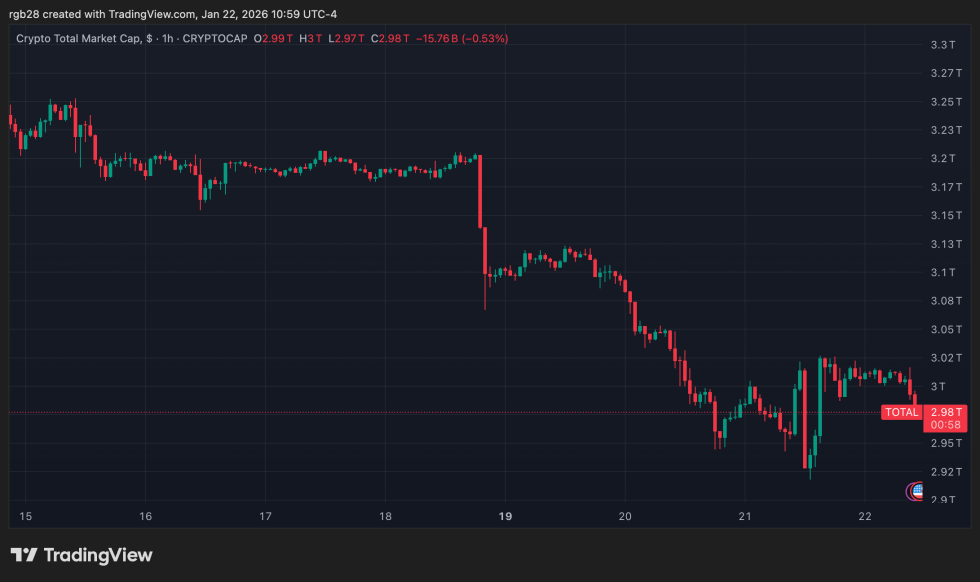
The total crypto market capitalization is at $2.98 trillion in the one-week chart. Source: TOTAL on TradingView


Preguntas relacionadas

QWhat is Circle CEO Jeremy Allaire's view on banks' concerns about interest payments on stablecoins?

AJeremy Allaire calls the banking industry's concerns about interest payments on stablecoins 'totally absurd' and rejects the narrative that they pose a threat to the industry or will cause significant deposit flight.

QAccording to the banking sector, what risk does the GENIUS Act pose?

ABanks have criticized the GENIUS Act, claiming it has loopholes that could distort market dynamics, affect credit creation, and pose risks to the overall financial system.

QWhat historical financial product does Allaire compare stablecoins to when refuting the banks' arguments?

AAllaire compares stablecoins to government money market funds, which also faced similar criticisms when they emerged, yet their growth did not stop the ability for lending to happen.

QHow much in bank deposits could potentially flow into the stablecoin sector according to the concerns raised by bank executives?

ABank executives warned that up to $6 trillion in deposits, or 30% to 35% of all US commercial bank deposits, could flow out of the banking system and into the stablecoin sector if interest-bearing stablecoins are not prohibited.

QWhere does Jeremy Allaire argue that lending is increasingly moving towards?

AAllaire argues that a huge amount of lending is moving away from traditional banks and towards private credit, fintech, and DeFi channels, citing the growth of the junk bond market as an example of capital formation that doesn't rely on bank credit.

Lecturas Relacionadas

20 Billion Valuation, Alibaba and Tencent Competing to Invest, Whose Money Will Liang Wenfeng Take?

DeepSeek, an AI startup founded by Liang Wenfeng, is reportedly in talks with Alibaba and Tencent for an external funding round that could value the company at over $20 billion. This marks a significant shift, as DeepSeek had previously relied solely on funding from its parent company,幻方量化 (Huanfang Quantitative), and had resisted external investment. The potential valuation would place DeepSeek among the top-tier AI model companies in China, comparable to competitors like MoonDark (valued at ~$18 billion) and ahead of recently listed firms like MiniMax and Zhipu. The funding—which could range from $600 million (for a 3% stake) to $2 billion (for 10%)—is seen as a move to secure resources for model development, retain talent, and support infrastructure needs, particularly as competition in inference models and AI agents intensifies. Both Alibaba and Tencent are eager to invest, not only for financial returns but also to integrate DeepSeek into their broader AI ecosystems. However, DeepSeek’s leadership is cautious about maintaining independence and may prefer financial investors over strategic ones to avoid being locked into a specific tech ecosystem. Alternative options, such as state-backed funds, offer longer-term capital and policy support but may come with slower decision-making and potential constraints on global expansion. With competing AI firms accelerating their IPO plans, DeepSeek’s window for securing optimal terms may be narrowing. The final decision will reflect a trade-off between capital, resources, and strategic independence.

marsbitHace 1 hora(s)

20 Billion Valuation, Alibaba and Tencent Competing to Invest, Whose Money Will Liang Wenfeng Take?

marsbitHace 1 hora(s)

After Losing 97% of Its Market Value, iQiyi Attempts to Use AI to Forcefully Extend Its Lifespan

After losing 97% of its market value since its 2018 peak, iQiyi is aggressively pivoting to AI in a desperate attempt to survive. At its 2026 World Conference, CEO Gong Yu announced an "AI Artist Library" with over 100 virtual performers and a new AIGC platform, "NaDou Pro," promising faster production and lower costs. This shift comes as the company faces severe financial distress: its market cap sits near delisting thresholds at $1.36 billion, with significant losses, declining membership revenue, and depleted cash flow. The AI strategy has sparked controversy. Top actors have issued legal threats against unauthorized digital replicas, while in Hengdian, over 134,000 background actors are seeing their already scarce job opportunities vanish as AI replaces them for background roles. iQiyi's move represents a fundamental shift from being a high-cost content buyer to a landlord" to becoming a "platform capitalist" that transfers production risk to creators. This contrasts with competitors like Douyin (TikTok's Chinese counterpart), which is investing heavily in *real* actor-led short dramas, betting that authentic human connection retains users better than AI-generated content. The article draws a parallel to the 1920s transition to "talkies," which made cinema musicians obsolete but ultimately enriched the art form. In contrast, iQiyi's AI drive is framed not as an artistic evolution but as a cost-cutting measure that could degrade storytelling, replacing genuine human emotion with algorithmically calculated stimulation and potentially numbing audiences' capacity for empathy. The core question remains: can a company focused solely on financial survival preserve the art of storytelling?

marsbitHace 1 hora(s)

After Losing 97% of Its Market Value, iQiyi Attempts to Use AI to Forcefully Extend Its Lifespan

marsbitHace 1 hora(s)

Trading

Spot
Futuros
活动图片




