Banks Advance Plans to Create Stablecoins as Bank for International Settlements Questions Their Role

cryptonews.ruPublicado a 2026-08-29Actualizado a 2026-08-29

Resumen

While the Bank for International Settlements (BIS) argues that stablecoins lack key properties to function as money at scale, major global banks are actively developing their own stablecoin plans on public blockchains. BIS head Pablo Hernández de Cos advocates for tokenized bank deposits as a superior foundation for modern digital payments, citing issues with stablecoins regarding uniformity, interoperability, and financial integrity. These problems include exchange rate fluctuations between different stablecoins, settlement complexities across fragmented blockchains, and anonymity concerns. Despite these warnings, a consortium of over a dozen major banks, including Bank of America and Citi, is preparing to launch a bank-issued stablecoin. This shift is driven by competitive pressure and regulatory changes like the GENIUS Act, with banks fearing potential deposit outflows to crypto-native issuers. Data shows stablecoin transaction volumes are massive, but a small fraction represents real-economy payments. While central banks prefer tokenized deposits for core payments, commercial banks increasingly see a strategic need for stablecoins to retain relevance, even as some, like JPMorgan, currently deny having imminent launch plans.

Despite the Bank for International Settlements (BIS) chief's view that stablecoins cannot be considered money on a large scale, the world's largest banks are moving financial settlements and regular transactions onto public blockchains.

Speaking at the Economic Symposium in Jackson Hole on August 28, BIS General Manager Pablo Hernández de Cos stated that a system based on tokenized deposits "looks more promising" than stablecoins. BIS representatives emphasized that tokenized deposits should form the foundation of modern digital payment systems as banks transition their operations to blockchain.

For banks, the dilemma is straightforward: should they adopt blockchain now, or wait for regulators to approve a more technologically advanced version of this innovative solution?

Where Stablecoins Fall Apart, According to de Cos

De Cos's argument centers on three properties he says money must possess: uniformity, interoperability, and financial integrity.

Regarding uniformity, he gave a simple example. If one person holds Tether's $USDT tokens and wants to transfer money to a recipient who only accepts Circle's $USDC tokens, that person would first have to sell $USDT and buy $USDC. However, since the coins' prices can fluctuate on the market, the final transfer amount might not equal one US dollar. The system does not guarantee that two stablecoins will exchange one-for-one.

The interoperability issue creates another problem. Most fiat-backed stablecoins operate on fragmented, permissionless public blockchains and scaling layers. Even a request to transfer the same stablecoin issued on different blockchains from one chain to another requires performing complex—and sometimes costly—procedures.

In contrast, the settlement process for tokenized deposits involves using central bank accounts, as de Cos noted, preserving the nominal redeemability and finality of such deposits.

The Integrity Issue BIS Keeps Returning To

The third issue is financial integrity. According to de Cos, information shows that most stablecoins are currently held in self-custodied wallets and that an increasing number of transfers between blockchain wallets are conducted without any platform performing "Know Your Customer" (KYC) checks. This is vastly different from traditional finance, where bank deposits, the least anonymous form of money, predominate.

In its Annual Economic Report on June 23, the Bank for International Settlements (BIS) presented a similar viewpoint. In the section on stablecoins, it went so far as to state that existing stablecoin designs "do not meet the fundamental properties of money and threaten financial integrity."

Furthermore, the research expressed concern about the concept of "stablecoin dollarization" in developing countries, where the demand for foreign stablecoins could impact capital flows and reduce their monetary sovereignty.

What Payment Data Actually Shows

The discussion on scale is backed by significant figures.

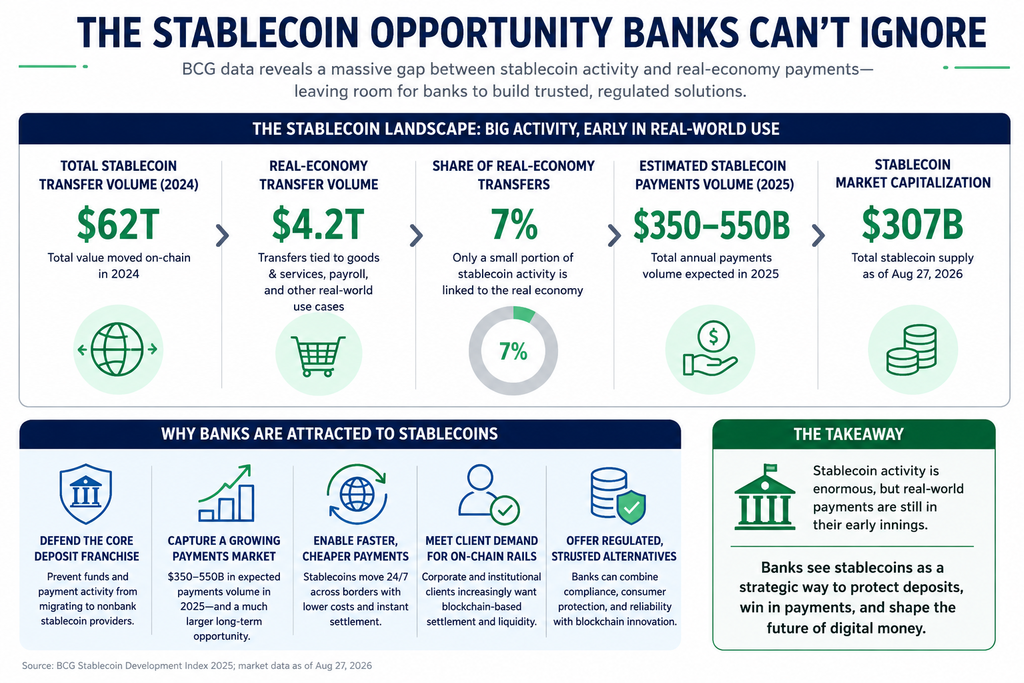
According to an analytical report published in January 2026 by Boston Consulting Group (BCG) and blockchain data analytics firm Allium, over $62 trillion worth of stablecoin transactions occurred on public blockchains in a year. However, of this amount, only about $4.2 trillion (approximately 7% of the total) represented payments made in the real economy.

BCG estimated the observed volume of bilateral payments for goods and services in 2025 to be between $350 and $550 billion, which they termed a minimal figure. Additionally, the article noted that the stablecoin market capitalization grew to $307 billion by December 2025.

Why Are Banks Shifting Policy at All?

These warnings have not stopped banks from moving towards blockchain adoption.

On August 28, Forkast reported that a consortium of over 12 global banks, including Bank of America, Wells Fargo, Santander, Citi, Goldman Sachs, and UBS, is preparing to issue its own stablecoin on public blockchains, rather than leaving the market to Tether and Circle.

The GENIUS Act, which took effect on July 18, 2025, was a legislative measure allowing banks to access the federal level through subsidiaries approved by the Office of the Comptroller of the Currency (OCC), although it prohibited issuers from paying any interest to holders.

Bank of America CEO Brian Moynihan warned that up to $6 trillion in deposits could be withdrawn from banks if stablecoin issuers were allowed to offer yields.

"If it is legalized, we will engage in this business."

Smaller lending institutions are also adopting new technologies. Cryptopolitan reported that 39 state bankers' associations have formed the BankChain Alliance, set to launch in 2027. This initiative aims to provide local banks with shared access to tokenized deposits and stablecoins without relying on crypto platforms.

Are Banks Moving from Research to Creating a Joint Stablecoin?

Today's article in the Seoul Economic Daily states that a major banking group is considering initially issuing a dollar-pegged token, with subsequent expansion to G7 currencies. It also highlights the strategic reason: banks fear stablecoins could divert deposits away from traditional banks.

Feature Stablecoins Tokenized Deposits
What is it? Digital tokens designed to maintain a stable value relative to a reference asset, typically the US dollar. Digital representation of ordinary commercial bank deposits on a programmable ledger.
Issuer Typically a private stablecoin issuer. Commercial bank.
Holder's Claim Claim on the stablecoin issuer's/reserve structure. Direct claim on the issuing bank.
Backing Typically reserves like cash, central bank reserves, Treasury bonds, or other permitted assets. Ultimately, the bank's deposit obligations are part of the banking system.
Redeemability Intended for redemption at $1, but secondary market prices may deviate from par. Exchanges at par as a bank deposit/claim.
Settlement Transfers between token holders on blockchain networks. Payment results in debiting one bank account and crediting another, with interbank settlement ultimately using central bank money.
Blockchain Often public/permissionless networks. Typically permissioned/controlled bank platforms, though hybrid models are possible.
Interoperability Can be fragmented across issuers and blockchains. Higher fungibility achieved when using tokenized central bank reserves.
AML/KYC May involve anonymous wallets and self-custody. Account ownership and activities within regulated bank infrastructure.
Bank Deposits Could potentially divert funds away from banks. Secures deposits within the banking system.
Main Advantage Global reach, programmability, and 24/7 transfer capability. Programmability while preserving the existing bank/central bank monetary structure.
BIS's Preferred Role Specialized uses, not the basis for everyday payments. Handling large daily payments and wholesale settlements.
Current Examples $USDT, $USDC, and other fiat-backed tokens. JPMorgan's deposit token model and other bank tokenization projects.
The differences between stablecoins and tokenized deposits are structural, not merely numerical. | BIS

Central banks want to see tokenized deposits and central bank money at the heart of the blockchain economy, while commercial banks are increasingly concluding that they also need stablecoins. Notably, JPMorgan's position remains that the company has no current plans to issue a stablecoin.

end-content

Criptos en tendencia

Preguntas relacionadas

QAccording to the head of the BIS, what are the three properties that money should have, and how do stablecoins fail to meet them?

AAccording to the head of the BIS, Pablo Hernández de Cos, the three properties money should have are unity (uniqueness), compatibility (interoperability), and financial integrity. He argues stablecoins fail because: 1) Different stablecoins like USDT and USDC are not guaranteed to exchange at a 1:1 rate (unity). 2) They operate on fragmented, permissionless blockchains, making cross-chain transfers complex (compatibility). 3) Many are held in self-custody wallets with limited KYC checks, raising concerns about financial integrity versus traceable bank deposits.

QWhat is the Bank for International Settlements' (BIS) preferred model for the foundation of modern digital payment systems, and why?

AThe BIS prefers a system based on tokenized bank deposits as the foundation for modern digital payment systems. They argue this model is more promising than one based on stablecoins because tokenized deposits utilize central bank accounts for settlement, preserving nominal redemption and finality. This approach maintains the existing monetary structure, ensures financial integrity through bank-level AML/KYC, and prevents potential disintermediation of commercial bank deposits.

QDespite the BIS's warnings, why are major global banks reportedly planning to issue their own stablecoin on public blockchains?

AMajor global banks are reportedly planning to issue their own stablecoin on public blockchains to prevent deposits from being drained away by private stablecoin issuers like Tether and Circle. They fear that if these private issuers are allowed to offer yield, trillions in deposits could leave the traditional banking system. The passing of the GENIUS law, which allows banks to access the public blockchain space via OCC-approved subsidiaries (though without paying interest), is a key factor enabling this strategic move.

QWhat does the data from Boston Consulting Group (BCG) and Allium reveal about the volume of stablecoin transactions versus payments in the real economy?

AData from BCG and Allium reveals a significant gap between total stablecoin transaction volume and real-economy payments. They estimated that over $62 trillion worth of stablecoin transactions occurred on public blockchains in a year. However, only about $4.2 trillion (approximately 7% of the total) constituted payments made within the real economy. The observed volume of bilateral payments for goods and services in 2025 was estimated to be between $350 billion and $550 billion, which they termed a minimal figure.

QAccording to the article's comparison table, what is a key structural difference between the holder's claim in a stablecoin versus a tokenized deposit?

AA key structural difference is the nature of the holder's claim. For a stablecoin, the holder has a claim on the stablecoin issuer's reserve structure. For a tokenized deposit, the holder has a direct claim on the issuing commercial bank itself, just like a traditional bank deposit. This makes tokenized deposits an integral part of the existing banking system, whereas stablecoins represent a claim on an external, often private, entity.

Lecturas Relacionadas

Ripple (XRP) Company Announces Plans for Major Future Update

Ripple (XRP) has announced a four-phase plan to prepare the XRP Ledger (XRPL) for future security threats posed by quantum computers. The company's senior director of engineering stated the goal is to build necessary infrastructure before quantum computers become a direct threat, aiming to minimize impact on existing systems, user assets, and network operations. The plan begins with identifying potential quantum vulnerabilities within XRPL, followed by testing quantum-resistant cryptographic methods. The next phase involves parallel testing of existing security mechanisms and new quantum-resistant solutions to ensure reliability and prevent disruption for users and applications. The final phase would involve transitioning the XRPL to more comprehensive, quantum-resistant security standards if the technology matures. Ripple is also developing contingency plans for a faster-than-expected advancement of quantum computing, which could accelerate the transition timeline. A current XRPL feature allowing users to change the keys controlling their accounts without altering the accounts themselves is seen as a potential advantage in any future migration. However, Ripple cannot unilaterally change transaction validation rules or network-wide cryptographic standards; such updates require coordination and approval from independent validators via XRPL's governance process. While quantum computers are not yet capable of breaking the cryptography used by major blockchains like Bitcoin or XRPL, developers across the industry are already evaluating transition scenarios to quantum-resistant algorithms due to the long-term risks they pose to public-key cryptography.

cryptonews.ruHace 15 min(s)

Ripple (XRP) Company Announces Plans for Major Future Update

cryptonews.ruHace 15 min(s)

Trading

Spot

Artículos destacados

Qué es $BANK

Banco AI: Un Paso Revolucionario en el Futuro de la Banca Introducción En una era marcada por avances rápidos en tecnología, Banco AI se sitúa en la intersección de la inteligencia artificial (IA) y los servicios bancarios. Este proyecto innovador busca redefinir el panorama financiero, mejorando la eficiencia operativa, las medidas de seguridad y las experiencias del cliente a través del poder de la IA. Al embarcarnos en esta exploración de Banco AI, profundizaremos en lo que implica el proyecto, sus dinámicas operativas, su contexto histórico y hitos significativos. ¿Qué es Banco AI? En su esencia, Banco AI representa una iniciativa transformadora destinada a integrar la inteligencia artificial en varias operaciones bancarias. Este proyecto aprovecha las capacidades de la IA para automatizar procesos, mejorar los protocolos de gestión de riesgos y mejorar la interacción con los clientes a través de servicios personalizados. Los objetivos principales de Banco AI incluyen: Automatización de Funciones Bancarias: Al aprovechar las tecnologías de IA, Banco AI tiene como objetivo automatizar tareas rutinarias, reduciendo la carga sobre los recursos humanos y mejorando la eficiencia. Mejora en la Gestión de Riesgos: El proyecto utiliza algoritmos de IA para predecir e identificar riesgos, fortaleciendo así las medidas de seguridad contra fraudes y otras amenazas. Personalización de Servicios Bancarios: Banco AI se centra en ofrecer productos y servicios financieros a medida al analizar datos y comportamientos de los clientes. Mejoramiento de la Experiencia del Cliente: La implementación de soluciones impulsadas por IA, como chatbots y asistentes virtuales, tiene como objetivo proporcionar a los usuarios interacciones más humanas, revolucionando la forma en que los clientes se relacionan con los bancos. Con estos objetivos, Banco AI se posiciona como un jugador crucial para hacer que la banca sea más eficiente, segura y centrada en el usuario. ¿Quién es el Creador de Banco AI? Los detalles sobre el creador de Banco AI siguen siendo desconocidos. Como tal, no se ha identificado a ninguna persona u organización específica en la información disponible. El anonimato que rodea el inicio del proyecto plantea preguntas, pero no resta valor a su ambiciosa visión y objetivos. ¿Quiénes Son los Inversores de Banco AI? Al igual que con el creador del proyecto, no se ha divulgado información específica sobre los inversores u organizaciones que apoyan a Banco AI. Sin esta información, es un desafío delinear el respaldo financiero y el apoyo institucional que podrían estar impulsando el proyecto hacia adelante. No obstante, la importancia de contar con una sólida base de inversión es fundamental para sostener el desarrollo en un campo tan innovador. ¿Cómo Funciona Banco AI? Banco AI opera en múltiples frentes innovadores, centrándose en factores únicos que lo diferencian de los marcos bancarios tradicionales. A continuación, se presentan las características operativas clave: Automatización: Al aplicar algoritmos de aprendizaje automático, Banco AI automatiza varios procesos manuales dentro de los bancos. Esto resulta en la reducción de costos operativos y permite que los trabajadores humanos redirijan sus esfuerzos hacia actividades más estratégicas. Gestión Avanzada de Riesgos: La integración de la IA en las prácticas de gestión de riesgos equipa a los bancos con herramientas para predecir con precisión amenazas potenciales como el fraude, garantizando que la información y los activos de los clientes permanezcan seguros. Recomendaciones Financieras Personalizadas: A través del aprendizaje continuo a partir de las interacciones con los clientes, los sistemas de IA desarrollan una comprensión matizada de las necesidades del usuario, lo que les permite ofrecer consejos adaptados sobre decisiones financieras. Interacciones Mejoradas con los Clientes: Al utilizar chatbots y asistentes virtuales impulsados por IA, Banco AI permite una experiencia más atractiva para el cliente, permitiendo a los usuarios resolver sus consultas rápidamente, reduciendo así los tiempos de espera y mejorando los niveles de satisfacción. En conjunto, estas características operativas posicionan a Banco AI como un pionero en el sector bancario, estableciendo nuevos parámetros para la entrega de servicios y la excelencia operativa. Línea de Tiempo de Banco AI Entender la trayectoria de Banco AI requiere mirar su contexto histórico. A continuación, se presenta una línea de tiempo que destaca hitos y desarrollos importantes: Inicios de 2010: La conceptualización de la integración de la IA en los servicios bancarios comenzó a ganar atención a medida que las instituciones bancarias reconocieron los posibles beneficios. 2018: Se produjo un aumento notable en la implementación de tecnologías de IA cuando los bancos comenzaron a utilizar herramientas de IA como chatbots para el servicio al cliente básico y sistemas de gestión de riesgos para mejorar la seguridad. 2023: La sofisticación de la IA continuó avanzando, con la introducción de IA generativa para tareas más complejas como el procesamiento de documentos y análisis de inversiones en tiempo real. Este año marcó un salto significativo en las capacidades que la tecnología de IA otorgó a los bancos. 2024-Estatus Actual: A partir de este año, Banco AI se encuentra en una trayectoria ascendente, con investigaciones y desarrollos en curso que pronto mejorarán las capacidades en las operaciones bancarias. La continua exploración de las aplicaciones de IA sugiere emocionantes desarrollos aún por venir. Puntos Clave Sobre Banco AI Integración de la IA en la Banca: Banco AI se centra en adoptar inteligencia artificial para optimizar los procesos bancarios y mejorar la experiencia del usuario. Enfoque en Automatización y Gestión de Riesgos: El proyecto enfatiza fuertemente estas áreas, con el objetivo de desplazar la carga de tareas rutinarias mientras mejora los marcos de seguridad a través de análisis predictivos. Soluciones Bancarias Personalizadas: Al aprovechar los datos de los clientes, Banco AI permite servicios bancarios adaptados a las necesidades individuales de los usuarios. Compromiso con el Desarrollo: Banco AI se mantiene comprometido con esfuerzos de investigación y desarrollo continuos, asegurando su adaptabilidad y relevancia continua a medida que la tecnología sigue evolucionando. Conclusión En resumen, Banco AI ejemplifica un paso crucial hacia adelante en la industria bancaria, aprovechando la inteligencia artificial para redefinir los paradigmas operativos, mejorar la seguridad y promover la satisfacción del cliente. A pesar de las lagunas en la información sobre el creador y los inversores, los objetivos claros y los mecanismos funcionales de Banco AI proporcionan una sólida base para su evolución continua. A medida que la tecnología de IA sigue avanzando y fusionándose con el sector bancario, Banco AI está bien posicionado para impactar significativamente el futuro de los servicios financieros, mejorando la forma en que entendemos e interactuamos con la banca.

323 Vistas totalesPublicado en 2024.04.06Actualizado en 2024.12.03

Qué es $BANK

Cómo comprar BANK

¡Bienvenido a HTX.com! Hemos hecho que comprar Lorenzo Protocol (BANK) sea simple y conveniente. Sigue nuestra guía paso a paso para iniciar tu viaje de criptos.Paso 1: crea tu cuenta HTXUtiliza tu correo electrónico o número de teléfono para registrarte y obtener una cuenta gratuita en HTX. Experimenta un proceso de registro sin complicaciones y desbloquea todas las funciones.Obtener mi cuentaPaso 2: ve a Comprar cripto y elige tu método de pagoTarjeta de crédito/débito: usa tu Visa o Mastercard para comprar Lorenzo Protocol (BANK) al instante.Saldo: utiliza fondos del saldo de tu cuenta HTX para tradear sin problemas.Terceros: hemos agregado métodos de pago populares como Google Pay y Apple Pay para mejorar la comodidad.P2P: tradear directamente con otros usuarios en HTX.Over-the-Counter (OTC): ofrecemos servicios personalizados y tipos de cambio competitivos para los traders.Paso 3: guarda tu Lorenzo Protocol (BANK)Después de comprar tu Lorenzo Protocol (BANK), guárdalo en tu cuenta HTX. Alternativamente, puedes enviarlo a otro lugar mediante transferencia blockchain o utilizarlo para tradear otras criptomonedas.Paso 4: tradear Lorenzo Protocol (BANK)Tradear fácilmente con Lorenzo Protocol (BANK) en HTX's mercado spot. Simplemente accede a tu cuenta, selecciona tu par de trading, ejecuta tus trades y monitorea en tiempo real. Ofrecemos una experiencia fácil de usar tanto para principiantes como para traders experimentados.

1.0k Vistas totalesPublicado en 2025.05.09Actualizado en 2026.06.02

Cómo comprar BANK

Discusiones

Bienvenido a la comunidad de HTX. Aquí puedes mantenerte informado sobre los últimos desarrollos de la plataforma y acceder a análisis profesionales del mercado. A continuación se presentan las opiniones de los usuarios sobre el precio de BANK (BANK).

活动图片