Banking Lobby Digs In Against Landmark Crypto Bill as $SUBBD Gains Ground

bitcoinistPublicado a 2026-02-11Actualizado a 2026-02-11

Resumen

A powerful banking coalition, including the ABA and BPI, is lobbying against the landmark FIT21 crypto bill, claiming it creates regulatory gaps and risks, despite its aim to provide clearer rules. This resistance highlights a power struggle, as traditional finance sees crypto and DeFi as threats to its dominance. The resulting regulatory uncertainty is pushing users toward decentralized alternatives. This centralization problem extends beyond finance to the $191B content creation industry, where high fees and platform control are common. SUBBD Token ($SUBBD) emerges as a Web3 solution, offering creators decentralized earnings through subscriptions, NFTs, and AI tools, while giving fans participation via token-gated content and staking. The project's presale has raised over $1.4 million, signaling strong interest in a decentralized model for creators. With a fixed 20% APY for staking, it incentivizes early adoption. Regulatory gridlock may ironically fuel SUBBD's growth, as users seek transparent, fair platforms outside traditional control.

As Washington grapples with regulating digital assets, a powerful banking coalition just drew a line in the sand against the landmark Financial Innovation and Technology for the 21st Century Act (FIT21). It’s a move that highlights the growing schism between traditional finance and crypto, a conflict that’s inadvertently pushing users toward projects operating completely outside the old guard’s control.

The banking groups involved did release a statement after the meeting, despite not moving forward, but it didn’t outline the next steps.

In a recent letter to Senate leadership, the American Bankers Association (ABA) and the Bank Policy Institute (BPI), among others, urged lawmakers to kill the bill, even after it passed the House with surprising bipartisan support. Why the pushback? They claim FIT21 would create regulatory gaps, undermine existing securities laws, and expose consumers to undue risk. The bill itself is designed to do the opposite: establish a clearer framework for digital assets by finally delineating the jurisdictions of the SEC and CFTC.

Let’s be clear: this resistance isn’t just about policy. It’s about power. The banking sector sees the burgeoning crypto ecosystem, especially stablecoins and DeFi, as a direct threat to its long-held dominance over finance.

By lobbying against regulatory clarity, they perpetuate the very uncertainty that stifles mainstream adoption. And the second-order effect? It pushes innovation and user interest right into the arms of decentralized platforms that promise to bypass the gatekeepers altogether. While titans debate, builders build.

SUBBD Emerges as an Answer to Centralized Control

This battle in Washington underscores a problem that goes way beyond finance: the pitfalls of centralization. Sound familiar? The same dynamics, exorbitant fees, censorship, and arbitrary rule changes, plaguing traditional banking, are just as rampant in the $191B content creation industry. Platforms like YouTube, Twitch, and OnlyFans can slash creator earnings with fees as high as 70%, all while holding the power of sudden de-platforming over their heads.

This is the exact friction point that SUBBD Token ($SUBBD) was built to solve. It’s a Web3-native alternative that merges a decentralized ethos with powerful AI tools, aiming to become the ultimate hub for the modern creator.

The platform tackles the industry’s biggest pain points head-on, offering creators multiple ways to earn, from subscriptions and tipping to NFT sales, all within a transparent ecosystem on Ethereum.

What most coverage misses is the parallel here. The banking lobby fears disintermediation, and frankly, the creator economy is more than ready for it. SUBBD’s entire architecture is designed to hand power back to the user. It integrates an AI Personal Assistant for automating fan interactions, AI voice cloning, and even the ability to launch fully AI-driven influencers.
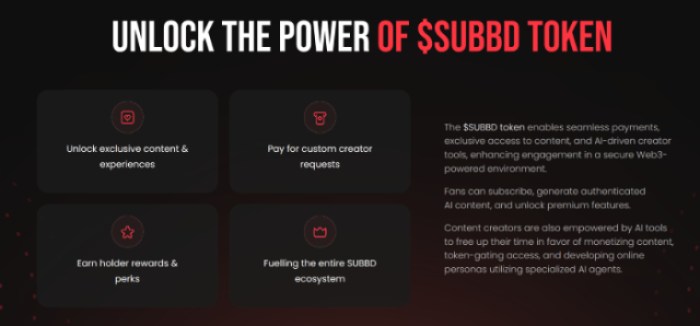
For fans, the platform isn’t just about consumption; it’s about participation through token-gated content and staking rewards. It creates a symbiotic economy where both sides win, without a middleman taking an outrageous cut.

CHECK OUT THE $SUBBD TOKEN ON ITS PRESALE PAGE

Presale Momentum Signals a Shift in Creator and Fan Sentiment

The market’s appetite for a decentralized fix is becoming undeniable. The ongoing SUBBD Token presale has already pulled in over $1.4 mwith tokens priced at just $0.057495. That kind of early-stage funding isn’t just noise; it’s a clear signal that people believe the creator economy is ripe for a shakeup.

Investors aren’t just buying a token; they’re buying into a whole new model for content ownership. The project’s staking mechanism, which offers a fixed 20% APY for the first year, gives an immediate incentive to get involved.

Stakers get access to exclusive content, livestreams, and other perks, transforming them from passive consumers into active participants. The risk? Well, like any new platform, it all comes down to achieving critical mass, attracting enough great creators and dedicated fans to make the ecosystem thrive.

Ironically, the regulatory gridlock in the U.S. might just be SUBBD’s biggest catalyst. As legacy institutions fight tooth and nail to preserve the status quo, they’re inadvertently making the best possible case for platforms that are transparent and fair by design.

The traction in SUBBD’s presale says it all: creators and users aren’t waiting for permission from Washington or Wall Street anymore. They’re just building a better system themselves. Join the SUBBD Token presale here.

BUY YOUR $SUBBD HERE

This article is for informational purposes only and should not be considered financial advice. All investments in cryptocurrency carry inherent risks, and you should conduct your own research.


Preguntas relacionadas

QWhat is the main argument made by the banking lobby (ABA and BPI) against the FIT21 Act?

AThe banking lobby argues that the FIT21 Act would create regulatory gaps, undermine existing securities laws, and expose consumers to undue risk.

QAccording to the article, what is the core problem that SUBBD Token ($SUBBD) aims to solve in the content creation industry?

ASUBBD Token aims to solve the problems of exorbitant fees (as high as 70%), censorship, and the risk of sudden de-platforming that creators face on centralized platforms like YouTube and OnlyFans.

QWhat are some of the key AI tools integrated into the SUBBD platform for creators?

AThe SUBBD platform integrates an AI Personal Assistant for automating fan interactions, AI voice cloning, and the ability to launch fully AI-driven influencers.

QHow does the SUBBD platform's staking mechanism work to incentivize users?

AThe staking mechanism offers a fixed 20% APY for the first year, and stakers gain access to exclusive content, livestreams, and other perks, turning them into active participants.

QWhat does the article suggest is the 'second-order effect' of the lobbying efforts against crypto regulation?

AThe second-order effect is that it pushes innovation and user interest toward decentralized platforms that operate outside of traditional financial control, as these platforms promise to bypass the gatekeepers altogether.

Lecturas Relacionadas

In Conversation with Ray Dalio: We Are Currently in an AI Bubble, with 1% of My Portfolio in Bitcoin

Ray Dalio, founder of Bridgewater Associates, warns in an interview that the current AI boom shows classic bubble characteristics, which could lead to significant economic downturns as seen in past cycles like 1929 or 2000. He explains that speculative enthusiasm, fueled by debt and overvaluation, often precedes a crash when rising rates or taxation force asset sales, causing widespread losses and recession. Dalio also outlines his "Big Cycle" theory, describing an approximate 80-year pattern where widening wealth gaps, massive government deficits, and shifting geopolitical power (like China's rise) create internal conflict and global instability. He emphasizes that we are in a late-cycle, transitional phase where traditional powers like the US and UK face decline. For personal wealth protection, Dalio advises diversification beyond cash into assets like stocks, bonds, real estate, and particularly gold, which he prefers over Bitcoin. While he holds about 1% of his portfolio in Bitcoin as a non-printable hard asset, he views gold as more secure from technological or governmental threats. Regarding AI's impact, Dalio believes it will disproportionately benefit capital owners, worsening inequality by replacing both physical and cognitive labor. He suggests that human intuition and emotional intelligence, combined with AI, will be key for future workers. On taxation, Dalio argues that wealth taxes are impractical and risk triggering asset sell-offs, reducing productive investment. He points to the UK as a cautionary example of debt, low productivity, and political strife. Geopolitically, Dalio foresees a more regionalized world, with the US showing weakness in prolonged conflicts like with Iran, akin to past imperial declines. The ideal outcome, he suggests, is coexisting powerful blocs (e.g., Americas, China-Asia Pacific) without major war.

marsbitHace 1 hora(s)

In Conversation with Ray Dalio: We Are Currently in an AI Bubble, with 1% of My Portfolio in Bitcoin

marsbitHace 1 hora(s)

Daily 7.2 Trillion KRW: Foreign Capital's Record Net Buying on Friday! Wall Street Says Headwinds for Korean Stock Fund Flows Have Subsided

South Korean stock market sees a dramatic shift in fund flows. On July 31, foreign investors made a record net purchase of approximately KRW 7.2 trillion in KOSPI stocks, marking a fundamental reversal from the persistent large-scale net outflows seen in previous months. This contributed to a significant narrowing of foreign net selling in July to KRW 9.8 trillion, down sharply from KRW 48.4 trillion in June and KRW 44.5 trillion in May. Simultaneously, domestic institutional pressure eased. South Korean pension funds and asset managers turned to a net buying position in July, purchasing KRW 1.0 trillion worth of KOSPI shares, contrasting with net sales in May and June. Market volatility is expected to be dampened by new financial regulations. Effective July 31, the Financial Services Commission tightened access for retail investors to single-stock leveraged ETFs by raising the minimum cash deposit requirement. Trading volumes for these products subsequently dropped to about 50% of their monthly average. Citigroup Research maintains its year-end KOSPI target of 10,000 points. The firm cites several supportive factors: the substantial easing of headwinds from capital outflows, a robust fundamental outlook for the semiconductor sector, historically low market valuations, strong economic fundamentals, and the potential for policy support from financial authorities if needed.

marsbitHace 1 hora(s)

Daily 7.2 Trillion KRW: Foreign Capital's Record Net Buying on Friday! Wall Street Says Headwinds for Korean Stock Fund Flows Have Subsided

marsbitHace 1 hora(s)

Thanks to Dice Rolls, Bitcoin Keys Are Stored Offline, But Not Everyone Will Do It

The article discusses using dice rolls to generate secure Bitcoin wallet seeds, providing entropy independent of potentially flawed hardware random number generators. It explains that each fair dice roll offers about 2.585 bits of entropy, with around 50 rolls needed for a standard 12-word seed phrase and 99+ recommended for higher security. This method gained attention after a vulnerability was revealed in some Coldcard hardware wallets, where a faulty firmware RNG (dating back to 2021) compromised generated keys. The analysis notes that while a dice-generated main seed was safe from this specific flaw, other Coldcard functions (like creating paper wallets, backup keys, or passwords) could still be vulnerable if they used the defective RNG. The piece argues that while dice-based entropy is technically robust, the manual process is error-prone, tedious, and unrealistic for most new users, who might make mistakes in recording or inputting rolls. It concludes that while manual entropy generation should remain an option for advanced users, the long-term goal is to develop reliable, user-friendly hardware and software that securely generates randomness without requiring specialized knowledge. Coldcard users are advised to check their firmware version and replace any secondary secrets (like paper wallet keys) created with vulnerable devices, while also considering multi-signature setups with devices from different manufacturers for added security.

cryptonews.ruHace 6 hora(s)

Thanks to Dice Rolls, Bitcoin Keys Are Stored Offline, But Not Everyone Will Do It

cryptonews.ruHace 6 hora(s)

Trading

Spot
活动图片




