Avalanche’s C-Chain explodes with activity – AVAX responds by rising 15%

ambcryptoPublicado a 2026-01-07Actualizado a 2026-01-07

Resumen

Avalanche's native token AVAX surged by 15% this week, breaking out of its recent trading range as on-chain activity on its C-Chain reached record levels. Notably, 43.3% of all C-Chain transactions ever recorded occurred in 2025 alone, highlighting a significant acceleration in network usage. Cumulative transactions surpassed 937 million by the end of 2025, with the network processing over 400 million C-Chain transactions and more than 32 million smart contracts deployed by approximately 113,000 unique users. On-chain volume is approaching $1 trillion, indicating substantial value movement within the ecosystem. The growth is supported by increased application activity across DeFi, gaming, and consumer apps, with new launches and upgrades driving demand. Technical indicators such as RSI climbing above 60 and MACD staying positive suggest strong buying pressure and a continued bullish trend. The rally appears fundamentally backed by rising participation and sustained network traction rather than speculative activity.

Avalanche [AVAX] jumped 15% this week, but there’s more for you to look at. On-chain activity on the C-Chain hit record levels, and more updates are all set to roll out in the near future.

The network is more active than ever. Will this push AVAX further?

Usage at its core

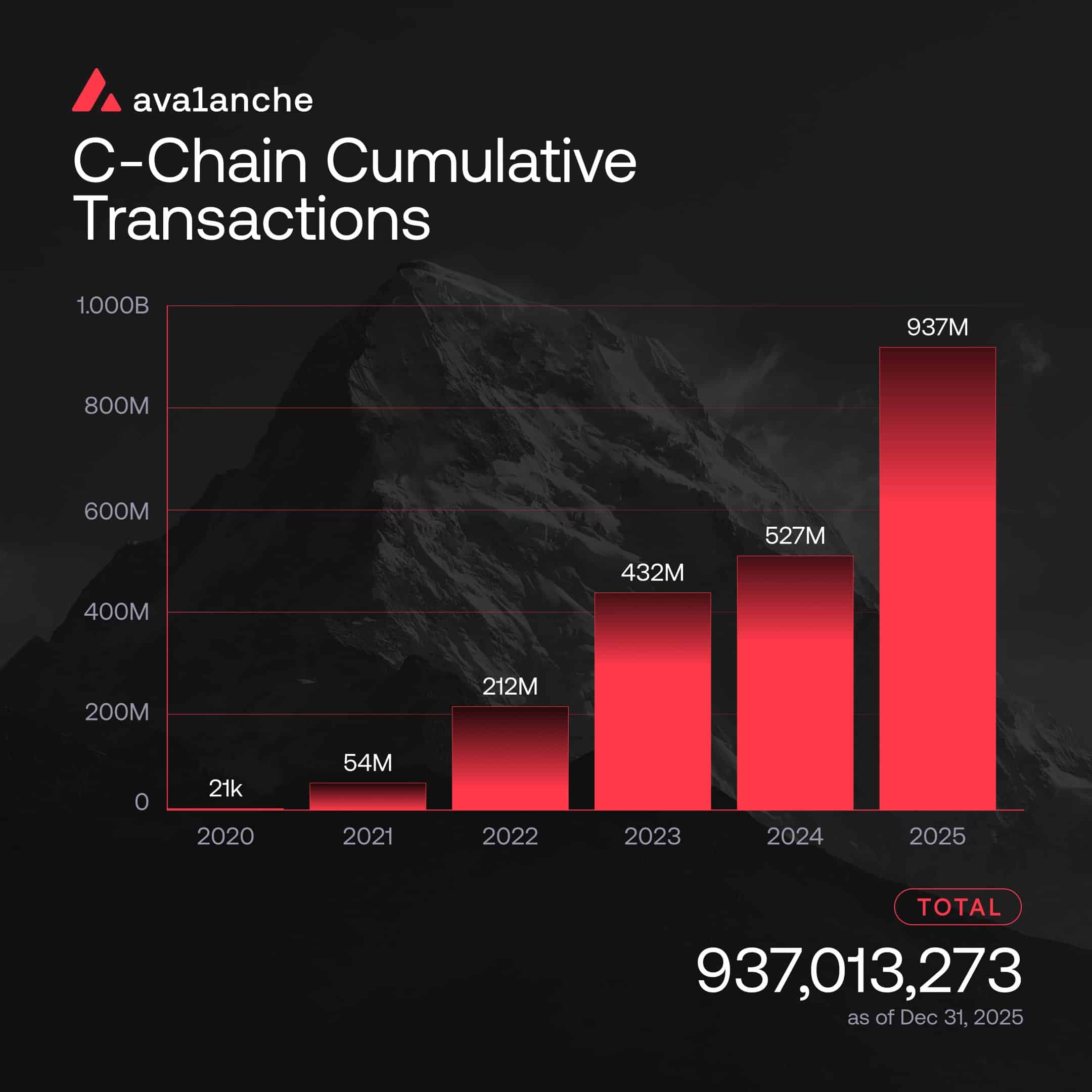
Avalanche’s price gains in the new year are happening in tandem with its on-chain activity. According to the network, 43.3% of all C-Chain transactions ever recorded happened in 2025 alone.

There’s been gradual growth over the years, but the sudden speed this past year stands out clearly.

Source: X

Cumulative transactions crossed 937 million by the end of 2025, so the network has become active in a short span of time. New users are entering the ecosystem, which means there’s a strong foundation underneath it all.

Real traction supporting it all

The network has now crossed 400 million C-Chain transactions, alongside more than 32 million smart contracts deployed by around 113,000 unique deployers.

On-chain volume is also approaching the $1 trillion mark; value is moving very frequently through the ecosystem.

At the same time, application activity is picking up. New launches and upgrades across DeFi, gaming, and consumer apps have brought new demand.

With DEX governance going live to gaming and sports-focused apps onboarding users, Avalanche’s recent activity surge is being built on sustained usage.

AVAX powers through

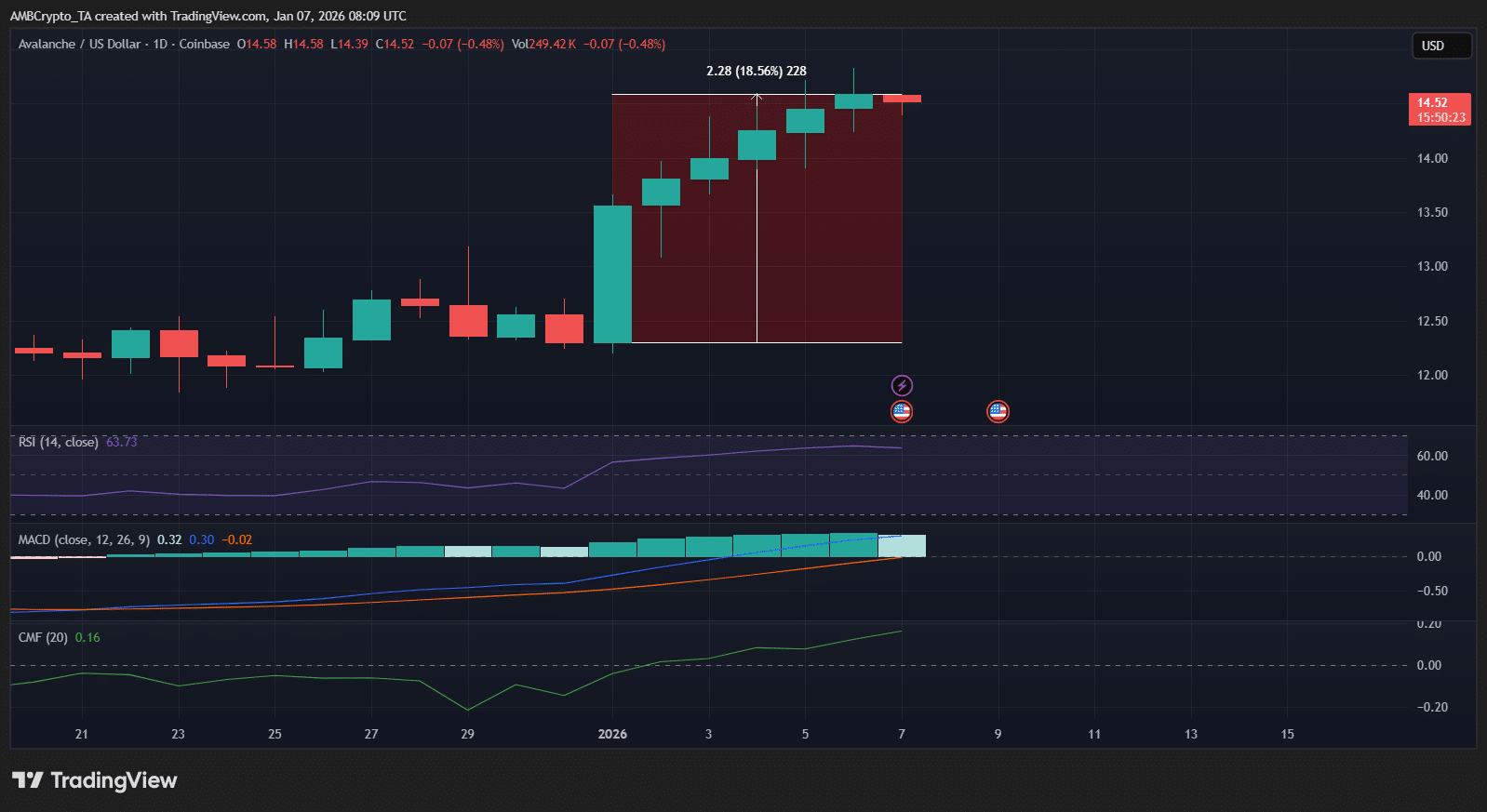
The coin rallied roughly 15% this week, breaking out of its recent range as buying pressure picked up alongside rising network activity. Price pushed from the $12.30 area toward $14.50.

That’s an 18% move at its peak before a pullback.

Sources: TradingView

RSI climbed above 60, so there’s strong demand without entering overbought territory. MACD stayed in positive territory, so the trend will continue for the most part. Capital flows also improved, with CMF holding above zero.

AVAX’s surge is certainly powered by improving participation and not air detached from the fundamentals.


Final Thoughts

  • AVAX’s rally is backed by record C-Chain usage, with 43% of all transactions happening in 2025 alone.
  • With on-chain volume nearing $1T, AVAX’s upside depends on activity converting into demand.
Next: PUMP token sets $2bn DEX volume record amid renewed memecoin risk appetite
Share
  • Share
  • Tweet

Preguntas relacionadas

QWhat was the percentage increase in AVAX's price this week and what was the main driver behind it?

AAVAX's price increased by 15% this week, primarily driven by a surge in on-chain activity on the Avalanche C-Chain, which hit record levels.

QWhat significant milestone did the Avalanche C-Chain achieve in terms of transactions in 2025?

AIn 2025 alone, 43.3% of all C-Chain transactions ever recorded on the Avalanche network occurred, highlighting a period of explosive growth.

QWhat are some of the key on-chain metrics mentioned that demonstrate Avalanche's growing ecosystem?

AKey metrics include over 400 million C-Chain transactions, more than 32 million smart contracts deployed by approximately 113,000 unique deployers, and on-chain volume approaching the $1 trillion mark.

QWhich sectors of application activity are contributing to the new demand on the Avalanche network?

ANew demand is being driven by application activity across DeFi, gaming, and consumer apps, including new launches, upgrades, and the onboarding of users in gaming and sports-focused applications.

QWhat do the technical indicators (RSI and MACD) suggest about the state of AVAX's price trend?

AThe RSI climbed above 60, indicating strong demand without being overbought, and the MACD remained in positive territory, suggesting the bullish price trend is likely to continue.

Lecturas Relacionadas

You Bet on the News, the Pros Read the Rules: The True Cognitive Gap in Losing Money on Polymarket

The article explains that the key to profiting on Polymarket, a prediction market platform, lies not just predicting real-world events correctly, but in meticulously understanding the specific rules that govern how each market will be resolved. It illustrates this with examples, such as a market on Venezuela's 2026 leader, where the official rules defining "officially holds" the office overruled the intuitive answer of who was in practical control. Other examples include debates over the definition of a "token" or what constitutes an "agreement." The core argument is that a "reality vs. rules" gap creates pricing discrepancies that savvy traders ("车头" or "whales") exploit. The platform has a formal dispute resolution process managed by UMA token holders to settle ambiguous outcomes. This process involves proposal submission, a challenge window, a discussion period, and a final vote. However, the article highlights a critical flaw in this system compared to a traditional court: the lack of separation between the arbiters (UMA voters) and the interested parties (traders with financial stakes in the outcome). This conflict of interest undermines the discussion phase, leads to herd mentality, and results in opaque final decisions without explanatory rulings. Consequently, the system lacks a body of precedent, making it difficult for users to learn from past disputes. The ultimate takeaway is that success on Polymarket requires a lawyer-like scrutiny of the rules to identify and capitalize on the cognitive gap between how events appear and how they are contractually defined for settlement.

marsbitHace 11 min(s)

You Bet on the News, the Pros Read the Rules: The True Cognitive Gap in Losing Money on Polymarket

marsbitHace 11 min(s)

Will the Fed Still Cut Interest Rates? Tonight's Data Is Crucial

The core debate surrounding the Federal Reserve's potential interest rate cuts is intensifying amid geopolitical conflict and rebounding inflation. The key question is whether high energy prices will cause persistent inflation or weaken consumer demand enough to force the Fed to cut rates. Citigroup presents a bullish case for cuts, arguing that oil supply disruptions from the Strait of Hormuz are temporary and will not lead to lasting inflationary pressure. They point to receding bond yields and oil prices as evidence the market is pricing in a short-lived shock. Citi's data also shows tightening financial conditions, a stabilizing labor market, and healthy tax returns, supporting their view that the path to lower rates remains open. Conversely, Deutsche Bank offers a starkly contrasting, more hawkish outlook. They argue the Fed's current policy is already neutral and expect rates to remain unchanged indefinitely. Their view is based on stalled disinflation progress and a shift toward more hawkish rhetoric from key Fed officials like Waller, who cited risks from prolonged Middle East conflict and tariffs. Other officials, including Williams and Hammack, signaled rates would likely stay on hold for a "considerable time." The market pricing has shifted dramatically, now forecasting zero cuts in 2026. The imminent release of the March retail sales "control group" data is highlighted as a critical test. This metric, which excludes gas station sales, will reveal if high gasoline prices are eroding consumer spending in other areas. A weak reading could support the case for imminent rate cuts, while a strong one would bolster the argument for the Fed to hold steady. This data is pivotal for determining the near-term policy path.

marsbitHace 32 min(s)

Will the Fed Still Cut Interest Rates? Tonight's Data Is Crucial

marsbitHace 32 min(s)

The Second Half of Macro Influencer Fu Peng's Career

Fu Peng, a prominent Chinese macroeconomist and former chief economist of Northeast Securities, has joined Hong Kong-based digital asset management firm Bitfire Group (formerly New Huo Group) as its chief economist. This move, announced in April 2026, triggered an 11% surge in Bitfire's stock price. Fu, known for his accessible macroeconomic commentary and large social media following, will focus on integrating digital assets into global asset allocation frameworks, particularly combining FICC (fixed income, currencies, and commodities) with cryptocurrencies for institutional clients. His career includes roles at Lehman Brothers and Solomon International, with significant influence gained through public communication. However, in late 2024, Fu faced temporary social media bans after a controversial private speech at HSBC on China's economic challenges, though he denied regulatory sanctions. He later left Northeast Securities citing health reasons. Bitfire, a licensed virtual asset manager serving high-net-worth clients, seeks to build trust and attract traditional capital through Fu’s expertise and credibility. The partnership represents a strategic shift for both: Fu enters the crypto sector after a traditional finance peak, while Bitfire aims to leverage his macro framework for institutional adoption. Outcomes remain uncertain regarding capital inflows and compatibility within corporate structure.

marsbitHace 1 hora(s)

The Second Half of Macro Influencer Fu Peng's Career

marsbitHace 1 hora(s)

Trading

Spot
Futuros

Artículos destacados

Cómo comprar AVAX

¡Bienvenido a HTX.com! Hemos hecho que comprar Avalanche (AVAX) sea simple y conveniente. Sigue nuestra guía paso a paso para iniciar tu viaje de criptos.Paso 1: crea tu cuenta HTXUtiliza tu correo electrónico o número de teléfono para registrarte y obtener una cuenta gratuita en HTX. Experimenta un proceso de registro sin complicaciones y desbloquea todas las funciones.Obtener mi cuentaPaso 2: ve a Comprar cripto y elige tu método de pagoTarjeta de crédito/débito: usa tu Visa o Mastercard para comprar Avalanche (AVAX) al instante.Saldo: utiliza fondos del saldo de tu cuenta HTX para tradear sin problemas.Terceros: hemos agregado métodos de pago populares como Google Pay y Apple Pay para mejorar la comodidad.P2P: tradear directamente con otros usuarios en HTX.Over-the-Counter (OTC): ofrecemos servicios personalizados y tipos de cambio competitivos para los traders.Paso 3: guarda tu Avalanche (AVAX)Después de comprar tu Avalanche (AVAX), guárdalo en tu cuenta HTX. Alternativamente, puedes enviarlo a otro lugar mediante transferencia blockchain o utilizarlo para tradear otras criptomonedas.Paso 4: tradear Avalanche (AVAX)Tradear fácilmente con Avalanche (AVAX) en HTX's mercado spot. Simplemente accede a tu cuenta, selecciona tu par de trading, ejecuta tus trades y monitorea en tiempo real. Ofrecemos una experiencia fácil de usar tanto para principiantes como para traders experimentados.

539 Vistas totalesPublicado en 2024.12.12Actualizado en 2025.03.21

Cómo comprar AVAX

Discusiones

Bienvenido a la comunidad de HTX. Aquí puedes mantenerte informado sobre los últimos desarrollos de la plataforma y acceder a análisis profesionales del mercado. A continuación se presentan las opiniones de los usuarios sobre el precio de AVAX (AVAX).

活动图片