arXiv Breaks Away from Cornell, Officially Takes Flight on Its Own

marsbitPublicado a 2026-07-02Actualizado a 2026-07-02

Resumen

arXiv, the widely used preprint server, has officially spun off from Cornell University as of July 1, becoming an independent nonprofit organization named arXiv, Inc. Registered in Delaware with 501(c)(3) tax-exempt status, this move ends its 25-year affiliation with Cornell. The new entity will be governed by a board of up to 12 members, with the Simons Foundation and Cornell University serving as founding members for the first five years. Ramin Zabih, a Cornell professor, will serve as interim CEO during the transition. All 26 staff members have transferred to the new organization, and operations—including free access to papers—are expected to remain unchanged for users in the near term. Founded in 1991 by physicist Paul Ginsparg, arXiv hosts over 3.09 million preprints across physics, mathematics, computer science, and other fields, facilitating rapid dissemination of research. Key motivations for independence include financial pressures—arXiv faced a deficit in 2025—and the need for greater operational flexibility to address challenges like the surge in AI-generated submissions. The platform remains committed to its free-access model but will explore broader funding avenues as a standalone entity.

The other shoe has finally dropped. The official arXiv blog has announced that as of July 1, the platform has formally separated from Cornell University, beginning a new chapter as an independent non-profit organization.
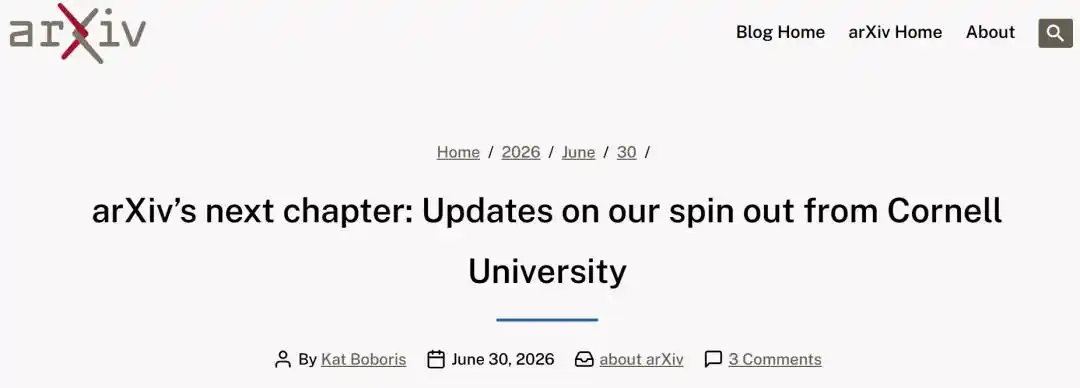
Announcement address: https://blog.arxiv.org/2026/06/30/arxivs-next-chapter/

The official name of the new organization is arXiv, Inc., registered under Delaware law as a non-profit, non-stock corporation and granted 501(c)(3) tax-exempt status by the IRS.

The "Cornell University" logo, which had accompanied users for over two decades on the page header, is now history.
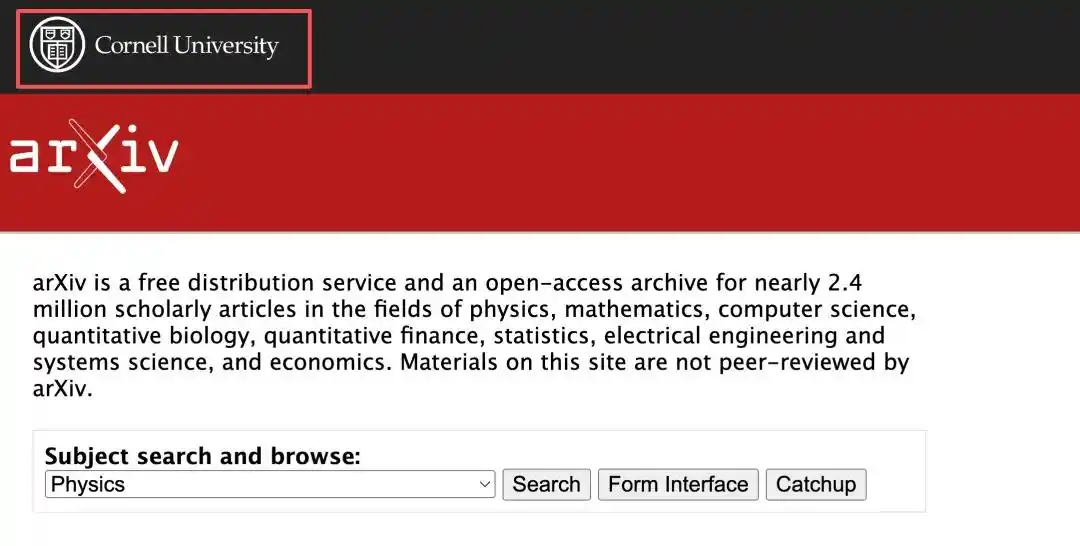
Not only that, but the familiar arXiv red has also turned to black.
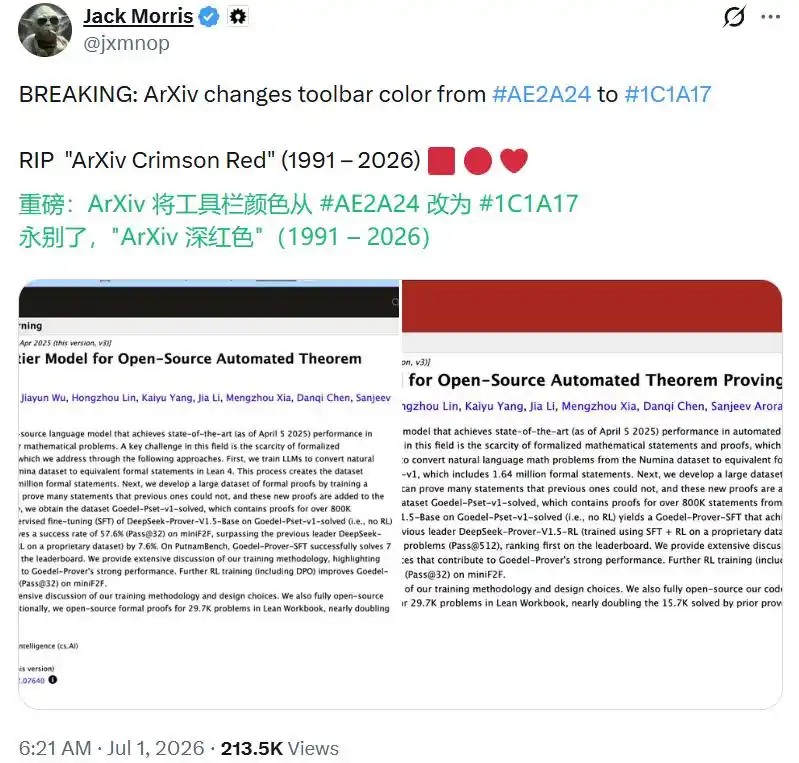
Of course, the functionality remains unchanged. The papers are still there, search still works, and submission portals remain open. The arXiv team specifically noted in the announcement, "For the next few months, arXiv's authors, readers, and the communities that depend on us will experience almost no change." This statement is aimed at users worried about sudden fees or major overhauls. For related concerns, see our previous report "arXiv Faces Major Change: To Break Away from Cornell University, Hiring CEO. Netizens: Can We Still Access for Free in the Future?"

The New Organizational Structure: From University Unit → Self-Governance

Within the Cornell system, arXiv was overseen by Cornell Tech Dean Greg Morrisett, with execution led by Computer Science Professor Ramin Zabih as Executive Director. After independence, this structure will be replaced by a formal corporate governance framework.

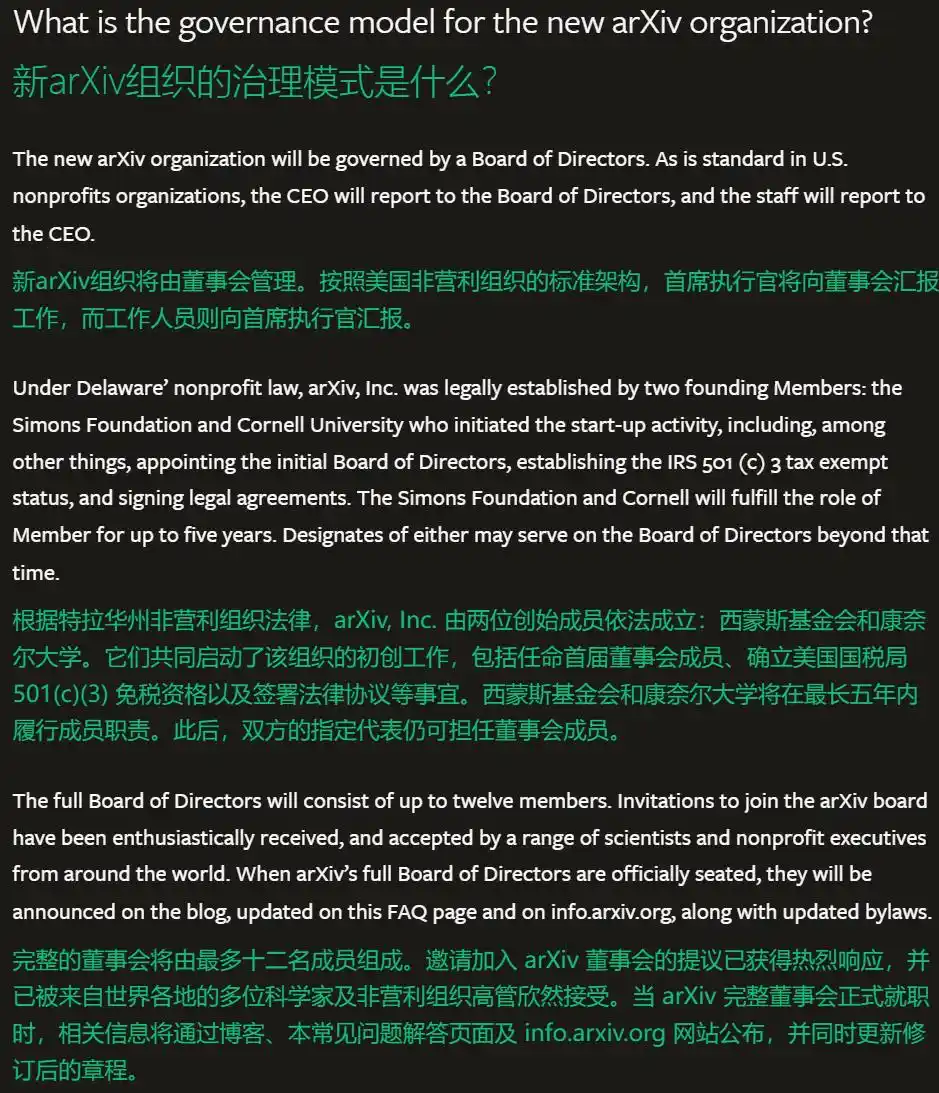
According to arXiv's published FAQ, the new organization will be governed by a Board of Directors with up to 12 members. The Simons Foundation and Cornell University, as two "Founding Members," jointly led the initial establishment work, including appointing the initial board, securing tax-exempt status, and signing a series of legal agreements. These two institutions will serve as "Members" for up to five years, and their representatives may continue to serve on the board thereafter.
Regarding the CEO position: Cornell Computer Science Professor Ramin Zabih will serve as Interim CEO during the transition period and assist the future permanent CEO with the handover.

The hiring process is currently nearing its conclusion. The previously widely discussed salary package of approximately $300,000 remains valid. Notably, arXiv's headquarters address will temporarily remain unchanged, with New York-based staff continuing to work from the Tata Innovation Center at Cornell Tech. All 26 employees have transitioned to the new company with the organization.

What is arXiv? Why Does It Deserve So Much Attention?

If you work in physics, mathematics, or computer science research, arXiv is a webpage opened almost daily. If you work in AI, it has practically become the default paper platform.

In short, arXiv is a "preprint" server: before a paper is formally peer-reviewed and published in a journal, scholars can first upload their manuscripts here for free, allowing global peers to see them immediately.

This model has fundamentally changed the speed of academic knowledge dissemination. Traditional academic journals often take months or even years from submission to publication, while arXiv reduces this time to days or even hours.

arXiv was born in 1991, founded by physicist Paul Ginsparg from Los Alamos National Laboratory.

Initially, it was just an automated script meant to replace messy email lists, expected to receive about 100 papers per year. But the first month saw nearly a hundred submissions flood in. Early endorsement by string theory master Ed Witten helped it quickly gain recognition in the academic community. In 2001, Ginsparg returned to his alma mater Cornell University to teach, and arXiv settled in the university's library, beginning its 25-year Cornell era.

Its value to the AI community is particularly irreplaceable.

Almost all seminal papers that shaped the contemporary AI landscape first debuted on arXiv. The attention mechanism (Attention), the Transformer architecture, BERT, the GPT series, diffusion models... these names represent not just papers, but the very foundations of the entire industry. The DeepSeek series of papers that shocked the global AI community also premiered on arXiv. Compared to the often months- or years-long review cycles of traditional academic publishing, arXiv's rapid turnaround mechanism has significantly accelerated progress in these fast-evolving fields.

More importantly, arXiv is free for everyone, no institutional subscription needed, no paywalls to climb. Scientists conducting research in Eastern Europe, Southeast Asia, or Africa are, to some extent, on the same starting line as scholars at MIT.

As of June 2026, arXiv has cumulatively archived over 3.09 million papers, covering eight subject areas including physics, mathematics, computer science, quantitative biology, quantitative finance, statistics, electrical engineering and systems science, and economics. The platform has provided over 3.7 billion downloads to date. Behind these numbers lies an infrastructure serving a global community of over tens of millions of monthly active users.
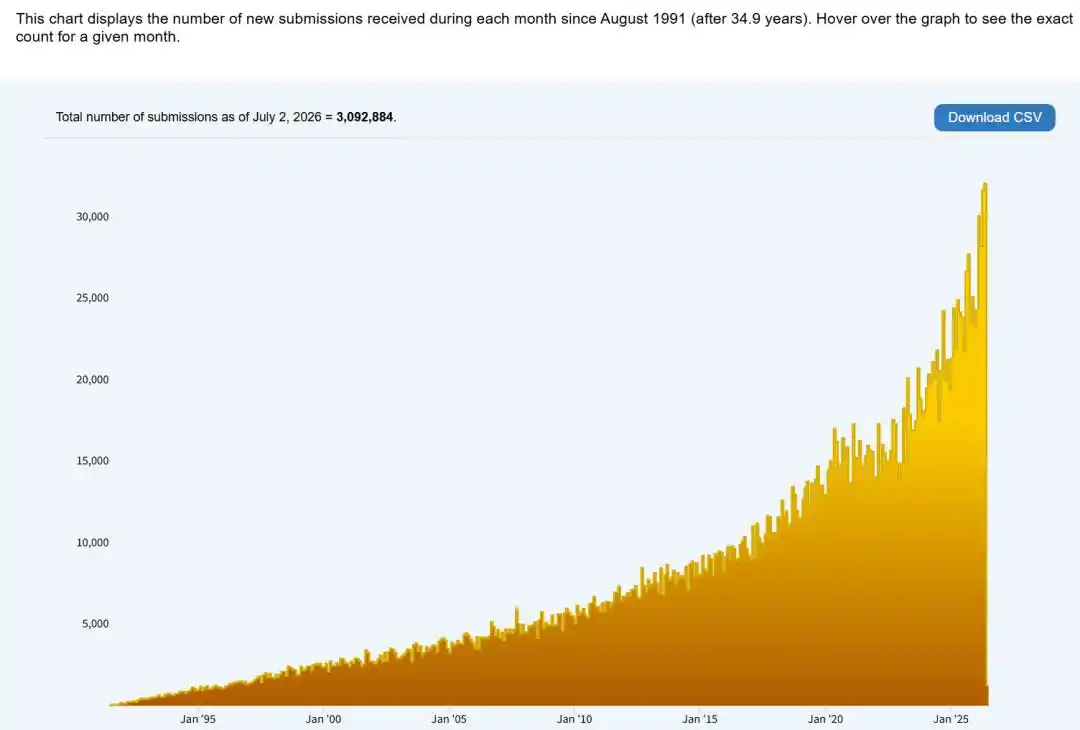
Statistics on paper submissions since August 1991
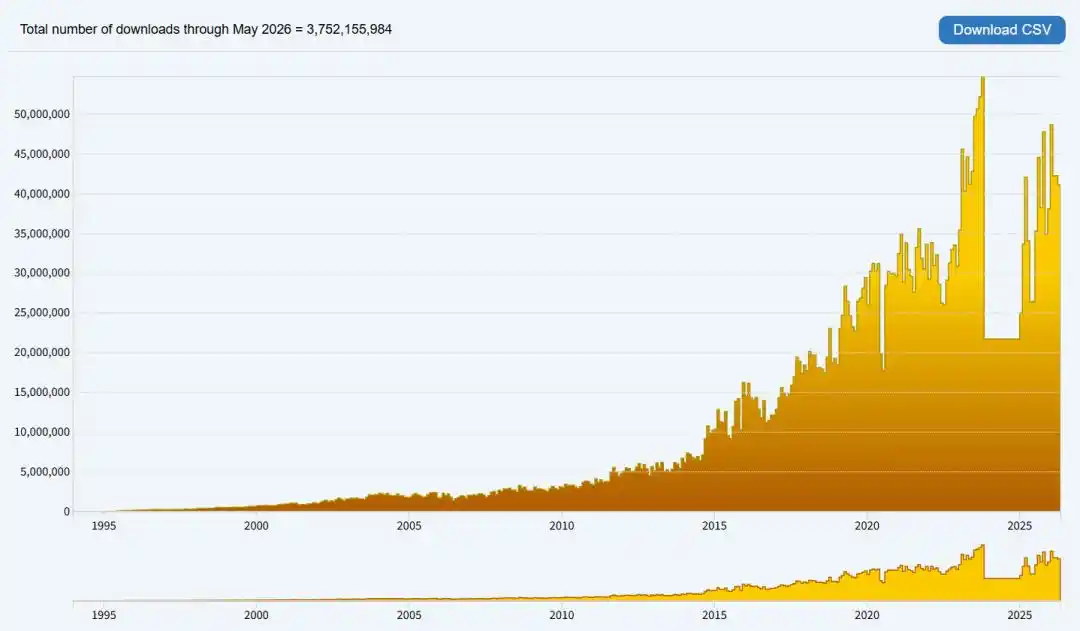
Statistics on paper download numbers

Why Go Independent Now? The Dual Pressures of Finances and AI

The decision to become independent was not impulsive. Internal discussions at arXiv have been ongoing for years, but real momentum coalesced in the last two years.
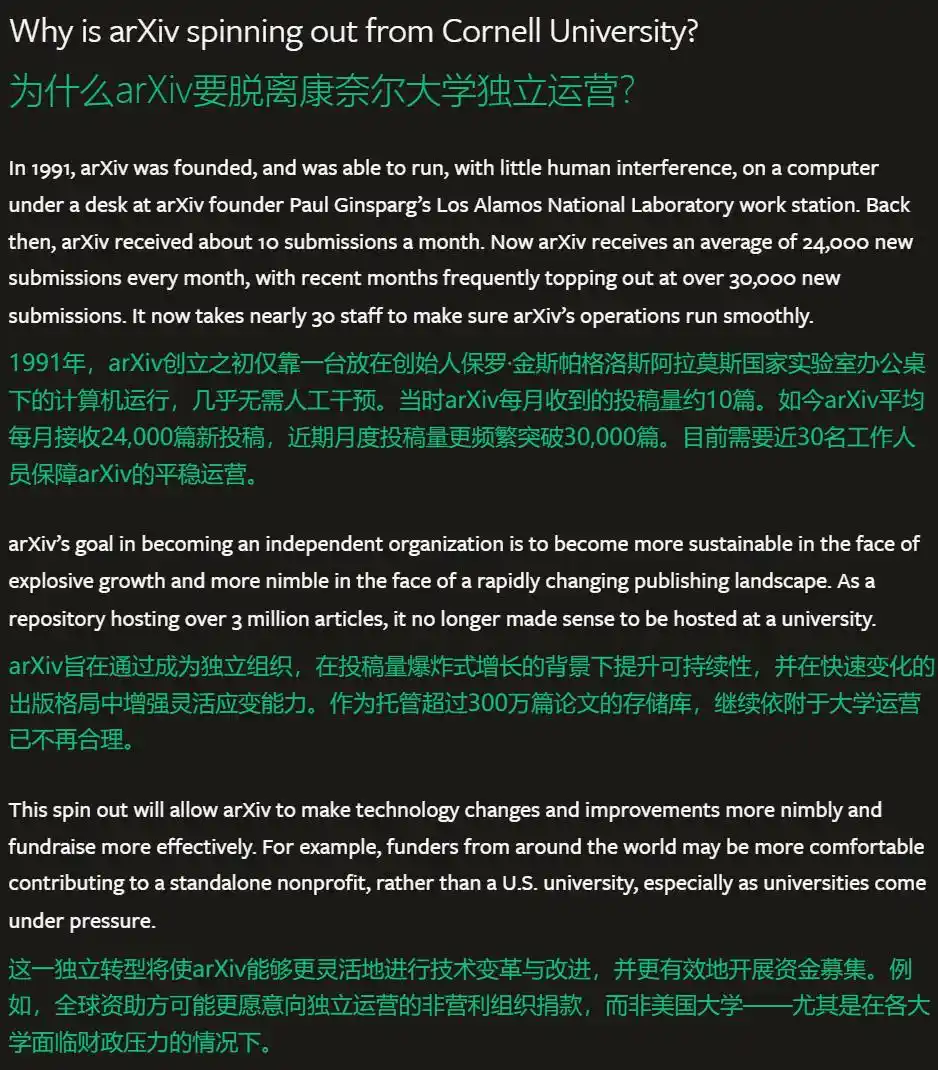
First, the financial issue.

arXiv's expenditures in fiscal year 2025 were approximately $6.7 million, resulting in a deficit of $297,000. Facing pressures from federal funding cuts and budget tightening, Cornell University could no longer sustain covering these deficits.
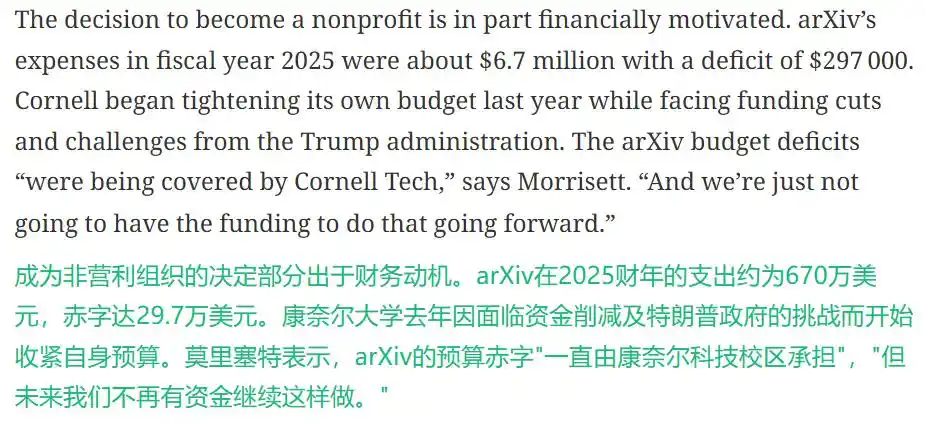
Independent operation means broader financing channels. Some institutions in Europe and Asia were previously reluctant to write checks directly to Cornell University, but their attitude would be markedly different if the recipient were an independent non-profit organization directly serving the scientific community.

Second, the flexibility of the system. The university's personnel system has its inherent pace (salary caps, hiring cycles, procurement processes), which sometimes posed visible hindrances for arXiv needing to respond quickly to technological waves. Morrisett once stated bluntly: "We need to hire more flexibly and offer more competitive salaries than the university allows."

Then comes the new variable brought by AI.

Since 2023, AI-generated content has flooded academic platforms, and arXiv is no exception. The number of low-quality or entirely AI-written paper submissions has increased dramatically. The platform relies on hundreds of professional volunteer moderators to process submissions, but facing tens of thousands of papers monthly, this system is under pressure.

In February 2026, arXiv introduced a new policy to "only accept papers containing an English version" to reduce the difficulty of multilingual moderation. In founder Ginsparg's view, the problem is more fundamental: "If LLM-generated computer science papers already exceed the quality of an average graduate student, how will the world cope three months from now?"

Can It Remain Free, What Will the CEO Do?

For most users, the most pressing question is only one: Will it remain free to use in the future?

arXiv's answer is clear: "arXiv remains committed to being free for readers and submitters. We are dedicated to providing global scientists with equitable access to new ideas and discoveries." However, regarding whether paid features might be introduced in the future, the official statement has not given a clear indication.

The general sentiment in academia is "cautiously optimistic and continuing to watch." Some researchers on social media recalled cases of former non-profit platforms gradually commercializing, expressing underlying concerns. Others in the field countered, saying arXiv's revenue structure (a combination of member institutions, foundations, and individual donations) is relatively healthy and that it has already raised funds sufficient to cover operational needs for the next three years.

As for the soon-to-arrive first CEO, the challenge list is long: complete the modernization migration of the codebase from Perl to Python; establish a moderation mechanism capable of handling the wave of AI submissions; expand the donor base to reduce reliance on a few major foundations; and reposition arXiv's brand image before the international academic community. The pricing for this position is not unreasonable within the circle of non-profit tech organization management in New York.

arXiv's independence marks a shift in identity from "an affiliated project of a university" to "global academic infrastructure." This shift itself will not change any of its functions, but it will change its position in the world.

Reference Links

https://news.cornell.edu/stories/2026/06/digital-research-repository-arxiv-start-new-chapter-nonprofit

https://info.arxiv.org/about/spinout_faq.html

https://blog.arxiv.org/2026/01/13/non-english-paper-submission-guidelines/

https://physicstoday.aip.org/news/arxiv-sets-out-on-its-own

This article is from the WeChat public account "Almost Human" (ID: almosthuman2014), author: Reading Papers.

Preguntas relacionadas

QWhat major change did arXiv announce recently, and what is its new legal status?

AarXiv announced its official spin-off from Cornell University and its establishment as an independent nonprofit organization called arXiv, Inc., registered in Delaware with 501(c)(3) tax-exempt status from the IRS.

QWhat are the main reasons cited for arXiv's decision to become an independent nonprofit organization?

AThe main reasons are financial pressures (Cornell could no longer cover its deficits), the need for greater institutional flexibility in hiring and operations, and the challenges posed by the influx of AI-generated content requiring more agile responses.

QHow is the governance of arXiv structured following its independence?

AGovernance is now handled by a Board of Directors with up to 12 members. The Simons Foundation and Cornell University are the founding members who helped establish the initial board and will serve as members for five years.

QWhat is arXiv's stated commitment regarding access and fees for users after the transition?

AarXiv has clearly stated its commitment to remain free for both readers and submitters, dedicated to providing global scientists with equitable access to new ideas and discoveries. However, it has not explicitly ruled out introducing paid features in the future.

QWhat significant challenge related to Artificial Intelligence does the new arXiv CEO need to address?

AA key challenge for the new CEO is to establish a robust moderation system capable of handling the surge in AI-generated paper submissions, which have increased the pressure on the platform's volunteer moderator system.

Lecturas Relacionadas

Ray Dalio's Latest Macro Analysis Full Text: Buy More Gold, Add Some Bitcoin

In his latest macro analysis, Ray Dalio applies his framework from "How Countries Go Broke: The Big Cycle" to the current global debt environment. He highlights recent events like Japan selling U.S. Treasuries and rising U.S. long-term yields as signs of an unsustainable debt dynamic. Dalio explains that excessive government debt leads to either unacceptably high interest rates, severe economic downturns, or significant currency debasement through central bank money printing. He summarizes the U.S. fiscal situation: with $5.5 trillion in revenue, $7.5 trillion in spending, a $2 trillion deficit, and total debt at six times annual revenue, debt servicing costs are immense. Without correction, U.S. debt could reach $55-$60 trillion in a decade. Dalio proposes a "3% Three-Way" solution: reducing the budget deficit to 3% of GDP through balanced spending cuts, tax increases, and interest rate reductions to avoid a traumatic adjustment. In response to FAQs, he argues that the risk of a U.S. debt crisis is high and could materialize within a few years if the current path continues. He dismisses the notion that the dollar's reserve status makes the U.S. immune, citing historical precedents of reserve currency declines. He is also unconvinced by Japan's high-debt stability, noting poor returns for yen-denominated assets. For investors, Dalio recommends diversifying globally, underweighting bonds, and overweighting assets like gold and a small allocation to Bitcoin (around 10-15% to gold) to hedge against currency debasement and poor debt returns.

marsbitHace 11 min(s)

Ray Dalio's Latest Macro Analysis Full Text: Buy More Gold, Add Some Bitcoin

marsbitHace 11 min(s)

Stripe’s 16-Year Chronicle: From 7 Lines of Code to a $100 Billion Valuation

Stripe's 16-year journey began with a simple promise: "7 lines of code to accept payments." Founded by Patrick and John Collison, the company started by hiding the complexity of bank integrations and merchant accounts behind a clean API, initially targeting developers at startups. This early focus on user experience and technical simplicity fueled rapid adoption. A key early milestone was establishing vital bank partnerships, a challenge overcome by hiring Billy Alvarado, who brought crucial institutional relationship skills. From this foundation, Stripe systematically expanded its product boundaries. It launched Connect for platform payments, Atlas for company formation, Radar for fraud prevention, and Billing for subscriptions. This transformed Stripe from a payment processor into a broader financial infrastructure suite for internet businesses. The COVID-19 pandemic accelerated growth but also led to over-hiring. A 14% layoff in 2022 marked a period of organizational correction. Subsequently, Stripe shifted its growth strategy towards strategic acquisitions to enter new domains quickly. It acquired Bridge (stablecoin infrastructure), Privy (wallet infrastructure), Metronome (usage-based billing), and agreed to buy OpenRouter (AI model routing). These moves signal Stripe's ambition to build a "programmable money system" for the emerging AI and agent-based economy, managing not just currency flows but also the measurement and pricing of computational resources like AI tokens. Internally, Stripe leverages AI agents (like "Minions") to boost engineering productivity. Despite scaling to nearly 8,000 employees and processing $1.9 trillion in payment volume annually, the company remains private. A recent employee tender offer valued it at $159 billion. The core question for Stripe's future is whether it can successfully integrate its expanding product matrix—spanning payments, crypto, and AI infrastructure—into a cohesive platform, positioning itself as the foundational economic layer for autonomous software agents.

marsbitHace 40 min(s)

Stripe’s 16-Year Chronicle: From 7 Lines of Code to a $100 Billion Valuation

marsbitHace 40 min(s)

Treasury Secretary's Move to Suppress Treasury Yields Ignites 'Currency Debasement Trade'! Gold Hits Three-Month High, Bitcoin Surges Over 25% in a Single Week

US Treasury Secretary Besant's efforts to lower long-term Treasury yields by announcing expanded buybacks had only a brief market impact. However, this move fueled a "currency devaluation trade," weakening the US dollar while boosting both gold (to a three-month high) and Bitcoin (up over 25% for the week). Analysts attribute this reaction to deepening market concerns over the massive US fiscal deficit and structural pressures keeping long-term rates elevated, including fierce competition for capital from global government borrowing and massive AI sector financing. Despite the Treasury's actions, fundamental forces like growth, inflation, and capital demand are seen as limiting its ability to sustainably suppress yields. Bitcoin's strong positive correlation with gold has reinforced its narrative as a hedge against devaluation. While equity markets have shown resilience, some strategists warn that Treasury yields nearing 5% increase pressure on the dollar and high-leverage assets. Figures like Ray Dalio have advised reducing bond exposure in favor of gold and some Bitcoin, citing US debt risks. Market opinions are divided on the sustainability of the devaluation trade, with some noting the lack of a near-term catalyst for its next leg higher. The underlying tension between the Treasury's desire for lower borrowing costs and the Federal Reserve's focus on inflation and reducing market intervention remains a key theme. Upcoming events like Nvidia's earnings and the Jackson Hole symposium will test whether AI profits can continue supporting stocks and if the Fed aligns more with Washington's preference for easier financial conditions.

华尔街日报Hace 2 hora(s)

Treasury Secretary's Move to Suppress Treasury Yields Ignites 'Currency Debasement Trade'! Gold Hits Three-Month High, Bitcoin Surges Over 25% in a Single Week

华尔街日报Hace 2 hora(s)

Alexander Shokhin: Business Needs an Interest Rate Below 10% and the Dollar at 90-95 Rubles

Alexander Shokhin, head of the Russian Union of Industrialists and Entrepreneurs (RSPP), has advocated for potentially using "non-market" tools to keep the ruble within a target exchange rate corridor. This, he argues on August 21, would help avoid excessive volatility, though he called the topic a separate discussion. Shokhin had previously raised the idea of a currency corridor in late May, noting the ruble's current exchange rate is not fully market-driven due to a limited currency segment and reduced foreign currency demand. He stated that many business community colleagues propose fixing a corridor, even through non-market methods, to ensure predictability. The business community's key targets, as outlined by Shokhin in late December 2025, are a Central Bank key rate of 12%, inflation of 4–5%, and a US dollar exchange rate of 90–95 rubles by the end of 2026. A turning point for investment, he said, would be lowering the rate to 12% with 6% inflation, though truly comfortable business conditions would require a rate below 10%. He stressed the critical importance of currency predictability for corporate investment decisions. From a data analysis perspective, the idea of a ruble corridor is not new. A similar mechanism was used in Russia from 1995 to 1998, where the central bank held the dollar within fixed boundaries through regular interventions. This regime lasted three years before ending abruptly during the 1998 default, illustrating the fragility of rigid targets under external shocks. The macro-economic link is clear: stricter corridors require more reserves to defend against currency pressure. The key unresolved technical aspect is the specific sources and volume of such interventions given the current market's limited liquidity. Whether this discussion remains theoretical or leads to concrete corridor parameters will be seen in the coming months.

cryptonews.ruHace 4 hora(s)

Alexander Shokhin: Business Needs an Interest Rate Below 10% and the Dollar at 90-95 Rubles

cryptonews.ruHace 4 hora(s)

Trading

Spot
活动图片